Teacher grading rubric and facilitation guide for the final synthesis project. Includes specific success criteria, common student misconceptions, and a guide for running the 'Survival Challenge' hook activity.
An answer key and teacher resource for the Mesopotamia central ideas do-now, including correct answers, rationales for each choice, and a teaching tip for RI.7.2.
A student worksheet focused on CCSS RI.7.2, featuring a short passage about Mesopotamia and three multiple-choice questions assessing central ideas and summary skills.
A teacher resource containing a grading rubric, a sample proficient response, and instructional tips. Condensed into a single-page format for teacher convenience.
A three-page worksheet focused on practicing structured paragraph writing using the PEEL method. It includes two distinct writing prompts, a self-check rubric, and a large drafting/brainstorming chamber. Layout improved for clear task separation.
A chronological reference sheet outlining the key events and acts leading to the Revolutionary War, designed to help students include specific evidence in their paragraph writing. Condensend to a single page for easy reference.
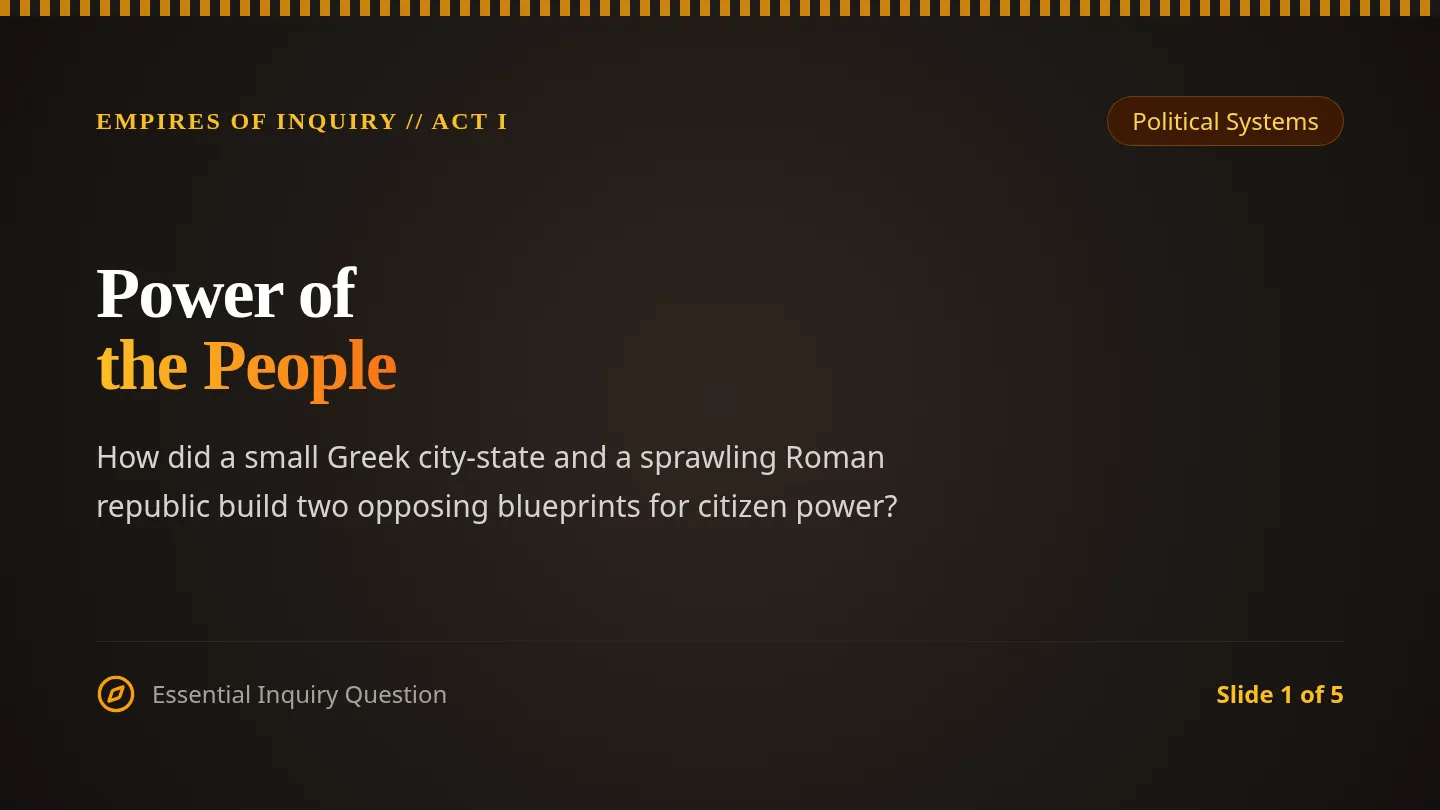
A presentation introducing the major economic and political causes of the American Revolution, including the debt from the French and Indian War, various taxation acts, and the escalating tensions leading to the Intolerable Acts. Includes a structured paragraph writing strategy (PEEL).
An answer key for the Olympian Matchup Worksheet, providing correct pairings for symbols and character descriptions. Condensed to a single page with teaching notes.
A visual presentation to introduce the 12 major Olympians, their home on Mount Olympus, and the concept of divine symbols.
A creative writing activity where students design their own Greek god or goddess using a blank trading card template. High-contrast labels and spacious work areas for younger writers.
A comprehension worksheet where students match Greek gods and goddesses to their symbols and identify them based on short character descriptions.
A collection of 12 beautifully designed trading cards featuring major Greek gods and goddesses, including their symbols, titles, and key mythological facts. Each page features 4 cards, ensuring they are cut-ready.
A comprehensive teacher-facing lesson plan for the Memory Detectives unit, outlining hook, instruction, guided practice, independent work, and differentiation strategies.
Answer key for the Detective Diary worksheet and Time Track organizer, providing teachers with expected student responses for 1st-grade sequencing tasks.
A set of two exit ticket slips (Memory Snap) for 1st grade, featuring sentence starters that check understanding of the concept 'before' in literature and real life.
A graphic organizer for 1st grade that challenges students to deduce and draw what happened 'before' based on visual 'present' cues like melted ice cream or a fallen tower.
A reading comprehension worksheet for 1st grade focusing on sequencing and the concept of 'before' using a simple rainy day story.
Instructional slides for 1st grade introducing the concept of the 'past' and the term 'before' using visual case studies and a simplified timeline.
A student discovery worksheet designed to accompany the Bohemian Journey presentation. Includes map labeling, city matching, short answer history questions, and a language lab section.
An 8-slide presentation exploring Czechia's geography, demographics, major cities, history, culture, food, and language for middle school students. Includes a visually engaging scrapbook-style design with consistent motifs and clear information.
A capstone framework for practitioners to apply social empathy to policy analysis and summarize their learning from the series.
Final presentation slides for the series, focusing on social empathy as a tool for policy analysis and macro-level social work advocacy.
Lesson plan for the final module on social empathy and policy change, applying neurobiological insights to macro-level advocacy and systemic design.