Symbiotic Bonds Slides
Ecology & Ecosystems Life Science Unit
Module 3: Species Interactions
Symbiotic Relationships
Investigating how organisms live, survive, and interact together across global ecosystems.
Launch Scenario: The Roommate Dilemma
Imagine three roommate scenarios: Roommates who cook and clean for each other, a roommate who shares nothing but causes no noise, and a roommate who takes your groceries without asking. In nature, species make similar arrangements!
Mission Goals Clear Outcomes
Today's Learning Objectives
By the end of this presentation, you will be able to:
Goal 1: Define & Apply
Distinguish between mutualism, commensalism, and parasitism based on who benefits, stays neutral, or gets harmed.
Key Signs: (+/+), (+/0), (+/-)
Goal 2: Differentiate
Contrast true co-living symbiosis with short-term predation events and resource competition.
Symbiosis vs. Predation vs. Competition
Goal 3: Construct
Write structured scientific explanations using Claim, Evidence, and Reasoning (C.E.R.) for open-response questions.
C.E.R. Framework Mastery
Keep these 3 goals in mind as we evaluate each organism pairing today!
Curriculum Bridge Connecting Past to Present
Previous Lesson Recap & How It Connects
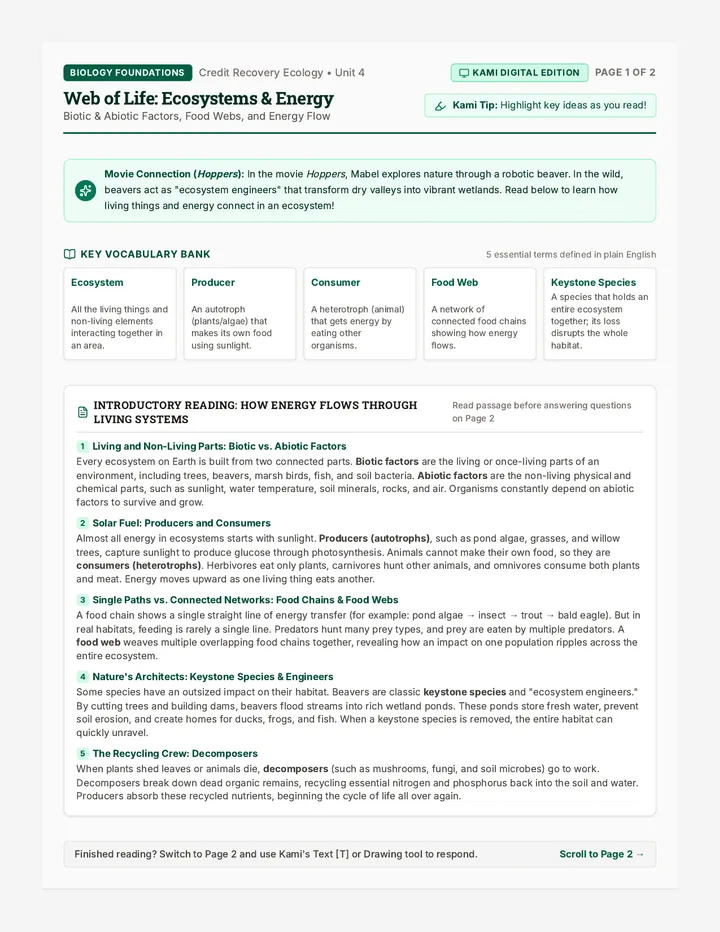
Building from food web energy flows to direct species cohabitation
Previous Lesson Objective
Trophic Energy Flows
In our last lesson, we identified how energy transfers through food chains and food webs—from solar-powered producers to primary consumers and apex predators.
Focus: Who eats whom in the broader community.
The Bridge to Today's Lesson
Beyond Just Eating
Organisms do not only interact by consuming one another! Today, we look deeper at symbiosis: sustained, intimate partnerships where species share shelter, defense, and vital resources over a long lifespan.
Focus: How species live together in shared survival alliances.
Key Connection: While food webs outline macro energy pathways, symbiotic relationships create the intimate micro-alliances that sustain biodiversity within those webs.
Academic Vocabulary The 3 Primary Types
What is Symbiosis? The 3 Alliances
From Greek: "living together" — close, long-term biological interactions between different species.
Mutualism (+ / +)
Both Organisms Benefit
A partnership where both species provide a service or resource to one another. Both leave ahead!
Win-Win Collaboration
Commensalism (+ / 0)
One Benefits, One Unaffected
One organism receives food, transport, or shelter, while the other is neither helped nor harmed.
Win-Neutral Balance
Parasitism (+ / -)
One Benefits, One Harmed
The parasite feeds or shelters at the physical expense of the host organism, weakening or sickening it.
Win-Lose Dynamic
Tip: Always ask, "What does Organism A get?" and "What happens to Organism B?"
Ecological Interactions Critical Distinctions
Symbiosis vs. Predation & Competition
Not every interaction in nature is a symbiotic partnership!
Symbiosis Shared Life
Long-Term Living Together
Two different species exist in close, physical cohabitation over an extended lifespan (Mutualism, Commensalism, or Parasitism).
🐠 Example: Clownfish & Anemone
Predation (+ / -)
Predator vs. Prey
One organism hunts, captures, and swiftly kills another for food. Unlike parasitism, it is a brief, lethal event rather than co-living.
🦅 Example: Red-tailed Hawk & Mouse
Competition (- / -)
Mutual Energy Drain
Two organisms struggle for the exact same limited resource (food, territory, sunlight). Both expend energy and face lowered fitness (-/-).
🌲 Example: Tall Trees competing for sunlight
Key Distinction: Parasites need their host alive to continue feeding (+/- over time). Predators kill their prey immediately. Competitors always experience a mutual cost (-/-) to fight for resources.
Scientific Vocabulary Guide Mastery & Application Rules
Essential Vocabulary & How to Apply Them
Follow these strict scientific rules when identifying and writing about ecological relationships.
Host vs. Symbiont Role Identification
How to apply: Always label the larger partner providing the habitat as the Host, and the smaller organism living on or inside it as the Symbiont.
Mutualism (+/+) Application Rule
How to apply: To justify mutualism, you must provide explicit evidence of advantages for both organisms (e.g., nutrition, defense, or transport).
Commensalism (+/0) Application Rule
How to apply: Show that one organism gains a distinct benefit, while citing clear proof that the second organism incurs zero injury and zero nutritional deficit.
Parasitism (+/-) Application Rule
How to apply: Emphasize that the parasite feeds off the host while keeping it alive over time; do not confuse with immediate predator-prey kills!
Application Formula: 1. Name the Pair ➔ 2. Assign Signs (+, 0, or -) ➔ 3. State Duration (Sustained or Brief)
Case Study 1 Marine Ecosystem
Mutualism (+ / +)
Analysis Question
Clownfish live nestled in venomous sea anemone tentacles. The clownfish has mucus protecting it from stings. What type of relationship exists here, and why?
🐠 The Clownfish
+ Benefits
Gains safe shelter from larger predators who cannot enter stinging tentacles, plus drops of food leftover in the anemone.
🪸 The Sea Anemone
+ Benefits
The clownfish chases away butterflyfish that eat anemones, cleans tentacles, and provides nitrogen waste as essential fertilizer.
Scientific Explanation
Because both organisms experience substantial survival advantages that increase reproductive fitness, this interaction is classified as Mutualism (+ / +).
Case Study 2 Pelagic Ocean
Commensalism (+ / 0)
Analysis Question
Barnacles attach themselves to the thick skin of migrating humpback whales. The whale swims through plankton-rich waters. What relationship is this?
🐚 The Barnacles
+ Benefits
Barnacles are stationary filter-feeders. Moving with the whale carries them into fresh, plankton-dense feeding currents without expending energy.
🐋 The Whale
0 Neutral
The whale's skin is extremely thick. The barnacles do not pierce blubber, siphon nutrients, or slow the whale down significantly.
Scientific Explanation
Because the barnacles gain mobile feeding grounds (+) while the host whale remains unharmed and unassisted (0), this interaction is Commensalism (+ / 0).
Case Study 3 Forest Woodland
Parasitism (+ / -)
Analysis Question
A tick latches onto a white-tailed deer, piercing skin to consume blood meals while transmitting bacteria like Lyme disease. What relationship is this?
🕷️ The Tick (Parasite)
+ Benefits
Directly extracts life-sustaining blood nutrients needed for energy, growth, and egg production.
🦌 The Deer (Host)
- Harmed
Loses blood nutrients, suffers skin irritation, and risks debilitating chronic bacterial infections that lower stamina and immunity.
Scientific Explanation
Because the parasite secures survival nourishment at direct biological harm and energy cost to the host, this relationship is Parasitism (+ / -).
Writing Toolkit Short Open-Response Strategy
How to Answer Open-Responses: C.E.R. Format
Use this 3-step scientific formula to write complete, full-credit explanations.
C
Claim
Direct Answer
State your direct, clear conclusion in one complete sentence. Identify which relationship is present.
Starter: "The relationship between [A] and [B] is..."
E
Evidence
Data & Observations
Provide specific facts from the scenario. Exactly what does each organism do, gain, or lose?
Starter: "According to the observations, [Species A] receives..."
R
Reasoning
Scientific Rule
Connect your evidence back to the scientific principle. Define the term to justify your claim.
Starter: "This qualifies as [Type] because science defines..."
A full-credit response always connects the specific evidence to the scientific definition!
Model Response C.E.R. in Action
Practice Question
Acacia ants hollow out thorny acacia stems to live inside and feed on sugar glands produced by the tree. In return, the ants vigorously sting beetles and mammals that try to eat the tree's foliage. Construct a C.E.R. response explaining this relationship.
Claim
The biological relationship between acacia ants and acacia trees is an example of mutualism.
Evidence
The text states the ants receive shelter in thorny stems and energy from sugary nectar (+). In return, the ants defend the tree by stinging herbivores that attempt to feed on its leaves (+).
Reasoning
Mutualism is scientifically defined as a symbiotic interaction where both species gain survival advantages (+/+). Because both the ant and the tree directly benefit, this interaction fits mutualism.
Notice how the Claim directly answers, Evidence uses facts, and Reasoning states the scientific rule!
Lesson Synthesis Final Debrief
Unit Guiding Question
Why are symbiotic relationships essential for the stability and biodiversity of Earth's ecosystems?
Master Explanation & Conclusion
Symbiotic relationships create complex interdependent webs where no organism lives completely alone. Mutualism drives resource sharing and habitat creation (like coral reefs); commensalism maximizes ecological niches without harm; and parasitism naturally regulates host population sizes alongside predation and competition. Together, these interactions balance ecosystems and maintain biodiversity.
🤝
Mutualism (+/+) Win-Win
⛵
Commensalism (+/0) Win-Neutral
⚠️
Parasitism (+/-) Win-Lose