Regents Reaction Chemistry Worksheet
NYS Regents Practice Living Environment & Chemistry
Matter, Bonds & Chemical Reactions
Pacing: 30 Min Total
Page 1 of 4 • English (Español al reverso)
Name:
Date:
Period:
Regents Core Rule:
Equation Anatomy: Inputs (Reactants) → Outputs (Products). Atoms in = Atoms out.
Bond Energetics: Breaking bonds ABSORBS energy; forming bonds RELEASES energy.
PART 1: DO NOW — Prior Knowledge Retrieval Target: 5 Min
- NYS Living Environment — June 2017, Q3
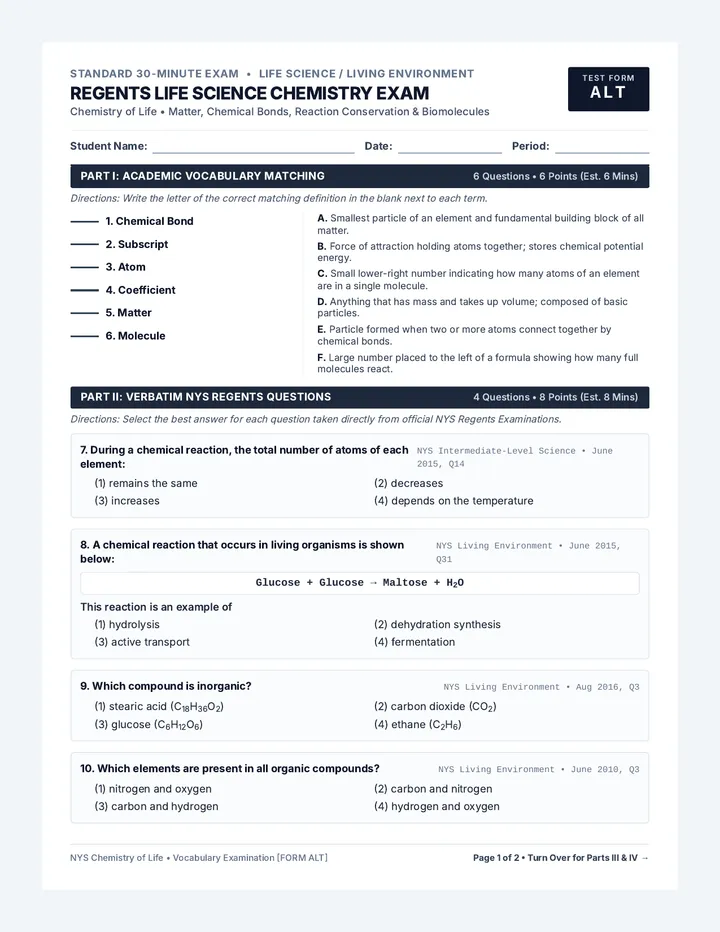
Which statement describes starches, fats, proteins, and DNA?
(1) They are used to store genetic information.
(2) They are complex molecules made from smaller organic molecules.
(3) They are used to assemble simple inorganic molecules.
(4) They are simple sugars that provide quick energy.
- NYS Chemistry — Aug 2018, Q11
Which statement describes the energy changes that occur as bonds are broken and formed during a chemical reaction?
(1) Energy is absorbed when bonds break, and released when bonds form.
(2) Energy is released when bonds break, and absorbed when bonds form.
(3) Energy is absorbed when bonds break, and absorbed when bonds form.
(4) Energy is released when bonds break, and released when bonds form.
PART 2: Chemical Equations, Notation & Conservation of Matter Target: 12 Min
- NYS Chemistry — June 2015, Q33
Given the balanced equation representing a reaction:
4Al(s) + 3O2(g) → 2Al2O3(s)
What is the total number of oxygen atoms present in the reactants and in the products?
(1) 3 and 3
(2) 5 and 5
(3) 6 and 6
(4) 12 and 12
- NYS Chemistry — Jan 2016, Q4
In all chemical reactions, there is a conservation of
(1) mass, only
(2) mass and charge
(3) charge & energy
(4) mass, charge, energy
Verification Task: Count atoms across Cellular Respiration C6H12O6 + 6O2 → 6CO2 + 6H2O
| Element | Atoms in Inputs (Reactants) | → Yields → | Atoms in Outputs (Products) | Conserved? |
|---|
| Carbon (C) | 6 (from C6H12O6) | → | 6 × 1 = 6 (from 6CO2) | ✓ Yes [6 = 6] |
| Hydrogen (H) | _____ | → | 6 × 2 = _____ | [ Yes / No ] |
| Oxygen (O) | 6 + (6 × 2) = _____ | → | (6 × 2) + (6 × 1) = _____ | [ Yes / No ] |
NYS Science Standards Alignment: PS1.B, LS1.C Page 1 • English (Turn over for Spanish / Voltee para español)
Práctica del Regents de NYS Entorno Vivo y Química
Materia, Enlaces y Reacciones Químicas
Meta: 30 Minutos
Página 2 de 4 • Versión en Español (Sincronizada)
Nombre:
Fecha:
Período:
Regla Clave del Regents:
Ecuación: Reactivos (Entradas) → Productos (Salidas). Átomos entran = Átomos salen.
Energía de Enlace: Romper enlaces ABSORBE energía; formar enlaces LIBERA energía.
PARTE 1: ACTIVIDAD INICIAL (DO NOW) — Conocimientos Previos Meta: 5 Min
- Regents de Entorno Vivo — Junio 2017, P3
¿Qué enunciado describe a los almidones, las grasas, las proteínas y el ADN?
(1) Se utilizan para almacenar información genética.
(2) Son moléculas complejas formadas por moléculas orgánicas menores.
(3) Se utilizan para ensamblar moléculas inorgánicas simples.
(4) Son azúcares simples que aportan energía inmediata.
- Regents de Química — Agosto 2018, P11
¿Qué enunciado describe los cambios de energía cuando se rompen y forman enlaces durante una reacción química?
(1) Se absorbe energía al romperse enlaces, y se libera al formarse enlaces.
(2) Se libera energía al romperse enlaces, y se absorbe al formarse enlaces.
(3) Se absorbe energía al romperse enlaces, y se absorbe al formarse.
(4) Se libera energía al romperse enlaces, y se libera al formarse.
PARTE 2: Ecuaciones Químicas, Notación y Conservación de la Materia Meta: 12 Min
- Regents de Química — Junio 2015, P33
Dada la ecuación balanceada que representa una reacción:
4Al(s) + 3O2(g) → 2Al2O3(s)
¿Cuál es el número total de átomos de oxígeno presentes en los reactivos y en los productos?
(1) 3 y 3
(2) 5 y 5
(3) 6 y 6
(4) 12 y 12
- Regents de Química — Enero 2016, P4
En todas las reacciones químicas ocurre una conservación de
(1) masa, únicamente
(2) masa y carga
(3) carga y energía
(4) masa, carga, energía
Tarea de Verificación: Cuente átomos en la Respiración Celular C6H12O6 + 6O2 → 6CO2 + 6H2O
| Elemento | Átomos en Entradas (Reactivos) | → Flecha → | Átomos en Salidas (Productos) | ¿Conservado? |
|---|
| Carbono (C) | 6 (de C6H12O6) | → | 6 × 1 = 6 (de 6CO2) | ✓ Sí [6 = 6] |
| Hidrógeno (H) | _____ | → | 6 × 2 = _____ | [ Sí / No ] |
| Oxígeno (O) | 6 + (6 × 2) = _____ | → | (6 × 2) + (6 × 1) = _____ | [ Sí / No ] |
Alineación con Estándares de NYS: PS1.B, LS1.C Página 2 • Español (Voltee para inglés / Turn over for English)
NYS Regents Practice Energetics & Synthesis
Biomolecular Energetics & Exit Slip
Remaining: 13 Min
Page 3 of 4 • English (Español al reverso)
Core Concept: Energy Transformations in Photosynthesis & Cellular Respiration Name:
PART 3: Bond Energy in Photosynthesis & Cellular Respiration Target: 8 Min
- NYS Living Environment — June 2016, Q35
The diagram below represents a biochemical process that occurs in green plants:
Carbon dioxide + Water —[ Sunlight / Chloroplast ]→ Glucose + Water + Oxygen
Which statement concerning this process is correct?
(1) The process is respiration and takes place in all living cells.
(2) The process is photosynthesis and takes place in all living cells.
(3) The process is respiration and stores energy in glucose molecules.
(4) The process is photosynthesis and stores energy in chemical bonds of glucose.
- NYS Living Environment — Aug 2017, Q11
During the process of cellular respiration, energy is released from
(1) carbon dioxide molecules and stored in glucose
(2) chemical bonds of glucose molecules and transferred to ATP
(3) water molecules and stored in ADP
(4) oxygen molecules and transferred to glucose
- NYS Chemistry — Jan 2018, Q12
Given the equation representing a reaction:
O + O → O2
Which statement describes the changes that occur as the oxygen molecule (O2) is produced?
(1) Energy is absorbed as bonds are broken.
(2) Energy is absorbed as bonds are formed.
(3) Energy is released as bonds are broken.
(4) Energy is released as bonds are formed.
PART 4: EXIT SLIP — Synthesis & Self-Assessment Target: 5 Min
8. Quick Concept Check: Regents Skill Core
Complete with absorbed or released: To break bonds in food molecules, energy is ; when new bonds in water and CO2 form, energy is .
9. Regents Constructed Response: NYS Living Environment — Part C Standard
A student claims: "In respiration, glucose is destroyed and converted directly into energy, so matter is not conserved." State why this claim is incorrect by explaining what happens to the atoms of glucose.
Self-Check: Can you apply bond energy rules & atom conservation?
1 - Need Review 2 - Developing 3 - Confident
NYS Regents Examination Standards — Released Questions Verified Page 3 • English (Turn over for Spanish / Voltee para español)
Práctica del Regents de NYS Energética y Síntesis
Energética Biomolecular y Boleto de Salida
Restante: 13 Min
Página 4 de 4 • Versión en Español (Sincronizada)
Concepto Central: Transformaciones de Energía en Fotosíntesis y Respiración Nombre:
PARTE 3: Energía de Enlace en Fotosíntesis y Respiración Celular Meta: 8 Min
- Regents de Entorno Vivo — Junio 2016, P35
El siguiente diagrama representa un proceso bioquímico que ocurre en las plantas verdes:
Dióxido de carbono + Agua —[ Luz solar / Cloroplasto ]→ Glucosa + Agua + Oxígeno
¿Qué enunciado con respecto a este proceso es correcto?
(1) Es respiración y se lleva a cabo en todas las células vivas.
(2) Es fotosíntesis y se lleva a cabo en todas las células vivas.
(3) Es respiración y almacena energía en moléculas de glucosa.
(4) Es fotosíntesis y almacena energía en enlaces químicos de la glucosa.
- Regents de Entorno Vivo — Agosto 2017, P11
Durante el proceso de respiración celular, se libera energía de
(1) moléculas de dióxido de carbono y se almacena en glucosa
(2) enlaces químicos de la glucosa y se transfiere al ATP
(3) moléculas de agua y se almacena en ADP
(4) moléculas de oxígeno y se transfiere a la glucosa
- Regents de Química — Enero 2018, P12
Dada la ecuación que representa una reacción:
O + O → O2
¿Qué enunciado describe los cambios que ocurren al formarse la molécula de oxígeno (O2)?
(1) Se absorbe energía a medida que se rompen enlaces.
(2) Se absorbe energía a medida que se forman enlaces.
(3) Se libera energía a medida que se rompen enlaces.
(4) Se libera energía a medida que se forman enlaces.
PARTE 4: BOLETO DE SALIDA (EXIT SLIP) — Síntesis y Autoevaluación Meta: 5 Min
8. Verificación Rápida de Conceptos: Habilidad Esencial del Regents
Complete con se absorbe o se libera: Para romper enlaces en los nutrientes, la energía ; al formarse nuevos enlaces en agua y CO2, la energía .
9. Pregunta de Respuesta Construida del Regents: Estándar Parte C de Entorno Vivo
Un estudiante afirma: "En la respiración, la glucosa se destruye y se convierte en energía pura, por lo que la materia no se conserva." Explique por qué esta afirmación es incorrecta indicando qué sucede con los átomos de glucosa.
Autoevaluación: ¿Aplica las reglas de energía de enlace y conservación?
1 - Repasar 2 - En proceso 3 - Seguro
Estándares del Examen Regents de NYS — Preguntas Oficiales Verificadas Página 4 • Español (Voltee para inglés / Turn over for English)