Praxis 5007 Study Guide
Official Exam Prep • Praxis 5007
Praxis 5007 Comprehensive Study Guide
Elementary Education: Reading & Language Arts and Social Studies Content & Pedagogical Knowledge
EXAM BLUEPRINT
ELA (~50%) | Social Studies (~50%)
Selected-Response & CKT Scenarios
Core CKT Rule: Always identify the student's exact zone of proximal development. Choose interventions that are developmentally targeted—not generic reteaching.
High-Yield
Domain 1: Foundational Reading Skills & Phonics Continuum
1. Phonological vs. Phonemic Awareness Continuum (Auditory & Oral Only)
No print involved; ears only!
1. Word Level
Sentence segmentation; identifying compound words.
2. Syllable Level
Clapping/counting beats (e.g., ba-na-na = 3).
3. Onset-Rime
Onset: initial consonant /c/; Rime: vowel/coda /at/.
4. Phonemic (Peak)
Isolate, blend, segment, substitute individual sounds.
Key Sequence: Isolation (/s/ in sun) → Blending (/k/-/a/-/t/ → cat) → Segmenting (ship → /sh/-/i/-/p/) → Manipulation (replace /m/ with /f/ in mat → fat).
The 6 Syllable Types (CLOVER)
- Closed (C): Ends in consonant; vowel is short (cat, pic-nic).
- Consonant-le (-L): Found at word end; unaccented (sta-ble, ti-tle).
- Open (O): Ends in vowel; vowel says its name/long (he, go, mu-sic).
- Vowel-Consonant-e (V-e): Silent e makes vowel long (cake, kite).
- Vowel Team (E): Two vowels work together (team, rain, boy).
- R-Controlled (R): Vowel sound modified by 'r' (car, bird, fern).
Critical Phonics Distinctions
- Phoneme vs. Grapheme: Phoneme = smallest unit of sound (44 in English); Grapheme = letter(s) representing it (e.g., sh, igh).
- Digraph vs. Blend: Digraph = 2 letters, 1 sound (ch, th, ph); Blend = 2+ letters, each sound heard (bl, str, cl).
- Diphthong: Gliding vowel sound within 1 syllable (oi/oy in coin/boy; ou/ow in cloud/cow).
- Morphemes: Smallest meaningful units; free (play) vs. bound (-ful, un-), inflectional (-ed, -s) vs. derivational (teach → teacher).
Ehri's Phases of Word Development
1. Pre-Alphabetic
Reads visual cues, environmental logos (e.g., golden arches for McDonald's); no letter-sound awareness.
2. Partial-Alphabetic
Connects some letters to sounds (usually initial and final consonants); may guess words by first letter.
3. Full-Alphabetic
Knows complete grapheme-phoneme mappings; sounds out unfamiliar regular words completely.
4. Consolidated
Chunks recurring letter groups (syllables, affixes, onsets/rimes); enables rapid sight recognition.
Fluency Triad Fluency = Accuracy (decoding correct) + Rate (pace) + Prosody (expression & phrasing)
Bridge to Comprehension: Automaticity frees working memory for meaning.
Praxis 5007 Quick-Reference Guide Page 1 of 4 • ELA Foundational Skills
Domain 2: Comprehension, Vocabulary & Diagnostic Assessment
Literary analysis, text complexity, writing process, and miscue diagnosis
ELA Subtest
Informational Text Structures
High-Yield Comprehension Strategies
- Reciprocal Teaching: 4 student roles: Predicting, Questioning, Clarifying, Summarizing (gradual release).
- Metacognition: Thinking about thinking; self-monitoring, self-correcting, using think-aloud protocols.
- QAR (Question-Answer Relationships): Right There & Think-and-Search (in-text) vs. Author and You & On My Own (in-head).
- Literary Elements: Plot mountain (exposition, rising action, climax, falling action, resolution), theme vs. main idea, points of view (1st, 3rd limited, 3rd omniscient).
Beck's Three Tiers of Vocabulary
Tier 1: Basic Words
Everyday speech, conversational, rarely requires direct instruction (e.g., clock, baby, happy, walk).
Tier 2: High-Utility (Instructional Focus)
Cross-curricular academic words; enhance comprehension across texts (e.g., analyze, contrast, establish, predict).
Tier 3: Domain-Specific
Low-frequency, content-area specific; taught within units (e.g., photosynthesis, federalism, isotope).
Running Records & MSV Miscue Analysis (Exam Essential)
Diagnostic Cueing
M = Meaning (Semantic)
Does it make sense in context? Text: "The dog ran into the barn." Reads: "The dog ran into the shed." (Preserves meaning; visual ignored).
S = Structure (Syntactic)
Does it sound right grammatically? Text: "She stood by the tree." Reads: "She walked by the tree." (Valid part of speech/syntax).
V = Visual (Graphophonic)
Does it look like the letters? Text: "The horse galloped." Reads: "The horse gulped." (Similar graphemes; lacks sense/meaning).
Reading Levels: Independent = 95–100% accuracy | Instructional = 90–94% accuracy | Frustrational = <90% accuracy.
The Writing Process & Modes
5 Recursive Stages:
1. Prewriting: Brainstorming, outlining, graphic organizers.
2. Drafting: Getting ideas down without mechanics focus.
3. Revising: Content restructuring, clarity, voice (A.R.M.S.).
4. Editing: Mechanics, spelling, grammar, punctuation (C.U.P.S.).
5. Publishing: Final presentation to audience.
3 Major Primary Modes:
- • Argumentative/Opinion: Stating claim with supporting logical evidence.
- • Informational/Explanatory: Conveying facts, procedures, definitions.
- • Narrative: Real or imagined experiences with story arc and dialogue.
Praxis 5007 Quick-Reference Guide Page 2 of 4 • ELA Comprehension & Assessment
Domain 3: U.S. & World History, Civics & Government
Founding documents, historical turning points, constitutional checks & balances
Social Studies Subtest
Major Eras & Watershed Turning Points in U.S. History
Colonial Era & Revolution (1607–1783)
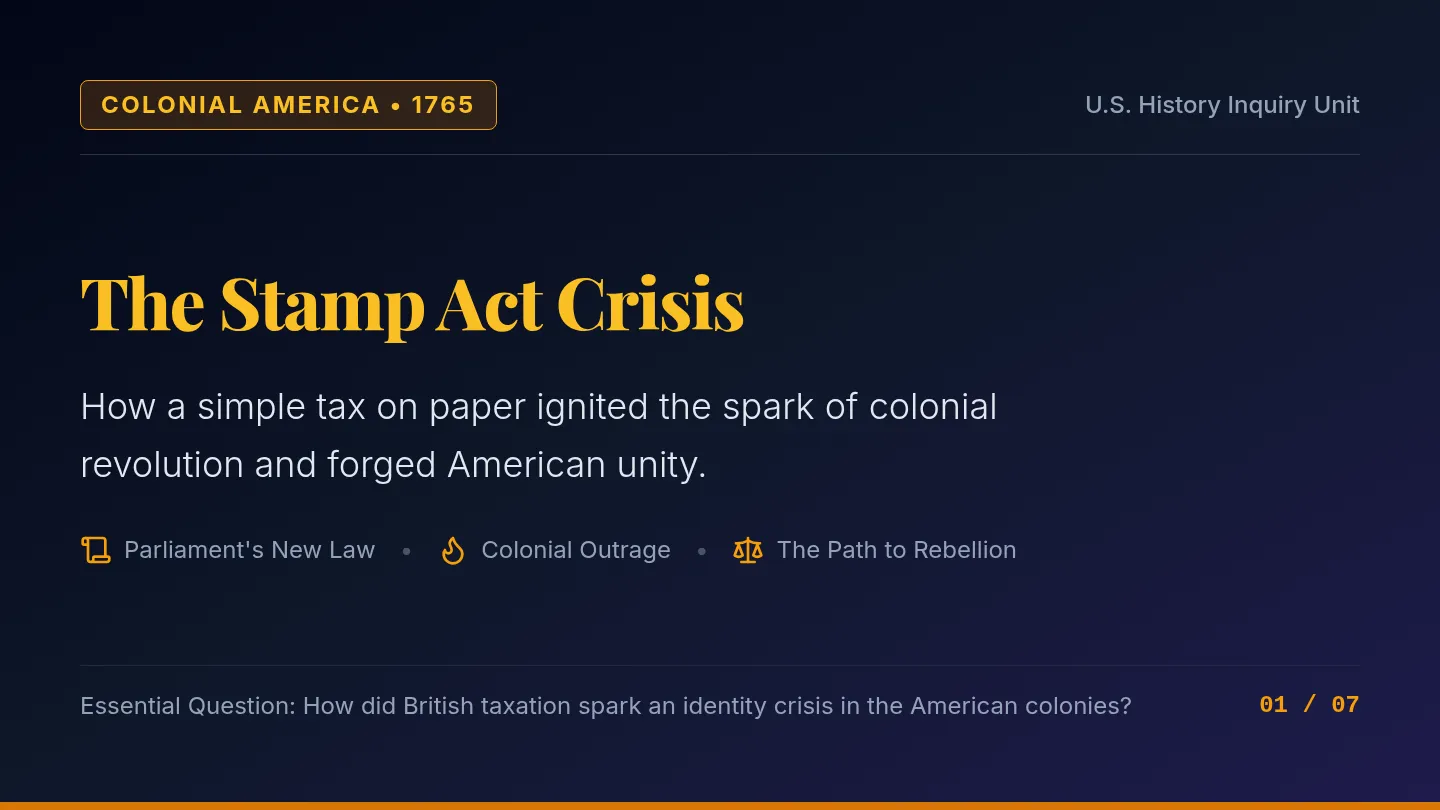
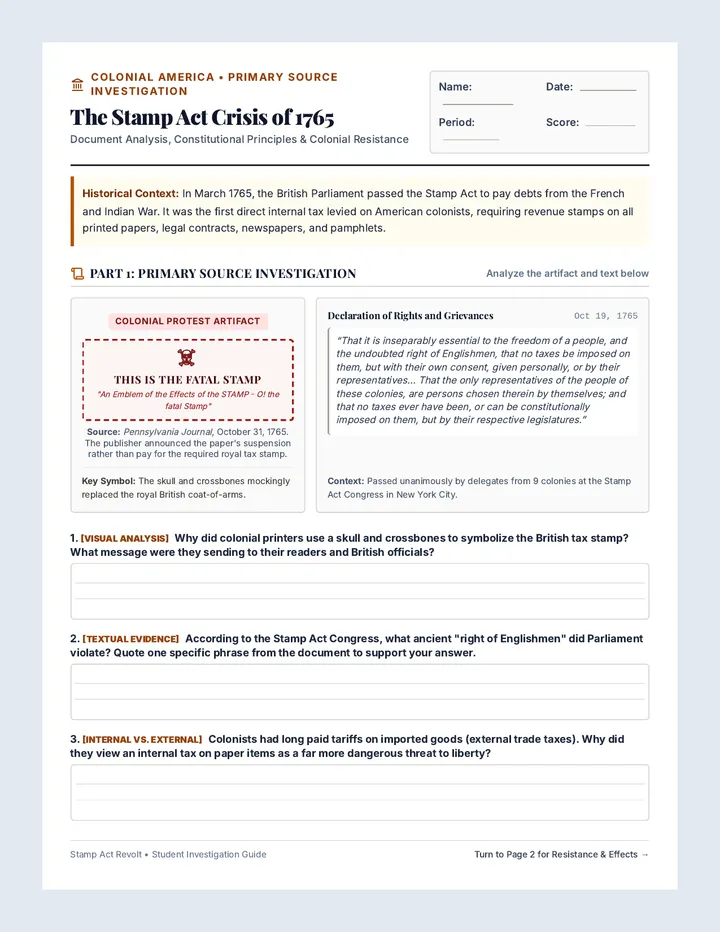
Mercantilism, Jamestown (1607), Mayflower Compact (self-governance), Stamp Act & "no taxation without representation," Declaration of Independence (1776, natural rights/Locke), Articles of Confederation (weak central gov, Shay's Rebellion led to 1787 Constitutional Convention).
Early Republic & Expansion (1789–1850)
Federalists (Hamilton, strong national bank) vs. Democratic-Republicans (Jefferson, states' rights); Louisiana Purchase (1803); War of 1812; Monroe Doctrine (1823); Manifest Destiny & Indian Removal Act (Trail of Tears, 1830).
Civil War & Reconstruction (1850–1877)
Sectional tensions over slavery, Missouri Compromise, Compromise of 1850, Dred Scott Decision; Lincoln election (1860); Emancipation Proclamation (1863), Gettysburg; Reconstruction Amendments: 13th (abolished slavery), 14th (citizenship & equal protection), 15th (voting rights for Black men).
Industrialization to Cold War (1877–1991)
Gilded Age (robber barons, labor unions); Progressive Era (reforms, 19th Amend women's suffrage); Great Depression & FDR's New Deal; WWII; Civil Rights Movement (Brown v. Board 1954, Civil Rights Act 1964, Voting Rights Act 1965); Cold War containment.
Separation of Powers & Checks/Balances Articles I, II, III of U.S. Constitution
Legislative (Congress)
Makes laws. Bicameral: House (population) & Senate (2 per state).
Checks: Can override veto (2/3), approve appointments/treaties, impeach officials, control budget.
Executive (President)
Enforces laws. Commander-in-Chief, Cabinet, Veto power.
Checks: Can veto congressional legislation; appoints federal judges and ambassadors; signs executive orders.
Judicial (Supreme Court)
Interprets laws. Lifetime tenure for federal judges.
Checks: Judicial Review (Marbury v. Madison, 1803) - can declare legislative laws or executive acts unconstitutional.
Must-Know Amendments & Landmark Judicial Precedents Frequent Exam Targets
Bill of Rights Highlights:
- • 1st: Freedoms of speech, press, religion, assembly, petition.
- • 4th: Protects against unreasonable searches and seizures.
- • 5th: Due process, self-incrimination, double jeopardy.
- • 10th: Powers not delegated to federal gov reserved to states.
Landmark Supreme Court Cases:
- • Marbury v. Madison (1803): Established judicial review.
- • McCulloch v. Maryland (1819): Federal supremacy & implied powers.
- • Plessy v. Ferguson (1896): Upheld "separate but equal."
- • Brown v. Board of Ed. (1954): Overturned Plessy; segregated schools unequal.
Foundational Constitutional Principles
- • Popular Sovereignty: Power resides with the people ("We the People").
- • Federalism: Power shared between national and state governments.
- • Rule of Law: No one is above the law; government must follow constitutional limits.
Historical Thinking Skills (Praxis CKT)
- • Primary Sources: Created during event (letters, diaries, treaties, photos).
- • Secondary Sources: Analysis after fact (textbooks, scholarly articles).
- • Sourcing & Context: Examining author bias, intended audience, and context.
World History Foundations for Elementary Curriculum
Early River Civilizations: Mesopotamia (Tigris/Euphrates, cuneiform, Hammurabi's Code), Egypt (Nile, papyrus, centralized theocracy), Indus Valley (Harappa, urban grid), China (Yellow River, dynastic cycle). Classical Era: Athens (direct democracy), Rome (republic, rule of law, engineering). Feudalism: Manorialism, land-for-protection hierarchy. Renaissance & Enlightenment: Humanism, scientific inquiry, Locke/Rousseau (social contract).
Praxis 5007 Quick-Reference Guide Page 3 of 4 • Social Studies: History & Civics
Domain 4: Geography, Economics & CKT Application
5 themes, spatial analysis, economic decision-making, and scenario rationales
Social Studies & CKT
The 5 Themes of Geography
1. Location
Absolute (lat/long coordinates) vs. Relative (next to the river).
2. Place
Physical (mountains, climate) & human (languages, architecture) traits.
3. H.E.I.
How humans adapt, modify, and depend on environment (dams, canals).
4. Movement
Migration of people, goods, and diffusion of cultural ideas.
5. Region
Formal (state borders), Functional (metro transit), Perceptual ("The South").
Map Skills & Projections: Latitude = parallels (equator, 0°); Longitude = meridians (Prime Meridian, 0°). Mercator: preserves shape/angle but drastically distorts size at poles; Winkel Tripel / Robinson: compromises distortion for world representation.
Fundamental Economics Concepts
Scarcity & Opportunity Cost
Unlimited human wants vs. limited resources. Opportunity Cost = the value of the next best alternative given up when making a choice.
Supply & Demand Dynamics
Price up → Demand down, Supply up. Equilibrium price = where supply meets demand. Surplus = supply > demand; Shortage = demand > supply.
Economic Systems
Market: Consumer sovereignty, private property. Command: Centralized government allocation. Mixed: Blend (e.g., U.S. free market with safety regulations).
Praxis CKT Sample Scenarios & Decision Rules
Exam Simulation
[ELA CKT] A 1st grade student reads the sentence: "The rabbit hopped into the garden." The student reads aloud: "The rabbit jumped into the garden." What cueing system did the student rely on, and what is the best instructional step?
✓ Correct Diagnosis: The student relied on Semantic (M) and Syntactic (S) cues because "jumped" makes grammatical sense and preserves context, but ignored Visual/Graphophonic (V) cues (/j/ does not match initial grapheme 'h').
Targeted Next Step: Direct the student's attention to the initial letter: "Look at the first letter in that word; what sound does 'h' make?"
[Social Studies CKT] A 4th-grade teacher plans an inquiry lesson on the American Revolution. Which student activity best fosters historical inquiry rather than passive memorization?
✓ Best Pedagogical Practice: Comparing a British newspaper editorial with a colonial pamphlet regarding the Boston Tea Party to evaluate author perspective and conflicting points of view.
Why distractors fail: Memorizing battle dates or writing definitions of the Stamp Act focuses on low-level recall; inquiry requires evaluating evidence, sourcing, and corroborating accounts.
Praxis 5007 Test-Day Elimination Strategy Eliminate answers that: (1) skip prerequisite skills (e.g., teaching phonics before phonemic blending), (2) rely exclusively on rote drill without context, or (3) present teacher-dominated lectures when student-centered inquiry is possible.
Praxis 5007 Quick-Reference Guide Page 4 of 4 • Geography, Economics & CKT Scenarios