Marathon Meal Open Response
Biology Open Response Biochemistry & Metabolism
The Fuel on Your Plate
Total Value 10 Points
Student Name:
Date:
Period:
Score:
Background Scenario • Pre-Championship Meal Plan
Marcus is preparing for tomorrow morning's state cross-country 5K championship race. Knowing he will need both immediate accessible fuel, sustained endurance reserves, and rapid muscle recovery after strenuous exertion, he consumes the following dinner twelve hours before competition:
Whole-Grain Pasta Complex starches
Grilled Chicken Lean muscle tissue
Olive Oil Glaze Plant triglycerides
Steamed Broccoli Plant cells & fiber
A Macromolecule Classification & Monomers
[4 Points]
For each food item from Marcus's meal listed below, identify the primary biological macromolecule present, the monomer building block that composes it, and the characteristic chemical elements (e.g., C, H, O, N, P, S) found in that macromolecule.
| Food Item | Macromolecule Class | Monomer Subunit | Elements (Symbols) |
|---|
| Whole-Grain Pasta | | | |
| Grilled Chicken Breast | | | |
| Olive Oil Dressing | | | |
| Broccoli Cells (Nuclei) | | | |
B Chemical Digestion: Catabolism & Hydrolysis
[3 Points]
Before Marcus's body can use these nutrients, the polymers must be chemically disassembled into monomers in his digestive tract. Name the metabolic process responsible for breaking down these compounds, explain the exact role that water (\(\text{H}_2\text{O}\)) molecules play in cleaving the covalent bonds, and state whether this reaction type is anabolic or catabolic.
High School Biology • Standardized Open Response Assessment Turn to Page 2 →
Macromolecule Assessment • Continued
Cellular Synthesis, Function & Physiological Reasoning
Student Name:
C Cellular Storage & Synthesis: Dehydration Reactions
[3 Points]
Once absorbed into his bloodstream, excess glucose monomers are transported to muscle and liver cells to build glycogen (an energy storage polymer), while amino acids are assembled into contractile proteins like actin and myosin. Name the specific chemical reaction used to build these polymers, describe what happens to the \(\text{-H}\) and \(\text{-OH}\) functional groups, and identify the byproduct molecule that is released.
D Dietary Selection & Physiological Justification
[4 Points]
Evaluate Marcus's dietary decision. In your response: (1) Explain why complex carbohydrates (pasta) and lipids (olive oil) provide complementary forms of energy for a long-distance runner. (2) Explain why protein (chicken) is critical even though it is not the primary fuel for muscle contraction. (3) Predict how Marcus's race performance would be affected if he instead ate a meal consisting solely of simple sugars (like candy) right before the race.
Scoring Guide & Response Criteria
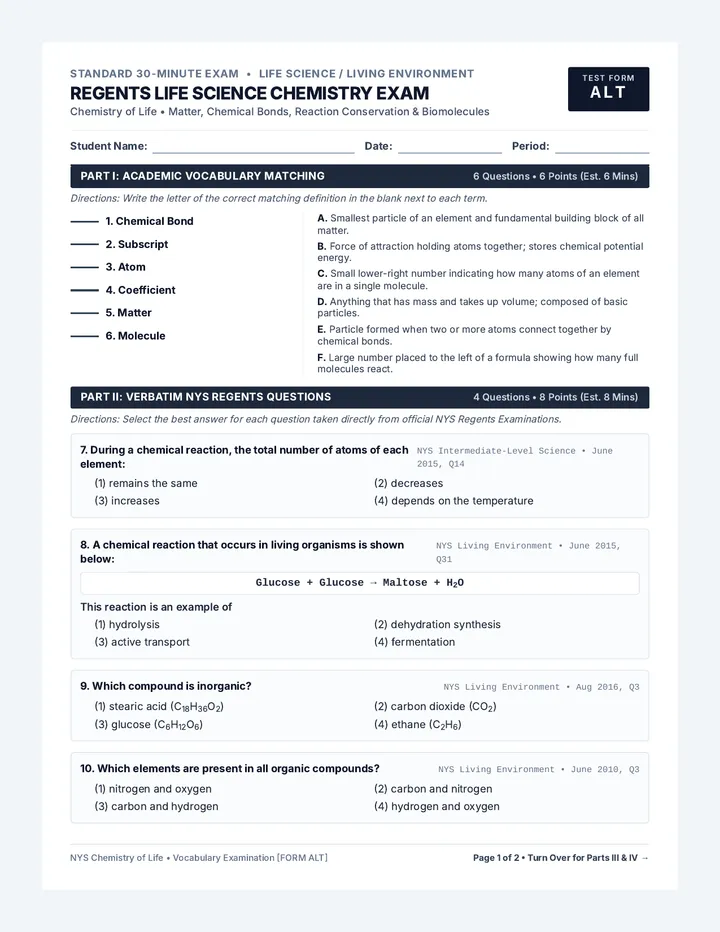
Part A: Subunits Accurately matches all 4 food items to macromolecules, monomer units, and elemental codes (CHO, CHON, CHONP).
Part B: Digestion Identifies hydrolysis (catabolism); articulates that water is added to split covalent bonds between monomers.
Part C: Synthesis Identifies dehydration synthesis (anabolism); explains release of \(\text{H}_2\text{O}\) from \(\text{-H}\) and \(\text{-OH}\) groups.
Part D: Justification Distinguishes quick vs. long-term energy storage; notes structural/enzyme repair role of protein and insulin crash hazard.
High School Biology • Assessment Form NP26-BIO Page 2 of 2