Genetics Casefiles Practice Worksheet
Genetics Casefiles
Monohybrid Cross Investigation Lab • Evidence & Probability
Name:
Date:
Period:
GENETIC DETECTIVE TOOLKIT (REFERENCE GUIDE)
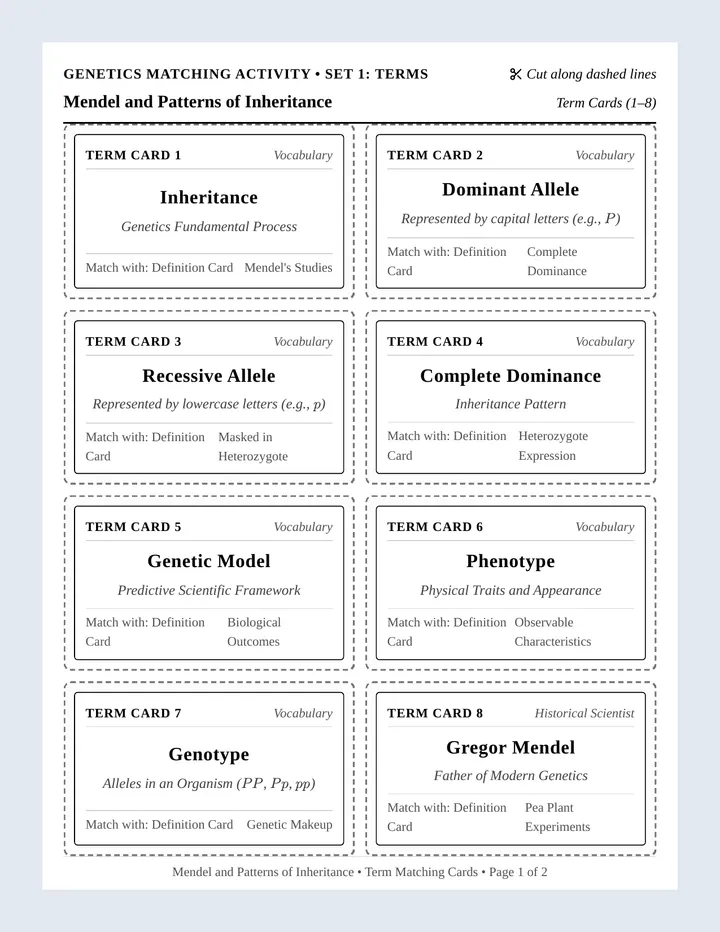
1. Allele Types Dominant (Capital): Strong trait (e.g., B)
Recessive (lowercase): Hidden trait (e.g., b)
2. Genotype Words Homozygous: Same letters (BB or bb)
Heterozygous: Mixed letters (Bb)
3. 4-Step Case Method • Find parent alleles in text.
• Split alleles outside 2×2 grid.
• Cross inside boxes & tally %.
Case 01
The Mystery of the Floppy-Eared Rescue Pups
Pointed Ears (E) vs. Floppy Ears (e)
Maya volunteers at Pine Creek Animal Rescue. A stray dog arrives at the shelter and gives birth to four puppies. Two puppies have pointed, upright ears, while two have soft, floppy ears. Maya investigates the records: pointed ears (E) are completely dominant over floppy ears (e). The mother dog has pointed ears, but carries the hidden floppy-ear allele (heterozygous, Ee). The father dog has floppy ears (homozygous recessive, ee).
Step 1: Identify Parent Genotypes
Mother: Father:
Step 2: Complete the 2×2 Grid
<table class="border-collapse text-xs"><tbody><tr><td class="w-6 h-6"></td><td class="w-11 h-5 text-center font-bold text-neutral-700 pb-0.5 text-xs">E</td><td class="w-11 h-5 text-center font-bold text-neutral-700 pb-0.5 text-xs">e</td></tr><tr><td class="w-5 h-11 text-center font-bold text-neutral-700 pr-1 text-xs">e</td><td class="w-11 h-11 border-2 border-black bg-white text-center font-mono text-sm"></td><td class="w-11 h-11 border-2 border-black bg-white text-center font-mono text-sm"></td></tr><tr><td class="w-5 h-11 text-center font-bold text-neutral-700 pr-1 text-xs">e</td><td class="w-11 h-11 border-2 border-black bg-white text-center font-mono text-sm"></td><td class="w-11 h-11 border-2 border-black bg-white text-center font-mono text-sm"></td></tr></tbody></table>
Step 3: Calculate Probabilities
Genotype Count:
Ee: / 4 boxes
ee: / 4 boxes
Phenotype (Appearance):
Pointed: %
Floppy: %
Step 4: Detective Conclusion
Why do some puppies have floppy ears even though the mother has pointed ears?
Case 02
The Sanctuary Dragons: The Hidden Silver Scale
Green Scales (G) vs. Silver Scales (g)
In a wildlife reserve for mythical reptiles, Caretaker Rowan tracks an endangered species of horned drake. Deep green scales (G) are dominant over icy silver scales (g). Rowan pairs two adult green dragons: Barnaby and Zephyr. Both dragons have green scales, but medical charts confirm both are heterozygous (Gg) because each had one silver-scaled parent. The sanctuary council assumes two green dragons will only produce green offspring. Rowan sets out to prove silver hatchlings are possible.
Step 1: Write Parent Genotypes
Barnaby: Zephyr:
Step 2: Label & Fill Square
<table class="border-collapse text-xs"><tbody><tr><td class="w-6 h-6"></td><td class="w-11 h-5 text-center font-bold text-neutral-700 pb-0.5 text-xs">__</td><td class="w-11 h-5 text-center font-bold text-neutral-700 pb-0.5 text-xs">__</td></tr><tr><td class="w-5 h-11 text-center font-bold text-neutral-700 pr-1 text-xs">__</td><td class="w-11 h-11 border-2 border-black bg-white text-center font-mono text-sm"></td><td class="w-11 h-11 border-2 border-black bg-white text-center font-mono text-sm"></td></tr><tr><td class="w-5 h-11 text-center font-bold text-neutral-700 pr-1 text-xs">__</td><td class="w-11 h-11 border-2 border-black bg-white text-center font-mono text-sm"></td><td class="w-11 h-11 border-2 border-black bg-white text-center font-mono text-sm"></td></tr></tbody></table>
Step 3: Evidence Breakdown
Genotype Ratios:
GG: /4 Gg: /4
gg: / 4
Offspring Appearance:
Green Scales: %
Silver Scales: %
Step 4: Case Resolution
Was Rowan right? What percent chance does each egg have of hatching a silver dragon?
Page 2
Genetics Casefiles: Independent Investigations
Student Name:
Reminder: Carefully read each case scenario, find the genotype clues, and fill in every step completely.
Case 03
The Greenhouse Mystery: The Vanishing Dwarf Plant
Tall Stem (T) vs. Dwarf Stem (t)
Botanist Dr. Clara Vance is restoring an antique greenhouse containing heritage pea plants. Tall stem height (T) is dominant over short dwarf stem height (t). Clara discovers seeds from first-generation hybrid tall plants. Both parent plants selected for this cross are heterozygous tall (Tt). Clara plans to grow a batch of 40 seedlings for a botanical showcase, but her assistant worries that the short dwarf trait has been permanently lost from this lineage.
Step 1: Extract Genotypes
Plant 1: Plant 2:
Step 2: Construct Punnett Square
<table class="border-collapse text-xs"><tbody><tr><td class="w-6 h-6"></td><td class="w-11 h-5 text-center font-bold text-neutral-700 pb-0.5 text-xs">__</td><td class="w-11 h-5 text-center font-bold text-neutral-700 pb-0.5 text-xs">__</td></tr><tr><td class="w-5 h-11 text-center font-bold text-neutral-700 pr-1 text-xs">__</td><td class="w-11 h-11 border-2 border-black bg-white text-center font-mono text-sm"></td><td class="w-11 h-11 border-2 border-black bg-white text-center font-mono text-sm"></td></tr><tr><td class="w-5 h-11 text-center font-bold text-neutral-700 pr-1 text-xs">__</td><td class="w-11 h-11 border-2 border-black bg-white text-center font-mono text-sm"></td><td class="w-11 h-11 border-2 border-black bg-white text-center font-mono text-sm"></td></tr></tbody></table>
Step 3: Analyze the Numbers
Offspring expected to be Tall: / 4 boxes ( %)
Offspring expected to be Dwarf: / 4 boxes ( %)
Out of 40 total seedlings, how many should be dwarf? (Hint: 25% of 40 = 1/4 of 40): dwarf plants
Step 4: Scientific Explanation
How can two tall parent plants produce a dwarf offspring? Use the word recessive.
Case 04
The Tundra Patrol: Arctic Fox Camouflage Alert
Brown Coat (B) vs. White Coat (b)
Wildlife biologist Marcus monitors arctic foxes on the Alaskan tundra during warm summer months. Normal brown summer coat coloration (B) is dominant over an ultra-rare white summer coat (b). Marcus spots a female fox with a white summer coat (homozygous recessive, bb). She pairs with a male fox possessing a brown coat. Genetic tests confirm the male is homozygous dominant (BB). The wildlife team needs to know if any white cubs will hatch this summer.
Step 1: Write Parent Genotypes
Mother Fox: Father Fox:
Step 2: Complete Punnett Square
<table class="border-collapse text-xs"><tbody><tr><td class="w-6 h-6"></td><td class="w-11 h-5 text-center font-bold text-neutral-700 pb-0.5 text-xs">__</td><td class="w-11 h-5 text-center font-bold text-neutral-700 pb-0.5 text-xs">__</td></tr><tr><td class="w-5 h-11 text-center font-bold text-neutral-700 pr-1 text-xs">__</td><td class="w-11 h-11 border-2 border-black bg-white text-center font-mono text-sm"></td><td class="w-11 h-11 border-2 border-black bg-white text-center font-mono text-sm"></td></tr><tr><td class="w-5 h-11 text-center font-bold text-neutral-700 pr-1 text-xs">__</td><td class="w-11 h-11 border-2 border-black bg-white text-center font-mono text-sm"></td><td class="w-11 h-11 border-2 border-black bg-white text-center font-mono text-sm"></td></tr></tbody></table>
Step 3: Probabilities & Ratios
Offspring Genotypes:
All offspring:
(Homo- or Heterozygous?)
Coat Color Chance:
Brown Coat: %
White Coat: %
Step 4: Official Report to Reserve
Should the team prepare tracking tags for white cubs from this pair? Defend your answer.