Frontier Faith Clash Worksheet
NM History Primary & Secondary Reader Territorial Period (1850–1888)
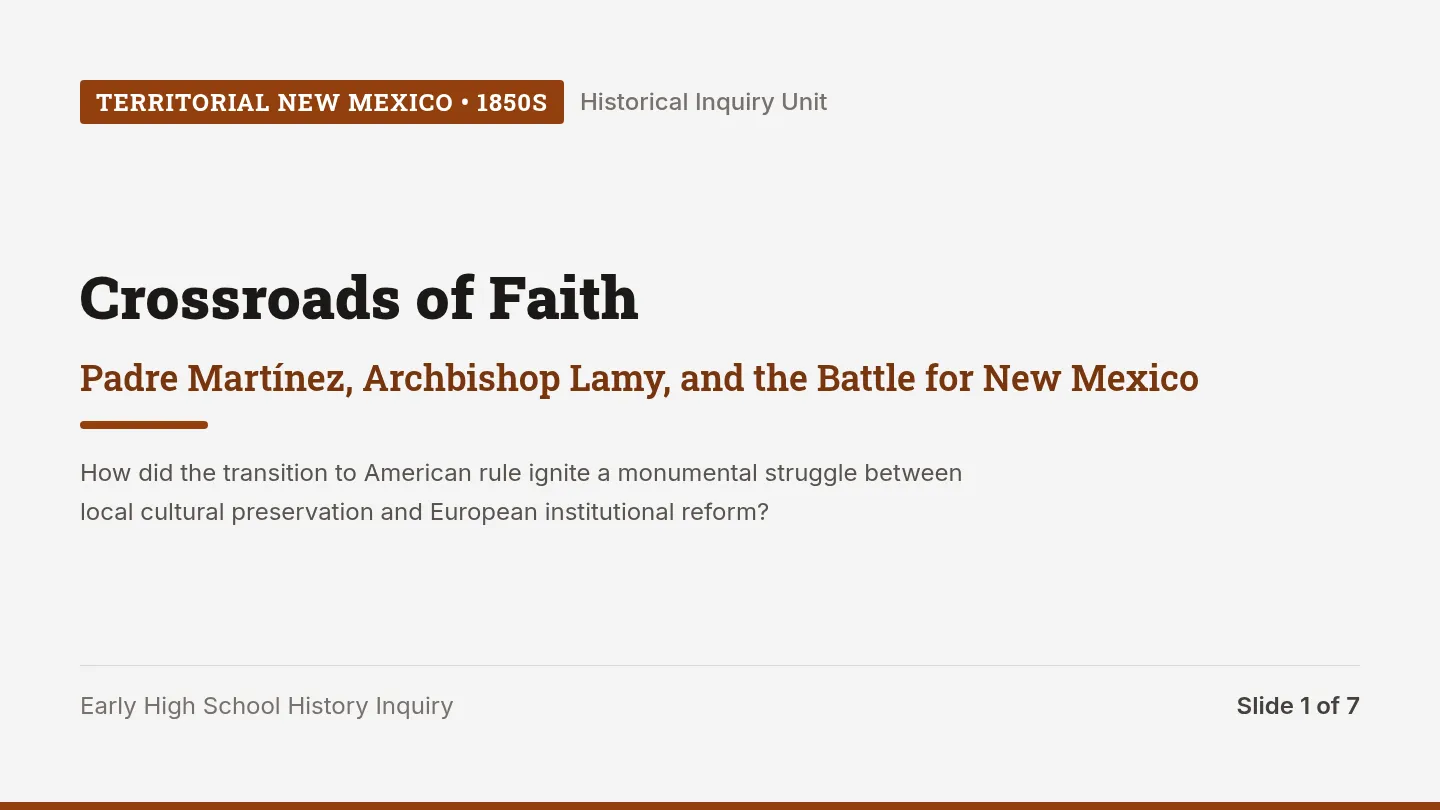
Frontier Faith Clash: Martínez & Lamy
NAME:
DATE: PERIOD:
Reading 1: Padre Antonio José Martínez — The Voice of Taos
1793–1867 • Taos Parish
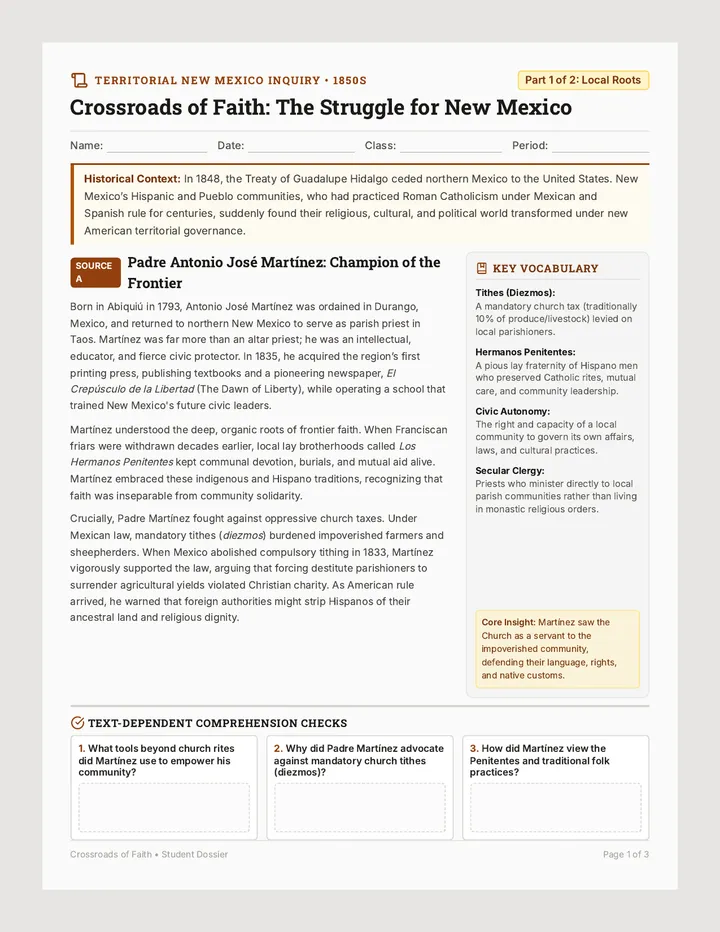
Born in Abiquiú, Antonio José Martínez was ordained in Durango, Mexico, before returning to Taos in 1826 as parish priest. Living through New Mexico's transition from Spanish rule to Mexican republic, and finally to an American territory after the Mexican-American War (1846–1848), Martínez emerged as the foremost defender of native Nuevomexicano culture, civil liberties, and communal land grants.
Martínez understood that education was essential for his people to protect their autonomy under foreign rule. In 1835, he acquired New Mexico’s first printing press, publishing schoolbooks, political treatises, and the region's first newspaper, El Crepúsculo de la Libertad. He also operated a co-educational academy and a preparatory seminary in Taos, training many future territorial lawmakers and clergy who championed Hispanic and Pueblo sovereignty.
Rooted deeply in folk traditions, Martínez fiercely opposed mandatory church tithes that burdened impoverished families. He also defended the Penitentes, a local lay brotherhood that maintained community welfare and religious devotions when priests were scarce. When newly appointed French bishop Jean-Baptiste Lamy demanded centralized control and rigid adherence to European canon law, Martínez passionately resisted what he viewed as pastoral tyranny, leading to his controversial excommunication in 1858.
Leader Profile
- Origin: New Mexico (Hispano)
- Roles: Priest, Publisher, Politician
- Legacy: Defender of local land, language, and poor families.
Key Vocabulary
Nuevomexicano:
A native Spanish-speaking resident of colonial/territorial NM.
Tithe (Diezmo):
A mandatory church tax (traditionally 10% of produce/income).
Penitentes:
A Catholic lay fraternity leading prayer and mutual community aid.
Canon Law:
Ecclesiastical ordinances governing the global Catholic Church.
Part 1 Check
Text-Dependent Questions (Answer in complete sentences)
1. Evidence & Tools: What educational and technological tools did Padre Martínez establish in Taos, and why did he view education as vital for his community?
2. Conflict & Tithes: Why did Martínez vehemently resist Bishop Lamy’s enforcement of compulsory church tithes on local families?
3. Cultural Defense: How did Martínez’s defense of the Penitentes demonstrate his belief in local parish traditions over foreign ecclesiastical decrees?
Unit: Territorial Clashes in the Southwest Page 1 of 3 • Continue to Reading 2
NM History Primary & Secondary Reader Territorial Period (1850–1888)
Frontier Faith Clash: Martínez & Lamy
NAME:
DATE: PERIOD:
Reading 2: Archbishop Jean-Baptiste Lamy — The Builder of Santa Fe
1814–1888 • Archdiocese of Santa Fe
Jean-Baptiste Lamy was born in Lempdes, France, and served as a missionary priest in Ohio before Pope Pius IX appointed him Vicar Apostolic of New Mexico in 1850. Following the U.S. annexation, American church leaders believed the isolated Southwest required modernization. Arriving in Santa Fe on horseback in 1851 after a treacherous voyage, Lamy encountered an expansive desert diocese that lacked European-style institutional oversight.
Lamy believed the New Mexican church had deteriorated through centuries of geographic isolation. Determined to bring orthodox discipline, he recruited French, Italian, and American clergy to replace native priests whom he deemed uneducated or lax. He established institutions that reshaped territorial life, bringing the Christian Brothers to found St. Michael’s High School (1859) and the Sisters of Loretto to open the Loretto Academy for young women (1852).
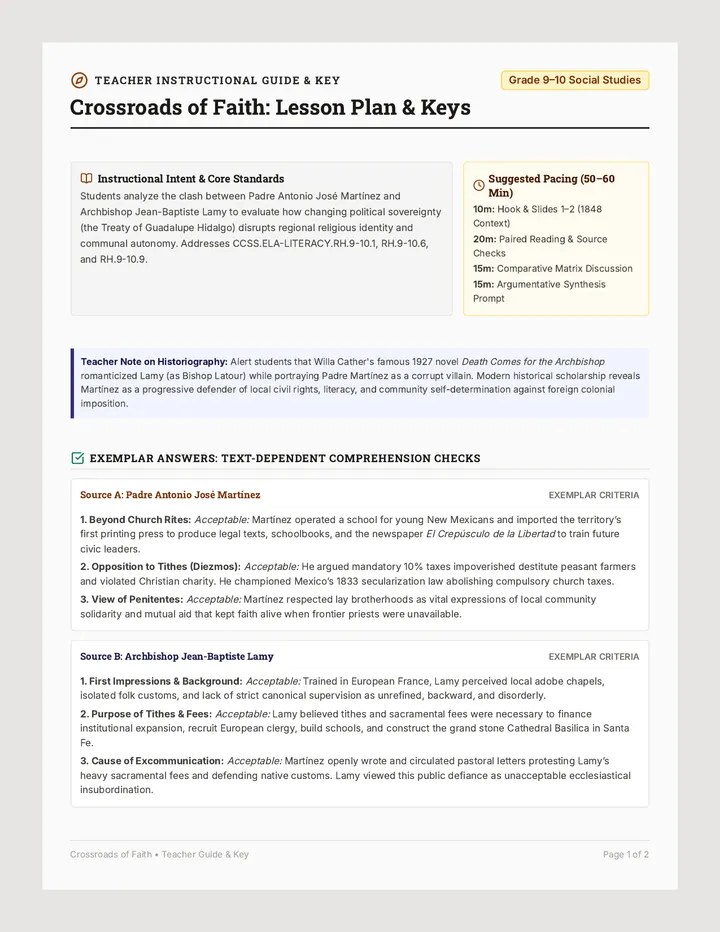
Lamy’s crown architectural achievement was the Romanesque Revival Saint Francis Cathedral, built from native yellow limestone by imported European stonemasons. However, his mission clashed directly with native customs. Lamy strictly banned Penitente practices, suspended popular Hispanic clergy who challenged his authority, and enforced rigid tithing to finance construction. Where Lamy saw order, civilization, and canonical renewal, his opponents saw cultural alienation and authoritarian rule.
Leader Profile
- Origin: Auvergne, France
- Roles: Bishop, 1st Archbishop, Builder
- Legacy: Institutional discipline, schools, and Romanesque architecture.
Key Vocabulary
Vicar Apostolic:
A bishop appointed by the Pope to govern a frontier territory.
Diocese:
A district of Catholic parishes under a bishop’s supervision.
Orthodoxy:
Authorized doctrinal belief sanctioned by central authority.
Romanesque Revival:
European architectural style featuring heavy stone and rounded arches.
Part 2 Check
Text-Dependent Questions (Answer in complete sentences)
1. Institutions & Education: What permanent educational institutions and religious orders did Bishop Lamy bring to New Mexico, and what was their objective?
2. Perspective on Reform: How did Lamy view the existing condition of the New Mexican Catholic Church, and why did he replace native clergy with European priests?
3. Cultural Friction: Why did Lamy’s architectural projects and suppression of folk practices like the Penitentes provoke deep resentment among many local Nuevomexicanos?
Unit: Territorial Clashes in the Southwest Page 2 of 3 • Proceed to Comparative Analysis
Part 3: Comparative Analysis
Two Visions for New Mexico: Martínez vs. Lamy
Synthesizing Conflicting Legacies
Directions: Use evidence from both readings to complete the matrix below comparing the beliefs, strategies, and impacts of both leaders. Then answer the synthesis questions.
| Comparison Category |
Padre Antonio José Martínez
|
Archbishop Jean-Baptiste Lamy
|
| --- | --- | --- |
| 1. Cultural Identity & Worldview |
Rooted in local Nuevomexicano heritage...
|
European perspective; Roman orthodoxy...
|
| 2. Educational Approach & Media |
Printing press, bilingual academy, local rights...
|
Imported Catholic orders (Christian Bros, Loretto)...
|
| 3. Church Taxes & Local Folk Faith |
Protected poor from tithes; defended Penitentes...
|
Mandated tithes for construction; banned Penitentes...
|
| 4. Enduring Physical / Civic Legacy |
Civic independence; statue on Taos Plaza...
|
St. Francis Cathedral; modern diocesan structure...
|
Historical Synthesis & Extended Reflection
A. The Wider Conflict: How did the religious clash between Lamy and Martínez reflect the broader cultural and political struggle between native Nuevomexicanos and the incoming United States territorial government after 1848?
B. Dual Legacies: Both Martínez and Lamy are celebrated as foundational figures in New Mexico history with public monuments in Taos and Santa Fe. Can their opposing visions both be seen as constructive, or was one leader’s impact more beneficial for New Mexico’s future? Justify with two specific pieces of text evidence.
Scoring Guide: Part 1: __/15 Part 2: __/15 Part 3: __/20
Total: __/50