Faith and Frontier Reading Guide
Territorial New Mexico Inquiry • 1850s
Part 1 of 2: Local Roots
Crossroads of Faith: The Struggle for New Mexico
Name:
Date:
Class:
Period:
Historical Context: In 1848, the Treaty of Guadalupe Hidalgo ceded northern Mexico to the United States. New Mexico’s Hispanic and Pueblo communities, who had practiced Roman Catholicism under Mexican and Spanish rule for centuries, suddenly found their religious, cultural, and political world transformed under new American territorial governance.
SOURCE A
Padre Antonio José Martínez: Champion of the Frontier
Born in Abiquiú in 1793, Antonio José Martínez was ordained in Durango, Mexico, and returned to northern New Mexico to serve as parish priest in Taos. Martínez was far more than an altar priest; he was an intellectual, educator, and fierce civic protector. In 1835, he acquired the region’s first printing press, publishing textbooks and a pioneering newspaper, El Crepúsculo de la Libertad (The Dawn of Liberty), while operating a school that trained New Mexico's future civic leaders.
Martínez understood the deep, organic roots of frontier faith. When Franciscan friars were withdrawn decades earlier, local lay brotherhoods called Los Hermanos Penitentes kept communal devotion, burials, and mutual aid alive. Martínez embraced these indigenous and Hispano traditions, recognizing that faith was inseparable from community solidarity.
Crucially, Padre Martínez fought against oppressive church taxes. Under Mexican law, mandatory tithes (diezmos) burdened impoverished farmers and sheepherders. When Mexico abolished compulsory tithing in 1833, Martínez vigorously supported the law, arguing that forcing destitute parishioners to surrender agricultural yields violated Christian charity. As American rule arrived, he warned that foreign authorities might strip Hispanos of their ancestral land and religious dignity.
Key Vocabulary
Tithes (Diezmos):
A mandatory church tax (traditionally 10% of produce/livestock) levied on local parishioners.
Hermanos Penitentes:
A pious lay fraternity of Hispano men who preserved Catholic rites, mutual care, and community leadership.
Civic Autonomy:
The right and capacity of a local community to govern its own affairs, laws, and cultural practices.
Secular Clergy:
Priests who minister directly to local parish communities rather than living in monastic religious orders.
Core Insight: Martínez saw the Church as a servant to the impoverished community, defending their language, rights, and native customs.
Text-Dependent Comprehension Checks
-
What tools beyond church rites did Martínez use to empower his community?
-
Why did Padre Martínez advocate against mandatory church tithes (diezmos)?
-
How did Martínez view the Penitentes and traditional folk practices?
Crossroads of Faith • Student Dossier Page 1 of 3
Territorial New Mexico Inquiry • 1850s
Part 2 of 2: Rome & Reform
Archbishop Jean-Baptiste Lamy: The Gallic Reformer
Analyzing the incoming ecclesiastical vision under United States territorial rule Document Source B
Ecclesiastical Context: Following the annexation of New Mexico, the Vatican detached the region from the Mexican diocese of Durango. In 1850, Pope Pius IX appointed 36-year-old French-born priest Jean-Baptiste Lamy to lead the new Vicariate Apostolic of Santa Fe, seeking to integrate New Mexico into the Roman and American church structure.
SOURCE B
A Quest for Canonical Order and European Modernity
When Jean-Baptiste Lamy rode into Santa Fe in the summer of 1851 after a harrowing overland trek, he encountered a territory vastly different from his native Auvergne in France. Lamy saw the southwest through European eyes: to him, northern New Mexico’s centuries-old adobe chapels, Spanish liturgical customs, and self-governing lay brotherhoods appeared backward, disorganized, and bordering on heresy.
Determined to impose strict orthodox discipline, Lamy recruited French and Italian priests, brought the Sisters of Loretto to establish Catholic boarding schools, and began replacing adobe structures with European architecture—most visibly the grand stone Romanesque Cathedral Basilica of St. Francis in Santa Fe. He saw himself as an agent of civilization and ecclesiastical refinement in a wild frontier.
To fund his ambitious diocese, Lamy re-instituted mandatory tithing and strict fees for sacraments like baptisms, weddings, and funerals. He issued decrees condemning the Penitentes and suspended native priests who questioned his authority. When Padre Martínez wrote open pastoral letters protesting that high fees impoverished the faithful and that local customs deserved respect, Lamy saw it as outright insubordination. In 1858, Lamy took the ultimate disciplinary step: formally excommunicating Martínez from the Catholic Church.
Key Vocabulary
Vicariate Apostolic:
A provisional church territory governed by a missionary bishop directly under Rome's supervision.
Canonical Discipline:
Strict adherence to universal Catholic canon law, papal authority, and episcopal hierarchy.
Romanesque Architecture:
European stone building style characterized by round arches and massive stone walls, contrasting with native adobe.
Excommunication:
The most severe ecclesiastical penalty, officially expelling a person from church sacraments and communion.
Core Insight: Lamy saw the Church as a centralized, hierarchical institution tasked with reforming frontier practices to match European and Roman standards.
Text-Dependent Comprehension Checks
-
How did Lamy's European background shape his first impressions of New Mexico?
-
Why did Lamy believe re-instituting mandatory tithes and sacramental fees was necessary?
-
What specific actions provoked Lamy to formally excommunicate Padre Martínez in 1858?
Crossroads of Faith • Student Dossier Page 2 of 3
Comparative Synthesis & Historical Argument
Assessment & Evaluation
Comparing Beliefs, Power, and Influence
PART A
Analytical Comparison Matrix
| Category of Analysis | Padre Antonio José Martínez | Archbishop Jean-Baptiste Lamy |
|---|
| Vision of the Church's Role | | |
| | |
|
| Local Culture & Traditions (Penitentes, Adobe, Language) |
|
|
| Tithing, Taxes & Sacramental Fees |
|
|
| Authority & Governance (Who holds power?) |
|
|
PART B
Evidence-Based Historical Argument
Paragraph Response (5-7 Sentences)
Inquiry Question: Was the bitter conflict between Padre Martínez and Archbishop Lamy primarily a theological disagreement over religious doctrine, or was it a socio-cultural struggle over community autonomy and political power?
Formulate a claim and support it with at least two pieces of direct evidence—one from Source A and one from Source B.
Clear Claim: Defines the core nature of the conflict.
Dual Evidence: Cites both Martínez and Lamy texts.
Historical Reasoning: Explains impact on New Mexicans.
Crossroads of Faith • Student Dossier Page 3 of 3
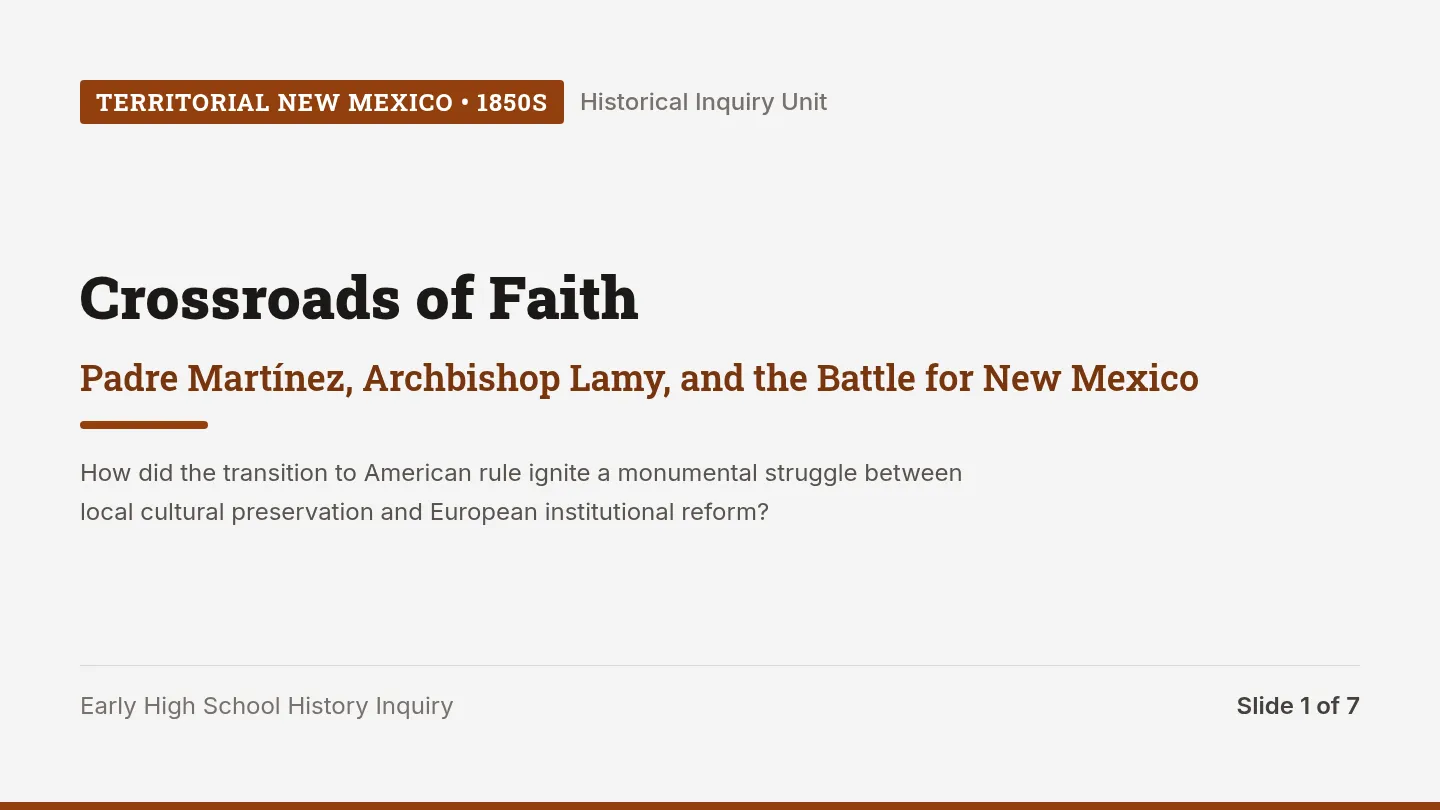
Crossroads of Faith Slides
Territorial New Mexico • 1850s Historical Inquiry Unit
Crossroads of Faith
Padre Martínez, Archbishop Lamy, and the Battle for New Mexico
How did the transition to American rule ignite a monumental struggle between local cultural preservation and European institutional reform?
Early High School History Inquiry Slide 1 of 7
Historical Turning Point
1848: The Border Crosses the People
The Treaty of Guadalupe Hidalgo
The Mexican-American War ends in 1848. Northern Mexico is ceded to the United States, instantly making over 60,000 Hispanic and Native people foreign subjects in their own ancestral homelands.
Rome Intervenes
The Catholic Church detaches New Mexico from the Mexican Diocese of Durango. Pope Pius IX appoints a French missionary bishop to establish Roman order in what church hierarchy viewed as an isolated frontier.
Contextual Foundations Slide 2 of 7
Perspective Source A
Padre Antonio José Martínez: Champion of the Frontier
1
Educator & Printer
Brought New Mexico's first printing press. Published textbooks and civic newspapers to train native youth for leadership.
2
Defender of Tradition
Honored local Hispano faith, including Los Penitentes, recognizing that lay brotherhoods sustained communal life.
3
Advocate for the Poor
Opposed mandatory church tithes that impoverished farmers. Fought to defend ancestral land and legal rights.
Padre Antonio José Martínez • Taos, New Mexico Slide 3 of 7
Perspective Source B
Archbishop Jean-Baptiste Lamy: The Gallic Reformer
1
Drive for Order
Viewed New Mexican folk Catholicism as backward and irregular. Sought to impose universal Roman Catholic discipline.
2
European Modernity
Recruited French clergy, invited religious teaching orders, and built the stone Romanesque Cathedral in Santa Fe.
3
Episcopal Authority
Demanded strict obedience to episcopal decrees, revived sacramental fees, and suppressed native resistance.
Archbishop Jean-Baptiste Lamy • Santa Fe, New Mexico Slide 4 of 7
Conflict Analysis
Three Key Flashpoints of Conflict
1. Tithing & Fees
Lamy required mandatory tithes to finance cathedral building. Martínez publicly protested that taxing impoverished parishioners was unjust.
Crossroads Teacher Guide
Teacher Instructional Guide & Key
Grade 9–10 Social Studies
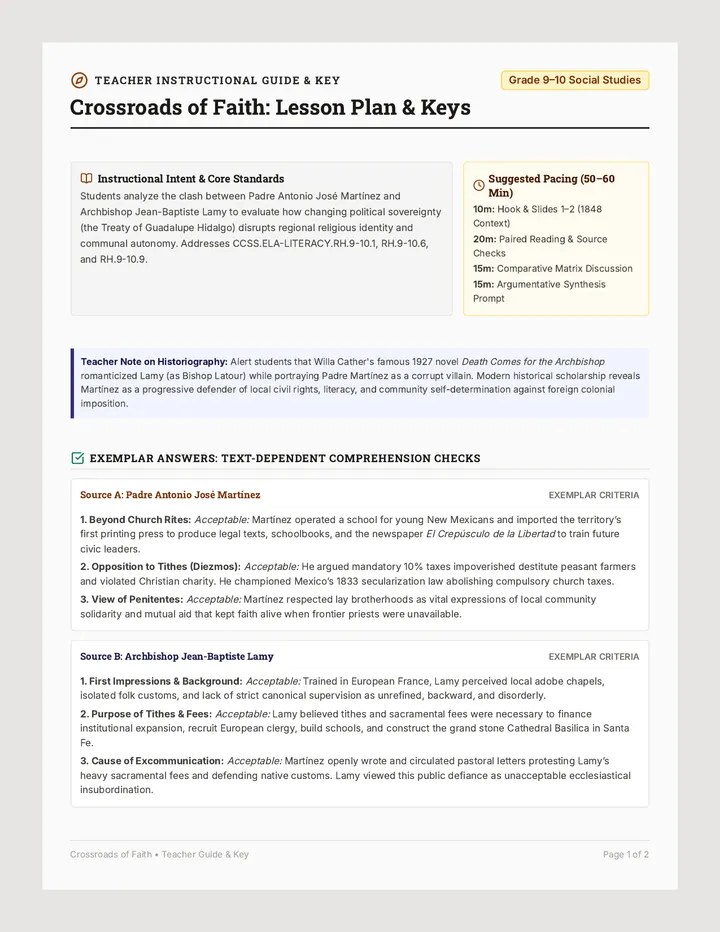
Crossroads of Faith: Lesson Plan & Keys
Instructional Intent & Core Standards
Students analyze the clash between Padre Antonio José Martínez and Archbishop Jean-Baptiste Lamy to evaluate how changing political sovereignty (the Treaty of Guadalupe Hidalgo) disrupts regional religious identity and communal autonomy. Addresses CCSS.ELA-LITERACY.RH.9-10.1, RH.9-10.6, and RH.9-10.9.
Suggested Pacing (50–60 Min)
- 10m: Hook & Slides 1–2 (1848 Context)
- 20m: Paired Reading & Source Checks
- 15m: Comparative Matrix Discussion
- 15m: Argumentative Synthesis Prompt
Teacher Note on Historiography: Alert students that Willa Cather's famous 1927 novel Death Comes for the Archbishop romanticized Lamy (as Bishop Latour) while portraying Padre Martínez as a corrupt villain. Modern historical scholarship reveals Martínez as a progressive defender of local civil rights, literacy, and community self-determination against foreign colonial imposition.
Exemplar Answers: Text-Dependent Comprehension Checks
Source A: Padre Antonio José Martínez Exemplar Criteria
1. Beyond Church Rites: Acceptable: Martínez operated a school for young New Mexicans and imported the territory’s first printing press to produce legal texts, schoolbooks, and the newspaper El Crepúsculo de la Libertad to train future civic leaders.
2. Opposition to Tithes (Diezmos): Acceptable: He argued mandatory 10% taxes impoverished destitute peasant farmers and violated Christian charity. He championed Mexico’s 1833 secularization law abolishing compulsory church taxes.
3. View of Penitentes: Acceptable: Martínez respected lay brotherhoods as vital expressions of local community solidarity and mutual aid that kept faith alive when frontier priests were unavailable.
Source B: Archbishop Jean-Baptiste Lamy Exemplar Criteria
1. First Impressions & Background: Acceptable: Trained in European France, Lamy perceived local adobe chapels, isolated folk customs, and lack of strict canonical supervision as unrefined, backward, and disorderly.
2. Purpose of Tithes & Fees: Acceptable: Lamy believed tithes and sacramental fees were necessary to finance institutional expansion, recruit European clergy, build schools, and construct the grand stone Cathedral Basilica in Santa Fe.