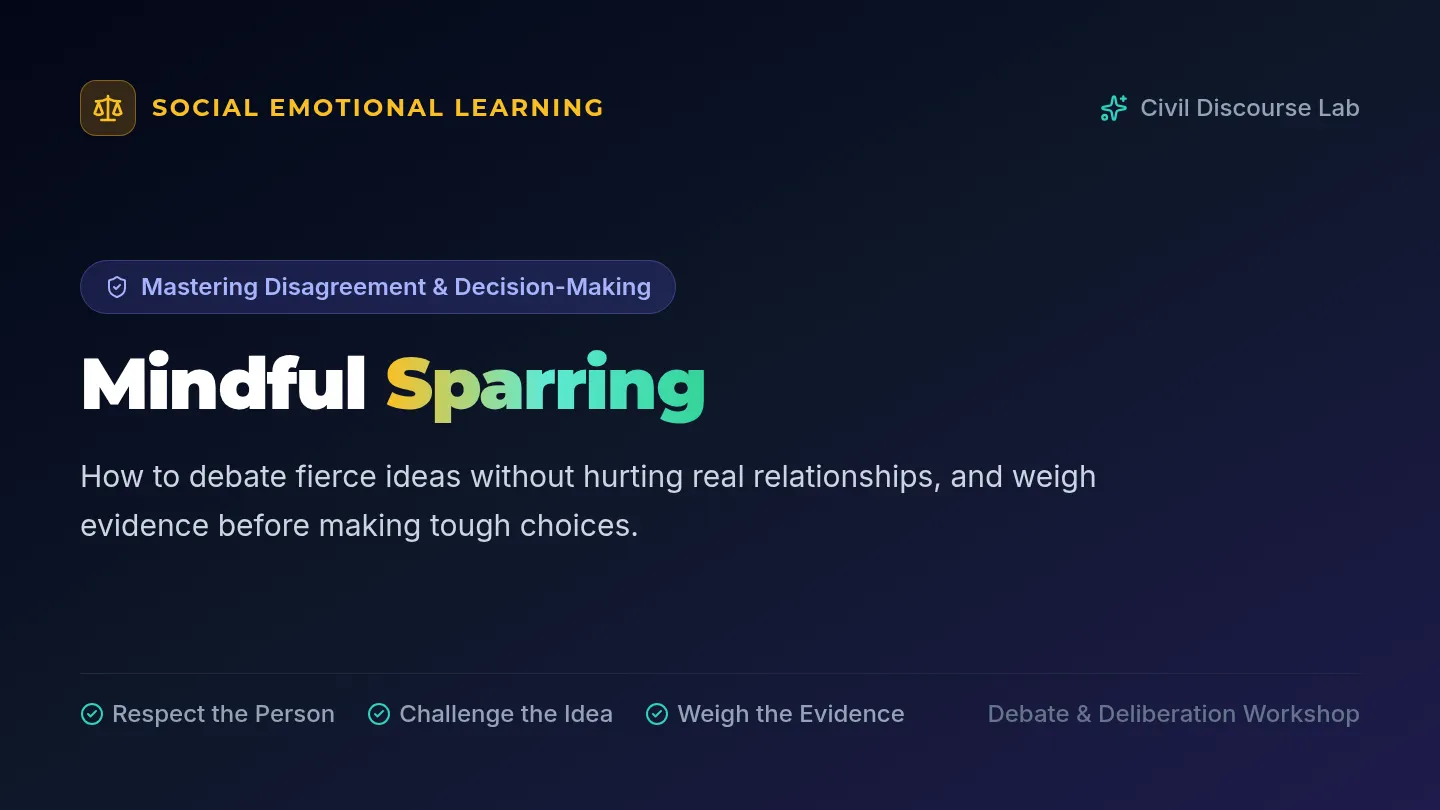
Updated outline slide with a navy blue background and sky blue text/accents for a professional look.
A set of hands-on activities corresponding to specific children's books that reinforce the Friendship Filter concept through creative play and modeling. Includes printable templates for shields, masks, and recipe cards.
A curated list of children's picture books that support the 'Friendship Filter' concept, including summaries, focus areas, and discussion questions for teachers. Updated with slightly larger text for focus labels.
A teacher's guide for facilitating the 'Filter Viewer' craft, including materials, steps, and discussion prompts. Optimized for single-page printing.
A hands-on craft template for students to create a physical 'Filter Viewer' with 'Stop, Think, Choose' steps. Optimized to fit on a single page.
An answer key for the Friendship Filter Worksheet, updated with 6 scenario answers and a rubric for student responses.
A set of role-play scenario cards for practicing how to say 'no' to friends in common elementary school peer pressure situations. Updated with 8 total scenarios and a paper-saving 2-column layout.
A worksheet for students to practice identifying appropriate behaviors and drafting responses to peer pressure scenarios. Updated with additional scenarios and optimized layout.
A colorful 6-slide presentation for elementary students explaining the 'Stop, Think, Choose' method for resisting peer pressure and using a 'Friendship Filter'.
A detailed teacher's lesson plan for grades 2-3 focused on the 'Friendship Filter' concept. Updated with literature references and consistent header styling.
A final planning worksheet for students to script their request for the calm-down corner and finalize their emotional regulation tool selection. Revised for single-page layout and improved contrast.
Slide deck for the final session of Mission Calm, focusing on role-playing scenarios and the protocol for requesting, using, and returning from the calm-down corner.
A checklist for students to test and evaluate different calm-down corner tools, selecting their 'top 3' personal favorite strategies for emotional regulation. Revised for single-page layout and improved contrast.
Slide deck for Session 2 of the Mission Calm unit, introducing students to the physical tools available in the Calm-Down Corner and their specific regulatory functions.
A student-facing body-mapping worksheet where students identify and color their physical 'alarm signals' during emotional escalation. Revised for improved silhouette and checkbox visibility.
Visual presentation for the first session of the Mission Calm unit, teaching students to identify physical emotional signals like increased heart rate and muscle tension. Revised Slide 5 padding.
A comprehensive weekly teacher guide for a small group unit on emotion regulation, featuring three detailed session plans with a 'Mission Control' theme. Revised to fix page break issues.
An answer key and teacher's guide for the War Wins Work Worksheet. Revised to reflect updated question formatting and include tips on using line numbers. Corrected to match Question 1 line reference.
A reading passage and comprehension worksheet about the World War I economic boom, written at a 1st-grade reading level with a vocabulary glossary and five multiple-choice questions. Revised to include line numbers, fix alignment issues, and ensure all questions fit on one page. Corrected answer choice uniformity.
A single-page facilitation guide for teachers, including objectives, lesson steps, discussion prompts, and common misconceptions for Kindergarten students. Optimized for single-page printing.
An answer key for the Consequence Clues Worksheet, providing exemplar answers for the case studies and the reflection question to assist teachers in grading or guided discussion.
A student worksheet designed as a "Case File" for identifying consequences. Includes scenario analysis for immediate vs. delayed consequences and a reflection section for critical thinking.
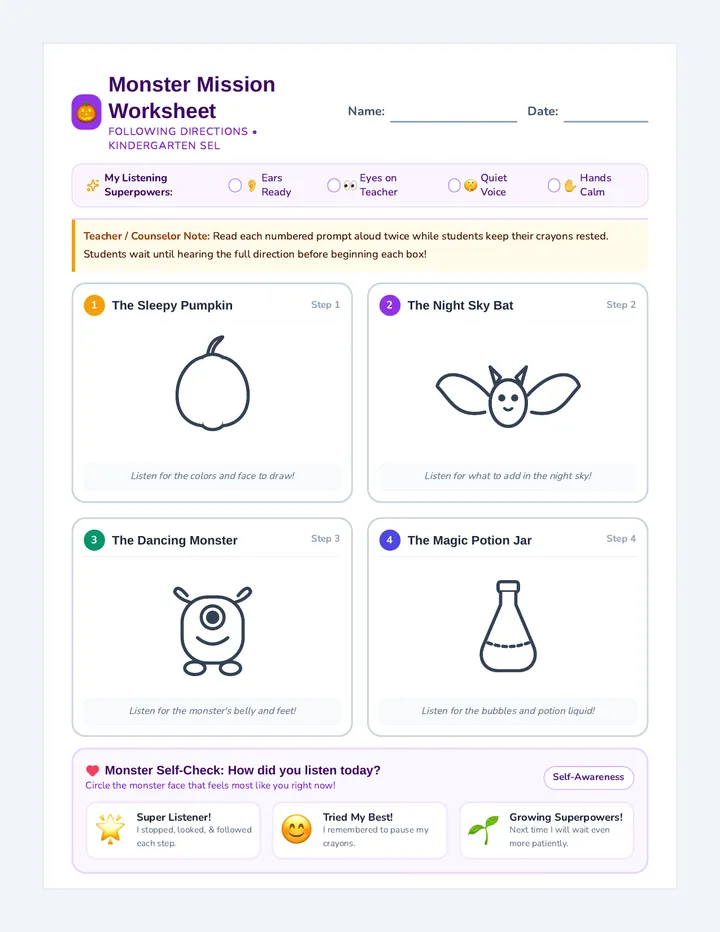
A self-advocacy practice worksheet for Kindergarteners featuring simple scenarios. All answer choices share uniform styling. Includes a large blank drawing area.
Relatable scenario cards for third-grade boys, covering situations like video games, classroom participation, and sports, to be used for group discussion and impulse control practice.
A set of four printable affirmation cards for Kindergarten students to color and keep, focusing on bravery, self-advocacy, asking for help, and self-kindness. Cards are outline-only to allow for coloring.
A high-impact slide deck for a lesson on identifying consequences. Features a detective theme, visual definitions of immediate vs. delayed consequences, and a mini-case study for class discussion.
Interactive worksheet styled as a 'Brain Remote Control' where students identify personal triggers, draw calming strategies, and practice applying the STOP protocol to a lunchroom scenario.
A social story presentation featuring a character named Sam who learns to use their 'Super Power Voice' for positive self-talk and self-advocacy. Features high contrast and clear layouts for Kindergarten.
A teacher facilitation guide for a 30-minute classroom lesson on identifying consequences. Includes mission objectives, key vocabulary, a timed pacing guide, and pedagogical tips.
Dynamic presentation slides with high-contrast visuals, introducing the 'Amygdala' vs 'Prefrontal Cortex' and the 'STOP' impulse control strategy through a 'Remote Control' theme.
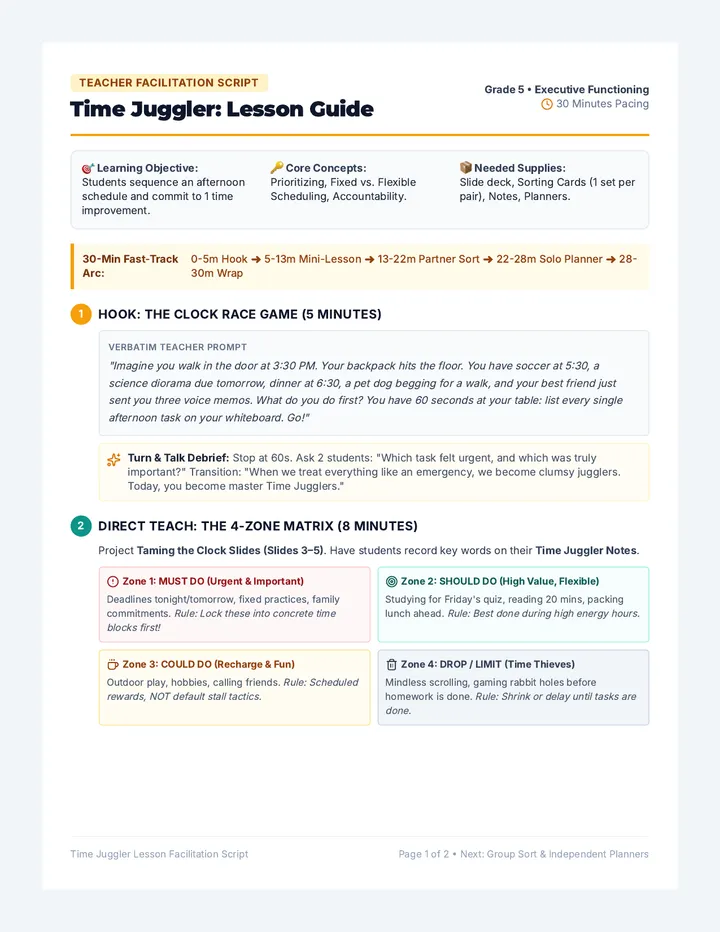
Detailed teacher facilitation guide for the 'Brake Lab' lesson, featuring learning objectives, a high-energy 'Robot Race' hook, and step-by-step instructional flow for teaching impulse control to third graders.
A visual slide deck designed for a 2nd-grade student to accompany the 'Tangled Truths' lesson, explaining the difference between exaggerating and hiding the truth through engaging graphics and large text.
A sentence-building worksheet where students use geography vocabulary to complete simple sentence frames. Includes visual cues and a word bank for support. Now optimized for single-page use with widened answer areas. Now fixed for page breaks and word bank symmetry. Now fixed for page breaks. Now optimized for readability and instruction clarity.
A compact, single-page infographic for middle school students featuring test anxiety coping strategies and helpful tips for before, during, and after exams.
Three visual exit tickets for formative assessment of geography concepts including landforms (now featuring Desert and Ocean), continent count, and map symbols. Now optimized for high-contrast text and removed labels in choices.
A cut-and-paste activity for students to practice organizing geographic hierarchy from city to continent, using visual icons and clear sorting boxes. Now includes County and updated arrow visuals.
A modified 4-slide presentation introducing geographic hierarchy, the seven continents, and now a wider variety of landforms including Ocean, Desert, and Lake. Now updated with consistent iconography.