Congress Clash Passage
U.S. History Series
CONGRESS CLASH
Name:
Date:
The Great Compromise of 1787
Imagine you and your friends are making rules for a new game. The players with the highest scores want rules that give high-scorers the most power. The players with lower scores want every single player to have an equal say, no matter what. Who wins? This debate almost tore a brand-new nation apart.
In the hot summer of 1787, fifty-five delegates gathered in Philadelphia to write the U.S. Constitution. They knew they wanted a legislature (a group of people to make laws), but they ran into a giant obstacle: How should states be represented? This question divided the delegates into two fierce camps.
The Virginia Plan (Big States)
States with large populations argued for proportional representation. This meant a state's representation in Congress would depend on its population. More citizens meant more votes. Large states argued this was the only fair democratic way.
The New Jersey Plan (Small States)
States with small populations were terrified of being bullied. They argued for equal representation. They believed every single state should get the exact same number of votes, regardless of how many people lived there.
The argument became so intense that some delegates threatened to pack up and leave. If they could not agree, the United States might fall apart before it even fully began.
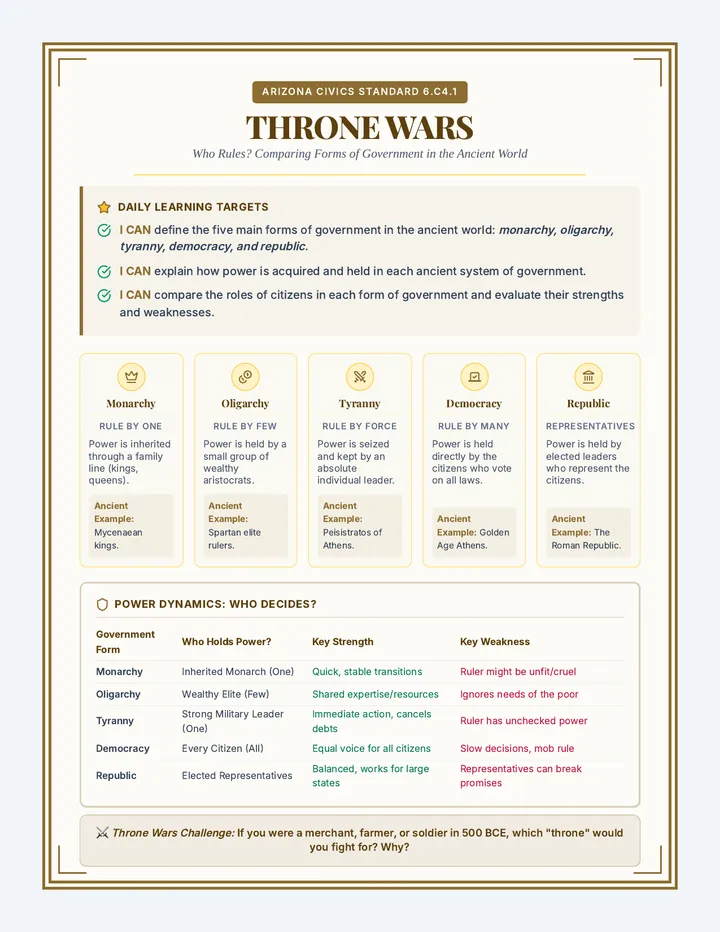
Finally, Roger Sherman, a clever delegate from Connecticut, proposed a brilliant solution that we call the Great Compromise. Instead of choosing one plan, he suggested a bicameral legislature—meaning a Congress made of two separate chambers:
1. The House of Representatives: Representation is based on population (proportional). States with more people get more representatives. This made the large states happy.
2. The Senate: Representation is perfectly equal (equal). Every state gets exactly two Senators, no matter how tiny or massive the state is. This made the small states happy.
To pass a national law, both chambers have to vote "yes" on the exact same bill. This double-system ensures that both the people (represented by the House) and the states (represented by the Senate) have a voice. Compromise saved the nation!
Grade 6 Reading Comprehension Page 1
Understanding Bicameralism
Name:
Graphic Organizer: The Road to Compromise
THE VIRGINIA PLAN Large States
What kind of representation did they want, and why?
THE NEW JERSEY PLAN Small States
What kind of representation did they want, and why?
The Solution: The Great Compromise
BICAMERAL CONGRESS (Two Houses)
House of Representatives How is power divided? Which states are happy?
The Senate How is power divided? Which states are happy?
Show What You Know
1. Why were small states afraid of proportional representation (representation based on population)? Use evidence from the text.
2. How does a bicameral system balance power so that no single state can completely take over the lawmaking process?
Grade 6 Reading Comprehension Page 2