Cell Transport Matching Worksheet
Part 1
Cell Transport Matching
Focus: Solutions, Solvents, Mixtures & Osmosis in Cells
Name
Date
Period
Section 1: Vocabulary & Definition Matching
Write the letter of the matching definition in each box
1. Solute
2. Solvent
3. Solution
4. Mixture
5. Osmosis
6. Isotonic
7. Hypertonic
8. Hypotonic
A. The substance that does the dissolving; usually the larger amount (e.g., water).
B. High solute outside the cell; water leaves and the cell shrinks/shrivels.
C. Two or more substances combined physically but not chemically stuck together.
D. The substance that gets dissolved in another substance (e.g., salt).
E. Movement of water across a membrane from high water to low water.
F. Low solute outside the cell; water enters and the cell swells.
G. A mixture where one substance is completely dissolved in another.
H. Equal solute inside and outside the cell; the cell stays the same.
Section 2: Mixtures & Solutions Classification
Match the examples to their correct scientific category
Part A: Solute vs. Solvent
Label each part of saltwater as Solute or Solvent:
1. Salt in the bowl:
2. Water in the jar:
Part B: Mixture (M) vs. Compound (C)
Write M for Mixture or C for Compound:
1. Salad bowl
2. H2O water
3. Trail mix
4. Saltwater
Section 3: Tonicity & Red Blood Cell Outcomes
Match each solution environment to its cell effect
| Solution Type | Solute Concentration Outside | Water Movement | Cell Fate (Outcome) |
|---|
| Isotonic | Equal inside and outside | Enters and leaves equally | Cell stays the same |
| Hypertonic | | | |
| Hypotonic | | | |
Word Bank: High solute outside • Low solute outside • Water leaves • Water enters • Cell shrinks • Cell swells
Cell Transport Matching Study Worksheet Page 1 of 2
Part 2
Membrane & Transport Types
Focus: Phospholipid Bilayer, Permeability, Diffusion & Active Transport
Name
Date
Period
Section 1: Membrane & Transport Diagrams
Match each lettered diagram (E–H) to the correct process below
Diagram E
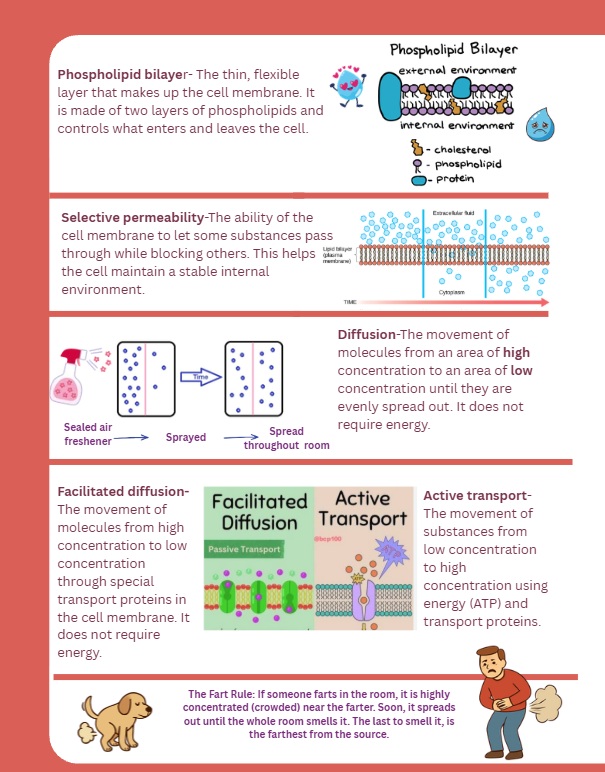
Diagram F
Diagram G
Diagram H
1. Phospholipid Bilayer (two layers, cholesterol, proteins)
2. Simple Diffusion (high to low concentration until even)
3. Selective Permeability (blocks some, lets others pass)
4. Passive Protein Channel vs. ATP Active Transport Pump
Section 2: Transport Terms & Definitions
Match each term with its exact scientific definition
1. Phospholipid Bilayer
2. Selective Permeability
3. Simple Diffusion
4. Facilitated Diffusion
5. Active Transport
A. Movement of substances from low to high concentration using cellular energy (ATP) and transport proteins.
B. The thin, flexible layer made of two phospholipid layers that controls what enters and exits the cell.
C. The movement of molecules from high to low concentration through special membrane transport proteins; no energy needed.
D. The ability of the cell membrane to allow some substances to pass through while completely blocking others.
E. Movement of molecules from high concentration to low concentration until evenly spread out; does not require energy.
Section 3: Transport Comparison & Real-World "Fart Rule" Application
Fill in the comparison table & answer the application question
| Type of Transport | Direction (High → Low OR Low → High) | Requires ATP Energy? |
|---|
| Simple Diffusion | High → Low | No (Passive) |
| Facilitated Diffusion | | |
| Active Transport | | |
💨 "The Fart Rule" Application
When someone farts, gas is highly crowded (concentrated) near the source, then spreads evenly throughout the entire room.
Which transport type does this illustrate?
Cell Transport Matching Study Worksheet Page 2 of 2