World History Curriculum Map
World History Curriculum Map
NC Social Studies Standards Alignment & Course Blueprint
GRADE 9-12
Core Reference Matrix
Instructional Design Framework
This comprehensive curriculum matrix provides standards-aligned instructional trajectories across eleven major global eras. Each unit bridges disciplinary skills with content knowledge, balancing intellectual rigor with accessible conceptual pathways to foster global citizenship.
Unit 1: World & Human Geography with Historical Skills
NC Standards: WH.H.1, WH.G.1
Unit Essential Questions
- How do geography, climate, and spatial patterns shape the development and movement of human civilizations?
- How do historians analyze primary sources to construct historical arguments while accounting for bias and perspective?
Students Will Know (SWK)
- The difference between absolute and relative location, and how physical barriers influence trade and isolation.
- The core historical thinking skills: sourcing, contextualization, corroboration, and close reading.
- How to distinguish between primary and secondary sources.
Students Will Be Able To (SWBAT)
- Analyze thematic maps to identify regional geographical factors and patterns of human settlement.
- Evaluate a variety of historical documents to determine origin, purpose, and potential perspective biases.
Unit 2: The Middle Ages & Regional Interconnectedness
NC Standards: WH.H.2, WH.C&G.1, WH.E.1
Unit Essential Questions
- In what ways did decentralized power systems like feudalism create social order and stability in Western Europe?
- How did trade routes like the Silk Road and Indian Ocean networks facilitate global exchange and cultural diffusion?
Students Will Know (SWK)
- The structure of feudalism, manorialism, and the political and social roles of the Catholic Church in Medieval Europe.
- The rapid expansion of the Islamic Golden Age, the Byzantine Empire, and the rise of trans-Saharan gold-salt trade.
- The environmental impact and transmission of the Black Death.
Students Will Be Able To (SWBAT)
- Compare social hierarchies of European feudalism with Shogunate Japan.
- Trace the diffusion of cultural belief systems and technologies across Eurasian trade networks.
NC Standard Course of Study - World History Page 1 of 4
World History Curriculum Map
Global Transitions: 14th to 18th Century
SECTION II
Unit 3: Renaissance & Reformation
NC Standards: WH.H.3, WH.C.1
Unit Essential Questions
- How does a shift in intellectual inquiry from theism to humanism transform artistic, political, and daily life?
- In what ways can technological innovations like the printing press destabilize entrenched political and religious institutions?
Students Will Know (SWK)
- The principles of Italian and Northern Renaissance Humanism, secularism, and individualism.
- Martin Luther's 95 Theses, the core theological shifts of the Protestant Reformation, and the Counter-Reformation.
- The impact of Gutenberg's moveable-type printing press.
Students Will Be Able To (SWBAT)
- Analyze the relationship between Renaissance visual art, patronage, and secular humanism.
- Evaluate the socio-political consequences of the religious fragmentation of Europe post-Reformation.
Unit 4: Global Exploration & Oceanic Expansion
NC Standards: WH.H.4, WH.E.1, WH.G.2
Unit Essential Questions
- How did the intersection of economic greed, religious zeal, and technological developments drive global exploration?
- What were the long-term demographic, environmental, and ecological consequences of the Columbian Exchange?
Students Will Know (SWK)
- Motivations for exploration (Gold, Glory, God) and key technological tools (astrolabe, caravel, compass).
- The Transatlantic Slave Trade (Middle Passage) and the triangular trade network.
- The demographic collapse of indigenous American empires due to pathogens.
Students Will Be Able To (SWBAT)
- Interpret primary source maps and journals to analyze European perceptions of Indigenous cultures.
- Construct a thesis evaluating how Mercantilism altered global commerce.
Unit 5: Absolutism, Enlightenment, & Scientific Revolution
NC Standards: WH.H.5, WH.C&G.1
Unit Essential Questions
- How do monarchs validate and retain absolute power, and how did empirical science challenge these paradigms?
- How do theories of "natural rights" and the "social contract" reshape expectations of political authority?
Students Will Know (SWK)
- Divine Right theory and key monarchs (Louis XIV, Peter the Great).
- The Scientific Method and figures like Copernicus, Galileo, Newton.
- Enlightenment philosophies (Locke, Montesquieu, Rousseau, Voltaire).
Students Will Be Able To (SWBAT)
- Corroborate perspectives on sovereignty by comparing Hobbes' Leviathan and Locke's Treatises.
- Analyze how scientific rationalism influenced social structures.
NC Standard Course of Study - World History Page 2 of 4
World History Curriculum Map
Age of Revolution & Industrialization: 18th to Early 20th Century
SECTION III
Unit 6: Political Revolutions
NC Standards: WH.H.6, WH.C&G.2
Unit Essential Questions
- How do economic inequality, social hierarchies, and ideological shifts trigger sudden, violent political change?
- To what extent did the Atlantic Revolutions realize or fail their self-proclaimed values of liberty and equality?
Students Will Know (SWK)
- Causes/effects of the American, French, and Haitian Revolutions, and Latin American independence movements.
- Key texts: Declaration of the Rights of Man and of the Citizen, Haitian Constitution.
- Socio-political figures: Robespierre, Toussaint Louverture, Simón Bolívar.
Students Will Be Able To (SWBAT)
- Compare motivations and structural social outcomes of the French and Haitian Revolutions.
- Deconstruct revolutionary rhetoric to trace the application of Enlightenment ideals.
Unit 7: Agricultural & Industrial Revolutions
NC Standards: WH.H.6, WH.E.2, WH.G.3
Unit Essential Questions
- How does a transition from agrarian labor to mechanized industrial labor redefine class structures and urban spaces?
- How did industrialization give rise to competing economic theories of Capitalism, Socialism, and Communism?
Students Will Know (SWK)
- The Enclosure Acts and innovations in farming.
- The mechanization of textiles, coal-powered steam energy, and growth of factory systems.
- Adam Smith's wealth concepts (capitalism) vs. Karl Marx's Communist Manifesto.
Students Will Be Able To (SWBAT)
- Analyze urbanization data to synthesize the impact of industrial development on populations.
- Draft a comparative analysis of capitalist markets vs. state-controlled economies.
Unit 8: Imperialism & World War I
NC Standards: WH.H.7, WH.G.3, WH.C&G.2
Unit Essential Questions
- In what ways did industrial capacity enable New Imperialism and the structural partition of the global South?
- How do structural factors (M-A-I-N) and rapid technological progress transform local conflicts into total global warfare?
Students Will Know (SWK)
- The Scramble for Africa, Berlin Conference, and direct/indirect imperial rules.
- The MAIN causes of WWI, trench warfare, and total war strategies.
- Socio-political outcomes of the Russian Revolution of 1917 and the Treaty of Versailles.
Students Will Be Able To (SWBAT)
- Assess structural long-term consequences of imperial borders using modern maps.
- Evaluate primary source war propaganda to identify psychological appeals.
NC Standard Course of Study - World History Page 3 of 4
World History Curriculum Map
The Modern Era: 20th to 21st Century
SECTION IV
Unit 9: Interwar Years & World War II
NC Standards: WH.H.8, WH.C.2
Unit Essential Questions
- How do economic devastation and political instability allow fascist and totalitarian regimes to seize total power?
- What historical lessons are revealed by examining genocide, the Holocaust, and state-sanctioned human rights atrocities?
Students Will Know (SWK)
- The impacts of the Great Depression, hyperinflation, and rise of totalitarianism (Hitler, Mussolini, Stalin).
- Key WWII theaters, military strategies (Blitzkrieg, Island Hopping), and the nuclear bomb decisions.
- The Nuremberg Laws, Kristallnacht, and the systemic architecture of the Holocaust.
Students Will Be Able To (SWBAT)
- Identify elements of fascist ideology within historical rhetoric and speeches.
- Evaluate ethical arguments surrounding the use of weapons of mass destruction.
Unit 10: Cold War & Decolonization
NC Standards: WH.H.8, WH.C&G.3
Unit Essential Questions
- How did the bipolar division of the global order shape political systems and proxy conflicts in developing nations?
- What political, cultural, and military strategies did colonized populations use to win independence?
Students Will Know (SWK)
- Ideological clashes (Capitalist democracy vs. Soviet communism) and alliances (NATO, Warsaw Pact).
- Proxy conflicts: Korean War, Vietnam War, Cuban Missile Crisis.
- Decolonization movements: India (Gandhi), Vietnam (Ho Chi Minh), Ghana (Nkrumah).
Students Will Be Able To (SWBAT)
- Deconstruct cold war propaganda to identify psychological strategies of persuasion.
- Compare peaceful and armed decolonization resistance techniques.
Unit 11: Globalization & Modern Issues
NC Standards: WH.H.8, WH.G.4, WH.E.3
Unit Essential Questions
- In what ways does hyper-globalization unify populations, and how does it exacerbate global inequality?
- How do international entities balance national sovereignty against collective global action for human rights?
Students Will Know (SWK)
- The rise of multi-national corporations, trade blocs (EU, USMCA), and financial institutions (IMF, World Bank).
- Digital communication networks and environmental challenges (climate change).
- International efforts like the UN UDHR.
Students Will Be Able To (SWBAT)
- Synthesize diverse perspectives on a modern international crisis (e.g. climate or trade).
- Formulate an evidence-based modern global challenge response proposal.
NC Standard Course of Study - World History Page 4 of 4
World History Teacher Guides
World History Teacher Guides
Actionable Instructional Hooks & Targeted Objectives
FACILITATION GUIDE
Units 1 - 3
Teacher Note: This planning companion is designed to turn curriculum objectives into memorable classroom realities. Use the "Unit Hooks" on the first day of each unit to spark cognitive conflict, ignite historical curiosity, and set a purpose for student inquiry.
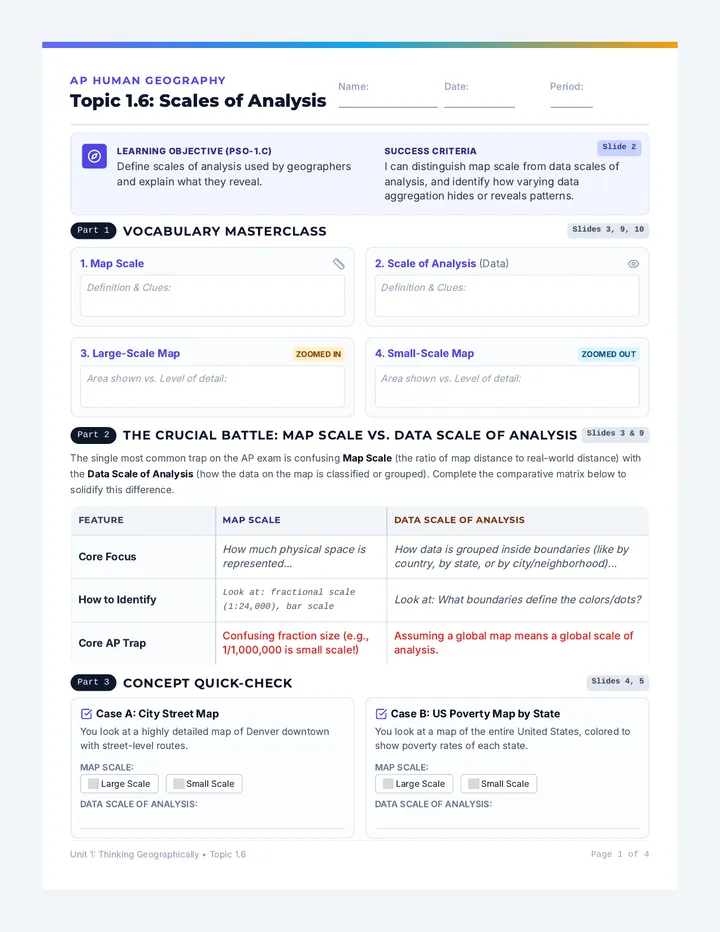
Unit 1: Human Geography & Historical Skills
WH.H.1 / WH.G.1
Key Target: Sourcing primary materials; spatial mapping of environmental barriers and resources.
Unit Hook: The Artifact Bureau
Hand students a sealed envelope containing four "clues" from an anonymous individual from 1926 (a transit receipt, a handwritten shopping list, a scrap of a physical map, and a vintage photo). Challenge student groups to determine their geographic origin, migration route, and social class. Use this to introduce sourcing, bias, context, and spatial geography.
Unit 2: Regional Interconnectedness (Middle Ages)
WH.H.2 / WH.E.1
Key Target: Tracking global exchange networks and analyzing decentralized power structures.
Unit Hook: The Feudal Guild Contract
Assign students structural roles upon entering (Monarchs, Nobles, Knights, Peasants) and distribute asymmetrical resources (e.g. colored tokens). Peasants must negotiate and sign formal protective alliances with Knights and Nobles in exchange for labor. Instantly models feudalism's mutual obligations and social hierarchies.
Unit 3: Renaissance & Reformation
WH.H.3 / WH.C.1
Key Target: Tracing the shift to humanism; assessing technology's power to decentralize institutions.
Unit Hook: The Censored Scriptorium
Have five students laboriously copy a long text by hand, while one student uses an "instant printing press" (a simple copier or pre-made stamp) to produce 50 copies in seconds. Ask the class: "If you were the reigning monarch, how does this new invention threaten your divine authority?" Discuss censorship and religious reform.
High School World History Planning Resource Page 1 of 4
World History Teacher Guides
Global Interconnections & Ideological Shifts
SECTION II
Unit 4: Global Exploration & Exchange
WH.H.4 / WH.G.2
Key Target: Evaluating demographic collapse and economic mercantilist models.
Unit Hook: The Spice Speculation
Pass around small jars of whole spices (cinnamon, cloves, nutmeg) and have students guess their identity. Reveal their historical price points—often matching their weight in gold. Discuss how sensory desires drove kingdoms to fund dangerous oceanic voyages, reshaped global mapping, and led to the exploitation of populations.