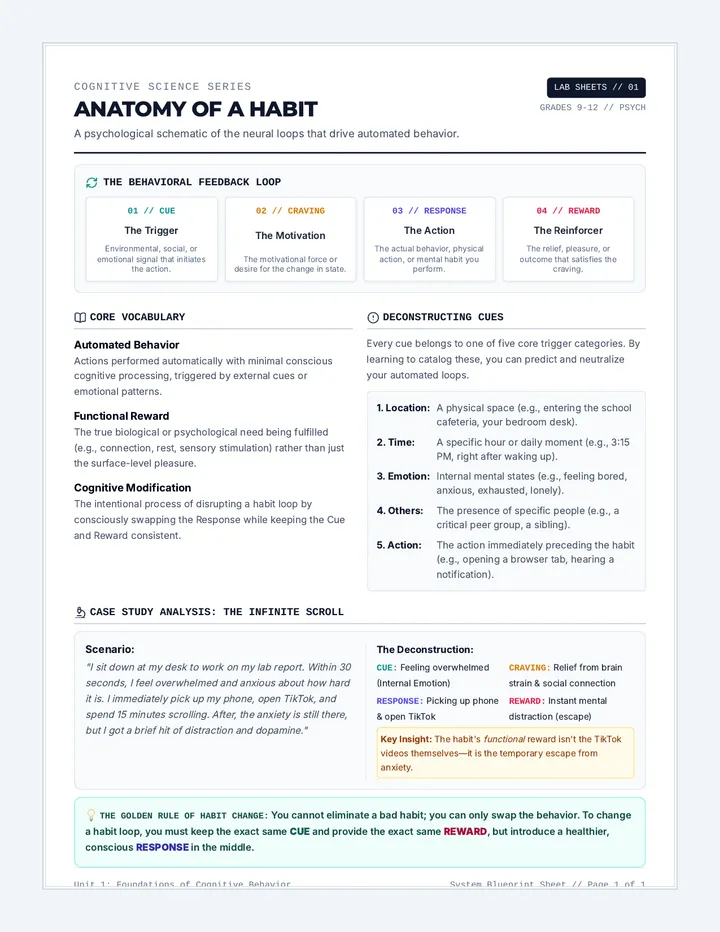
An introductory lesson on the Trait Approach to personality, guiding students through key definitions, major theorists (Allport, Cattell, Eysenck), the Big Five model, and the real-world applications and limitations of trait theory.
A comprehensive lesson exploring the transition from the roaring optimism of the 1920s to the structural causes of the Great Depression, including the agricultural crisis, income inequality, global trade collapse, and the 1929 stock market crash.
An empathy-driven, systemic lesson for young teens (grades 7-9) exploring the realities of homelessness. Students dismantle stereotypes, examine structural causes of housing insecurity, learn to support peers discretely, and identify concrete avenues for local service and advocacy.
A high school lesson where students collaborate to design a tabletop card game centered on real-world ethical choices, applying game theory, logical reasoning, and creative writing to balance competing moral priorities.
An exploration of the core differences and connections between Ancient Greece and Ancient Rome. This lesson focuses on comparative analysis across political, economic, geographic, and cultural structures, helping students understand how these two titans shaped Western Civilization.
A comprehensive AP US History research and presentation project exploring the Civil War. Students engage in deep historical inquiry using AP-aligned skills including contextualization, comparative analysis, and continuity and change over time.
An introductory US History lesson bridging the World History Age of Enlightenment with the founding of the United States. Students explore how radical European ideas crossed the Atlantic to spark a constitutional republic through a historical narrative, text-based writing, matching, short-answer questions, and a thematic word hunt.
An AP U.S. History unit investigating the critical events of the 1850s that tore the Union apart. Students examine causation, sectionalism, and the inevitability of the Civil War through primary source analysis and presentation of historic clues.
A 10th-grade social studies stations activity investigating the Constitutions of 1791, 1793, and 1795. Students analyze how France repeatedly drafted and revised its foundational laws in a turbulent quest for a more democratic society.
Session 7 du passeport PFMP. Les élèves découvrent comment l'agriculture calédonienne s'adapte aux préoccupations environnementales océaniennes (sol, eau, biodiversité, déchets).
Session 6 du passeport PFMP. Les élèves réfléchissent aux compétences qu'ils aimeraient développer ou améliorer et découvrent les perspectives de formation et d'évolution de carrière.
Session 5 du passeport PFMP. Les élèves découvrent et identifient les compétences requises (savoirs, savoir-faire techniques, savoir-être) pour exercer l'emploi observé.
Session 4 du passeport PFMP. Les élèves découvrent les droits, les devoirs du salarié et du stagiaire, ainsi que les règles du Code du travail de Nouvelle-Calédonie et la sécurité.
Session 3 du passeport PFMP. Les élèves apprennent à identifier les conditions réelles de travail, à analyser les contraintes d'un poste agricole et à apprécier ses atouts.
Session 2 du passeport PFMP. Les élèves apprennent à identifier l'organigramme de l'entreprise, à repérer leur maître de stage et à comprendre les fonctions et attributions de chaque salarié.
Session 1 du passeport PFMP. Les élèves apprennent à identifier et à décrire le contexte géographique, sectoriel et juridique de leur entreprise d'accueil en Nouvelle-Calédonie.
A cohesive morning routine framework designed to engage students immediately upon entering the classroom. This lesson integrates daily administrative templates with historical quote analysis, map literacy, and current events discussions to prime students' minds for social studies learning.
A comprehensive classroom simulation and analysis lesson about the assassination of Julius Caesar. Students examine historical perspectives, engage with primary sources, and debate civic duty through a mock trial and a three-page investigative document.
A grade 11 history and SEL lesson examining global trade, local labor, and economic interdependence. Students analyze complex global scenarios using multi-perspective lenses and cultural competence.
A comprehensive 5-day history unit exploring the Age of Exploration, cultural exchanges, technological innovations in navigation, the Transatlantic Slave Trade, and encounters with East Asian empires.
An in-depth exploration of the factors that drove European powers to seek new trade routes, introducing the GREASES framework for historical analysis of global expansion.
A comprehensive study bundle designed for high school students preparing for the Iowa-required civics exam. The materials use chunked information, visual aids, and scaffolded structures to support rote memorization, quick recall, and structured independent study of the official 100 citizenship questions.
A deep dive into the structural principles of the U.S. Constitution, focusing on separation of powers, checks and balances, and federalism, culminating in a standards-aligned unit assessment.
A close analytical reading of the Declaration of Independence and the original United States Constitution, detailing the historical grievances and the structural compromises of early American nation-building.
An analysis of early American regional geography, resource distribution, and economic systems, investigating how physical geography shaped the development of distinct Northern, Middle, and Southern colonial societies.
An exploration of how European Enlightenment thinkers like John Locke and Baron de Montesquieu, along with historic English documents like the Magna Carta, shaped early American beliefs about government and individual liberty.
A comprehensive lesson investigating redistricting, packing, and cracking to evaluate if legislative branches truly represent the will of the people. Includes a slide deck, a structured DBQ worksheet, a professional teacher guide, and an interactive exit ticket.
A service-learning and community activism lesson localized for Southern Oregon. Students explore the spectrum of community impact, brainstorm local issues, and research a self-selected cause using guided organizers.
An 8th-grade civics lesson detailing the long fight for voting rights from the Seneca Falls Convention to the Civil Rights Movement and the 26th Amendment. Students participate in a hands-on Cut-and-Paste Sorting Activity analyzing constitutional amendments and protest strategies.
A collaborative research lesson on WWII Pacific battles. Students work in intelligence teams to analyze military strategy, island-hopping, and geographical barriers, exploring how these battles shifted momentum and led to the atomic bomb decision.
A lesson centered on the landmark civil rights case Tape v. Hurley (1885), examining the Tape family's fight for public education in San Francisco and its historical links to Mendez v. Westminster and Brown v. Board of Education.
A high school/college level history and literature lesson focused on James Baldwin's documentary 'I Am Not Your Negro'. It examines literal comprehension and recall of key historical figures, events, and Baldwin's core arguments about race, media, and American identity.
A deep dive into Solomon Asch's classic conformity experiment, examining behavioral mechanisms, neural pathways of peer pressure, experimental design flaws, and quantitative data analysis.
An Honors US History gallery walk exploration of the Civil War home fronts, examining the social, economic, and political experiences of civilians, marginalized groups, and frontline medical pioneers.
The final quarter assessment and answer key covering New Jersey state government, Essex County government, Newark municipal structure, and contemporary local policy issues.
A Grade 10 History & SEL lesson focused on active listening and respectful communication during structured stakeholder dialogue about community environmental space use. Features a complete slide deck, a student worksheet, a teacher facilitation guide with scripts, and a self-reflective exit ticket.
A multi-faceted historical and geographical investigation of Europe, examining critical physical features and key crises from the Middle Ages to modern environmental challenges.
A lesson exploring Europe's geography, rich history, and modern institutions through a detailed reading passage and comprehension packet.
An engaging, high-energy classroom trivia game reviewing Topic 7 through Topic 10 of the Economics curriculum. Includes a visual slide deck with questions and answers, a student team answer sheet, and a detailed teacher facilitation guide.
An inquiry-based lesson exploring how the demographic crisis of the 14th-century Black Death disrupted feudal structures in Europe. Students analyze labor scarcity, roleplay economic shifts, and evaluate primary sources to understand how catastrophe led to working-class empowerment.
A lesson covering the outbreak of World War II, tracking the path from European invasions to the expansion in the Pacific and the attack on Pearl Harbor, based on historical lecture slides.
A lesson comparing the strategies and philosophies of major Black rights activists across three distinct eras: Abolitionism, the Jim Crow Era, and the Civil Rights Movement.
A highly scaffolded, SPED-accessible lesson exploring the pros and cons of gentrification from the perspective of an inner-city family. Features chunked readings, visual vocabulary, sentence starters, and structured discussions.
A scaffolded reading and vocabulary lesson about the history and significance of Memorial Day, designed specifically for High School ESL students at the Transitioning and Expanding proficiency levels. Includes an informational reading passage, vocabulary activities, and visual task cards.
Un programme de révision intensif et structuré sur 3 semaines pour préparer sereinement les épreuves de SVT, Physique-Chimie et Histoire-Géographie du Diplôme National du Brevet.
Planning de révision structuré sur 3 semaines pour préparer efficacement l'ensemble des matières du Brevet (Histoire-Géographie, EMC, Physique-Chimie et SVT).
Fiche de révision recto-verso sur les signaux physiques pour communiquer (signaux sonores, lumineux, ondes, vitesse de propagation, relation d = v x t, fréquence et hauteur d'un son).
Fiche de révision recto-verso sur l'énergie et ses conversions (énergie cinétique, potentielle, mécanique, sources et transferts d'énergie, circuits électriques, puissance et énergie électrique).
Fiche de révision recto-verso sur la mécanique (vitesse, mouvements rectilignes et circulaires, forces, modélisation des actions par des vecteurs, gravitation, poids et masse).
Fiche de révision recto-verso sur l'organisation et les transformations de la matière (atomes, ions, molécules, constitution, pH, réactions chimiques, combustion, métaux, solutions aqueuses).