Lenny.com
Explore
Create
ActivitiesNewMathEnglish Language ArtsScience & EngineeringSocial StudiesGlobal LanguagesHealth & Physical EducationSpecial EducationCounseling & Life SkillsArts & CreativityESL
Lenny.com
Lenny.com
Explore
Create
ActivitiesNewMathEnglish Language ArtsScience & EngineeringSocial StudiesGlobal LanguagesHealth & Physical EducationSpecial EducationCounseling & Life SkillsArts & CreativityESL
Lenny.com
Lenny.com

Solutions

Lenny for EducatorsLenny for SchoolsLenny for Districts

Product

ExploreSign inCreateSupportAbout

Resources

Getting startedMTSS Acceleration Program

© 2026 Lenny Learning Inc.

TermsPrivacyAccessibility
LinkedInInstagramX
Lenny
Science & EngineeringLife ScienceLiving ThingsAnimalsPlantsBody SystemsTraitsAdaptationsCellsEcosystemsHeredityGenes to TraitsCell DivisionPhysicsComparing MaterialsShapes and PropertiesMagnetsMagnetismLightSoundLight and SoundMatterStates of MatterChanges of StateMixturesPhysical and Chemical ChangeHeating and CoolingHeat and Thermal EnergyEnergyForce and MotionElectrical CircuitsAtoms and MoleculesPeriodic TableMotion in One DimensionMotion in Two DimensionsScalars and VectorsForces and Laws of MotionCircular Motion and GravityMomentum and ImpulseWork, Energy, and PowerWavesElectromagnetic WavesGeometric OpticsElectricity and MagnetismSimple Harmonic MotionThermodynamicsNuclear PhysicsEarth Science & AstronomyWeatherWater CycleRocks and MineralsFossilsEarth's FeaturesEarth's ResourcesEarth's StructureWeather and ClimateEarth EventsFossils and Geologic TimePlate TectonicsHuman ImpactsAstronomyChemistryUnits and MeasurementAtomic StructurePeriodic TrendsChemical BondingNomenclatureMolecular StructureIntermolecular ForcesThe MoleStoichiometryProperties of GasesSolutionsChemical ReactionsBalancing EquationsEnergy ChangesRates of ReactionsEquilibriumAcids and BasesQuantum ModelBiologyClassificationCell StructureThe Chemistry of LifeBiomoleculesCellular TransportCell EnergyCell Growth and DivisionDNAProtein SynthesisMeiosis and Sexual ReproductionPatterns of InheritanceMulticellular OrganismsEvolutionEcologyBiodiversityComputer ScienceAlgorithms and Computational ThinkingProgramming LanguagesComputing SystemsNetworks and InternetData AnalysisCybersecurityAI and Machine LearningSoftware Design and DevelopmentBlockchainEngineering & AIDesigning ExperimentsEngineering PracticesDesign ThinkingEngineering Design ProcessMechanical EngineeringElectrical EngineeringMaterials and StructuresCAD and 3D DesignRoboticsArtificial Intelligence BasicsVibe CodingMachine LearningAI Ethics and SocietySystems ThinkingEntrepreneurship & InnovationEntrepreneurial MindsetBusiness Idea DevelopmentBusiness Plan BasicsMarketing & Customer DiscoveryFinancial Management for Startups

Thermodynamics First Law

A comprehensive AP Physics 2 assessment and teacher scoring guide covering Topic 9.4: The First Law of Thermodynamics, including Ideal Gas Law applications, PV cycle analysis, and microscopic kinetic reasoning.

LWLucas Wickham

Thermodynamics First Law

A comprehensive AP Physics 2 assessment and teacher scoring guide covering Topic 9.4: The First Law of Thermodynamics, including Ideal Gas Law applications, PV cycle analysis, and microscopic kinetic reasoning.

LWLucas Wickham

Common Error: Misassigning signs yields \(Q = -700\text{ J}\) (Choice D) or \(+700\text{ J}\) (Choice C).

Question 6 Correct: (B)

Rationale: In the reference frame of the container, molecules collide elastically with the moving piston. Because the piston has inward velocity, particles rebound with increased speed, increasing average translational kinetic energy and macroscopic temperature.

Common Error: Attributing ideal gas temperature changes to intermolecular potential energy.

AP Physics 2 — Topic 9.4 Scoring Guidelines Page 1 of 3

Section II: Short Answer Scoring Rubrics & Solutions 9 Points Total

Question 7: Path Independence & State Functions [4 Points] Conceptual Justification

(a) Comparing \(\Delta U\) [2 Points]:

Answer: \(\Delta U_A = \Delta U_B\).

  • 1 pt: Stating that internal energy \(U\) is a state function that depends solely on equilibrium state variables (\(T\) or \(PV\)).
  • 1 pt: Explaining that both paths have the exact same initial state \(i\) and final state \(f\), making \(\Delta U\) identical regardless of path.

(b) Comparing \(W_{\text{on}}\) [2 Points]:

Answer: \(W_{\text{on}, B} < W_{\text{on}, A}\) (more negative).

  • 1 pt: Relating work done to the area under the curve on the \(PV\) diagram, noting that Path B has a strictly greater area.
  • 1 pt: Explaining that since the gas expands, work done on the gas is negative; greater expansion work by the gas means \(W_{\text{on}}\) is more negative.

Exemplary Student Response: "Internal energy is a state function that depends only on the current state \((P, V, T)\) of the gas. Since both Path A and Path B begin at the same state \(i\) and end at the same state \(f\), the net change is identical: \(\Delta U_A = \Delta U_B\). For work, the area under the curve on a \(PV\) diagram represents the work done by the gas. Path B remains at the high initial pressure before depressurizing, enclosing more area than the curved isotherm of Path A. Because both processes are expansions, work done on the gas is negative; therefore, \(W_{\text{on}, B}\) is more negative than \(W_{\text{on}, A}\) (\(W_{\text{on}, B} < W_{\text{on}, A}\))."

Question 8: Analytical Calculation & PV Graphing [5 Points] Quantitative & Graphical

Work Calculation [2 Points]:

\(W_{\text{on}, 1} = -P\Delta V = -(1.0 \times 10^5\text{ Pa})(3.0 - 1.0)\times 10^{-3}\text{ m}^3\)
\(W_{\text{on}, 1} = -(1.0 \times 10^5)(2.0 \times 10^{-3}) = -200\text{ J}\)

  • 1 pt: Correct formula and numerical substitution (\(P = 1.0\times 10^5\text{ Pa}\), \(\Delta V = 2.0\times 10^{-3}\text{ m}^3\)).
  • 1 pt: Correct magnitude (\(200\text{ J}\)) and explicit negative sign for work done on the gas.

PV Diagram Sketch [3 Points]:

  • 1 pt: A horizontal line segment at \(P = 1.0\times 10^5\text{ Pa}\) from \(V = 1.0\) to \(3.0\times 10^{-3}\text{ m}^3\) with an arrow pointing right.
  • 1 pt: A vertical downward line segment at \(V = 3.0\times 10^{-3}\text{ m}^3\) from \(P = 1.0\) to \(0.5\times 10^5\text{ Pa}\) with an arrow pointing down.
  • 1 pt: Correctly identifying and labeling the three states (or numbering 1, 2, 3).

Target Student Graph 1.0 0.5 1.0 2.0 3.0 State 1 State 2 State 3 Step 1: Isobaric | Step 2: Isochoric

AP Physics 2 — Topic 9.4 Scoring Guidelines Page 2 of 3

Section III: Free Response Question Detailed Rubric (14 Points)

AP Exam Format — Qualitative / Quantitative Translation & Thermal Cycle Analysis

14 Points Total

Part (a): Temperatures at A and B [3 Points] Ideal Gas Law

State A: \(T_A = \frac{P_A V_A}{nR} = \frac{(1.0\times 10^5\text{ Pa})(2.0\times 10^{-3}\text{ m}^3)}{(0.050\text{ mol})(8.314\text{ J/(mol}\cdot\text{K)})} = \frac{200}{0.4157} \approx 481\text{ K}\)

  • 1 pt: Valid substitution into \(PV = nRT\).
  • 1 pt: Correct answer for \(T_A \approx 481\text{ K}\) (accept 480–482 K).

State B: \(T_B = \frac{P_B V_B}{nR} = 3 \times T_A \approx 1443\text{ K}\) (accept 1440–1445 K).

  • 1 pt: Correct answer for \(T_B\).

Part (b): Work Done on the Gas [3 Points] Area Integration

Process \(B \to C\) [2 Points]: Area of trapezoid under linear curve: \(\text{Area} = \frac{P_B + P_C}{2}\Delta V = \frac{3.0\times 10^5 + 1.0\times 10^5}{2}(4.0\times 10^{-3}) = 800\text{ J}\). Gas expands \(\implies W_{\text{on}, B \to C} = -800\text{ J}\).

  • 1 pt: Correct trapezoid area calculation (800 J).
  • 1 pt: Correct negative sign for expansion work on gas.

Process \(C \to A\) [1 Point]: Isobaric compression: \(W_{\text{on}, C \to A} = -P\Delta V = -(1.0\times 10^5)(2.0 - 6.0)\times 10^{-3} = +400\text{ J}\).

  • 1 pt: Correct value and positive sign (\(+400\text{ J}\)).

Part (c): Thermodynamic Cycle Table Solution [4 Points] 1 pt per fully correct row

Process\(\Delta U\) (J)\(Q\) (J)\(W_{\text{on}}\) (J)Scoring Note / Derivation
\(A \to B\)+600+6000Isochoric: \(W=0\), \(\Delta U = \frac{3}{2}\Delta(PV) = \frac{3}{2}(400) = +600\text{ J}\)
\(B \to C\)0+800-800\(P_B V_B = P_C V_C = 600\text{ J} \implies \Delta T = 0 \implies \Delta U = 0\); \(Q = -W\)
\(C \to A\)-600-1000+400\(\Delta U = \frac{3}{2}(200 - 600) = -600\text{ J}\); \(Q = \Delta U - W = -600 - 400 = -1000\text{ J}\)
Full Cycle0+400-400State function: \(\sum\Delta U = 0\); \(W_{\text{net, by}} = \text{area of enclosed triangle} = +400\text{ J}\)

Part (d): AP Paragraph-Length Argument Rubric [4 Points] Scientific Argumentation

  • 1 pt (First Law Application): Clearly identifies that although work is done on the gas during compression (\(W_{\text{on}} = +400\text{ J}\)), heat is simultaneously released to the surroundings (\(Q = -1000\text{ J}\)).

  • 1 pt (Internal Energy & Temperature): Reasons that because \(|Q_{\text{released}}| > |W_{\text{done on}}|\), the net internal energy changes negatively (\(\Delta U = -600\text{ J}\)), requiring the temperature to decrease (\(T_C \to T_A\)).

  • 1 pt (Microscopic Collision Mechanism): Explains that while gas particles gain speed upon striking the inward-moving piston, they collide with cooler cylinder walls / cooling reservoir, transferring more kinetic energy away than gained from the piston.

  • 1 pt (AP Coherence & Structure): Connects macroscopic energy transfers to particle mechanics in an internally consistent, well-reasoned paragraph without contradiction.

Exemplary AP Paragraph Response: "The student's claim is incorrect because it accounts only for the mechanical work done on the gas while ignoring thermal energy transfer. According to the First Law of Thermodynamics, \(\Delta U = Q + W_{\text{on}}\). During the isobaric compression from \(C\) to \(A\), \(+400\text{ J}\) of work is performed on the gas. However, to maintain a constant pressure as the volume decreases by a factor of three, the gas must be cooled by removing \(1000\text{ J}\) of heat (\(Q = -1000\text{ J}\)). Because the magnitude of heat removed far exceeds the mechanical work done, the net change in internal energy is negative (\(\Delta U = -600\text{ J}\)), meaning the temperature drops from \(1443\text{ K}\) to \(481\text{ K}\). Microscopically, although gas molecules momentarily gain kinetic energy upon rebounding from the advancing piston, they continually collide with the cooler container walls and lose substantially more kinetic energy to the external thermal reservoir than they acquire from the moving piston. Consequently, the average translational kinetic energy of the molecules decreases, causing the temperature to decrease."

AP Physics 2 — Topic 9.4 Scoring Guidelines Page 3 of 3

You might also like

Helix Studio Slides

Candy Code Sequence

A multi-day competency-based biology sequence exploring DNA architecture, complementary base pairing, and semi-conservative replication through tactile candy modeling and evidence-based assessment.

TM

Teri Minami

6
Switch Mastery Slides

Switch Craft

A comprehensive adult learning unit exploring residential light switch wiring, circuit topology, and household electrical safety. Adult learners master single-pole and three-way switch mechanics, terminal identification, wire color standards, and strict zero-energy verification protocols.

JW

J Watson

5
Circuit Diagnostics Answer Key

Circuit Diagnostics Answer Key

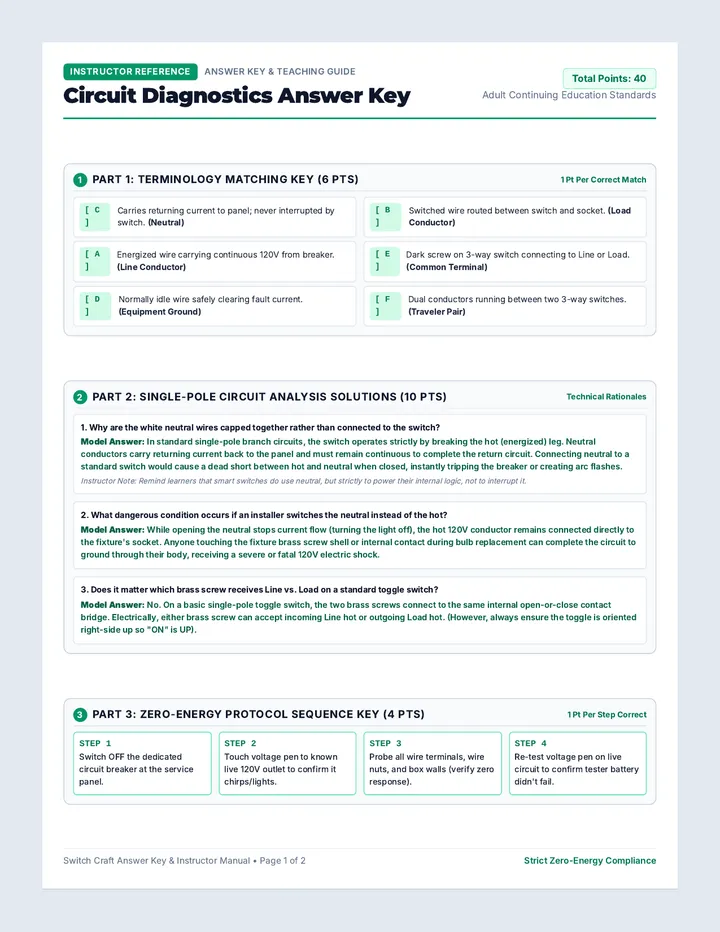
A comprehensive two-page instructor answer key and facilitation guide providing full solutions, electrical theory rationales, common adult misconceptions, and debrief notes.

JW

J Watson

Pesky Biters Slides

Bug Busters

A two-part fifth-grade science sequence investigating how insects can be annoying nuisances, bite and sting, and damage crops and homes. Specially scaffolded with high-visual supports, decodable text chunks, and guided practice for lower-literacy learners.

Lenny Avatar
Lenny
11
Food Web Lesson Plan

Food Web Detectives

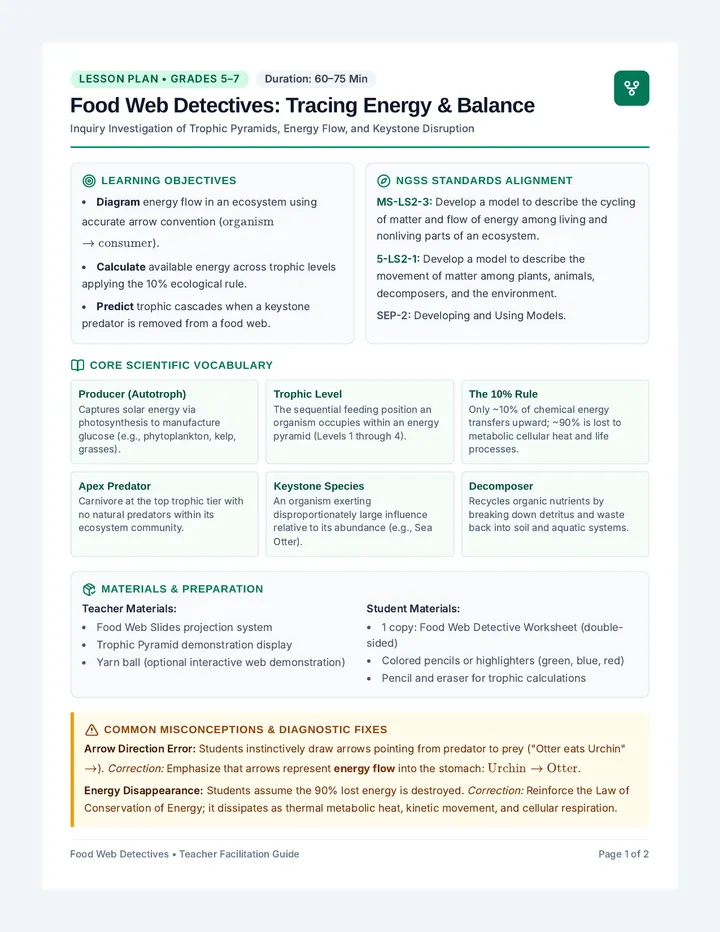
An inquiry-driven science lesson exploring trophic levels, energy transfer, and ecosystem stability for upper elementary and middle school learners. Students trace energy flow through food webs and investigate the ripple effects of keystone species disruption.

Lenny Avatar
Lenny
4
Circuit Diagnostics Worksheet

Circuit Diagnostics Worksheet

A two-page practical diagnostic worksheet for adult learners featuring circuit analysis problems, terminal identification, 3-way logic puzzles, and real-world troubleshooting scenarios.

JW

J Watson

Helix Studio Slides

Candy Code Sequence

A multi-day competency-based biology sequence exploring DNA architecture, complementary base pairing, and semi-conservative replication through tactile candy modeling and evidence-based assessment.

TM

Teri Minami

4
Cell Detectives Slides

Cell Detectives

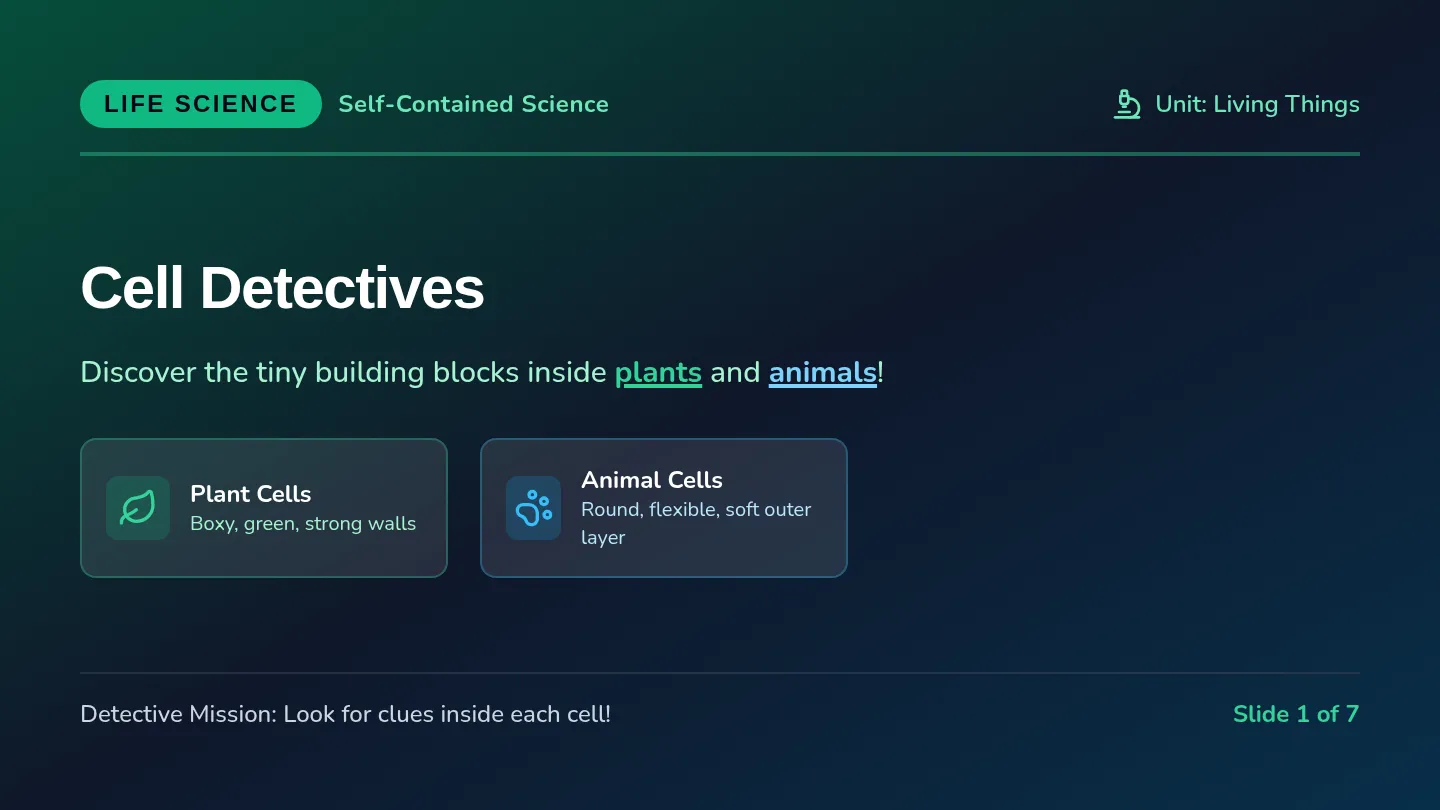
A foundational life science lesson introducing plant and animal cells for self-contained classrooms, featuring high-contrast visual diagrams, simple analogies, and hands-on matching.

CF

Carissa Fenner

4
Electrical Safety Handout

Electrical Safety Handout

A one-page safety and code reference sheet summarizing the 5-step zero-energy protocol, switch types comparison, terminology matrix, and crucial hazard red flags for adult DIYers.

JW

J Watson

Habitability Blueprint Slides

Life Beyond Limits

A one-week interdisciplinary astrobiology sequence investigating Earth's habitability, extreme biological adaptations across eleven Earth species, and the plausibility of life on other celestial bodies.

M

Megan.Tanner

7
Mendel Inheritance Matching Cards

Mendel Inheritance

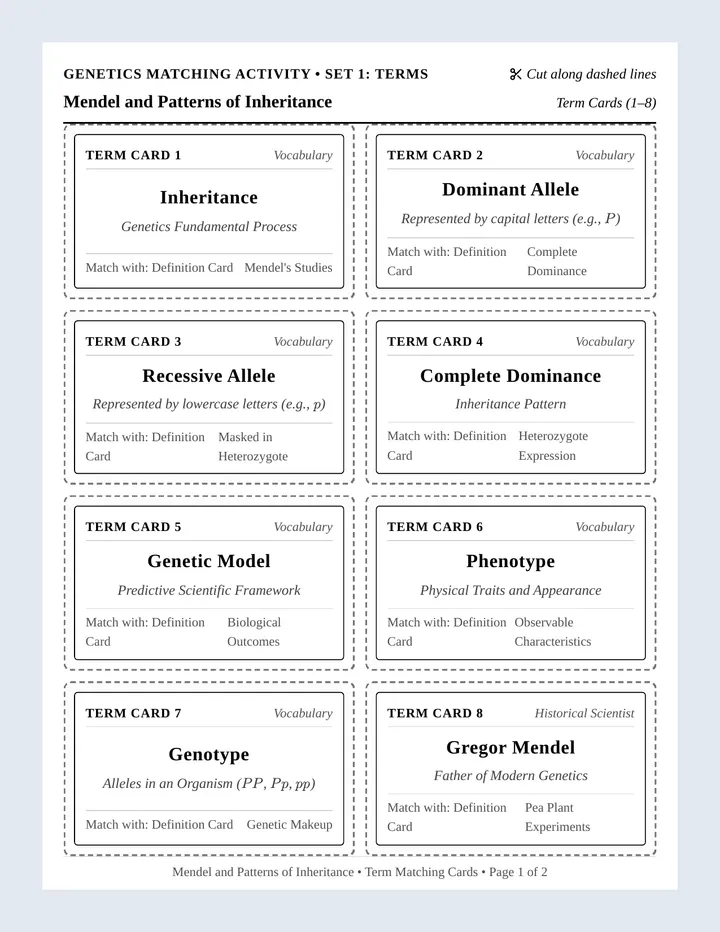
An introductory genetics lesson exploring Gregor Mendel's foundational pea plant experiments, inheritance patterns, allele types, genotype versus phenotype, and complete dominance.

MB

Marsha Bolden

4
Switch Wiring Field Guide

Switch Wiring Field Guide

A two-page printable bench manual featuring labeled visual schematics, terminal breakdowns, and plain-language wiring guides for single-pole and 3-way residential lighting circuits.

JW

J Watson