Storm Sentinel Slides
GRADE 5 STEM RESCUE MISSION • TEKS 5.8B & 4.8A
60-Minute Challenge
Emergency Engineering Directive
OPERATION STORM SENTINEL
Restore emergency signals, build closed circuits, and transfer energy across air and water to guide rescuers through the gale!
Role
Coastal Tech Squad
System
Closed Circuit Beacon
Physics Focus
Energy Transformations
Emergency Transmission // Cape Horizon
Phase 1 • Mission Briefing
Category 4 Storm Knocked Out Power at the Harbor!
Hurricane Zephyr took down Cape Horizon's main electrical generator. A rescue cutter is navigating through pitch-black fog and heavy waves toward rocky reefs.
The Problem:
The harbor foghorn and lighthouse are dark. The ship cannot see the entrance, and rangers on shore cannot detect rising wave surges!
Squad Objective
- Build a working circuit beacon with a switch from salvaged supplies.
- Transform electrical energy into light and sound or motion.
- Demonstrate energy transfer through water waves to detect surge danger.
"Engineers solve problems under pressure using what they have on hand!"
Science Briefing • TEKS 4.8A
Core Concept: Complete Circuits
What Makes an Electric Circuit Function?
Electrical energy can only flow in an unbroken, continuous loop known as a closed circuit.
1
Energy Source
Battery (Chemical → Electrical). Provides voltage push from negative to positive.
Component: Battery Cell
2
Conductor
Pathways that let electrons flow freely (copper wire, aluminum foil, steel clips).
Path: Metal Pathways
3
Electrical Load
Transforms electricity into useful energy forms: light (LED), sound (buzzer), motion (motor).
Receiver: LED / Buzzer / Motor
4
Switch (Controller)
Opens or closes the loop. Open = broken loop (OFF). Closed = complete loop (ON).
Control: Paperclip Switch
Crucial Check: If there is any gap, disconnect, or non-conductive insulator in the path, current stops instantly!
Science Briefing • TEKS 5.8B & 4.8A
Energy in Action
Transformations vs. Transfers
Key Rule: Energy is never created or destroyed — it transforms form and transfers across matter!
Energy Transformation (Changes Form)
Energy changes from one form to another within the circuit system:
Chemical (Battery) → Electrical (Current)
Electrical Energy → Light Energy (LED Beacon)
Electrical Energy → Mechanical Motion / Sound
Energy Transfer (Moves Through Matter)
Energy moves from one object or medium to another:
Objects in Motion
Moving motor arm or vibrating cup strikes water/air molecules.
Waves in Water
Kinetic energy radiates outward across the water surface as ripples.
Sound Waves in Air
Vibrations compress air particles, transferring energy to our ears.
Watch closely: Does the water travel across the room, or does the energy travel through the water?
Mission Parameters
Criteria & Materials Depot
Sentinel Build Criteria
1 Light Beacon: Must power an LED to produce a visible flash or steady beam.
2 Tactical Switch: Must have an easy ON/OFF control mechanism (no taping wires permanently!).
3 Wave Surge Coupling: Motion/vibration from your device must transfer energy to create visible ripples in a water cup!
4 Freestanding Tower: Unit must stand upright on its own base (craft sticks/cup).
Salvage Depot Supplies
1-2 AA / Coin Cells
1-2 LED Bulbs
Foil Strips / Wires
3 Metal Paperclips
Mini Buzzer or Motor
Water Basin / Cup
Craft Sticks & Tape
Blueprint Log
Remember: Long leg of the LED connects to the positive (+) battery terminal!
Phase 2 • 25-Minute Engineering Sprint
Build • Test • Refine
STEP 1 • 5 MIN
Schematic
Draw your circuit path on your Blueprint Log. Identify battery poles (+/-) and plan your switch location.
"Plan before you tape!"
STEP 2 • 10 MIN
Circuit Build
Connect battery, foil pathways, and load. Test the switch. Does the circuit close firmly? Does the LED shine?
"Check contact points!"
STEP 3 • 6 MIN
Wave Coupling
Attach your motion/sound element to the tower. Position near water basin. Can you see waves rippling across the surface?
"Energy transfers outward!"
STEP 4 • 4 MIN
Iteration
Fix loose connections. Strengthen the tower stand. Make your beacon shine brighter and trigger cleaner waves!
"Every engineer iterates!"
Troubleshooting Hotline
LED dark? Flip it 180 degrees. Switch loose? Press firmly with paperclip.
Squad Timer
25:00 REMAINING
Phase 3 • Inspection & Testing
10-Minute Verification Trials
Official Coast Guard Inspection Protocol
Test A: Optical Signal
Close the switch. Measure how far across the darkened room your beam can be seen.
Check: Chemical → Electrical → Light
Test B: Acoustic Wave
Place your ear 2 feet away. Can you feel or hear the sound vibrations moving through the air?
Check: Motion/Vibration → Sound Waves
Test C: Water Wave
Touch your vibrating/moving mechanism to the edge of the water basin. Observe the circular ripples!
Check: Kinetic Energy → Water Waves
Record in your Log: Did the water travel across the bowl, or did the energy travel across the bowl? (Hint: Watch a floating speck!)
Mission Accomplished
CER Debrief • Synthesis
Scientific Claim, Evidence & Reasoning
Engineers prove their solutions work using rigorous scientific evidence!
Claim (C)
State clearly how your team transformed electrical energy and transferred energy through waves to signal the rescue ship.
Evidence (E)
Give specific data: "When we closed the paperclip switch, the LED emitted bright yellow light and the motor produced 12 ripples per second."
Reasoning (R)
Apply the science law: "A closed circuit allowed electrons to flow, converting chemical energy into electrical, then radiant light and mechanical waves."
Rescue cutter safely docked in Cape Horizon Harbor!
Excellent Engineering, Squads!
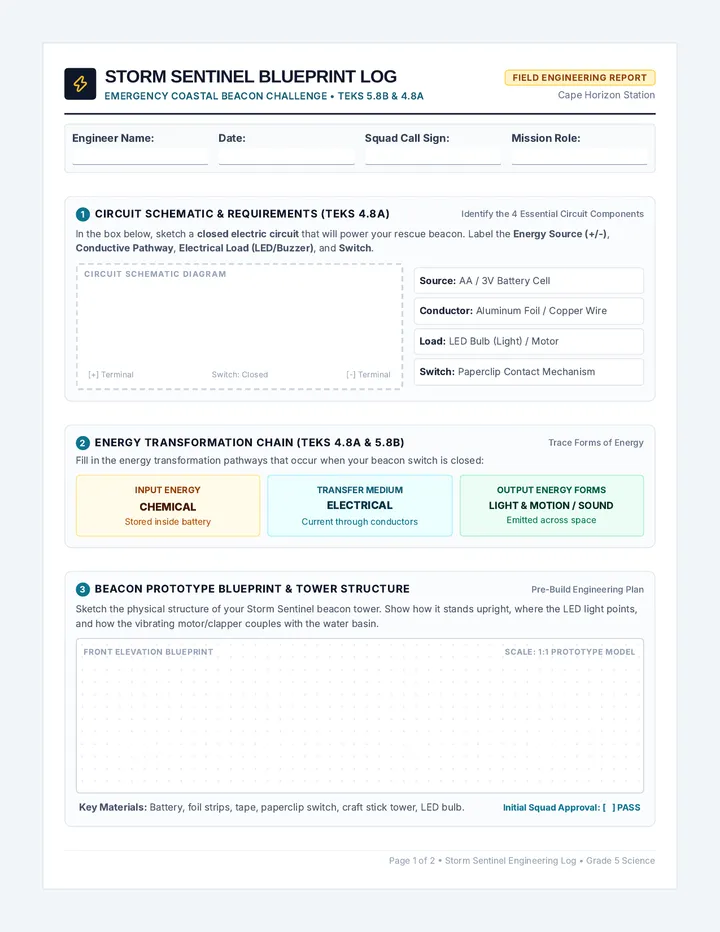
Storm Sentinel Blueprint Log
Storm Sentinel Blueprint Log
EMERGENCY COASTAL BEACON CHALLENGE • TEKS 5.8B & 4.8A
Field Engineering Report
Cape Horizon Station
Engineer Name:
Date:
Squad Call Sign:
Mission Role:
1 Circuit Schematic & Requirements (TEKS 4.8A)
Identify the 4 Essential Circuit Components
In the box below, sketch a closed electric circuit that will power your rescue beacon. Label the Energy Source (+/-), Conductive Pathway, Electrical Load (LED/Buzzer), and Switch.
Circuit Schematic Diagram
[+] Terminal Switch: Closed [-] Terminal
Source: AA / 3V Battery Cell
Conductor: Aluminum Foil / Copper Wire
Load: LED Bulb (Light) / Motor
Switch: Paperclip Contact Mechanism
2 Energy Transformation Chain (TEKS 4.8A & 5.8B)
Trace Forms of Energy
Fill in the energy transformation pathways that occur when your beacon switch is closed:
Input Energy
CHEMICAL
Stored inside battery
Transfer Medium
ELECTRICAL
Current through conductors
Output Energy Forms
LIGHT & MOTION / SOUND
Emitted across space
3 Beacon Prototype Blueprint & Tower Structure
Pre-Build Engineering Plan
Sketch the physical structure of your Storm Sentinel beacon tower. Show how it stands upright, where the LED light points, and how the vibrating motor/clapper couples with the water basin.
Front Elevation Blueprint Scale: 1:1 Prototype Model
Key Materials: Battery, foil strips, tape, paperclip switch, craft stick tower, LED bulb. Initial Squad Approval: [ ] PASS
Page 1 of 2 • Storm Sentinel Engineering Log • Grade 5 Science
Inspection Trials & Energy Transfer Analysis
Testing Protocol • TEKS 5.8B (Motion, Sound & Waves in Water)
Squad Call Sign:
4 Engineering Iteration Log (Design Modifications)
| Trial Run | Problem / Challenge Encountered | Engineering Solution / Fix |
|---|
| Trial 1: Circuit Test | | |
| Trial 2: Wave Coupling | | |
5 Energy Transfer Investigation Table (TEKS 5.8B)
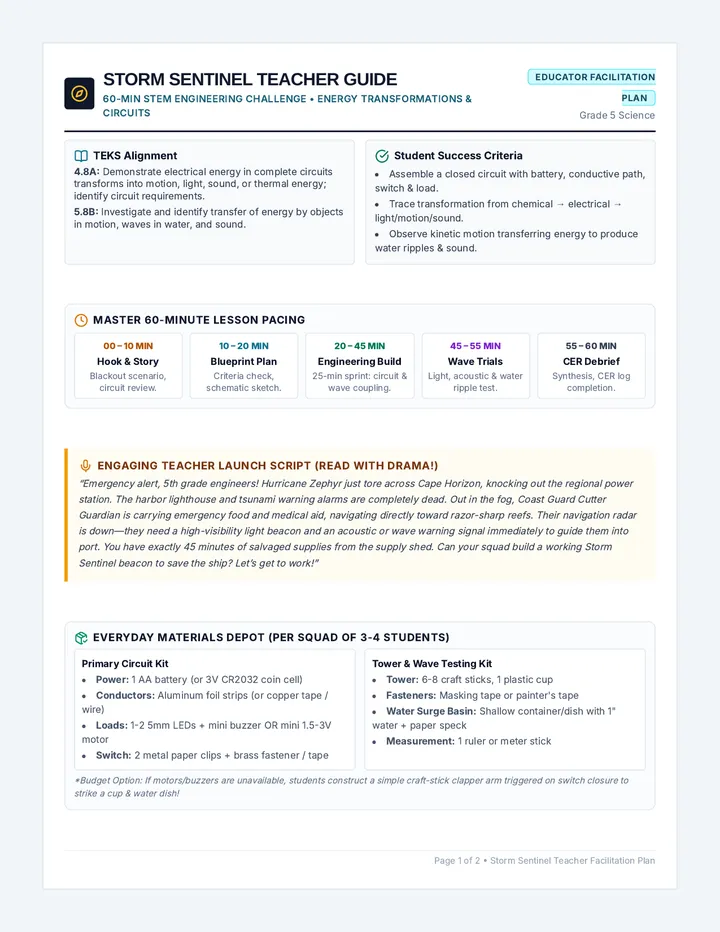
Storm Sentinel Teacher Guide
Storm Sentinel Teacher Guide
60-Min STEM Engineering Challenge • Energy Transformations & Circuits
Educator Facilitation Plan
Grade 5 Science
TEKS Alignment
4.8A: Demonstrate electrical energy in complete circuits transforms into motion, light, sound, or thermal energy; identify circuit requirements.
5.8B: Investigate and identify transfer of energy by objects in motion, waves in water, and sound.
Student Success Criteria
- Assemble a closed circuit with battery, conductive path, switch & load.
- Trace transformation from chemical → electrical → light/motion/sound.
- Observe kinetic motion transferring energy to produce water ripples & sound.
Master 60-Minute Lesson Pacing
00 – 10 MIN
Hook & Story
Blackout scenario, circuit review.
10 – 20 MIN
Blueprint Plan
Criteria check, schematic sketch.
20 – 45 MIN
Engineering Build
25-min sprint: circuit & wave coupling.
45 – 55 MIN
Wave Trials
Light, acoustic & water ripple test.
55 – 60 MIN
CER Debrief
Synthesis, CER log completion.
Engaging Teacher Launch Script (Read with Drama!)
“Emergency alert, 5th grade engineers! Hurricane Zephyr just tore across Cape Horizon, knocking out the regional power station. The harbor lighthouse and tsunami warning alarms are completely dead. Out in the fog, Coast Guard Cutter Guardian is carrying emergency food and medical aid, navigating directly toward razor-sharp reefs. Their navigation radar is down—they need a high-visibility light beacon and an acoustic or wave warning signal immediately to guide them into port. You have exactly 45 minutes of salvaged supplies from the supply shed. Can your squad build a working Storm Sentinel beacon to save the ship? Let’s get to work!”
Everyday Materials Depot (Per Squad of 3-4 Students)
Primary Circuit Kit
- Power: 1 AA battery (or 3V CR2032 coin cell)
- Conductors: Aluminum foil strips (or copper tape / wire)
- Loads: 1-2 5mm LEDs + mini buzzer OR mini 1.5-3V motor
- Switch: 2 metal paper clips + brass fastener / tape
Tower & Wave Testing Kit
- Tower: 6-8 craft sticks, 1 plastic cup
- Fasteners: Masking tape or painter's tape