Pumpkin Seed Sequence CardsKitchen Science & Life Skills Cleaning Pumpkin Seeds: Picture Cards Name: Date: Instructions: Cut out each picture card along the dashed lines. Inspect the clues, then arrange the steps in order! 6 Cards (Scrambled) Card A Running Water Rinse in the Colander Place seeds into a mesh strainer or colander and wash under cold running water to wash away slippery residue. Card B Big Metal Spoon Scoop from the Pumpkin Cut the pumpkin open and use a sturdy spoon or your hands to scrape the gooey seeds and pulp out into a bowl. Card C Water Bowl Trick Seeds Float! Pulp Sinks! Soak in a Bowl of Water Dump the mixture into a deep bowl of cold water. Because of trapped air, the seeds float up while heavy pulp sinks! Card D Absorb Moisture Pat dry completely! Pat Completely Dry Spread wet seeds in a single layer on clean dish towels or paper towels. Press gently to absorb every drop of moisture. Card E Finger Separation Discard Pulp Separate Strings with Fingers Use your fingers to gently pull clinging orange fibrous strings off the seeds. The slimy strings hold too much water! Card F Season & Roast Ready to Bake! Spread & Season on Tray Spread the dry seeds evenly onto a baking sheet. Toss with a drizzle of oil and a pinch of salt, ready to roast in the oven! Tip for Detectives: Look closely at how wet, gooey, or dry the seeds look in each picture to deduce the natural order! Sequencing Storyboard Mat Pumpkin Seed Cleaning Storyboard Name: Date: Mission: Match each letter (Card A through F) into the correct chronological box. Use the transition words to retell the steps! 1 First Card: What action starts the process? Key tool: Spoon / Hands 2 Next Card: How does water help separate? Key clue: Seeds float to top 3 Then Card: What must fingers untangle? Key clue: Orange pulp strings 4 After That Card: Where do seeds get rinsed? Key tool: Mesh strainer/colander 5 Next Card: How do we remove water? Key clue: Towel single layer 6 Finally Card: How are seeds prepared to bake? Key tool: Baking tray & oil Pumpkin Science & Chef Questions 1. Buoyancy: Why do seeds float in water while pumpkin pulp sinks to the bottom? 2. Kitchen Prep: Why is it important that seeds are bone-dry before putting them in the oven? Action Word Bank: Scoop Submerge Untangle Rinse Pat Dry Season
Roasted Seed Recipe GuideVisual-First & Deaf-Accessible Recipe All Visual & Tactile Cues • No Audio Needed How to Cook Pumpkin Seeds: Visual Roasting Guide Oven Dial 300°F (150°C) Visual Timer Flash / Vibrate Alert Stir Point At 15 Minutes Total Time 25–30 Mins Deaf & Hard-of-Hearing Sensory Checks (100% Visual & Tactile) Sight: Color Test Turn on the oven light and look through the glass window. Seeds change from chalk-white to a warm golden-honey with toasted edges. Touch: Snap Test Take 1 seed off tray, let cool 60 seconds, then pinch between your thumb and index finger. It should snap crisply rather than bend. Visual / Vibrate Alert Set a smartphone or smartwatch countdown timer with strobe flash or strong vibration set at 15 min (stir) and 25 min (done). 5 Steps to Golden, Crunchy Seeds 1 Preheat Oven & Line Baking Sheet Set: 300°F (150°C) Check the digital oven display. Line a metal baking sheet with parchment paper to prevent sticking. 2 Dry the Seeds 100% (Touch Check) Tactile Test Spread seeds on a clean towel and pat with paper towels. Rub between fingers: they must feel dry and papery, not slippery! 3 Coat with Oil & Seasonings Visual Shine Place seeds in a bowl. Add 1 tbsp oil + ½ tsp salt. Toss with spoon until every single seed has a glossy, reflective shine. 4 Spread Flat in a Single Layer Visual Pattern Pour onto the baking sheet. Spread seeds flat so no seeds stack on top of each other. Hot air must touch all edges. 5 Bake, Stir at 15 Mins, & Cool Bake 25–30 Mins Bake for 25–30 mins. At vibration alert (15 mins), stir with spatula. When golden, remove and let cool 10 mins to lock in crispness. The Flavor Lab: Mix & Match Spice Blends Per 1 Cup of Seeds Classic Salty Sea Salt & Pepper 1 tbsp Olive Oil ¾ tsp Sea Salt ¼ tsp Black Pepper Savory Garlic Garlic & Paprika 1 tbsp Olive Oil ½ tsp Garlic Powder ½ tsp Smoked Paprika Sweet Cinnamon Cinnamon Sugar 1 tbsp Melted Butter 1 tbsp Brown Sugar ½ tsp Cinnamon
Pumpkin Seed Answer KeyEducator & Self-Check Key Pumpkin Seed Sequencing: Answer Key Correct Order: B → C → E → A → D → F Chronological Step Solutions & Visual Identifiers 1 Card B Scoop Seeds & Pulp Visual Clue: Cut pumpkin cavity, silver spoon scraping gooey pulp out into bowl. 2 Card C Float in Water Bowl Visual Clue: Seeds float at water surface while dense orange pulp strands sink to bottom. 3 Card E Pull Away Stringy Pulp Visual Clue: Hands pulling apart slimy orange fibers from smooth clean seeds. 4 Card A Rinse in Colander Visual Clue: Running water pouring from faucet through seeds in a perforated strainer. 5 Card D Pat Dry on Towel Visual Clue: Seeds spread flat across striped cloth with paper towel pressing down. 6 Card F Season on Baking Tray Visual Clue: Dry seeds on rimmed cookie sheet drizzled with olive oil and salt crystals. Storyboard Science Questions: Model Answers 1. Why do seeds float while pulp sinks? Key Concept (Buoyancy): Pumpkin seeds have miniature air pockets inside their protective outer hull, making them less dense than water (they float). Pumpkin pulp contains heavy water-dense vegetable fibers with no trapped air, so it sinks to the bottom. 2. Why must seeds be completely dry before baking? Key Concept (Evaporation vs. Steam): Residual water creates steam in the oven, which makes the shells soggy and rubbery. When seeds are bone-dry, the oil directly conducts dry heat to caramelize sugars and produce a crisp, crunchy bite. Visual Kitchen Signs & Gestures (Deaf-Accessible Reference) ASL / Visual Gestures 1. SCOOP How: Cup your hand into a spoon shape. Dig forward and curve up twice into an imaginary bowl. 2. FLOAT How: Sign 'W' at chin (Water), then hold flat palm face-down and rock it gently on top of the surface. 3. RINSE How: Cup both palms upward together like a strainer basket. Rub fingers in circles under the faucet stream! 4. PAT DRY How: Swipe curved index finger across chin (sign DRY), then pat flat palms downward gently on towel.
Pumpkin History Timeline HandoutAgricultural & Cultural History Pumpkin Time Machine: 1800 to 2000 Name: Date: 200 Years of Change: Discover how pumpkins evolved from humble farm sustenance into jack-o'-lanterns, canned pies, and 1,000-pound champions! 1820 Folklore Icon Sleepy Hollow Legend Author Washington Irving publishes The Legend of Sleepy Hollow. The pumpkin becomes an American cultural legend after the Headless Horseman famously hurls one at Ichabod Crane! Significance: First major American pumpkin story in books. 1850s Jack-o'-Lanterns Turnips Become Pumpkins Irish immigrants fleeing famine arrive in America. In Ireland, they carved scary faces into hard root turnips. In America, they discover native pumpkins are softer, bigger, and far easier to carve! Significance: Born of the modern Halloween pumpkin tradition! 1890s Farm Breeding The Great Pumpkin Split Farmers and seed breeders intentionally separate pumpkin breeds: sweet, thick-fleshed Sugar Pie pumpkins for baking, and hollow, thin-walled Connecticut Field pumpkins for carving and seed roasting. Significance: Distinct carving pumpkins vs. baking pumpkins emerge. 1929 Factory Innovation Canned Pumpkin Capital Libby's opens its canning plant in Morton, Illinois, perfecting Dickinson pumpkin puree. Morton becomes known as the "Pumpkin Capital of the World," supplying over 85% of North America's canned pumpkin! Significance: Pumpkin pie becomes a fast holiday staple in every home. 1959 Pop Culture The Great Pumpkin Patch Charles Schulz features Linus waiting in the pumpkin patch for "The Great Pumpkin" in the Peanuts comic strip. Families begin traveling to rural farms every October to pick their own pumpkins directly off the vine! Significance: Launch of modern fall pumpkin patch farm tourism. 1979–1996 World Records The 1,000-Pound Barrier Howard Dill patents the Atlantic Giant pumpkin seed in Nova Scotia (1979). Competitive weigh-offs erupt across the globe. In 1996, the world record shatters 1,000 lbs (1,061 lbs by Nathan Zehr)! Significance: Giant pumpkin growing becomes an international science sport. Evolution Summary: Year 1800 vs. Year 2000 Year 1800: Winter Survival Food Grown as livestock feed (cows and pigs) and stored in cellars. No Halloween carving; dried pumpkin strips cooked in stews.
Pumpkin Size Sorting ActivityMath & Science Measurement Lab Pumpkin Size & Scale: Sorting Lab Name: Date: Mission: Compare 5 real pumpkin varieties from tiny minis to 1,000-lb monsters. Measure, sort, and discover the seed mystery! Visual Size Spectrum: Smallest to Largest Notice the proportional scale below! Mini Jack-Be-Little 0.5 lbs (8 oz) Width: ~3 inches Seeds: ~50 tiny seeds Best: Table decor Small Sugar Pie 3 – 5 lbs Width: ~6–8 inches Seeds: ~200 sweet seeds Best: Baking pies Medium Field Carving 15 – 22 lbs Width: ~12–14 inches Seeds: ~500 big seeds Best: Carving & roasting Large Big Max 50 – 100 lbs Width: ~20–24 inches Seeds: ~800 jumbo seeds Best: Fair displays Monster Atlantic Giant 500 – 1,000+ lbs Width: 4 – 5 feet! Seeds: ~1,200 seeds Best: World contests! Part 1: Match the Pumpkin to the Job Write the correct pumpkin variety name in the blank box for each situation: A. You want to make a smooth, sweet Thanksgiving pie for 6 people. Best Choice: B. You want to carve a classic spooky jack-o'-lantern for your front porch. Best Choice: C. You want to compete in a county fair weigh-off and need a forklift to move it! Best Choice: D. You want a cute, pocket-sized pumpkin to set next to your classroom computer. Best Choice: Part 2: Hands-On Seed Measurement Lab Use Ruler Below! 0 in1 in2 in3 in4 in5 in6 in ||||||| 0 cm3 cm6 cm9 cm12 cm15 cm 1. Seed Length: 2. Seed Width: 3. Estimated Seed Total: 4. Actual Count: The Seed Mystery: An Atlantic Giant pumpkin is 2,000 times heavier than a mini pumpkin, but its seeds are only 2 times larger! The rest of the giant weight is pure water and cellular flesh! Scale Mystery!
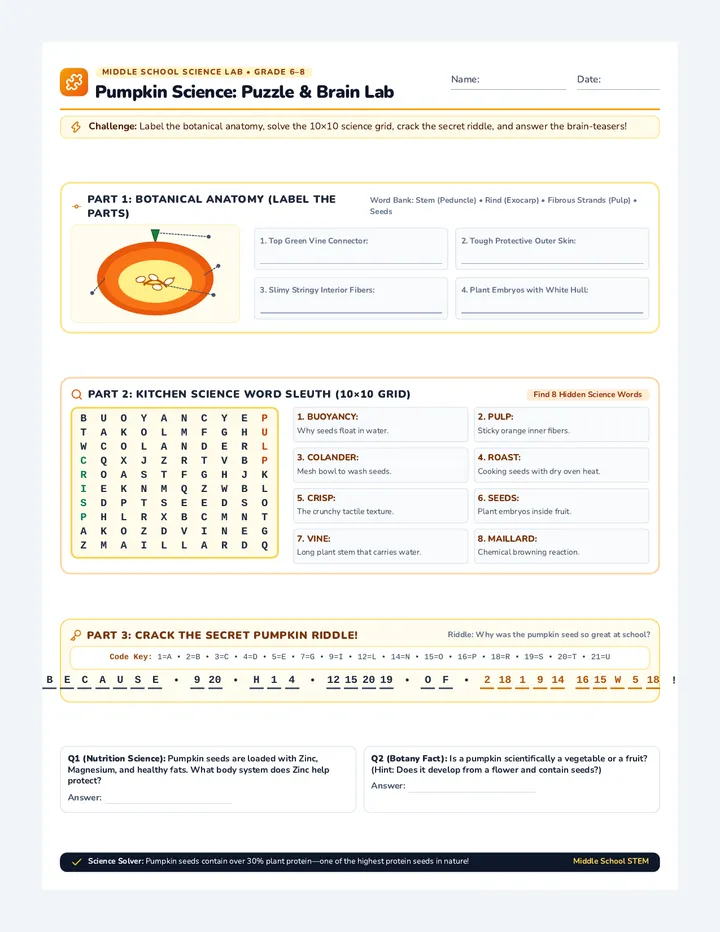
Pumpkin Science Puzzle WorksheetMiddle School Science Lab • Grade 6–8 Pumpkin Science: Puzzle & Brain Lab Name: Date: Challenge: Label the botanical anatomy, solve the 10×10 science grid, crack the secret riddle, and answer the brain-teasers! Part 1: Botanical Anatomy (Label the Parts) Word Bank: Stem (Peduncle) • Rind (Exocarp) • Fibrous Strands (Pulp) • Seeds 1. Top Green Vine Connector: 2. Tough Protective Outer Skin: 3. Slimy Stringy Interior Fibers: 4. Plant Embryos with White Hull: Part 2: Kitchen Science Word Sleuth (10×10 Grid) Find 8 Hidden Science Words BUOYANCYEP TAKOLMFGHU WCOLANDERL CQXJZRTVBP ROASTFGHJK IEKNMQZWBL SDPTSEEDSO PHLRXBCMNT AKOZDVINEG ZMAILLARDQ 1. BUOYANCY: Why seeds float in water. 2. PULP: Sticky orange inner fibers. 3. COLANDER: Mesh bowl to wash seeds. 4. ROAST: Cooking seeds with dry oven heat. 5. CRISP: The crunchy tactile texture. 6. SEEDS: Plant embryos inside fruit. 7. VINE: Long plant stem that carries water. 8. MAILLARD: Chemical browning reaction. Part 3: Crack the Secret Pumpkin Riddle! Riddle: Why was the pumpkin seed so great at school? Code Key: 1=A • 2=B • 3=C • 4=D • 5=E • 7=G • 9=I • 12=L • 14=N • 15=O • 16=P • 18=R • 19=S • 20=T • 21=U B E C A U S E • 9 20 • H 1 4 • 12 15 20 19 • O F • 2 18 1 9 14 16 15 W 5 18 ! Q1 (Nutrition Science): Pumpkin seeds are loaded with Zinc, Magnesium, and healthy fats. What body system does Zinc help protect? Answer: Q2 (Botany Fact): Is a pumpkin scientifically a vegetable or a fruit? (Hint: Does it develop from a flower and contain seeds?) Answer: Science Solver: Pumpkin seeds contain over 30% plant protein—one of the highest protein seeds in nature!