TR Reformer Guide TR Reformer Guide
Teacher Instructional Resource
Standard: US.17
30-Minute Lesson Plan
Objective
Students will analyze the significant progressive achievements of Theodore Roosevelt’s administration, focusing on the Square Deal, trust-busting, consumer protection, and conservation.
Essential Question
How did Theodore Roosevelt use the power of the federal government to transform American life?
Key Vocabulary
Progressivism: Reform movement to fix industrial-era problems.
Square Deal: TR's policy of fairness for all.
Arbitration: Settling disputes via a third party.
Lesson Pacing (30 Minutes)
0-5m
Hook & Context
Discuss the "Bull Moose" persona. Ask: "If a company sells you bad food, who should fix it: the company, the state, or the President?"
5-15m
Direct Instruction (Square Deal Slides)
Walk through the achievements. Ensure students are completing the Progressive Power Notes as you go.
Focus on the "Three Cs" of the Square Deal.
Differentiate between "Good" and "Bad" trusts.
15-30m
Geographic Awareness (Wilderness War Activity)
Students use the Wilderness War Activity to analyze human-environment interaction (SSP.06).
Compare the Newlands Act (altering nature for human use) vs. the Forest Service (protecting nature from human abuse).
Lead a final synthesis discussion on "managing nature for humans."
Pro-Tips for Delivery
SSP.06 Spotlight
Emphasize how conservation shifted humans from exploiters to stewards. Use the western irrigation projects as a prime example of humans physically changing the Earth.
The Jungle Connection
Briefly mention Upton Sinclair's book. TR read it and was so disgusted he pushed for the Meat Inspection Act immediately.
Square Deal Slides US.17 Standard
Rough Rider Reforms
Theodore Roosevelt's Progressive Achievements
"A square deal for every man"
Speech at Springfield, IL (1903)
https://www.theodorerooseveltcenter.org
The Square Deal
Corporations
Control big business and prevent monopolies through "Trust-Busting."
Consumers
Protect public health with food and drug safety laws.
Conservation
Protect natural resources and create National Parks.
Trust-Busting
"We do not wish to destroy corporations, but we do wish to make them subserve the public good."
Theodore Roosevelt, First Annual Message (1901)
https://tucson.com/opinion/roosevelt-first-annual-message/article\_0e683348-18e3-5c74-89d3-57c2c9d0d347.html
Distinction
Differentiated between "Good Trusts" (efficient) and "Bad Trusts" (greedy/unfair).
Northern Securities
TR successfully sued J.P. Morgan’s railroad monopoly in 1904.
Consumer Protection
The Jungle
Upton Sinclair’s novel exposed horrific conditions in meatpacking.
Source: Sinclair, U. (1906). The Jungle. Doubleday, Page & Co.
TR read it and acted immediately.
New Law!
Meat Inspection Act (1906)
Mandated strict sanitary requirements for meatpackers.
Pure Food & Drug Act (1906)
Halted the sale of contaminated foods; called for Truth in Labeling.
Support for Conservation
"The preservation of our natural resources is the fundamental problem."
TR, Annual Message to Congress (1907)
https://www.presidency.ucsb.edu/node/206001
148M Acres Saved
50+ Refuges Set
National Parks & Forests
Established the U.S. Forest Service in 1905 with Gifford Pinchot as lead.
Newlands Reclamation Act (1902): Federal funding for western irrigation projects.
The TR Legacy
Roosevelt significantly expanded the power of the Presidency to ensure a fair deal for the American public.
Protection
Regulation
Preservation
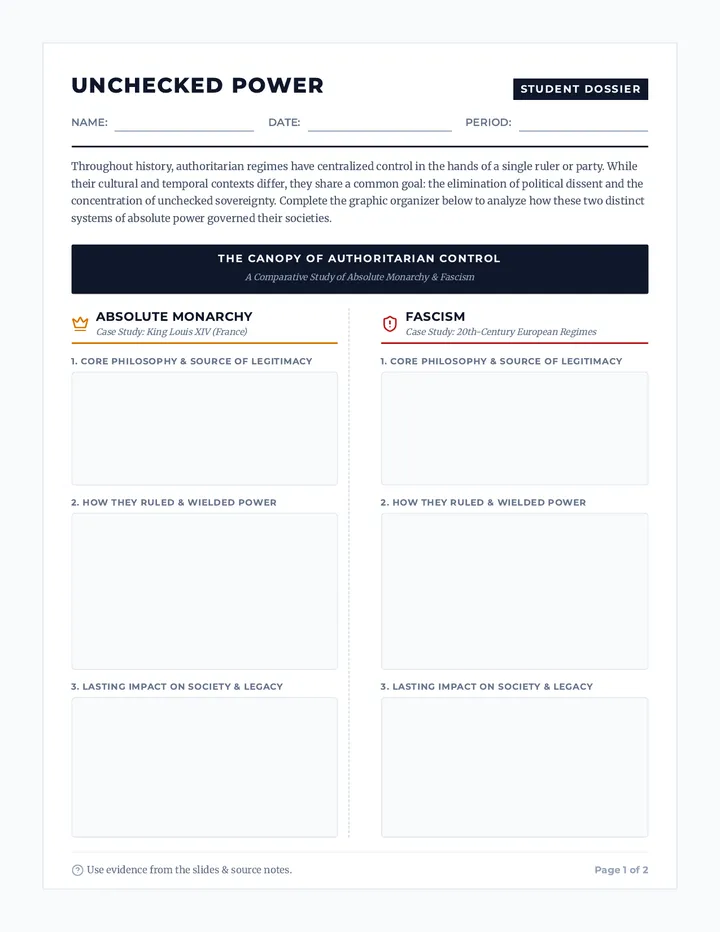
Progressive Power Notes Progressive Power Notes
TR'S SQUARE DEAL & REFORMS (US.17)
NAME:
DATE:
Essential Question
How did Theodore Roosevelt use federal power to create a "Square Deal" for the American public?
1. The Three Cs of the Square Deal
Roosevelt believed the federal government should provide fairness for everyone—labor, capital, and the public.
Control of __________________
Goal: Stop unfair monopolies and trusts.
________________ Protection
Goal: Ensure products are safe to eat/use.
________________ of Resources
Goal: Protect the wilderness from ruin.
2. Trust-Busting
TR differentiated between two types of trusts:
"Good" Trusts
Efficient, provided lower prices, and just needed federal ________________________.
"Bad" Trusts
Used unfair practices and hurt the public; these were ________________________.
Significant Case: In 1904, TR won a lawsuit against the __________________________________ Company, breaking up a major railroad monopoly.
3. Consumer Protection
Impact of "The Jungle":
Upton Sinclair exposed horrific conditions in the _____________________________ industry. TR was so disgusted he pushed for two new laws in 1906:
A. Meat Inspection Act: Mandated federal inspection and sanitation rules.
B. Pure Food and Drug Act: Required "Truth in Labeling" and banned contaminated food/drugs.
4. Support for Conservation
TR worked with Gifford Pinchot, the first head of the U.S. __________________ Service.
Set aside ____________ million acres of public land.
Established over 50 wildlife refuges.
Reflection
Which achievement of TR has the biggest impact on your life today? Why?
Wilderness War Activity Wilderness War Activity
SSP.06: Human-Environment Interaction
NAME: ________________________
PERIOD: _____
The Interaction Challenge
Theodore Roosevelt’s conservation policy wasn’t just about "saving trees." It was about managing the interaction between growing human populations and the physical environment.
1. Shaping the Earth
Newlands Reclamation Act (1902)
This law funded irrigation projects to turn "wastelands" into fertile farmland for settlers. Source: National Archives (Newlands Act of 1902) - archives.gov
A) How did humans change the physical environment through this act?
B) What was the intended benefit for the human population?
2. Restraining Consumption
U.S. Forest Service (1905)
Led by Gifford Pinchot, this agency managed millions of acres for sustainable use. Source: Forest Service History - fs.usda.gov/learn/history
A) How did the government restrict human interaction with these lands?
B) Why was this preservation necessary for the environment’s future?
The Synthesis
Roosevelt’s Conservation motto was "the greatest good for the greatest number in the long run."
Source: Gifford Pinchot, "The Fight for Conservation" (1910) - https://archive.org/details/fightforconserva00pinc
Do you think TR was more interested in protecting nature from humans, or managing nature for humans? Explain.
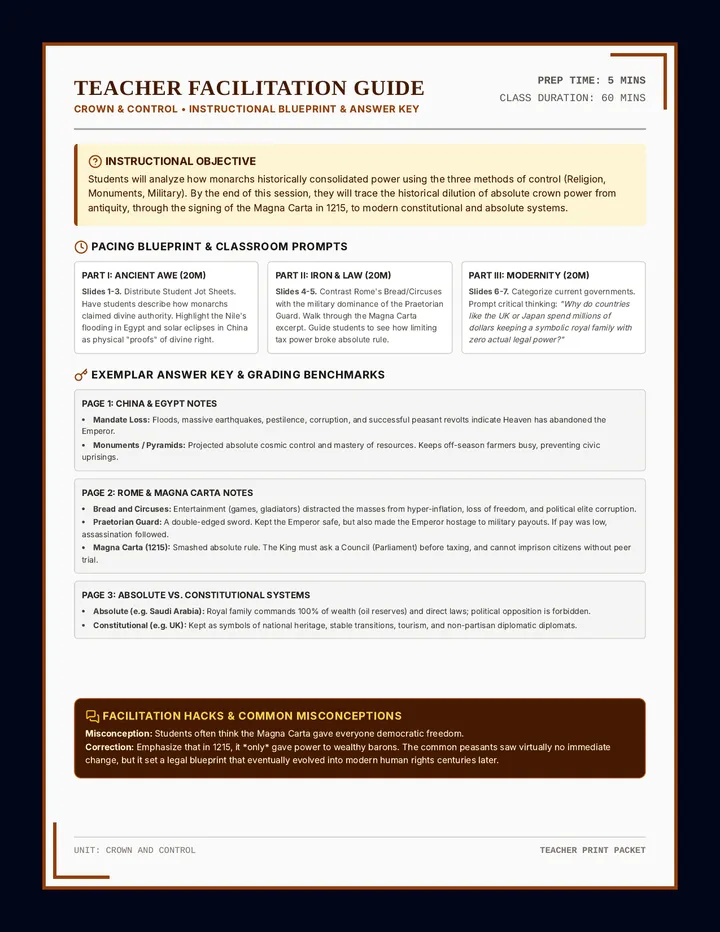
Progressive Power Notes Key Progressive Power Notes
TEACHER ANSWER KEY
Standard: US.17
1. The Three Cs of the Square Deal
Control of Corporations
Busting bad trusts.
Consumer Protection
Safety for food/medicine.
Conservation of Resources
Saving natural resources.
2. Trust-Busting
"Good" Trusts
Efficient, provided lower prices, and just needed federal regulation / supervision.
"Bad" Trusts
Used unfair practices and hurt the public; these were broken up (busted).
Significant Case: In 1904, TR won a lawsuit against the Northern Securities Company, breaking up a major railroad monopoly.
3. Consumer Protection
Upton Sinclair exposed horrific conditions in the meatpacking industry. TR was so disgusted he pushed for two new laws in 1906:
A. Meat Inspection Act: Ensured meat was slaughtered and processed under sanitary conditions.
B. Pure Food and Drug Act: Banned mislabeled products; required ingredients to be listed on labels.
4. Support for Conservation
TR worked with Gifford Pinchot, the first head of the U.S. Forest Service.
Set aside 148 million acres of public land.
Established over 50 wildlife refuges.
Sample Reflection Response
"The Pure Food and Drug Act has the biggest impact because I know the food I buy at the store won't make me sick and the medicine I take is actually what the label says it is."
Wilderness War Activity Key Wilderness War Activity
TEACHER ANSWER KEY
Standard: SSP.06
Key Concept
Conservation = Sustainable Development (Managing resources for future human use, not just leaving nature untouched).
1. Shaping the Earth
Newlands Reclamation Act Answers:
A) How did humans change the physical environment?
Humans built massive dams and irrigation canals to redirect water flow, turning dry, arid desert environments into fertile farmland.
B) What was the intended benefit for humans?
It allowed for large-scale agricultural settlement in the West, providing food security and economic opportunities for thousands of families.
2. Restraining Consumption
Forest Service Answers:
A) How did the government restrict human interaction?
They ended "free-for-all" logging and grazing. Humans could still use the land, but they needed permits and had to follow strict scientific guidelines.
B) Why was this preservation necessary for the future?
Without regulation, humans would have completely exhausted timber and water resources, making the land unusable for future generations.
Synthesis Key
Managing nature FOR humans or protecting it FROM humans?
Sample Answer: TR was primarily interested in managing nature FOR humans. Unlike preservationists who wanted to keep nature untouched, TR and Pinchot believed in "wise use." They protected the environment so that it could provide timber, water, and beauty for the human population indefinitely.
Square Deal Speaker Script Square Deal Speaker Script
Teacher Script & Presentation Guide
Companion to: Square Deal Slides
Slide 1: Title & Hook
Talking Point: Start with the persona. TR wasn't just a politician; he was a "Rough Rider," a rancher, and a hunter. He brought that "Strenuous Life" energy to the White House.
Script: "Roosevelt believed in a 'Square Deal.' In 1903, he famously said he wanted to give every man a fair shake—not more, not less. This wasn't about giving everyone the same outcome, but ensuring the *rules* of the game were fair."
Slide 2: The Square Deal
Talking Point: Introduce the 'Three Cs' framework. This is the core of TR's domestic policy.
Script: "To remember the Square Deal, remember the three Cs: Corporations, Consumers, and Conservation. TR used the 'Bully Pulpit' of the presidency to advocate for the public interest in all three of these areas."
Slide 3: Trust-Busting
Talking Point: Explain the nuance. TR wasn't anti-business; he was anti-monopoly.
Script: "Look at the quote from his 1901 message. He didn't want to destroy big companies—he knew they were efficient. But he wanted them to 'subserve the public good.' If a trust lowered prices and acted fairly, he left it alone (Good Trust). If it bullied competitors and jacked up prices, he brought out the hammer (Bad Trust), like he did with J.P. Morgan's Northern Securities."
Slide 4: Consumer Protection
Talking Point: The power of the pen. Sinclair's *The Jungle* was the catalyst.
Script: "Upton Sinclair wrote *The Jungle* to highlight poor labor conditions, but the public (and TR) got hung up on the description of meat. TR actually invited Sinclair to the White House. Within months, he pushed through the Meat Inspection Act and the Pure Food and Drug Act. This was the start of 'Truth in Labeling' that we see on every candy bar and medicine bottle today."
Slide 5: Support for Conservation
Talking Point: Conservation vs. Preservation. TR and Pinchot were 'wise use' guys.
Script: "TR saw natural resources as something that belonged to the public. He said in 1907 that preservation was the 'fundamental problem.' Working with Gifford Pinchot, he didn't just lock up the land—he managed it. He set aside 148 million acres for national forests so they could be used sustainably rather than logged into oblivion."
Slide 6: Legacy & Summary
Talking Point: Shift in government philosophy.
Script: "Before TR, the presidency was relatively weak compared to Congress and Big Business. TR changed that. He proved that the government could be an active force for social justice. His legacy is the modern regulatory state—the idea that the public deserves protection and a fair shake."
TR Visual Resource Bank TR Visual Resource Bank
Primary Source Gallery & Media Links
Lesson Component: US.17
This document provides a curated collection of high-resolution historical visuals, political cartoons, and primary source documents to enhance the "Rough Rider Reforms" lesson. Use these to stimulate class discussion or as supplemental material for the slide deck.
The Progressive President
Control of Corporations
Consumer Protection
Support for Conservation
1. TR and John Muir at Yosemite (Photo, 1903)
The most iconic image of TR's commitment to the wilderness.
https://www.loc.gov/resource/cph.3g02554/
2. Map of National Forest Proclamations (1907)
Visual record of the millions of acres TR set aside during his term.