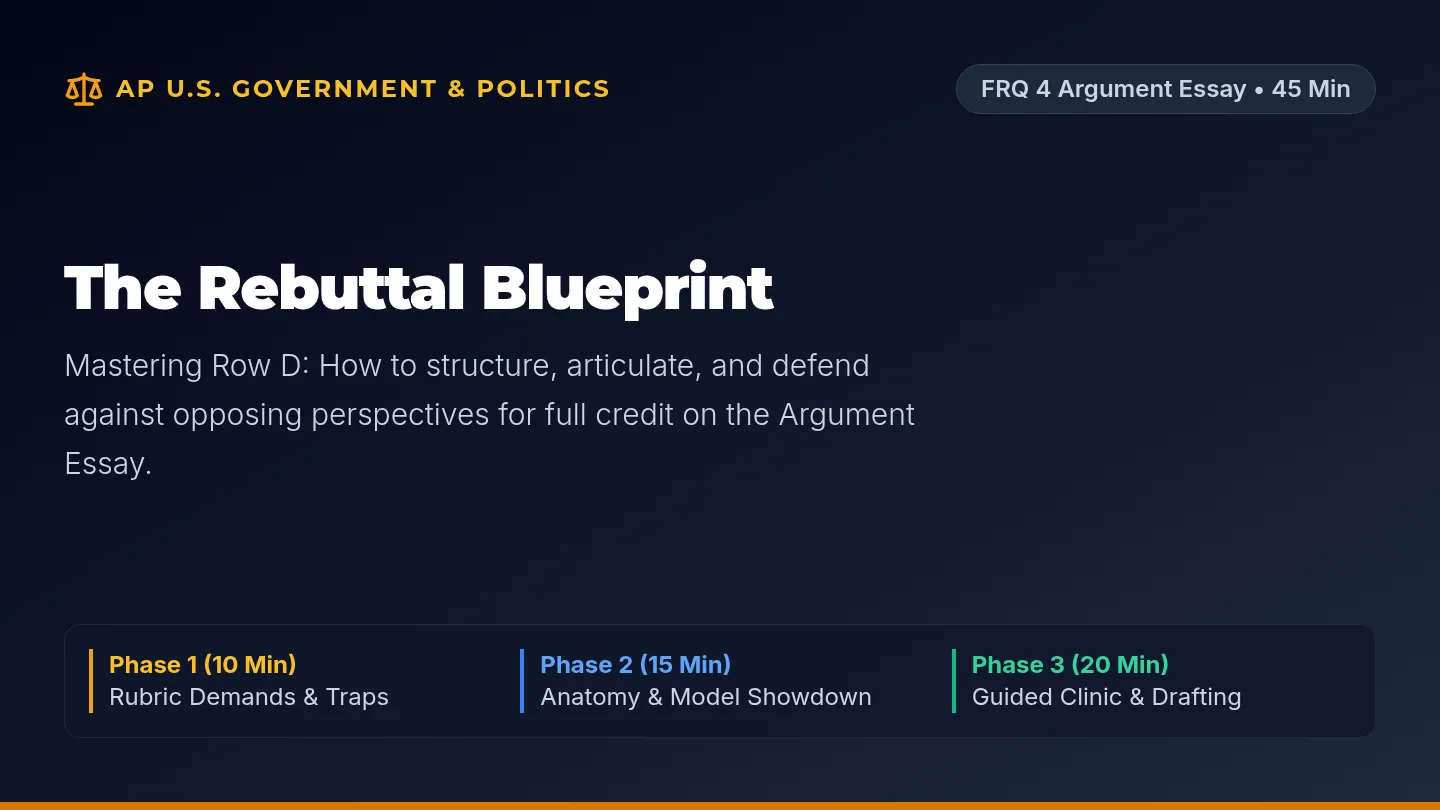
Rebuttal Blueprint Slides AP U.S. Government & Politics
FRQ 4 Argument Essay • 45 Min
The Rebuttal Blueprint
Mastering Row D: How to structure, articulate, and defend against opposing perspectives for full credit on the Argument Essay.
Phase 1 (10 Min)
Rubric Demands & Traps
Phase 2 (15 Min)
Anatomy & Model Showdown
Phase 3 (20 Min)
Guided Clinic & Drafting
Rubric Breakdown
Row D: Opposing Perspective (1 Point)
Lowest-Scored Point Nationally
What College Board Requires
Describe an alternate or opposing perspective (accurate and substantive).
Respond using refutation, concession, or rebuttal with constitutional reasoning.
Align directly with your thesis claim, not a broad tangent.
The Three Fatal Pitfalls
✗ The Strawman: Dismissing opponents without explaining their rationale.
✗ The Self-Sabotage: Validating the counterargument without rebutting it.
✗ The Unbacked Pivot: Saying "they are wrong" without institutional evidence.
Scorer Insight: Point 4 is a two-step threshold. Describe without refuting = 0. Refute without describing = 0.
Structural Formula
The 3-Part Architecture of Row D
STEP 1
Acknowledge
State the opposition's claim and their institutional rationale fairly.
"Opponents contend that... because [rationale]..."
STEP 2
Pivot
Concede narrow validity or expose their core analytical weakness.
"While [concession], this overlooks [critical flaw]..."
STEP 3
Rebut
Defend your thesis with constitutional documents or principles.
"In Federalist 51, ambition checks ambition to prevent..."
The Golden Rule: Never present an opposing claim without an immediate institutional counter-strike.
Comparative Analysis
Prompt: Presidential Power Expansion
Weak vs. Rubric-Earning Counterclaim
Score: 0 / 1 Pt Dismissive Strawman
"Some people say presidents need unlimited executive orders in crises. Those people are wrong because presidents shouldn't act like absolute monarchs."
Why 0 Points:
• Exaggerates opposition; offers no constitutional refutation.
Score: 1 / 1 Pt Formatted Master
"Opponents argue unilateral orders are vital during gridlock. While swift action has utility, unchecked decrees bypass Article I lawmaking and erode Federalist 51 checks."
Why 1 Point:
• Fairly describes rationale; refutes using Article I and Federalist 51.
Takeaway: Don't mock the other side—out-argue them with institutional mechanisms.
Guided Practice
Diagnose the Draft: Point or No Point?
Draft A: Electoral College Sample
"Supporters of national popular vote argue it ensures democracy. They are right that direct democracy represents the people, making the Electoral College an outdated relic."
Diagnosis: The Self-Sabotage (0 Pts)
Conceded without rebutting! This completely destroys your own thesis.
Draft B: Electoral College Sample
"Advocates argue the Electoral College violates majority rule. However, Federalist 10 warns that pure majority rule enables tyranny over minority geographic interests."
Diagnosis: The Complete Rebuttal (1 Pt)
States opposing principle, then neutralizes it using Federalist 10.
On Your Worksheet:
Open Section 2 now to complete the rewrite drills with your partner.
Independent Execution
20 Minutes
Prompt: Federal vs. State Power
Practice Essay Prompt:
Develop an argument that explains whether the expansion of federal power over states through federal mandates has strengthened or weakened American constitutional democracy.
1. Fair Description
State the alternate side's rationale without using mockery or caricature.
2. Clear Pivot
Use precise pivot transitions ("While it is true that...", "However...").
3. Document Anchor
Back your refutation with Brutus 1, Fed 10, Fed 51, or 10th Amendment.
Exit Ticket Requirement: Self-score your paragraph using the 3-question diagnostic rubric on page 2.
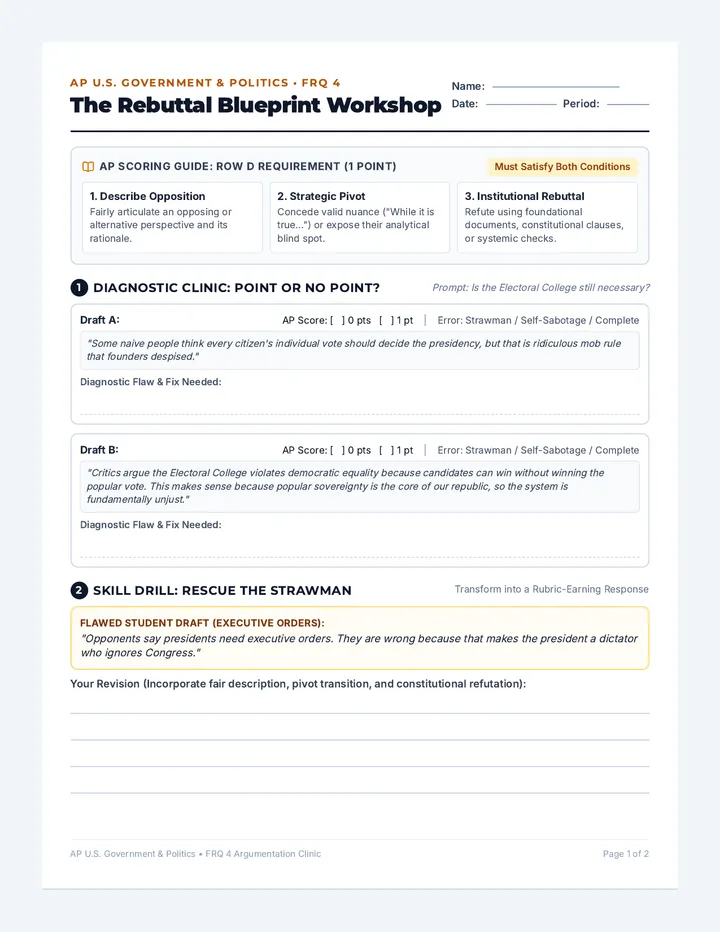
Rebuttal Blueprint Worksheet AP U.S. Government & Politics • FRQ 4
The Rebuttal Blueprint Workshop
Name:
Date: Period:
AP Scoring Guide: Row D Requirement (1 Point) Must Satisfy Both Conditions
1. Describe Opposition
Fairly articulate an opposing or alternative perspective and its rationale.
2. Strategic Pivot
Concede valid nuance ("While it is true...") or expose their analytical blind spot.
3. Institutional Rebuttal
Refute using foundational documents, constitutional clauses, or systemic checks.
1 Diagnostic Clinic: Point or No Point?
Prompt: Is the Electoral College still necessary?
Draft A:
AP Score: [ ] 0 pts [ ] 1 pt | Error: Strawman / Self-Sabotage / Complete
"Some naive people think every citizen's individual vote should decide the presidency, but that is ridiculous mob rule that founders despised."
Diagnostic Flaw & Fix Needed:
Draft B:
AP Score: [ ] 0 pts [ ] 1 pt | Error: Strawman / Self-Sabotage / Complete
"Critics argue the Electoral College violates democratic equality because candidates can win without winning the popular vote. This makes sense because popular sovereignty is the core of our republic, so the system is fundamentally unjust."
Diagnostic Flaw & Fix Needed:
2 Skill Drill: Rescue the Strawman
Transform into a Rubric-Earning Response
Flawed Student Draft (Executive Orders):
"Opponents say presidents need executive orders. They are wrong because that makes the president a dictator who ignores Congress."
Your Revision (Incorporate fair description, pivot transition, and constitutional refutation):
AP U.S. Government & Politics • FRQ 4 Argumentation Clinic Page 1 of 2
Independent Execution
AP FRQ 4 Counterclaim Sprint
20 Minutes Target
Official FRQ Prompt:
Develop an argument that explains whether the expansion of federal power over states through federal mandates has strengthened or weakened American constitutional democracy.
Step A: Your Central Thesis Claim
What primary position are you defending?
Step B: Strongest Opposing Argument
What is the most compelling point the other side makes?
Step C: Final Counterclaim & Rebuttal Paragraph
Write 4–6 complete, formal sentences
Row D Diagnostic Self-Audit Checklist
Fair Description: Did I describe the alternate position without mocking or trivializing it?
Clear Pivot: Did I use an explicit pivot transition ("While opponents argue...", "However...")?
Substantive Rebuttal: Did I explain why their argument fails rather than just declaring it wrong?
Document Anchor: Did I support my rebuttal with Brutus 1, Fed 10, Fed 51, or 10th Amendment?
AP U.S. Government & Politics • FRQ 4 Argumentation Clinic Page 2 of 2
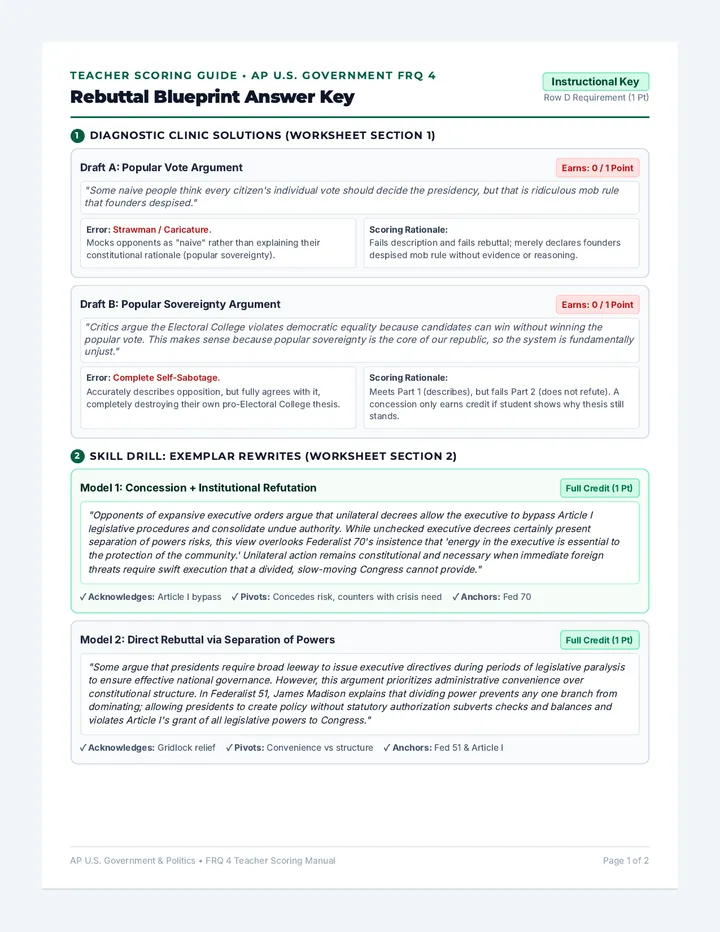
Rebuttal Blueprint Answer Key Teacher Scoring Guide • AP U.S. Government FRQ 4
Rebuttal Blueprint Answer Key
Instructional Key
Row D Requirement (1 Pt)
1 Diagnostic Clinic Solutions (Worksheet Section 1)
Draft A: Popular Vote Argument Earns: 0 / 1 Point
"Some naive people think every citizen's individual vote should decide the presidency, but that is ridiculous mob rule that founders despised."
Error: Strawman / Caricature.
Mocks opponents as "naive" rather than explaining their constitutional rationale (popular sovereignty).
Scoring Rationale:
Fails description and fails rebuttal; merely declares founders despised mob rule without evidence or reasoning.
Draft B: Popular Sovereignty Argument Earns: 0 / 1 Point
"Critics argue the Electoral College violates democratic equality because candidates can win without winning the popular vote. This makes sense because popular sovereignty is the core of our republic, so the system is fundamentally unjust."
Error: Complete Self-Sabotage.
Accurately describes opposition, but fully agrees with it, completely destroying their own pro-Electoral College thesis.
Scoring Rationale:
Meets Part 1 (describes), but fails Part 2 (does not refute). A concession only earns credit if student shows why thesis still stands.
2 Skill Drill: Exemplar Rewrites (Worksheet Section 2)
Model 1: Concession + Institutional Refutation Full Credit (1 Pt)
"Opponents of expansive executive orders argue that unilateral decrees allow the executive to bypass Article I legislative procedures and consolidate undue authority. While unchecked executive decrees certainly present separation of powers risks, this view overlooks Federalist 70's insistence that 'energy in the executive is essential to the protection of the community.' Unilateral action remains constitutional and necessary when immediate foreign threats require swift execution that a divided, slow-moving Congress cannot provide."
✓ Acknowledges: Article I bypass ✓ Pivots: Concedes risk, counters with crisis need ✓ Anchors: Fed 70
Model 2: Direct Rebuttal via Separation of Powers Full Credit (1 Pt)
"Some argue that presidents require broad leeway to issue executive directives during periods of legislative paralysis to ensure effective national governance. However, this argument prioritizes administrative convenience over constitutional structure. In Federalist 51, James Madison explains that dividing power prevents any one branch from dominating; allowing presidents to create policy without statutory authorization subverts checks and balances and violates Article I's grant of all legislative powers to Congress."
✓ Acknowledges: Gridlock relief ✓ Pivots: Convenience vs structure ✓ Anchors: Fed 51 & Article I
AP U.S. Government & Politics • FRQ 4 Teacher Scoring Manual Page 1 of 2
Scoring Benchmarks
Independent FRQ 4 Exemplars & Reader Rules
Prompt: Federal Mandates
Dual-Perspective Model Responses (Both Earn Full Row D Credit)
Perspective A: Thesis Claim = Mandates Strengthen Democracy Earns Point
"Opponents of federal mandates argue that coercive national directives infringe upon state sovereignty guaranteed by the Tenth Amendment, creating an overbearing central government detached from local needs. While local administration is valuable, this argument fails to account for the dangers of state-level factional oppression highlighted in Federalist 10. Without uniform federal standards such as the Americans with Disabilities Act or voting rights legislation, individual states have historically denied fundamental civil rights to minority populations. Thus, federal mandates are vital to protecting equal democratic citizenship across all jurisdictions."
Opposing view described: 10th Amendment & state local autonomy Rebuttal logic: Fed 10 factional tyranny & civil rights enforcement
Perspective B: Thesis Claim = Mandates Weaken Democracy Earns Point
"Supporters of federal mandates maintain that national directives are indispensable for establishing uniform standards and promoting general welfare across all fifty states. However, this perspective overlooks Brutus 1's warning that a distant, centralized government cannot comprehend or fairly address the diverse interests and conditions of a vast republic. Unfunded federal mandates compel state legislatures to divert local tax dollars toward federally dictated priorities without state voter consent, reducing state officials to mere administrative agents and undermining federalism."
Opposing view described: Uniformity and general welfare promotion Rebuttal logic: Brutus 1 distant rule & distortion of state legislative priorities
AP Reader Official Scoring Guidelines for Row D
What Secures the Point
• Accurate description of the alternate claim and its backing logic (not just a buzzword).
• A clear pivot using refutation (showing why it's flawed), concession (acknowledging limited merit before overriding), or rebuttal.
• Direct alignment with the author's specific prompt thesis.
What College Board Denies
• Merely stating "others disagree" or naming an alternate option without stating their reasoning.
• Blanket contradiction ("they are wrong") without explanatory reasoning or evidence.
• Conceding the point so thoroughly that the student argues against their own stated thesis.
AP U.S. Government & Politics • FRQ 4 Teacher Scoring Manual Page 2 of 2
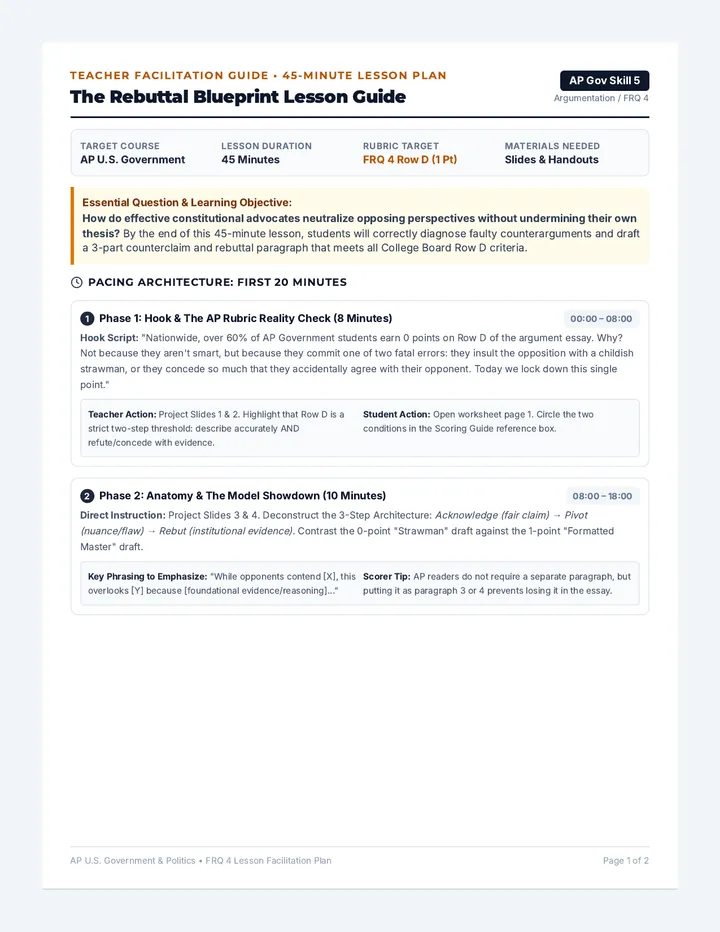
Rebuttal Blueprint Teacher Guide Teacher Facilitation Guide • 45-Minute Lesson Plan
The Rebuttal Blueprint Lesson Guide
AP Gov Skill 5
Argumentation / FRQ 4
Target Course
AP U.S. Government
Lesson Duration
45 Minutes
Rubric Target
FRQ 4 Row D (1 Pt)
Materials Needed
Slides & Handouts
Essential Question & Learning Objective:
How do effective constitutional advocates neutralize opposing perspectives without undermining their own thesis? By the end of this 45-minute lesson, students will correctly diagnose faulty counterarguments and draft a 3-part counterclaim and rebuttal paragraph that meets all College Board Row D criteria.
Pacing Architecture: First 20 Minutes
1 Phase 1: Hook & The AP Rubric Reality Check (8 Minutes) 00:00 – 08:00
Hook Script: "Nationwide, over 60% of AP Government students earn 0 points on Row D of the argument essay. Why? Not because they aren't smart, but because they commit one of two fatal errors: they insult the opposition with a childish strawman, or they concede so much that they accidentally agree with their opponent. Today we lock down this single point."
Teacher Action: Project Slides 1 & 2. Highlight that Row D is a strict two-step threshold: describe accurately AND refute/concede with evidence.
Student Action: Open worksheet page 1. Circle the two conditions in the Scoring Guide reference box.
2 Phase 2: Anatomy & The Model Showdown (10 Minutes) 08:00 – 18:00
Direct Instruction: Project Slides 3 & 4. Deconstruct the 3-Step Architecture: Acknowledge (fair claim) → Pivot (nuance/flaw) → Rebut (institutional evidence) . Contrast the 0-point "Strawman" draft against the 1-point "Formatted Master" draft.
Key Phrasing to Emphasize: "While opponents contend [X], this overlooks [Y] because [foundational evidence/reasoning]..."
Scorer Tip: AP readers do not require a separate paragraph, but putting it as paragraph 3 or 4 prevents losing it in the essay.
AP U.S. Government & Politics • FRQ 4 Lesson Facilitation Plan Page 1 of 2
Facilitation & Differentiation
Guided Practice, Sprint & Interventions
25 Minutes Pacing
3 Phase 3: Partner Clinic & Strawman Rescue Drill (12 Minutes) 18:00 – 30:00
Pair students to evaluate Draft A and Draft B on Worksheet Section 1. Cold-call pairs to justify their diagnosis. Transition directly to Section 2: students independently execute the "Strawman Rescue" rewrite drill for 4 minutes, then share with partners.
Teacher Look-For: Ensure students provide a constitutional rationale rather than personal opinion.
4 Phase 4: Independent FRQ Sprint & Audit Debrief (15 Minutes) 30:00 – 45:00
Independent Drafting (10 Min): Students flip to worksheet page 2. Prompt: Federal Mandates. Students plan Steps A and B, then write a 4–6 sentence counterclaim paragraph in Step C.
Self/Peer Audit (5 Min): Students exchange with a peer and complete the 4-point Row D Diagnostic Checklist at the bottom of page 2 before turning in.
Teacher Circulation Look-Fors & Rapid Corrections
Frequent Trap Observed:
Student writes: "Opponents argue mandates are unconstitutional, but they are wrong because the national government protects everyone."
Immediate Teacher Prompt:
"Why do opponents say it's unconstitutional? Name the 10th Amendment! And what specific clause or document justifies national power?"
Frequent Trap Observed:
Student writes a long paragraph praising state autonomy and forgets to defend their own pro-mandate thesis.
Immediate Teacher Prompt:
"You just wrote their essay for them! Where is your pivot? Add 'While state autonomy is valuable, without federal mandates...'"
Differentiation Strategies
Scaffolding (Struggling Writers):
Provide fill-in-the-blank transition stems on the board: "While advocates of [Opposing Side] argue that [Constitutional Rationale], this view fails because [Foundational Document/Principle] proves that [Original Thesis]."
Extension (Advanced Writers):
Challenge students to construct a complex concession that synthesizes competing foundational texts—e.g., acknowledging the Antifederalist fears in Brutus 1 before demonstrating how Federalist 10's extended republic mitigates those specific risks.
AP U.S. Government & Politics • FRQ 4 Lesson Facilitation Plan Page 2 of 2