Holiday Heredity Slides
8th Grade Science • Genetics
Holiday Lab
Punnett Square Workshop
North Pole Genetics
Predicting festive traits, decoding genotypes and phenotypes, and comparing holiday crosses.
🦌 Reindeer Traits 🧝 Elf Heredity 🌺 Poinsettia Genetics 🌿 Holly Leaf Traits
Dominant & Recessive Alleles
Concept 1
Dominant Allele R
Written as a capital letter. It masks the recessive allele whenever at least one copy is present.
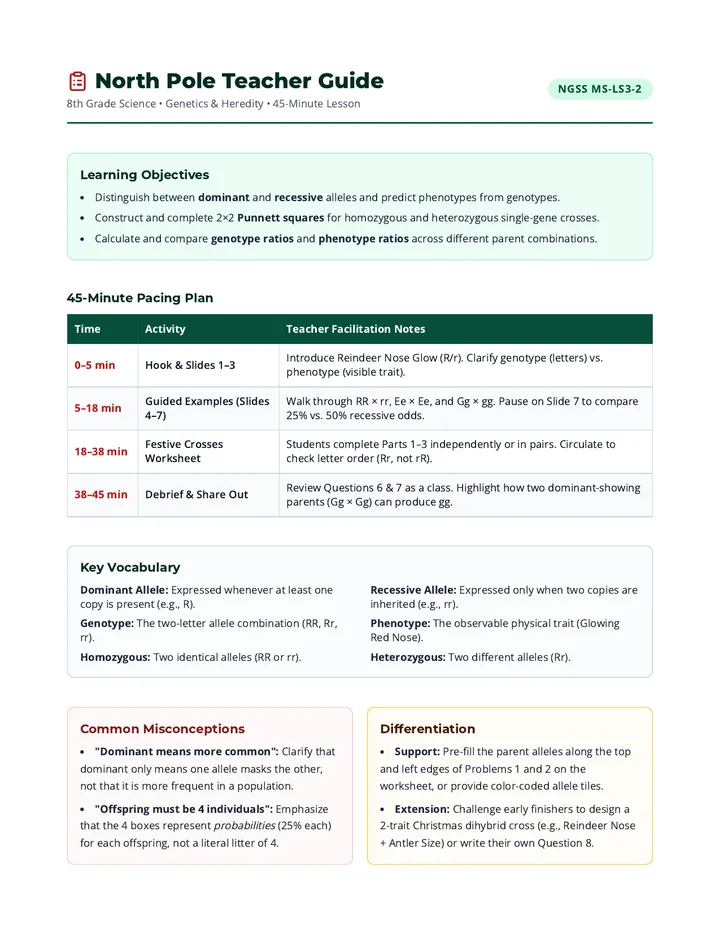
Example: R = Glowing Red Nose 🦌🔴
Recessive Allele r
Written as a lowercase letter. It only shows in the trait when two copies are inherited.
Example: r = Classic Black Nose 🦌⚫
One dominant allele (Rr) is enough to show the dominant glowing red nose!
Genotype vs. Phenotype
Concept 2
Genotype (Letters)
The actual allele combination an organism inherits from its parents.
RR — Homozygous Dominant
Rr — Heterozygous (Carrier)
rr — Homozygous Recessive
Phenotype (Trait)
The observable physical trait you can actually see.
RR → Glowing Red Nose 🔴
Rr → Glowing Red Nose 🔴
rr → Classic Black Nose ⚫
Memory Trick: Genotype = Genes (letters) • Phenotype = Physical appearance
Example 1: Reindeer Nose (RR × rr)
Guided Cross
Parent 1: RR (Glowing Red)
R
R
r
Rr
Rr
r
Rr
Rr
Parent 2: rr (Classic Black)
Genotype Ratio
4 Rr : 0 RR : 0 rr
100% Heterozygous (Rr)
Phenotype Ratio
4 Glowing Red : 0 Black
100% Glowing Red Nose 🦌🔴
Example 2: Elf Ears (Ee × Ee)
Heterozygous Cross
E = Pointed Ears • e = Rounded Ears
E
e
E
EE
Ee
e
Ee
ee
Genotype Ratio
1 EE : 2 Ee : 1 ee
25% EE • 50% Ee • 25% ee
Phenotype Ratio
3 Pointed : 1 Rounded
75% Pointed Ears • 25% Rounded Ears 🧝
Example 3: Poinsettia Color (Gg × gg)
Mixed Cross
G = Red Bracts • g = Cream-White Bracts
G
g
g
Gg
gg
g
Gg
gg
Genotype Ratio
2 Gg : 2 gg (1 : 1)
50% Heterozygous • 50% Recessive
Phenotype Ratio
2 Red : 2 Cream-White
50% Red Bracts • 50% Cream-White 🌺
Comparing Cross Outcomes
Big Picture
RR × rr
100% Dominant Trait
All offspring are heterozygous carriers (Rr). Zero recessive phenotypes appear.
Ee × Ee
75% Dom / 25% Rec
Two parents with the dominant trait can still have a recessive offspring (ee)!
Gg × gg
50% Dom / 50% Rec
Equal chance of dominant or recessive phenotype — just like flipping a coin.
Key Question: Why did Ee × Ee produce fewer recessive offspring than Gg × gg?
Whiteboard Practice 1: Holly Leaves 🌿
Your Turn
Cross: Ss × ss
S
s
s
?
?
s
?
?
Trait Key
S = Spiny Leaf Edges
s = Smooth Leaf Edges
Draw this Punnett square on your whiteboard, fill all 4 boxes, and write the ratios!
Whiteboard Practice 1: Holly Leaves 🌿
Step 1 of 4
Cross: Ss × ss
S
s
s
Ss
?
s
?
?
Box 1 Check
Top allele S + left allele s = Ss
Keep checking your whiteboard for Box 2...
Whiteboard Practice 1: Holly Leaves 🌿
Step 2 of 4
Cross: Ss × ss
S
s
s
Ss
ss
s
?
?
Box 2 Check
Top allele s + left allele s = ss
Next up: Bottom-left (Box 3)...
Whiteboard Practice 1: Holly Leaves 🌿
Step 3 of 4
Cross: Ss × ss
S
s
s
Ss
ss
s
Ss
?
Box 3 Check
Top allele S + left allele s = Ss
One box left! Check your final square and ratios...
Whiteboard Practice 1: Complete! 🌿
Full Solution
S = Spiny Edges • s = Smooth Edges
S
s
s
Ss
ss
s
Ss
ss
Genotype Ratio
2 Ss : 2 ss (50% : 50%)
Phenotype Ratio
2 Spiny : 2 Smooth (50% : 50%)
Whiteboard Practice 2: Elf Eye Color 🧝
Your Turn
Cross: Bb × Bb (Heterozygous)
B
b
B
?
?
b
?
?
Trait Key
B = Brown Eyes
b = Blue Eyes
Clear your whiteboard, solve Bb × Bb, and find both ratios!
Whiteboard Practice 2: Elf Eye Color 🧝
Step 1 of 4
Cross: Bb × Bb
B
b
B
BB
?
b
?
?
Box 1 Check
Top allele B + left allele B = BB
Next up: Top-right (Box 2)...
Whiteboard Practice 2: Elf Eye Color 🧝
Step 2 of 4
Cross: Bb × Bb
B
b
B
BB
Bb
b
?
?
Box 2 Check
Top allele b + left allele B = Bb
(Always write capital letter first!)
Whiteboard Practice 2: Elf Eye Color 🧝
Step 3 of 4
Cross: Bb × Bb
B
b
B
BB
Bb
b
Bb
?
Box 3 Check
Top allele B + left allele b = Bb
Hold up your whiteboards for the final box and ratios!
Whiteboard Practice 2: Complete! 🧝
Full Solution
B = Brown Eyes • b = Blue Eyes
B
b
B
BB
Bb
b
Bb
bb
Genotype Ratio
1 BB : 2 Bb : 1 bb
25% BB • 50% Bb • 25% bb
Phenotype Ratio
3 Brown Eyes : 1 Blue Eyes
75% Brown Eyes • 25% Blue Eyes
Independent Practice
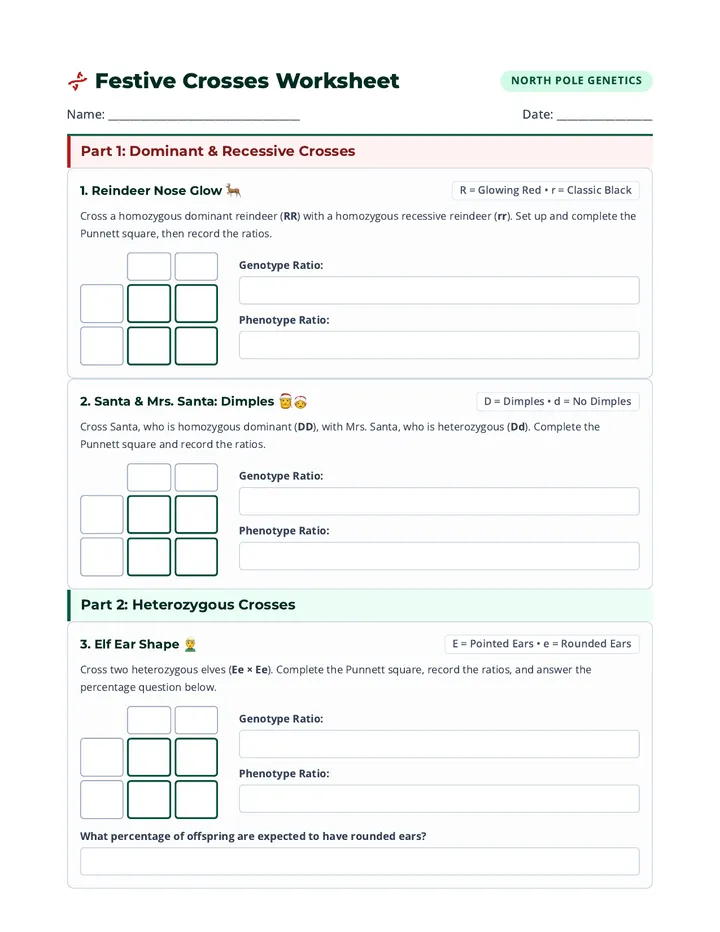
Festive Crosses Worksheet
1 Read each North Pole trait key carefully to identify dominant and recessive alleles.
2 Place parent alleles along the top and left side of each Punnett square.
3 Record both the genotype ratio and phenotype ratio for every cross.
4 Complete the Mixed Review to compare how different crosses change offspring odds.
Tip: Always write capital letters before lowercase letters (Rr, not rR). 🎄 Good luck, geneticists!
Festive Crosses Worksheet
Festive Crosses Worksheet
North Pole Genetics
Name: ____________________________________
Date: __________________
Part 1: Dominant & Recessive Crosses
1. Reindeer Nose Glow 🦌
R = Glowing Red • r = Classic Black
Cross a homozygous dominant reindeer (RR) with a homozygous recessive reindeer (rr). Set up and complete the Punnett square, then record the ratios.
Genotype Ratio:
Phenotype Ratio:
2. Santa & Mrs. Santa: Dimples 🎅🤶
D = Dimples • d = No Dimples
Cross Santa, who is homozygous dominant (DD), with Mrs. Santa, who is heterozygous (Dd). Complete the Punnett square and record the ratios.
Genotype Ratio:
Phenotype Ratio:
Part 2: Heterozygous Crosses
3. Elf Ear Shape 🧝
E = Pointed Ears • e = Rounded Ears
Cross two heterozygous elves (Ee × Ee). Complete the Punnett square, record the ratios, and answer the percentage question below.
Genotype Ratio:
Phenotype Ratio:
What percentage of offspring are expected to have rounded ears?
Part 3: Mixed Review & Outcome Comparisons
Page 2
4. Gingerbread Icing 🍪
G = Peppermint Swirl • g = Classic Vanilla
Cross a heterozygous gingerbread cookie (Gg) with a homozygous recessive cookie (gg). Complete the Punnett square and record the ratios.
Genotype Ratio:
Phenotype Ratio:
5. Christmas Tree Needles 🎄
N = Evergreen • n = Frosted Silver
Cross a homozygous dominant tree (NN) with a heterozygous tree (Nn). Complete the Punnett square and record the ratios.
Genotype Ratio:
Phenotype Ratio:
Compare Cross Outcomes
6. Compare your results from Problem 3 (Ee × Ee) and Problem 4 (Gg × gg). Which cross has a higher probability of producing a recessive phenotype, and by how many percentage points?
7. Santa wants to cross two peppermint-swirl gingerbread cookies (Gg × Gg) and hopes to get a classic vanilla cookie (gg). Is this possible? Explain using genotype and phenotype evidence.
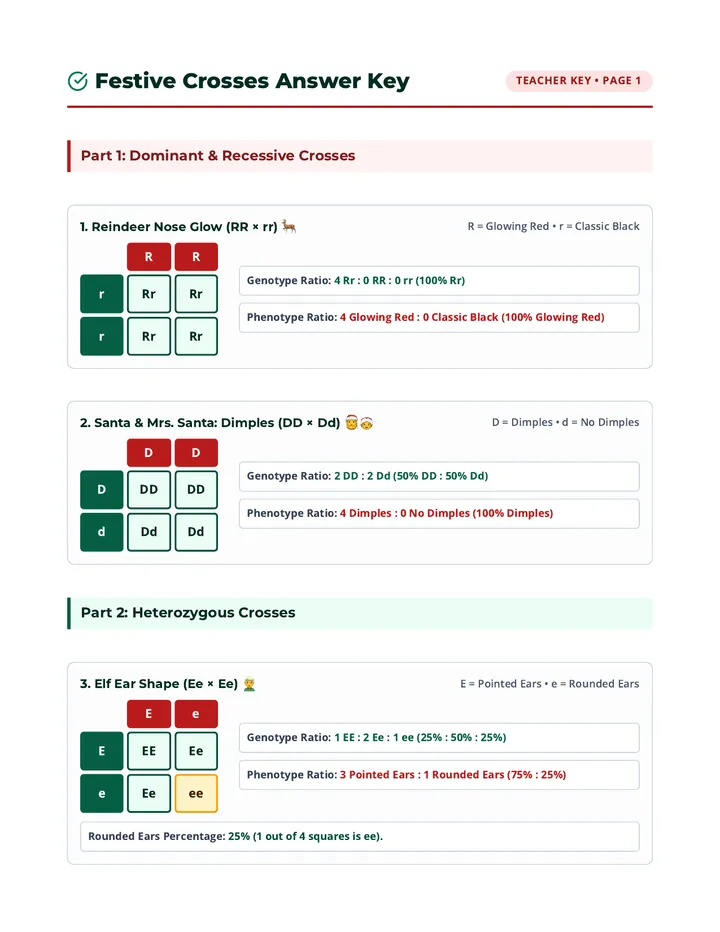
Festive Crosses Answer Key
Festive Crosses Answer Key
Teacher Key • Page 1
Part 1: Dominant & Recessive Crosses
1. Reindeer Nose Glow (RR × rr) 🦌
R = Glowing Red • r = Classic Black
R
R
r
Rr
Rr
r
Rr
Rr
Genotype Ratio: 4 Rr : 0 RR : 0 rr (100% Rr)
Phenotype Ratio: 4 Glowing Red : 0 Classic Black (100% Glowing Red)
2. Santa & Mrs. Santa: Dimples (DD × Dd) 🎅🤶
D = Dimples • d = No Dimples
D
D
D
DD
DD
d
Dd
Dd
Genotype Ratio: 2 DD : 2 Dd (50% DD : 50% Dd)
Phenotype Ratio: 4 Dimples : 0 No Dimples (100% Dimples)
Part 2: Heterozygous Crosses
3. Elf Ear Shape (Ee × Ee) 🧝
E = Pointed Ears • e = Rounded Ears
E
e
E
EE
Ee
e
Ee
ee
Genotype Ratio: 1 EE : 2 Ee : 1 ee (25% : 50% : 25%)
Phenotype Ratio: 3 Pointed Ears : 1 Rounded Ears (75% : 25%)
Rounded Ears Percentage: 25% (1 out of 4 squares is ee).
Part 3: Mixed Review & Outcome Comparisons
Teacher Key • Page 2
4. Gingerbread Icing (Gg × gg) 🍪
G = Peppermint Swirl • g = Classic Vanilla
G
g
g
Gg
gg
g
Gg
gg
Genotype Ratio: 2 Gg : 2 gg (1 : 1 or 50% : 50%)
Phenotype Ratio: 2 Peppermint : 2 Vanilla (50% : 50%)
5. Christmas Tree Needles (NN × Nn) 🎄
N = Evergreen • n = Frosted Silver
N
N
N
NN
NN
n
Nn
Nn
Genotype Ratio: 2 NN : 2 Nn (1 : 1 or 50% : 50%)
Phenotype Ratio: 4 Evergreen : 0 Frosted Silver (100% Evergreen)
Compare Cross Outcomes — Sample Responses
6. Comparing Problem 3 (Ee × Ee) and Problem 4 (Gg × gg):
Problem 4 (Gg × gg) has a higher probability of producing a recessive phenotype: 50% (2 out of 4) compared to 25% (1 out of 4) in Problem 3 (Ee × Ee). That is a difference of 25 percentage points.
7. Crossing two peppermint-swirl cookies (Gg × Gg) for a vanilla cookie (gg):
Yes, it is possible. Even though both parents show the dominant peppermint-swirl phenotype, each parent carries one recessive allele (g). When crossed (Gg × Gg), there is a 25% (1 in 4) chance of an offspring inheriting two recessive alleles (gg) and showing the classic vanilla phenotype.