Key Quest Slides
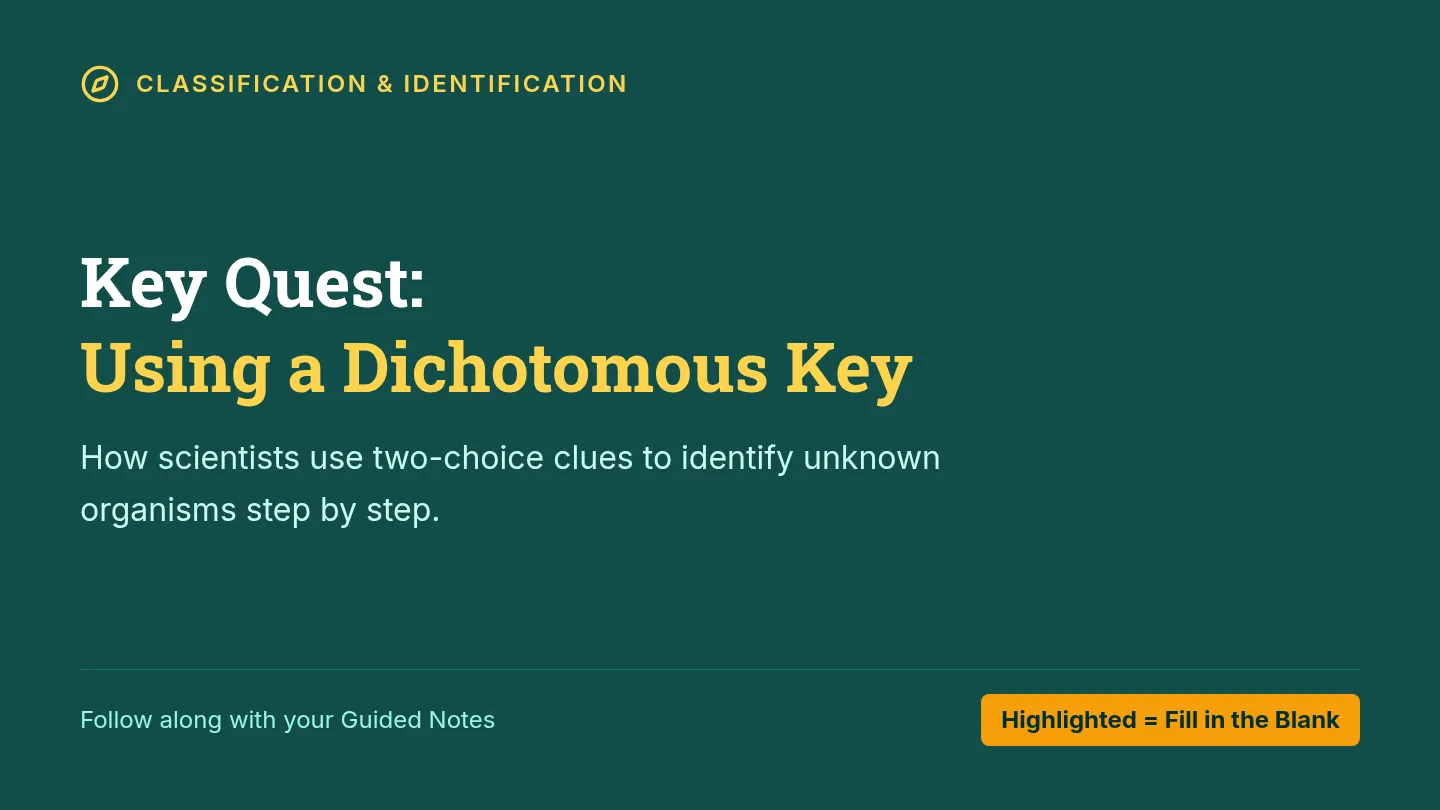
Classification & Identification
Key Quest:
Using a Dichotomous Key
How scientists use two-choice clues to identify unknown organisms step by step.
Follow along with your Guided Notes Highlighted = Fill in the Blank
1. Why We Classify
Part 1
The science of classifying living things is called taxonomy.
The word classify means to group items based on similarities and differences.
All good classification systems use consistent characteristics throughout.
Example: Grouping organisms by backbone, cell type, or body parts.
2. What Is a Dichotomous Key?
Part 2
A dichotomous key is a tool used to identify unknown organisms.
The prefix “di-” means two, because each step gives you two contrasting choices.
Each pair of choices describes observable physical traits (like body parts, hair, or wings).
Think of it like a “Choose Your Own Adventure” trail for science!
3. The Golden Rules (1 & 2)
Part 3
Rule 1 • Where to Start
Always begin at the top (Step 1) of the key for each item you identify.
Rule 2 • Compare the Pair
Read both choices in a step carefully before deciding which one matches.
Every new organism resets your journey back to Step 1!
3. The Golden Rules (3 & 4)
Part 3
Rule 3 • Stay Focused
Look at one organism at a time and pick the statement that best describes it.
Rule 4 • Follow the Path
Follow the directions at the end of your choice—either go to the next step or read the name of the organism.
Example: “1a. Has pointed ears ....... go to 2” → Jump straight to Step 2!
4. Common Mistakes to Avoid
Part 4
NEVER begin at the bottom of the key and work your way up.
DO NOT skip steps or guess—always retrace your path from Step 1 if an answer seems wrong.
Slow and steady from Step 1 gets the right answer every time!
Let’s Practice Together!
Guided Practice
Mystery Critter Dichotomous Key
1a. Has wings ................................................ go to 2
1b. Does NOT have wings ............................. go to 3
2a. Has spots on wings .............................. Flutterbug
2b. Has plain wings (no spots) ................. Zoomwing
3a. Has curly hair on head ....................... Fuzzgremlin
3b. Has NO hair (bald head) .................... Slicktoad
Critter A
Traits: Has 2 large wings with dark spots on them.
Path: 1a → 2a → Flutterbug
Critter B
Traits: No wings; tuft of curly hair on top of head.
Path: 1b → 3a → Fuzzgremlin
Critter C
Traits: No wings; smooth bald head.
Path: 1b → 3b → Slicktoad
Notice: For Critter A, B, and C, we started back at Step 1 every single time!
Quick Check: Test Prep
Exit Check
1. When using a dichotomous key, it is important to:
A. Read every choice before looking at any of the items
B. Begin at the top (Step 1) of the key for each item
C. Begin at the bottom of the key and work your way up
2. Which of the following is NOT a characteristic of all good classification systems?
A. Uses consistent characteristics throughout
B. Shows similarities and differences of items being classified
C. Contains eight different levels of organization
Write your answers on your Guided Notes before we review! Good luck on your Classification Test!
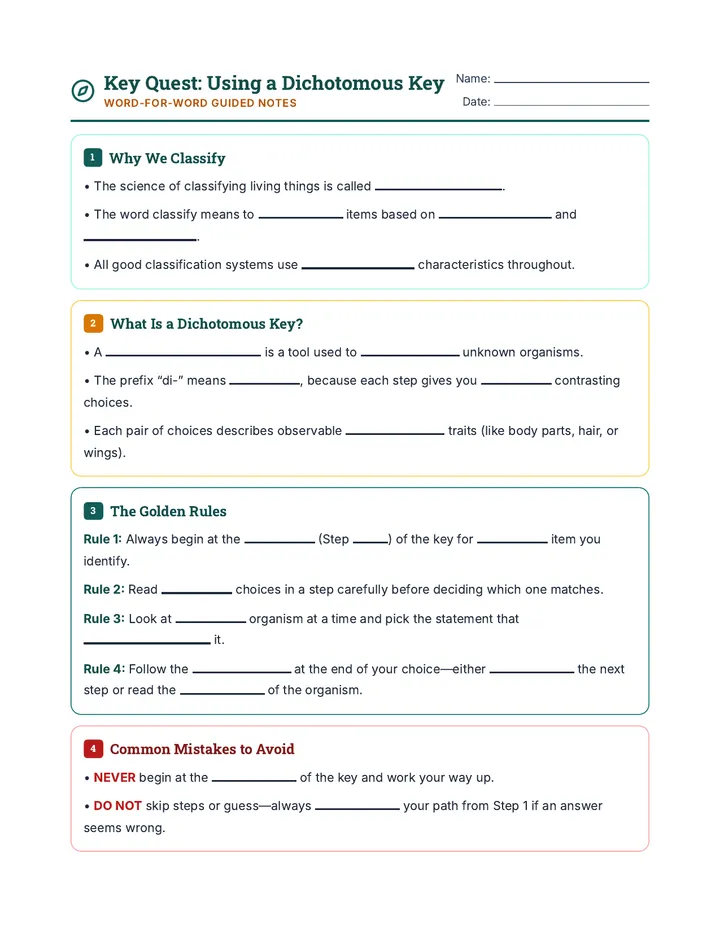
Key Quest Guided Notes
Key Quest: Using a Dichotomous Key
Word-for-Word Guided Notes
Name:
Date:
1 Why We Classify
• The science of classifying living things is called .
• The word classify means to items based on and .
• All good classification systems use characteristics throughout.
2 What Is a Dichotomous Key?
• A is a tool used to unknown organisms.
• The prefix “di-” means , because each step gives you contrasting choices.
• Each pair of choices describes observable traits (like body parts, hair, or wings).
3 The Golden Rules
Rule 1: Always begin at the (Step ) of the key for item you identify.
Rule 2: Read choices in a step carefully before deciding which one matches.
Rule 3: Look at organism at a time and pick the statement that it.
Rule 4: Follow the at the end of your choice—either the next step or read the of the organism.
4 Common Mistakes to Avoid
• NEVER begin at the of the key and work your way up.
• DO NOT skip steps or guess—always your path from Step 1 if an answer seems wrong.
Let’s Practice Together!
Guided Practice
Mystery Critter Dichotomous Key
1a. Has wings ........................................................................... go to 2
1b. Does NOT have wings ........................................................ go to 3
2a. Has spots on wings ......................................................... Flutterbug
2b. Has plain wings (no spots) ............................................ Zoomwing
3a. Has curly hair on head .................................................. Fuzzgremlin
3b. Has NO hair (bald head) ............................................... Slicktoad
Directions: Start at Step 1 for each critter. Write the steps you followed and the critter’s name.
Critter A Traits: Has 2 large wings with dark spots on them.
Path:
Critter Name:
Critter B Traits: No wings; tuft of curly hair on top of head.
Path:
Critter Name:
Critter C Traits: No wings; smooth bald head.
Path:
Critter Name:
Quick Check: Test Prep
Circle the Best Answer
1. When using a dichotomous key, it is important to:
A. Read every choice before looking at any of the items
B. Begin at the top (Step 1) of the key for each item
C. Begin at the bottom of the key and work your way up
2. Which of the following is NOT a characteristic of all good classification systems?
A. Uses consistent characteristics throughout
B. Shows similarities and differences of items being classified
C. Contains eight different levels of organization
Key Quest Answer Key
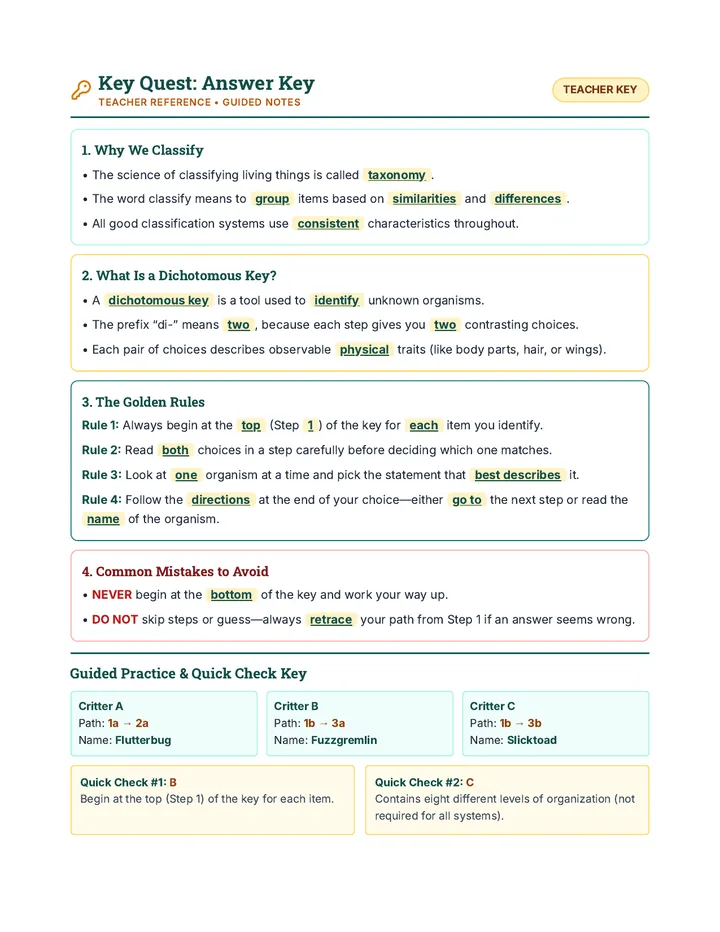
Key Quest: Answer Key
Teacher Reference • Guided Notes
TEACHER KEY
1. Why We Classify
• The science of classifying living things is called taxonomy.
• The word classify means to group items based on similarities and differences.
• All good classification systems use consistent characteristics throughout.
2. What Is a Dichotomous Key?
• A dichotomous key is a tool used to identify unknown organisms.
• The prefix “di-” means two, because each step gives you two contrasting choices.
• Each pair of choices describes observable physical traits (like body parts, hair, or wings).
3. The Golden Rules
Rule 1: Always begin at the top (Step 1) of the key for each item you identify.
Rule 2: Read both choices in a step carefully before deciding which one matches.
Rule 3: Look at one organism at a time and pick the statement that best describes it.
Rule 4: Follow the directions at the end of your choice—either go to the next step or read the name of the organism.
4. Common Mistakes to Avoid
• NEVER begin at the bottom of the key and work your way up.
• DO NOT skip steps or guess—always retrace your path from Step 1 if an answer seems wrong.
Guided Practice & Quick Check Key
Critter A
Path: 1a → 2a
Name: Flutterbug
Critter B
Path: 1b → 3a
Name: Fuzzgremlin
Critter C
Path: 1b → 3b
Name: Slicktoad
Quick Check #1: B
Begin at the top (Step 1) of the key for each item.
Quick Check #2: C
Contains eight different levels of organization (not required for all systems).