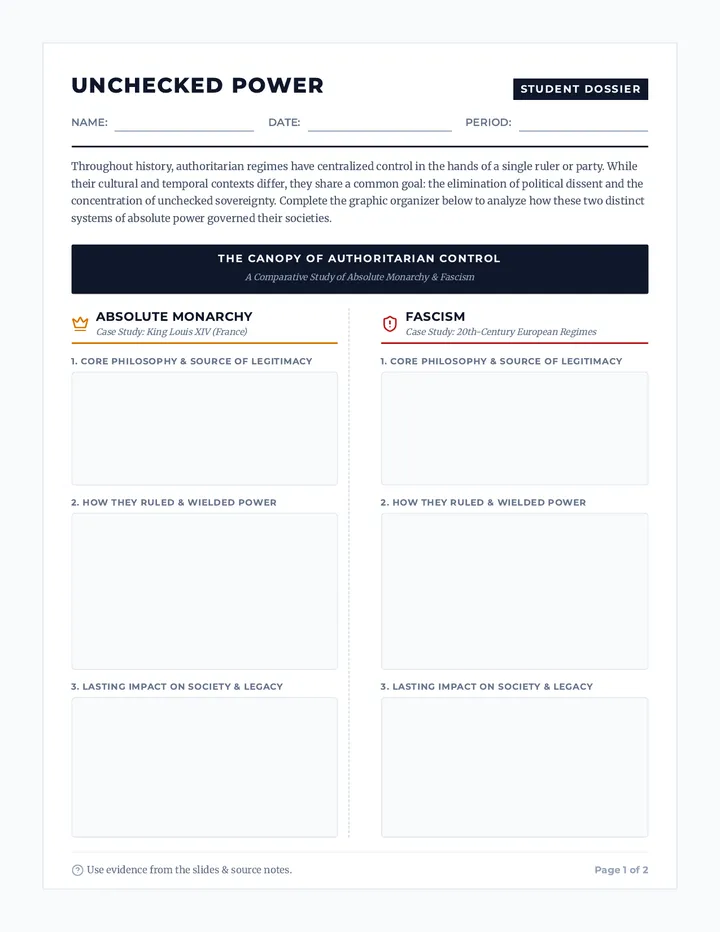
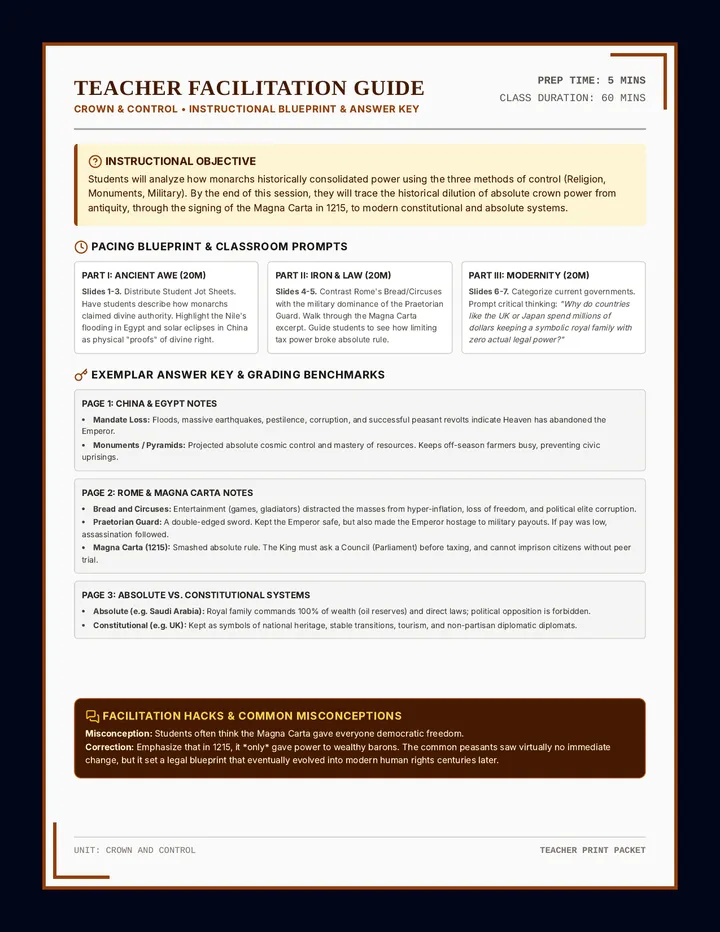
Underground Empire Slides Underground Empire
Prohibition & The 18th Amendment
"The Noble Experiment"
US.39 History / Politics / Culture / Economics
The Dry Movement
Politics
The 18th Amendment (1919)
Banned the manufacture, sale, and transportation of "intoxicating liquors."
The Volstead Act
The federal law that defined "intoxicating" and gave the government power to enforce the amendment.
"The reign of tears is over. The slums will soon be only a memory. We will turn our prisons into factories... The hell-holes will be closed forever."
— Billy Sunday, Evangelist (Jan. 16, 1920)
Whispered Secrets
Culture
Speakeasies
Illegal, secret bars that required a password or secret knock to enter.
Social Change
Women began drinking in public alongside men, challenging traditional Victorian norms.
Password Required
Did drinking actually stop? No—it just went underground.
The Rise of the Mob
Economics / Crime
Bootlegging
The illegal production and distribution of alcohol (named after the practice of hiding flasks in boots).
Organized Crime
Gangs, like Al Capone's Chicago Outfit, took over the multi-million dollar liquor industry, using bribery and violence.
St. Valentine's Day Massacre
Feb. 14, 1929: Highlighting the extreme violence associated with turf wars for alcohol profits.
Economics of Sin
Huge profits for criminals
Loss of government tax revenue
Costly (and often corrupt) enforcement
Cartoon Analysis: The Leaky Barrel
Primary Source
Rollin Kirby, *New York World* (1924)
The 18th Amdt.
Booze
SPLASH!
The Mob
"A tiny bandage can't stop a massive flood... especially when others are profiting from the leaks."
1
The Bandage: Why did Rollin Kirby use a tiny bandage to represent the 18th Amendment in 1924?
2
The Profits: Who is capturing the 'leaks' of the law, and why does that matter?
3
Context: Is this cartoon advocating for more enforcement or for repeal?
The 21st Amendment
History / Politics
The Repeal (1933)
The 21st Amendment ratified to undo the 18th. The only time an amendment has been fully repealed.
Why did it fail?
Unintended rise in crime
Lack of public support / enforcement
Need for tax revenue during the Great Depression
21
Repeal
Secret Sip Notes Secret Sip Notes
Confidential File: US.39
Prohibition & Organized Crime
Name:
Date:
Investigation I
The Noble Experiment
The Amendment (1919) banned the manufacture, sale, and transportation of alcohol.
The Act was the federal law passed to provide enforcement rules.
Social Problems
Identify one social problem "Dries" hoped to solve by banning alcohol (based on Billy Sunday's 1920 quote):
Investigation II
Whispered Secrets & Mob Profits
Speakeasies:
Bootlegging:
Organized Crime
What methods did crime bosses like Al Capone use to keep power?
Investigation III
Evidence Analysis: The Leaky Barrel
Based on the 1924 cartoon by Rollin Kirby, answer the following:
What is the "Bandage" doing?
Who is getting rich in this scene?
Final Verdict: Was the 18th Amendment working as intended?
Closing Case
The 21st Amendment
The Year of Repeal: 1933
21st Amendment
List two reasons why the United States decided to repeal Prohibition (ref: 1929 Massacre):
A.
B.
Agent Briefing Guide Agent Briefing Guide
Teacher Resource • The Noble Experiment (25 Min)
Lesson Objective
Students will describe the impacts of the 18th Amendment and Prohibition on American society, specifically focusing on the rise of organized crime, bootlegging, speakeasies, and the 21st Amendment repeal.
Pacing Guide
Intro Hook 2m
18th Amd. 4m
Culture 4m
Crime 4m
Cartoon 5m
Repeal 4m
Wrap-up 2m
i Hook & Context (2 min)
Start with the "Underground Empire" title slide. Ask: "If the government made your favorite snack illegal tomorrow, what would happen to its price? Who would control the supply?"
1 The Dry Movement (Slide 2)
Key Point: The 18th Amendment banned commerce, not consumption.
Prompt: Discuss Billy Sunday's quote from January 16, 1920. Why did reformers believe crime would disappear completely with Prohibition?
2 Whispered Secrets (Slide 3)
Key Point: Speakeasies modernized public life for women.
Prompt: "Traditional rules often disappear in illegal spaces. How did this help women's equality?"
3 Organized Crime (Slide 4)
Key Point: The law funded its own worst enemies.
Fact: Discuss the St. Valentine's Day Massacre (1929) as the peak of Prohibition violence that shocked the American public.
A Cartoon Analysis (Slide 5)
Activity: Full Class Discussion (5 min)
Analyze Rollin Kirby's 1924 cartoon "The Leaky Barrel". Discuss how Kirby used satire to highlight that the 18th Amendment was a "tiny bandage" on a problem too large to fix with current laws.
Prompt: "If the artist thinks the law is a 'tiny bandage' for a 'massive leak,' what is their ultimate opinion on Prohibition?"
4 The Repeal (Slide 6)
Key Point: Economic desperation (Depression) fueled the 21st Amendment.
Prompt: "Why did 1933's economy make the government desperate for alcohol tax money?"
Case Closed Key Case Closed Key
Teacher Answer Key
Secret Sip Notes (US.39)
Investigation I: The Noble Experiment
1. The 18th Amendment banned alcohol commerce.
2. The Volstead Act provided enforcement rules.
Social Problem: Domestic violence, poverty, or liver disease (Billy Sunday, 1920).
Investigation II: Whispered Secrets & Mob Profits
Speakeasies:
Illegal bars where alcohol was sold; required passwords.
Bootlegging:
Illegal manufacture or distribution of liquor.
Organized Crime Boss Methods:
Bribery, violence/murder (e.g., St. Valentine's Day Massacre), intimidation.
Investigation III: Cartoon Analysis (Rollin Kirby, 1924)
What is the "Bandage" doing?
It is failing to stop the flood of alcohol; it is too small and weak.
Who is getting rich?
The gangster/Mob; they are catching the "leak" as profit.
Verdict on the 18th Amendment:
No, it was not working. It was ineffective and accidentally funded crime.
Closing Case: The 21st Amendment
Reasons for Repeal (Any two):
Increase in violent crime (St. Valentine's Day Massacre, 1929).
Widespread public defiance and government corruption.
Need for tax revenue during the Great Depression.
Whispered Scripts Notes Whispered Scripts
Speaker Notes • Underground Empire Slides
File No: PR-1920-33
Status: Confidential
Slide 1: Title Slide
"Welcome everyone. Today we are stepping back into an era of secret knocks, fast cars, and a massive failure in American law known as 'The Noble Experiment.' We're looking at US Standard 39—the 18th Amendment and the chaos it left in its wake."
Teacher Action: Set the tone with the "Hook" question from your Briefing Guide: "If your favorite snack became illegal tomorrow, who would control the supply?"
Slide 2: The Dry Movement
"In 1919, the 'Dries' won. The 18th Amendment was ratified, but it needed teeth, which came in the form of the Volstead Act. Notice Billy Sunday’s quote from January 16, 1920. He literally believed that closing saloons would end the need for prisons. He thought morality could be legislated. History would prove him very, very wrong."
Teacher Action: Direct students to fill in Investigation I on their Secret Sip Notes.
Slide 3: Whispered Secrets
"Drinking didn't stop; it just went behind heavy doors. Speakeasies changed American culture. For the first time, women were drinking in public alongside men. This broke down Victorian-era social walls and helped create the 'New Woman' of the 1920s. The law intended to clean up society, but it accidentally modernized it in ways the Dries never wanted."
Teacher Action: Emphasize the "Culture" theme here. Ask students to define "Speakeasy" in their own words.
Slide 4: The Rise of the Mob
"This is where the 'Noble Experiment' gets bloody. When you make a popular product illegal, you don't kill demand; you just hand the supply to criminals. Bootlegging made men like Al Capone multi-millionaires. The St. Valentine's Day Massacre in 1929 was the turning point. When the public saw seven men executed in a garage over liquor profits, they realized Prohibition was causing more crime than it solved."
Teacher Action: Point out the 'Economics of Sin' list. Mention that police were often on the Mob payroll.
Slide 5: Political Cartoon Analysis
"Look at Rollin Kirby’s 1924 cartoon. The artist is being incredibly sarcastic here. A tiny bandage labeled '18th Amendment' against a giant, leaking barrel. And look at the Mob catching the leaks as cash. This source tells us that even by 1924, people knew the law was a joke. It wasn't just failing; it was actively fueling the 'Underground Empire' we’re talking about today."
Teacher Action: Pause for 3 minutes for the class to discuss Question 3 on the slide: "Is this artist a Wet or a Dry?"
Slide 6: The Great Repeal
Prohibition Source Archive Prohibition Archive
Primary Source Dossier • US.39
Legal Foundations
The 18th Amendment
Jan 16, 1919
Constitutional amendment banning the manufacture, sale, and transportation of intoxicating liquors.
https://www.archives.gov/milestone-documents/18th-amendment
The Volstead Act (H.R. 6810)
Oct 28, 1919
The National Prohibition Act which provided enforcement details for the 18th Amendment.
https://www.archives.gov/education/lessons/volstead-act
Social & Cultural Evidence
Billy Sunday: "Reign of Tears"
Jan 16, 1920
Famous evangelical sermon celebrated the beginning of the Prohibition era.
https://teachingamericanhistory.org/document/billy-sunday-on-prohibition/
Rollin Kirby: "The Leaky Barrel"
1924
Editorial cartoon satirizing the government's failed enforcement efforts.
https://www.loc.gov/pictures/collection/acd/item/2012645366/
Crime & Conclusion
St. Valentine's Day Massacre
Feb 14, 1929
FBI files regarding the peak of gangland violence in Chicago.
https://vault.fbi.gov/st.-valentines-day-massacre
The 21st Amendment
Dec 5, 1933
Constitutional amendment ending federal Prohibition.
https://www.archives.gov/milestone-documents/21st-amendment
Verified by the Bureau of Historical Records • Evidence Archive Folder US.39
Case Summary Exit Ticket Exit Ticket
Case Summary
Name:
Date:
1. Match the Amendment to its impact:
18th Amendment
21st Amendment
Options: [A] Repealed Prohibition [B] Started Prohibition
2. How did Prohibition change culture unintentionally?
3. Why was Prohibition repealed in 1933?
Exit Ticket
Case Summary
Name:
Date:
1. Match the Amendment to its impact:
18th Amendment
21st Amendment
Options: [A] Repealed Prohibition [B] Started Prohibition
2. How did Prohibition change culture unintentionally?
3. Why was Prohibition repealed in 1933?
Case Summary Key Summary Key
Teacher Resource
Case Summary Exit Ticket Key
1. Matching Amendments
B
18th Amendment (Started Prohibition)
A
21st Amendment (Repealed Prohibition)
2. Cultural Changes (Accept any one)
Mixed-gender drinking: Women and men began drinking together in public speakeasies.
The Flapper Culture: Rise of new social norms for women in the 1920s.
Public Defiance: Normalized breaking federal laws on a massive scale.
3. Reasons for Repeal (Accept any one)
Economic Need: The Great Depression meant the government desperately needed liquor tax revenue.
Violence: Extreme gang violence (e.g., St. Valentine's Day Massacre) turned public opinion against the law.
Corruption: Widespread bribery of police and officials made the law impossible to enforce.
Verified Case Key • Prohibition Unit US.39
Historical Visuals Reference Visual Evidence Log
Historical Imagery Dossier • Folder US.39
Agent Note: These verified primary source visuals from the Library of Congress and National Archives are selected to support Standard US.39. Use these to enhance the "Underground Empire" slide deck.
Enforcement & Drys
Agents Destroying Barrels (1921)
Iconic enforcement photo from NYC.
https://catalog.archives.gov/id/522888
WCTU Protest Parade (1919)
Activists with "Lips That Touch Liquor" signs.
https://www.loc.gov/item/2016805125/
Underground Culture
Speakeasy Interior (1925)
A rare view of mixed-gender drinking.
https://www.loc.gov/item/95504786/
Charleston Dance Contest (1926)
Energy of the Jazz Age youth culture.
https://www.loc.gov/item/2002717019/
The Empire of Crime
Al Capone Mugshot (1931)
Criminal record of the most famous boss.
https://www.archives.gov/milestone-documents/conviction-of-al-capone
St. Valentine's Day Massacre News
Original news coverage of the execution.
https://vault.fbi.gov/st.-valentines-day-massacre
The Repeal
"Prohibition Ends" Headlines (1933)
Celebratory crowds and news from 1933.
https://catalog.archives.gov/id/522915
Ratification of the 21st (1933)
Official records of the repeal process.
https://www.archives.gov/milestone-documents/21st-amendment
Verified Visual Reference • Evidence Archive Folder US.39 • "The Noble Experiment"