A deep dive into contemporary ethical dilemmas through the lens of classical and modern philosophical frameworks, featuring AI ethics, environmental justice, and social media responsibility.
An introductory lesson on the Age of Exploration covering motives, key figures, maritime technology, and the global impacts of the Columbian Exchange for 9th-grade students.
A foundational lesson exploring the concepts of past, present, and future through storytelling, identification exercises, and active task-based learning. Students will learn to distinguish between different time periods and the verb tenses associated with them.
Un cours complet sur la méthodologie de la revue de littérature en sciences sociales, de la recherche documentaire à la rédaction finale.
A professional presentation and administrative guide for school leaders regarding the end-of-year Behavioral Threat Assessment (BTA) and Safe and Supportive School Program (SSSP) reporting processes and future planning.
A lesson exploring the conflict between King John and the Barons, the creation of the Magna Carta, and its lasting impact on modern democracy.
A comprehensive look at the French and Indian War, exploring its causes, the shift in global power, and how it set the stage for the American Revolution through debt, taxes, and colonial unity.
A comprehensive lesson exploring the tension between westward expansion and the spread of slavery, focusing on Indian removal, the Kansas-Nebraska Act, and the Dred Scott decision.
Investigates America's transition into a global empire, focusing on the causes and consequences of the Spanish-American War and the often-overlooked Filipino-American War.
Analyzes the United States from the 1980s to the present, focusing on the technological revolution, globalization, post-9/11 challenges, and current societal trends.
Focuses on the struggle for racial equality and social justice, examining the Civil Rights Movement, the Cold War's impact on domestic policy, and the expansion of the American Dream.
Explores America's emergence as a global power through the lenses of World War I, the Great Depression, and World War II, focusing on how these events reshaped the domestic landscape.
Examines the rapid industrialization of America, the rise of big business, the era of the Gilded Age, and the experiences of immigrants and workers during this transformative period.
An investigation into the rebuilding of the United States after the Civil War, focusing on the 13th, 14th, and 15th Amendments, and the challenges faced by newly freed African Americans.
A diagnostic assessment and introductory exploration of the structure and function of Massachusetts state and local government, focusing on the General Court, executive roles, and municipal governance models.
A 30-minute introductory lesson for newcomer English learners focusing on key female figures in history through visual vocabulary and simplified biographies.
In this lesson, students step into the shoes of investigators to research and present on specific property crimes, exploring legal definitions, real-world impacts, and prevention methods.
This lesson explores the causes and immediate impacts of the 1929 Stock Market Crash, helping students understand how the 'Roaring Twenties' ended in financial catastrophe.
A comparative study of military governance structures, examining the US principle of civilian control versus the autonomous power of the military in Interwar Japan. Students will analyze constitutional frameworks and the consequences of military independence.
A lesson exploring the transition from the Articles of Confederation to the U.S. Constitution, highlighting the structural shifts in federal power and STAAR-aligned analysis.
A lesson focusing on the ideological divide between Federalists and Anti-Federalists during the ratification of the U.S. Constitution, featuring STAAR-aligned practice questions.
An examination of armed rebellion as a form of resistance, analyzing the factors that lead to violent conflict and the long-term consequences of revolutionary movements.
An introduction to nonviolent resistance, focusing on the philosophy of civil disobedience and its historical impact on social and political change.
An exploration of non-violent resistance strategies used during the American Women's Movement, focusing on the tactics that transformed social and political landscapes.
Cette leçon explore les concepts fondamentaux de la production en microéconomie, notamment la substitution des facteurs et le Taux Marginal de Substitution (TmS). Elle comprend des exercices résolus détaillant les calculs de productivité et d'équilibre du producteur.
A comprehensive lesson exploring James Monroe's 1817 tour of the Northern states, which coined the phrase 'Era of Good Feelings' and redefined the American presidency's relationship with the public.
A 30-minute intensive lesson for 9th-grade ELLs focusing on Cesar Chavez's leadership and the United Farm Workers movement. Students practice TELPAS-aligned skills through a mini-lecture, guided reading, and a creative protest-sign writing craft.
A quick introductory lesson focusing on James Monroe's presidency and the emergence of national unity following the War of 1812.
A high-impact 20-minute exploration of Women's History Month for 12th graders, focusing on intersectional contributions and the systemic impact of women who redesigned social and professional landscapes.
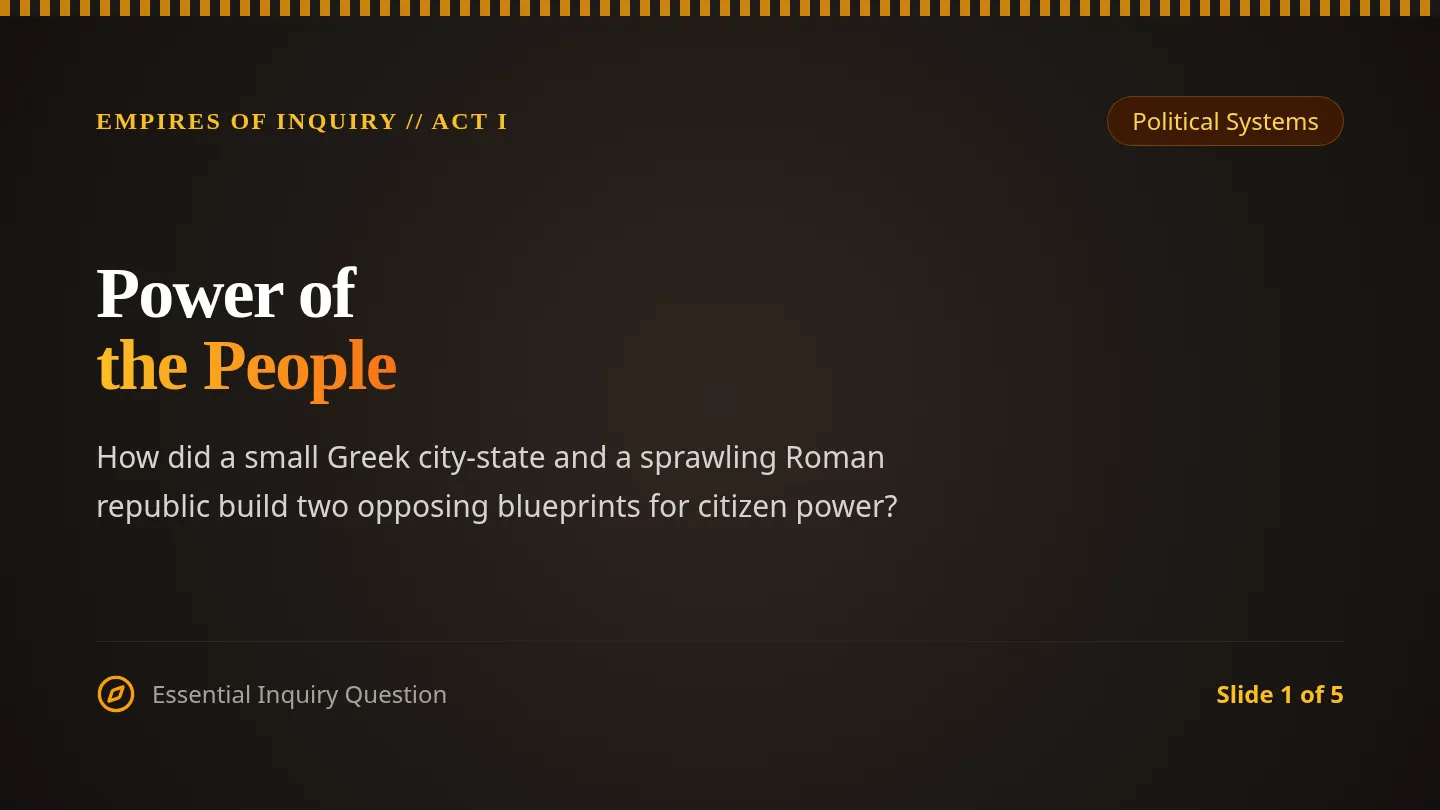
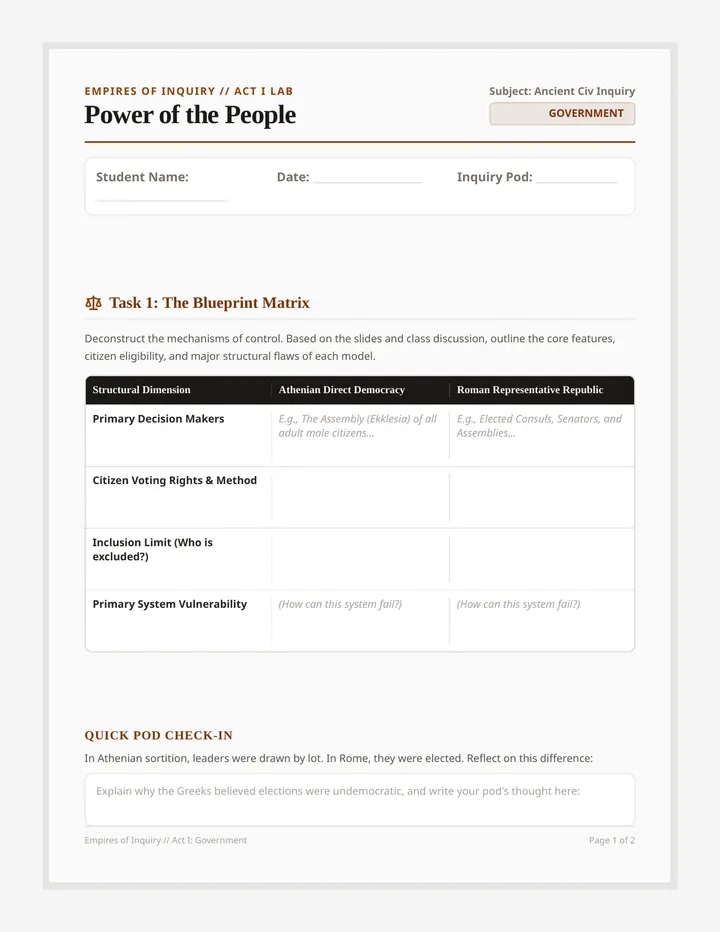
A deep dive into the peak of Athenian culture under Pericles and the eventual decline following the Peloponnesian War. Students explore democracy, architecture, and the cost of conflict.
A quick-fire guide for history educators on leveraging Google Arts & Culture's digital archives and virtual tours to enhance classroom engagement.
A deep dive into Maurice Ogden's 'The Hangman,' exploring the themes of bystander apathy, personal responsibility, and the historical parallels to the Holocaust, with a final bridge to modern civic duty in 2026.
This lesson explores the often-overlooked contributions of colonial subjects from Africa and Asia during World War I, highlighting their roles as soldiers and laborers on the global stage.