Matter Mystery Lab Worksheet Matter Mystery Lab
8th Grade Physical Science Investigation
Name:
Date:
Period:
Learning Targets
I can define matter as anything that has mass and takes up space.
I can describe the difference between atoms and molecules.
I can distinguish between pure substances and mixtures using evidence from observations and text.
Bellringer: Is Air Matter?
A student blows up a balloon and says, “Air is invisible, so it isn’t matter.” Do you agree or disagree? Explain your reasoning using what you know about mass and space .
Lab Station Materials
2 balloons • 1 ruler • tape & string (or pencil) • colored beads or mini marshmallows & toothpicks • 3 labeled cups: Sample A (table salt), Sample B (saltwater), Sample C (sand & water)
PART 1
Testing Air: Mass and Space
Procedure: Tape two empty balloons to opposite ends of a ruler and balance it on a pencil (or hang it by string at the center). Remove one balloon, blow it up, tie it, and re-tape it to the same end.
Setup Step
Balance Tilt (Mass)
Balloon Size (Space)
Both Balloons Empty
One Balloon Inflated
1. How does this test prove that air has mass and takes up space ?
2. Based on your observations, write a complete definition of matter in your own words:
PART 2
Modeling Atoms and Molecules
Procedure: Use colored beads or marshmallows for atoms (e.g., Red = Oxygen, White = Hydrogen) and toothpicks for chemical bonds . Build each model below, then sketch it in the box.
Model A: 2 Separate O Atoms
Model B: 1 Oxygen Molecule (O2)
Model C: 1 Water Molecule (H2O)
3. How is a molecule different from a single atom ? Use your models to explain.
PART 3
Pure Substances vs. Mixtures
Lab Field Brief: Read Before Classifying
A pure substance (an element or a compound) has a fixed composition and the exact same properties throughout. Its atoms are chemically bonded in a set ratio (like table salt, NaCl, or pure water, H2O) and cannot be separated by physical methods like filtering. A mixture contains two or more substances that are physically combined, not chemically bonded. Each substance keeps its own identity, the ratio can vary, and parts can often be separated physically (such as filtering sand or evaporating water).
Procedure: Inspect Samples A, B, and C. Classify each and support your claim with one observation and one piece of text evidence from the Field Brief.
Sample
Classification
Evidence from Observations & Field Brief Text
Sample A
Table Salt (NaCl)
Pure Substance
or
Mixture
Sample B
Saltwater
Pure Substance
or
Mixture
Sample C
Sand & Water
Pure Substance
or
Mixture
Matter Mystery Slides 8th Grade Physical Science
Matter Mystery Lab
Investigating mass, space, atoms, molecules, and how we classify the stuff around us.
Part 1: Balloon Balance • Part 2: Atom & Molecule Models • Part 3: Substance Classification
Learning Targets
I can define matter as anything that has mass and takes up space.
I can describe the difference between atoms and molecules.
I can distinguish between pure substances and mixtures using evidence from observations and text.
Bellringer: Is Air Matter?
A student blows up a balloon and says:
“Air is invisible, so it isn’t matter.”
Do you agree or disagree? Explain using what you know about mass and space .
Write your answer in the Bellringer box on Page 1 of your worksheet.
PART 1
Testing Air: Mass & Space
Lab Steps
Tape 2 empty balloons to opposite ends of a ruler and balance it on a pencil.
Remove one balloon, blow it up, tie it, and re-tape it to the same end.
Record how the balance tilts and how the balloon’s size changes.
What Does It Show?
Tilting down proves air has mass .Expanding proves air takes up space .Matter = anything with mass that takes up space!
PART 2
Modeling Atoms & Molecules
Use colored beads or marshmallows for atoms and toothpicks for chemical bonds . Build and sketch all three models:
Model A
2 Separate O Atoms
Single, unbonded building blocks
Model B
1 Oxygen Molecule (O2)
2 same atoms bonded together
Model C
1 Water Molecule (H2O)
Different atoms bonded in a set ratio
PART 3
Pure Substances vs. Mixtures
Pure Substance
• Fixed composition (set ratio)
• Atoms are chemically bonded
• Cannot be separated physically
Mixture
• Physically combined (not bonded)
• Ratio can vary; keeps identity
• Can be separated physically
Classify Samples A, B, and C using 1 observation + 1 piece of Field Brief text evidence .
Lab Debrief
Think Back to Our Bellringer:
1. How do we know air is matter even though we cannot see it?
2. Air contains nitrogen (N2), oxygen (O2), and carbon dioxide (CO2) mixed together. Is air a pure substance or a mixture ?
Matter Mystery Answer Key Matter Mystery Lab
8th Grade Physical Science Investigation
Answer Key
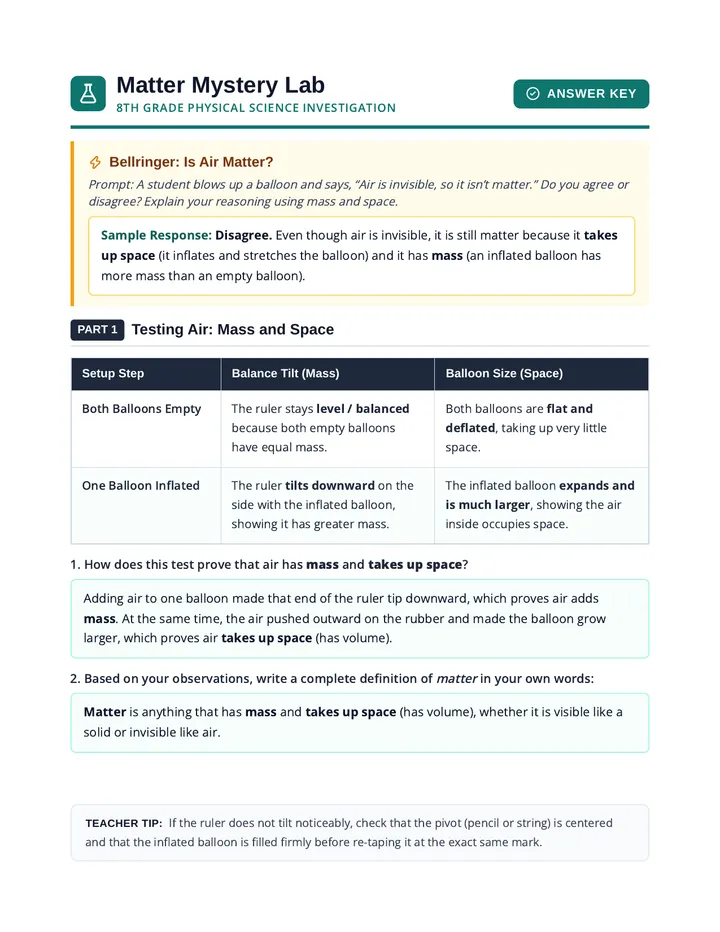
Bellringer: Is Air Matter?
Prompt: A student blows up a balloon and says, “Air is invisible, so it isn’t matter.” Do you agree or disagree? Explain your reasoning using mass and space.
Sample Response: Disagree. Even though air is invisible, it is still matter because it takes up space (it inflates and stretches the balloon) and it has mass (an inflated balloon has more mass than an empty balloon).
PART 1
Testing Air: Mass and Space
Setup Step
Balance Tilt (Mass)
Balloon Size (Space)
Both Balloons Empty
The ruler stays level / balanced because both empty balloons have equal mass.
Both balloons are flat and deflated , taking up very little space.
One Balloon Inflated
The ruler tilts downward on the side with the inflated balloon, showing it has greater mass.
The inflated balloon expands and is much larger , showing the air inside occupies space.
1. How does this test prove that air has mass and takes up space ?
Adding air to one balloon made that end of the ruler tip downward, which proves air adds mass . At the same time, the air pushed outward on the rubber and made the balloon grow larger, which proves air takes up space (has volume).
2. Based on your observations, write a complete definition of matter in your own words:
Matter is anything that has mass and takes up space (has volume), whether it is visible like a solid or invisible like air.
Teacher Tip: If the ruler does not tilt noticeably, check that the pivot (pencil or string) is centered and that the inflated balloon is filled firmly before re-taping it at the exact same mark.
PART 2
Modeling Atoms and Molecules
Model A: 2 Separate O Atoms
Model B: 1 Oxygen Molecule (O2)
Model C: 1 Water Molecule (H2O)
O
O
2 unbonded red atoms
|
O
O
2 red atoms bonded together
|
H
O
H
1 red atom bonded to 2 white atoms
|
3. How is a molecule different from a single atom ? Use your models to explain.
An atom is a single basic unit of matter (like one separate oxygen bead in Model A). A molecule is formed when two or more atoms are chemically bonded together (represented by toothpicks in Models B and C). Molecules can be made of the same kind of atom (O2) or different kinds of atoms (H2O).
PART 3
Pure Substances vs. Mixtures
Sample
Classification
Exemplar Evidence (Observation & Field Brief Text)
Sample A
Table Salt (NaCl)
Pure Substance
Observation: All grains look uniform (white crystals) and have the same properties throughout.
Text Evidence: The Field Brief states that a pure substance like NaCl has a “fixed composition” with atoms chemically bonded in a set ratio and cannot be separated physically.
Sample B
Saltwater
Mixture
Observation: Looks like clear liquid, but it is made of salt dissolved in water (and tastes salty / leaves salt behind if dried).
Text Evidence: The Field Brief states mixtures are physically combined, the “ratio can vary,” and parts can be separated physically by “evaporating water.”
Sample C
Sand & Water
Mixture
Observation: Sand settles at the bottom while water sits on top; two distinct parts are visible.
Text Evidence: The Field Brief states that in a mixture, “each substance keeps its own identity” and can be separated physically by “filtering sand.”