Kitchen Matter Lab Sheet Kitchen Matter Lab
8th Grade Science • 90-Minute Block Investigation
Name:
Date: Period:
Learning Targets
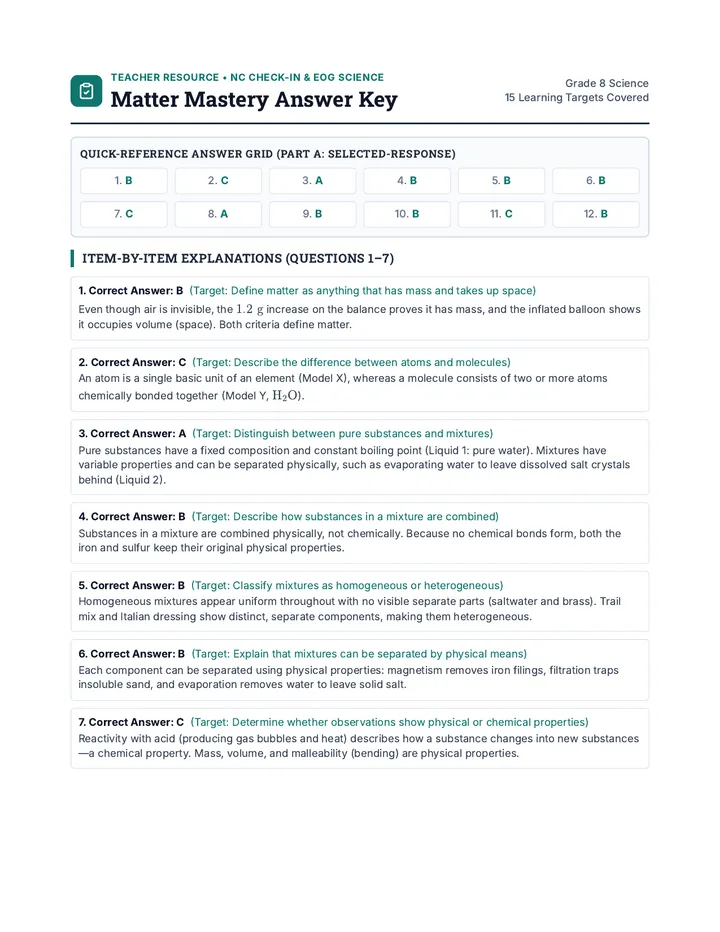
✓ I can describe physical and chemical properties of substances.
✓ I can make and record detailed observations of matter using scientific tools.
✓ I can determine whether observations show physical or chemical properties.
Bellringer: Two Mystery Liquids
10 Minutes (Work & Share)
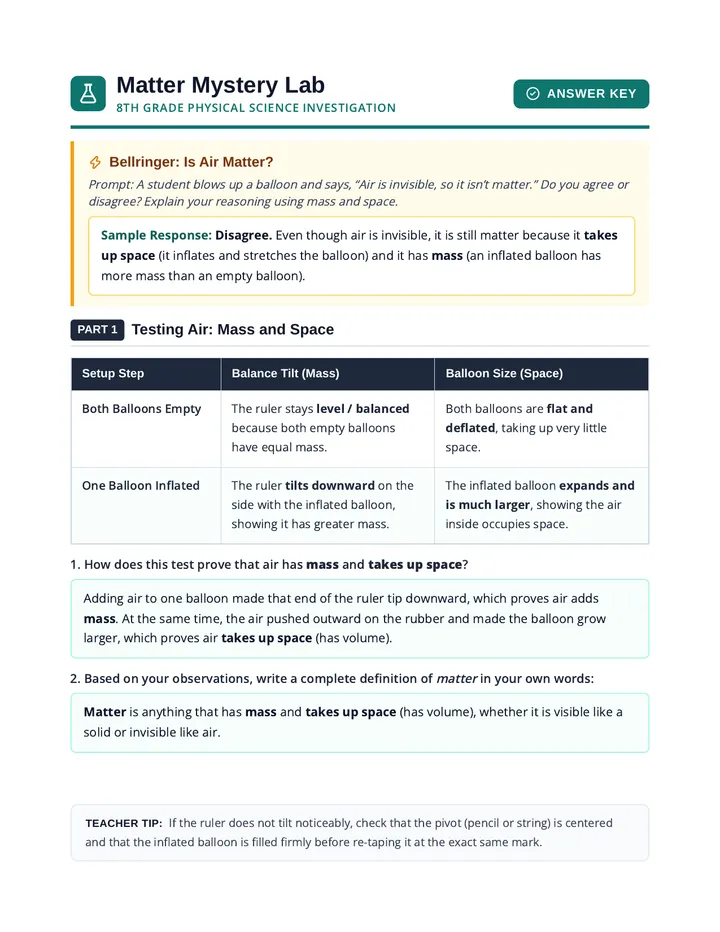
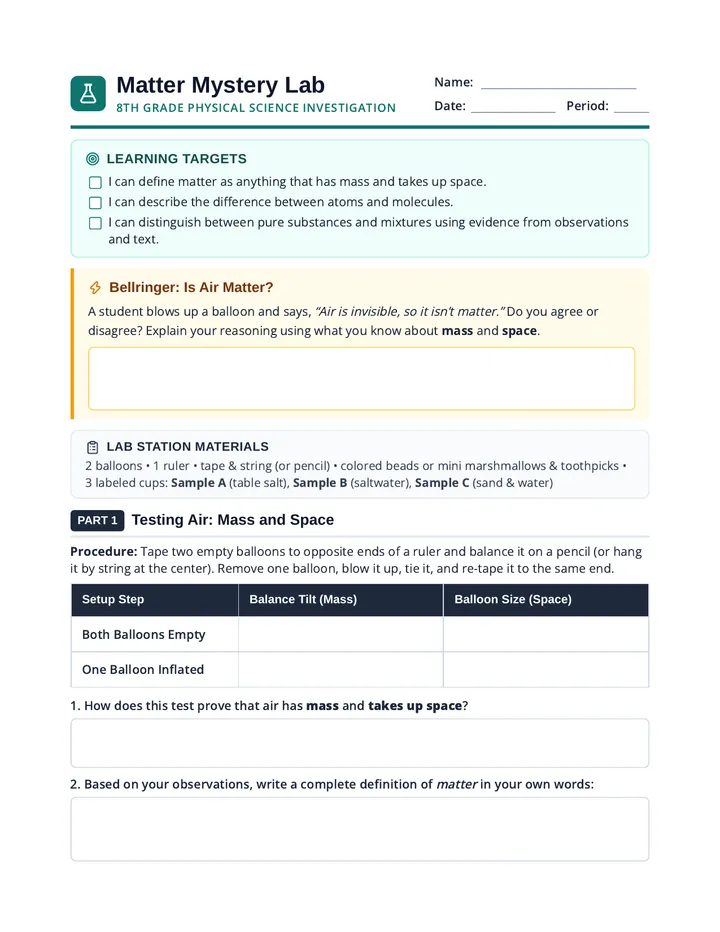
Imagine you have two clear liquids in unmarked cups: water and white vinegar . Without tasting them, how could you tell them apart? List two physical properties and one chemical property you could observe or test.
Household Substances & Tools
Substances: Table salt, baking soda, cornstarch, sugar, Mystery Powder, water, white vinegar
Tools: Hand lens, digital scale, thermometer, droppers, cups/well plate, toothpicks, timer
Lab Safety Rules
• Wear safety goggles at all times during the lab.
• Never taste any substance, even kitchen items.
• Use the wafting technique to check odors safely.
Lab Procedure (Parts 1 & 2)
Check Prepared Samples: Locate the pre-portioned, labeled cups of dry substances (table salt, baking soda, cornstarch, sugar) at your station. Use the digital scale to verify that each prepared sample has a constant mass of 2.0 g .Observe Physical Features: Examine each prepared sample with your eyes and a hand lens . Record color, texture, crystal/grain shape, and odor (by wafting) in the Data Table on Page 2.Water Test (Solubility): Use the prepared Water cup and a dropper to add 10 drops of water to the first set of labeled cups. Stir gently with a toothpick, start your timer for 30 seconds, and record if it dissolves.Vinegar Test (Reactivity & Temp): Measure the starting temperature of the prepared Vinegar cup with a thermometer . Use a clean dropper to add 10 drops of vinegar to the second set of cups and record bubbling, fizzing, or temperature changes.Part 2 — Mystery Powder: Test the pre-portioned Mystery Powder cup at your station using the same physical and chemical tests, then compare its properties to Part 1 to figure out what it is.
Kitchen Matter Lab — Data Collection Name:
Part 1: Observations of Household Matter
Constant Mass: 2.0 g per sample
| Substance
| | | |
| Baking Soda
Mass: 2.0 g
| | | |
| Cornstarch
Mass: 2.0 g
| | | |
| Sugar
Mass: 2.0 g
| | | |
Part 2: Mystery Powder Identification
Apply Your Data
Test your teacher's Mystery Powder (2.0 g) using your scientific tools. Record your observations below, then compare them to Part 1 to explain what it is or what it contains.
Physical Observations
Water Test
Vinegar Test
Claim: Our Mystery Powder is because:
Kitchen Matter Lab — Analysis & Exit Ticket Name:
Analysis & Conclusion
1. Which observations from Part 1 show physical properties ? Give two specific examples and explain why they are physical properties.
2. Which observation shows a chemical property ? Identify the substance and describe two pieces of evidence (including temperature or gas).
3. Tool Check: How did using scientific tools (hand lens, digital scale, thermometer, dropper) help you tell apart table salt and sugar ?
4. Explain: Why is dissolving salt or sugar in water a physical property instead of a chemical property?
Exit Ticket: Physical or Chemical?
Last 5 Minutes
Circle whether each observation describes a Physical or Chemical property.
A. Cornstarch is a smooth, bright white powder.
Physical Chemical
B. Baking soda fizzes and cools down when mixed with vinegar.
Physical Chemical
C. Sugar crystals dissolve completely in warm water.
Physical Chemical
Kitchen Matter Teacher Guide Kitchen Matter Teacher Guide
90-Minute Block Pacing, Prep & Answer Key
8th Grade Science
Suggested Pacing (90-Minute Block Period)
0–10 min
Bellringer
5 min independent writing; 5 min class share-out.
10–22 min
Targets & Safety
Review properties, wafting, scale & thermometer use.
22–62 min
Parts 1 & 2 Lab
Test 4 known solids, then identify Mystery Powder.
62–80 min
Analysis & CER
Complete questions 1–4 and peer-check evidence.
80–90 min
Debrief & Exit
Reveal Mystery Powder; complete Exit Ticket.
Household Materials (Per 8 Groups)
• Table Salt, Baking Soda, Cornstarch, Sugar: Pre-weigh 2.0 g per cup
• Mystery Powder: Pre-weigh 2.0 g per cup (see Page 2 key for Baking Powder, Powdered Sugar, or a 50/50 mix)
• White Vinegar & Tap Water: ~150 mL each in labeled cups
• Extras: Toothpicks, small cups or spot plates
Scientific Tools & Setup Tips
• Per Group: 1 hand lens, 1 thermometer, 2 droppers (labeled W and V), 1 timer.
• Shared: 2–4 digital scales so groups can verify the 2.0 g constant mass.
• Prep Tip: Hold back the Mystery Powder cups until groups finish Part 1 so they stay focused.
Bellringer Answer Key: Two Mystery Liquids
• Physical Properties: Vinegar has a strong, sharp odor (checked by wafting), whereas water is odorless. They also have different boiling points, freezing points, and densities.
• Chemical Property: Reactivity with baking soda—vinegar will fizz and produce gas bubbles, while water will not react.
Common Misconceptions & Differentiation
Misconception Alert (Dissolving): Students often think dissolving salt or sugar is a chemical change because the crystals "disappear." Emphasize that dissolving is a physical property (solubility) because no new substance forms.Support for Struggling Learners: Post an observation word bank (cubic crystals, fine powder, dissolves, cloudy, fizzes, temperature drops ) on the board.Extension: Challenge early finishers to write a 2-sentence explanation of why the baking soda + vinegar reaction feels cooler (endothermic reaction).
Kitchen Matter Teacher Guide — Answer Key Page 2 of 2
Part 1: Expected Data Table Observations
Substance
Physical Observations
Water Test (Solubility)
Vinegar Test (+ Temp)
Table Salt
2.0 g; white, tiny cubic crystals under hand lens; gritty; odorless.
Dissolves mostly or completely; clear liquid.
No fizzing; no significant temperature change.
Baking Soda
2.0 g; bright white fine powder; chalky; odorless.
Partially dissolves; slightly cloudy.
Reacts: vigorous fizzing (CO2 gas) and temp drops 1–3 °C.
Cornstarch
2.0 g; off-white ultra-fine powder; silky/squeaky; faint odor.
Does not dissolve; thick milky suspension.
No fizzing; milky mixture; no temp change.
Sugar
2.0 g; clear/white larger irregular crystals; gritty; faint sweet scent.
Dissolves completely when stirred; clear liquid.
No fizzing; slowly dissolves; no temp change.
Part 2: Mystery Powder Key (New Household Options)
Option A: Baking Powder
Fine white powder; fizzes in both water and vinegar because it already contains baking soda + a dry acid.
Option B: Powdered Sugar
Ultra-fine silky powder like cornstarch, but dissolves clear in water (like sugar) with no vinegar fizz.
Option C: 50/50 Mixture
Baking Soda + Cornstarch: turns milky/cloudy in water and fizzes vigorously in vinegar.
Analysis & Conclusion Answer Key
1. Physical Properties: Color, crystal shape, texture, mass (2.0 g), and solubility in water are physical properties because they can be observed or measured without changing the substance's identity.
2. Chemical Property & Evidence: Baking soda reacting with vinegar shows reactivity with acid. Evidence includes vigorous fizzing/bubbling (new gas produced) and a temperature drop.
3. Tool Check (Salt vs. Sugar): The hand lens showed regular cubic crystals in salt versus larger, irregular crystals in sugar; the scale kept both samples at 2.0 g for a fair test.
4. Dissolving Explanation: Dissolving is a physical property because no new substance is formed—if the water evaporates, the solid salt or sugar crystals remain.
Exit Ticket Answer Key
A. Physical (color & texture)
B. Chemical (gas & temp change)
C. Physical (solubility in water)
Kitchen Matter Slides 90-Minute Lab Investigation
Kitchen Matter Lab
Investigating Physical and Chemical Properties of Household Substances
8th Grade Physical Science • Materials: Lab Sheet & Pencil
Today's Learning Targets
✓
I can describe physical and chemical properties of substances.
✓
I can make and record detailed observations of matter using scientific tools.
✓
I can determine whether observations show physical or chemical properties.
Bellringer: Two Mystery Liquids
10 Minutes
Imagine you have two clear liquids in unmarked cups: water and white vinegar . Without tasting them, how could you tell them apart?
On your Lab Sheet, list two physical properties and one chemical property you could observe or test.
Physical vs. Chemical Properties
Physical Properties
Observed or measured without changing the identity of the substance.
• Color, texture, crystal shape
• Odor and mass (grams)
• Solubility (dissolving in water)
Chemical Properties
Describes how a substance reacts to form a brand-new substance.
• Reactivity with acid (vinegar)
• Signs: fizzing / gas bubbles
• Temperature change
Safety Rules & Your Lab Station
Lab Safety First
• Wear safety goggles at all times.
• Never taste any substance, even kitchen items.
• Use the wafting technique to check odors safely.
Prepared at Your Station
• 4 Known Solids (2.0 g each): Salt, Baking Soda, Cornstarch, Sugar
• Mystery Powder (2.0 g) + Water & Vinegar cups
• Tools: Hand lens, digital scale, thermometer, droppers, timer
Part 1: Physical Observations
Steps 1 & 2
Step 1: Verify Constant Mass
Use the digital scale to verify that each prepared cup of dry substance has a constant mass of 2.0 g .
Step 2: Observe Physical Features
Use your eyes and a hand lens to record color, texture, crystal/grain shape, and odor (by wafting) on Page 2.
Part 1: Water & Vinegar Tests
Steps 3 & 4
Step 3: Water Test
• Add 10 drops of water with a dropper.
• Stir gently with a toothpick.
• Time for 30 seconds and record solubility.
Step 4: Vinegar Test
• Check starting temp with a thermometer .
• Add 10 drops of vinegar with a clean dropper.
• Record fizzing, bubbles, or temp change.
Part 2: Mystery Powder Challenge
Test your pre-portioned 2.0 g Mystery Powder using the exact same tools and tests from Part 1.
On Page 2 of Your Lab Sheet:
1. Record physical observations, water test, and vinegar test.
2. Write a Claim explaining what your Mystery Powder is—or what it contains—using evidence from Part 1.
Wrap-Up: Analysis & Exit Ticket
Page 3: Analysis (18 min)
Answer Questions 1–4 using specific evidence from your data table, tools, and observations.
Exit Ticket (Last 5 min)
Complete the 3 classification items at the bottom of Page 3: Physical or Chemical property?