Property Detective Test
Matter & Properties Assessment • DOK Level 2
Property Detective Test
Name:
Date: Score: / 12
Directions: Read each short sentence describing a property of an object. Decide whether it describes a Physical Property or a Chemical Property, then write a brief reason explaining whether the substance's chemical identity changes.
Part 1: Classify & Justify (Questions 1–7)
- The copper roof turns green after years in the rain.
Physical Property Chemical Property
Reason:
- Aluminum foil bends easily into a tight ball without breaking.
Physical Property Chemical Property
Reason:
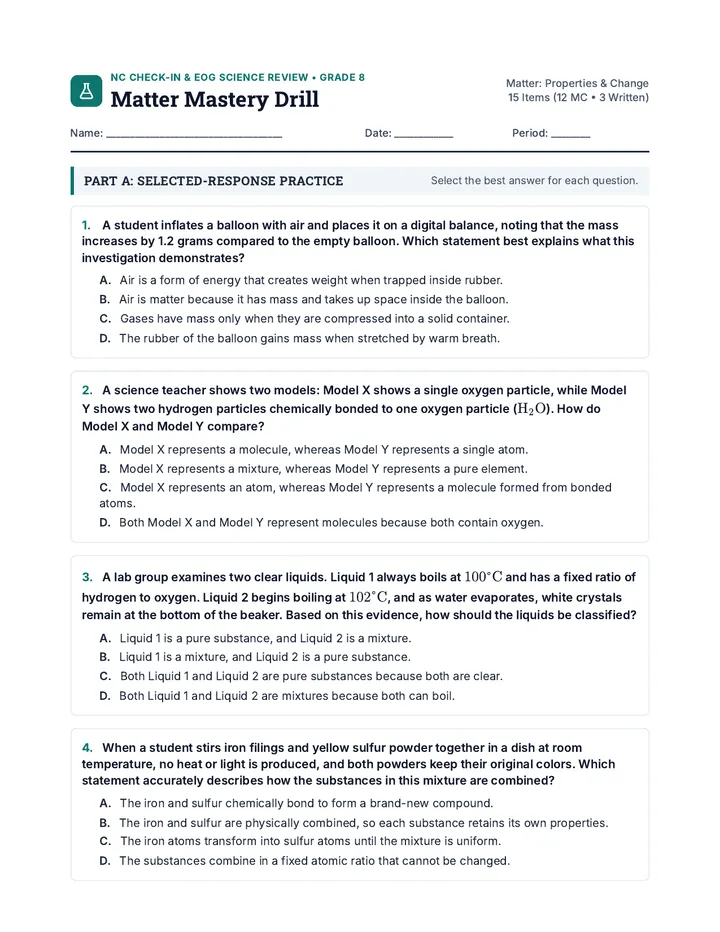
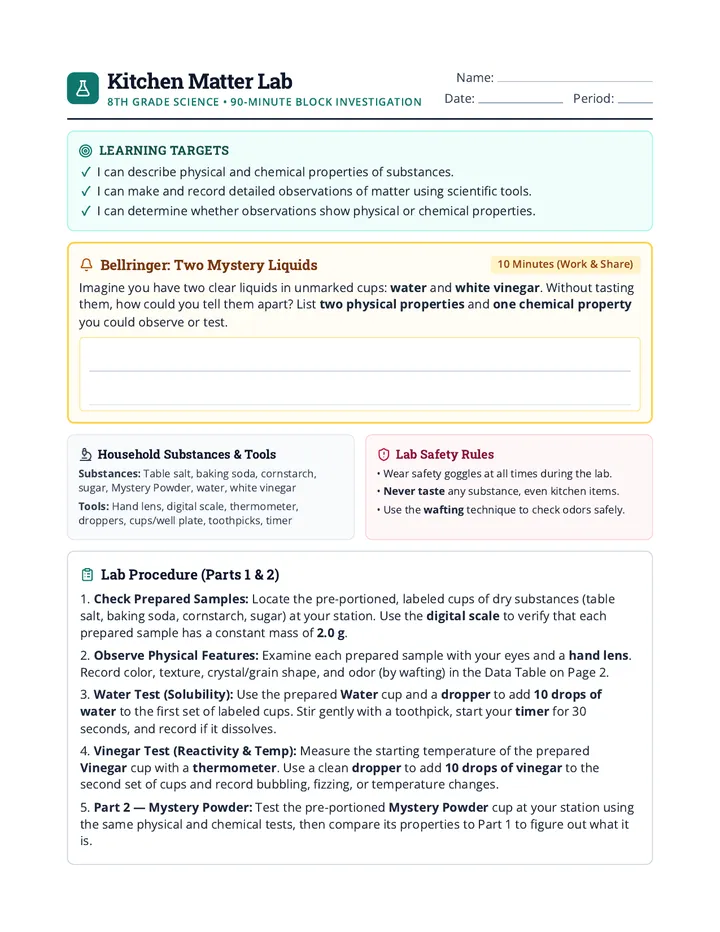
- Baking soda fizzes and releases gas when it touches vinegar.
Physical Property Chemical Property
Reason:
- The clear rubbing alcohol boils at 82°C.
Physical Property Chemical Property
Reason:
- Dry wood catches fire quickly when held near a spark.
Physical Property Chemical Property
Reason:
- The iron nail is pulled strongly toward a magnet.
Physical Property Chemical Property
Reason:
- A spoonful of sugar dissolves completely in warm tea.
Physical Property Chemical Property
Reason:
Property Detective Test — Page 2 Name:
- Silver spoons slowly turn dark when exposed to air over time.
Physical Property Chemical Property
Reason:
Part 2: DOK 2 Reasoning & Evidence (Questions 9–12)
- Read the sentence: "The glass marble sinks to the bottom of a bowl of water." Which choice correctly classifies this property and gives the best reason?
A. Physical property, because sinking depends on density and does not create a new substance.
B. Physical property, because the marble dissolves into the water as it sinks.
C. Chemical property, because gravity reacts with the glass to change its mass.
D. Chemical property, because the marble changes position when placed in water.
- Read the sentence: "Fresh apple slices turn brown after sitting on a plate for an hour." Which choice correctly classifies this property and gives the best reason?
A. Physical property, because only the temperature of the apple changes.
B. Physical property, because slicing the apple is a change in shape.
C. Chemical property, because the apple reacts with oxygen in the air to form new substances.
D. Chemical property, because the apple dries out and loses water into the air.
-
Compare these two sentences about a steel fork: Sentence X: The steel fork feels cold when you pick it up. Sentence Y: The steel fork rusts if left in salty water. Which sentence describes a chemical property, and what evidence tells you?
-
Read the sentence: "Butter melts into a puddle on warm toast." A student says this describes a chemical property because the butter changes from a solid to a liquid. Do you agree or disagree? Explain your reasoning.
Property Detective Answer Key
Teacher Resource • Matter Detective
Property Detective Answer Key
DOK Level 2 Focus
Classify using evidence of identity change
Part 1: Classify & Justify (1 pt classification + 1 pt rationale, or 1 pt total)
| # |
Property Sentence |
Answer |
DOK 2 Rationale (Sample Student Reasoning) |
| 1 |
The copper roof turns green after years in the rain. |
Chemical |
Copper reacts with air/moisture to form a new green substance (patina); identity changes. |
| 2 |
Aluminum foil bends easily into a tight ball without breaking. |
Physical |
Bending/malleability only changes shape; the foil is still aluminum. |
| 3 |
Baking soda fizzes and releases gas when it touches vinegar. |
Chemical |
Reactivity with acid produces a new gas (CO₂); new substances form. |
| 4 |
The clear rubbing alcohol boils at 82°C. |
Physical |
Boiling point is a state change (liquid to gas); it is still rubbing alcohol. |
| 5 |
Dry wood catches fire quickly when held near a spark. |
Chemical |
Flammability describes burning, which turns wood into new substances (ash, smoke, gases). |
| 6 |
The iron nail is pulled strongly toward a magnet. |
Physical |
Magnetism can be observed without changing the iron into a new substance. |
| 7 |
A spoonful of sugar dissolves completely in warm tea. |
Physical |
Solubility mixes sugar into tea without forming a new substance (sugar can be recovered). |
| 8 |
Silver spoons slowly turn dark when exposed to air over time. |
Chemical |
Tarnishing is a chemical reaction with sulfur/air that forms a new dark compound on silver. |
Part 2: DOK 2 Reasoning & Evidence
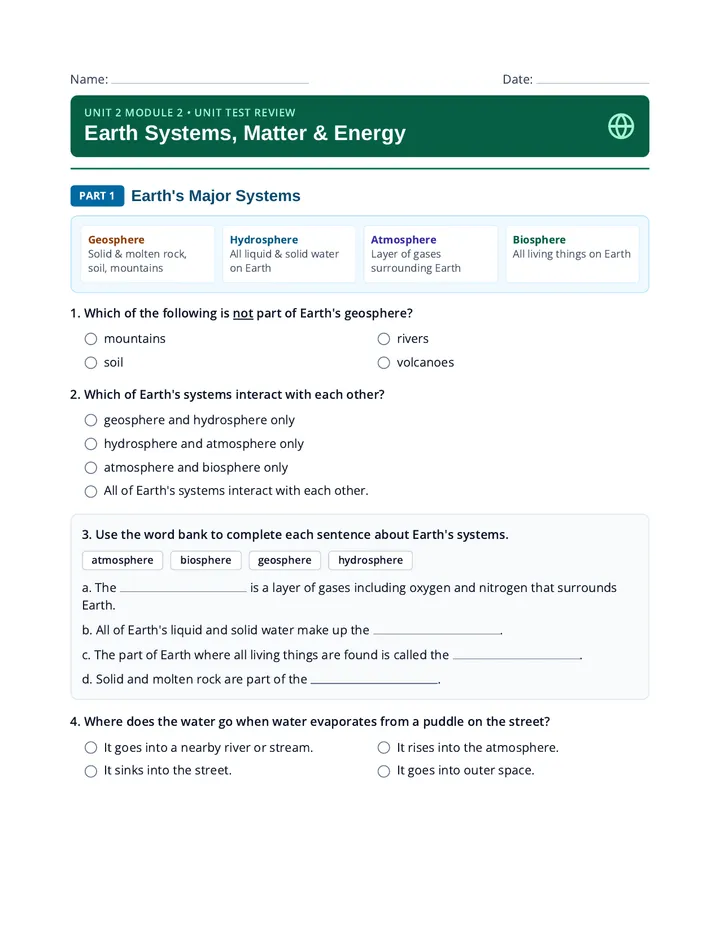
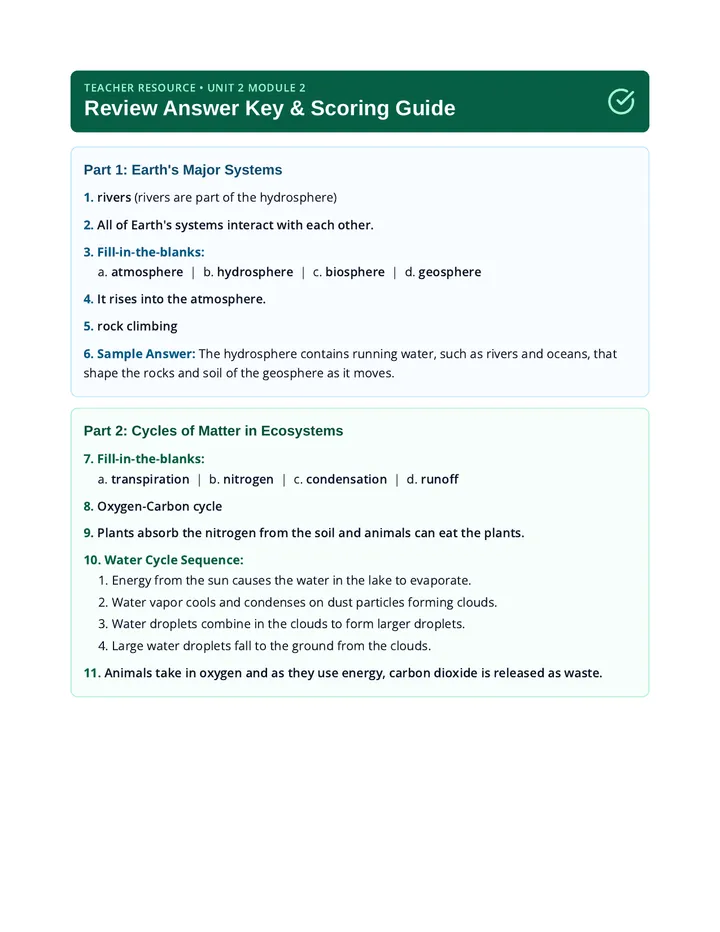
9. Answer: A — Physical property, because sinking depends on density and does not create a new substance. (Distractors B, C, D confuse dissolving, gravity, or position change with chemical reactions.)
10. Answer: C — Chemical property, because the apple reacts with oxygen in the air to form new substances. (Tests oxidation vs. physical changes like temperature, shape, or drying.)
11. Sample Response: Sentence Y describes a chemical property. Rusting happens when steel reacts with water and oxygen to form rust, which is a new substance. (Sentence X describes thermal conductivity/temperature, which is physical.)
12. Sample Response: Disagree. Melting is a physical property because changing from solid to liquid only changes the state of matter—the butter is still butter, and no new substance is formed.
Common Misconceptions to Watch For: Students often think phase changes (Q4 boiling, Q12 melting) or dissolving (Q7) are chemical properties because the object's appearance changes. Reinforce the DOK 2 rule of thumb: "Did the substance's chemical identity change, or is it still the same substance?"