Matter Mastery Drill Worksheet NC Check-In & EOG Science Review • Grade 8
Matter Mastery Drill
Matter: Properties & Change
15 Items (12 MC • 3 Written)
Name: ____________________________________
Date: ____________
Period: ________
Part A: Selected-Response Practice
Select the best answer for each question.
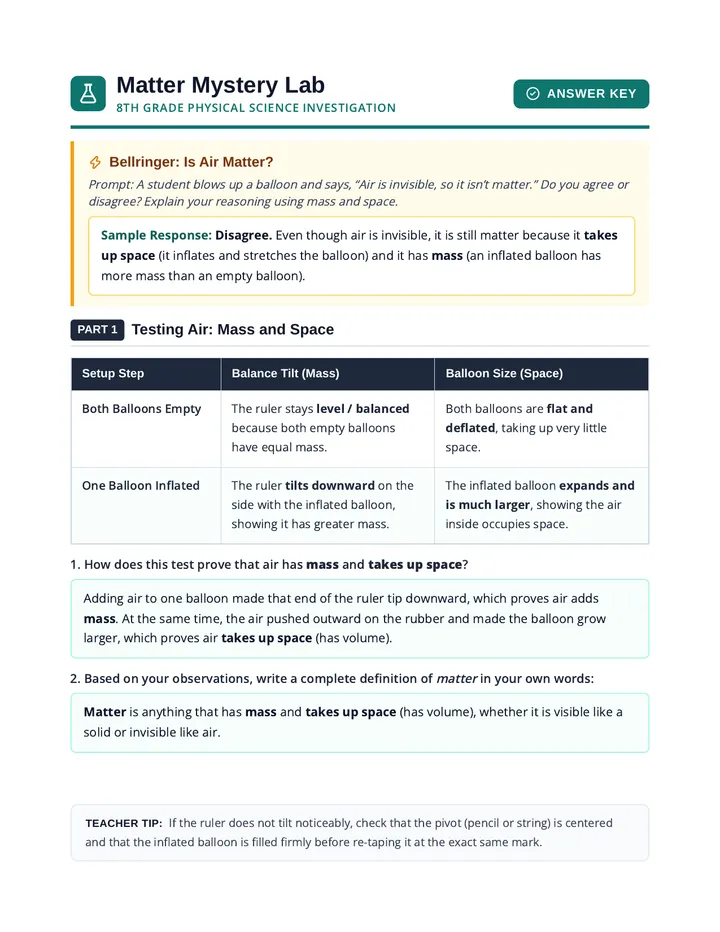
A student inflates a balloon with air and places it on a digital balance, noting that the mass increases by 1.2 grams compared to the empty balloon. Which statement best explains what this investigation demonstrates?
A. Air is a form of energy that creates weight when trapped inside rubber.
B. Air is matter because it has mass and takes up space inside the balloon.
C. Gases have mass only when they are compressed into a solid container.
D. The rubber of the balloon gains mass when stretched by warm breath.
A science teacher shows two models: Model X shows a single oxygen particle, while Model Y shows two hydrogen particles chemically bonded to one oxygen particle (\(\text{H}_2\text{O}\)). How do Model X and Model Y compare?
A. Model X represents a molecule, whereas Model Y represents a single atom.
B. Model X represents a mixture, whereas Model Y represents a pure element.
C. Model X represents an atom, whereas Model Y represents a molecule formed from bonded atoms.
D. Both Model X and Model Y represent molecules because both contain oxygen.
A lab group examines two clear liquids. Liquid 1 always boils at \(100^\circ\text{C}\) and has a fixed ratio of hydrogen to oxygen. Liquid 2 begins boiling at \(102^\circ\text{C}\), and as water evaporates, white crystals remain at the bottom of the beaker. Based on this evidence, how should the liquids be classified?
A. Liquid 1 is a pure substance, and Liquid 2 is a mixture.
B. Liquid 1 is a mixture, and Liquid 2 is a pure substance.
C. Both Liquid 1 and Liquid 2 are pure substances because both are clear.
D. Both Liquid 1 and Liquid 2 are mixtures because both can boil.
When a student stirs iron filings and yellow sulfur powder together in a dish at room temperature, no heat or light is produced, and both powders keep their original colors. Which statement accurately describes how the substances in this mixture are combined?
A. The iron and sulfur chemically bond to form a brand-new compound.
B. The iron and sulfur are physically combined, so each substance retains its own properties.
C. The iron atoms transform into sulfur atoms until the mixture is uniform.
D. The substances combine in a fixed atomic ratio that cannot be changed.
Matter Mastery Drill • Grade 8 Science Part A: Selected-Response
A student observes four samples: (1) trail mix with visible nuts and raisins, (2) saltwater that looks completely uniform, (3) Italian salad dressing with oil floating above vinegar and herbs, and (4) brass metal with an even golden appearance throughout. Which samples are classified as homogeneous mixtures?
A. Samples 1 and 3 only
B. Samples 2 and 4 only
C. Samples 1, 2, and 3
D. Samples 2, 3, and 4
A student accidentally spills a mixture of sand, table salt, and iron filings into a beaker of water. Which sequence of physical separation methods would best separate all three solids from the water?
A. Heat the mixture until everything melts, then pour off the iron.
B. Use a magnet to remove the iron, filter out the sand, and evaporate the water to collect the salt.
C. Filter out the salt first, evaporate the sand, and use a magnet to pull out the water.
D. Add vinegar to dissolve the iron and sand so only salt remains.
Lab Observation Log: Unknown Metal Strip (Use for Questions 7–8)
Test Number
Procedure / Tool Used
Recorded Observation
Test 1
Measured mass with digital balance; measured volume by water displacement in a graduated cylinder.
Mass = \(27.0\text{ g}\); Volume = \(10.0\text{ cm}^3\)
Test 2
Bent the strip gently with pliers.
Strip bent easily without breaking.
Test 3
Placed a small piece in hydrochloric acid.
Bubbles of gas formed rapidly and the strip warmed up.
Which test in the Lab Observation Log demonstrates a chemical property of the metal strip?
A. Test 1, because mass and volume change the identity of the metal.
B. Test 2, because bending the metal changes its chemical bonds.
C. Test 3, because bubbling and a temperature increase show a reaction with acid.
D. Tests 1 and 2, because both use scientific laboratory tools.
Based on Test 1, what is the density of the metal strip, and is density a physical or chemical property?
A. \(2.7\text{ g/cm}^3\); physical property, because it can be measured without changing the substance.
B. \(2.7\text{ g/cm}^3\); chemical property, because water displacement caused a reaction.
C. \(0.37\text{ g/cm}^3\); physical property, because it depends on the shape of the strip.
D. \(270\text{ g/cm}^3\); chemical property, because mass and volume are combined.
Matter Mastery Drill • Grade 8 Science Part A: Selected-Response
A student uses a hand lens to compare two white crystalline solids. Solid X has cubic, shiny crystals with sharp \(90^\circ\) edges. Solid Y has powdery, irregular grains with dull surfaces. Which statement best describes what the student recorded?
A. Chemical properties, because crystal shape indicates how a solid will burn.
B. Physical properties, because crystal shape and luster can be observed without changing identity.
C. Chemical changes, because using a hand lens alters the surface of the crystals.
D. Solubility rates, because shiny crystals always dissolve faster than dull grains.
Solubility Investigation: \(100\text{ mL}\) of Water at \(20^\circ\text{C}\) (Use for Questions 10–11)
Substance
Mass Added
Mass Dissolved
Observation After Evaporation
Table Salt
\(40\text{ g}\)
\(36\text{ g}\)
\(36\text{ g}\) of white cubic salt crystals remained.
Baking Soda
\(40\text{ g}\)
\(9.6\text{ g}\)
\(9.6\text{ g}\) of fine white powder remained.
What does the data in the table demonstrate about solubility?
A. All white solids have the exact same solubility in \(20^\circ\text{C}\) water.
B. Solubility is a characteristic physical property that differs between substances.
C. Baking soda is insoluble in water because less than \(40\text{ g}\) dissolved.
D. Solubility can only be measured after all the water has boiled away.
Which piece of evidence from the investigation best supports the claim that dissolving table salt in water is a physical change ?
A. The water remained clear while the salt disappeared from view.
B. Only \(36\text{ g}\) of the \(40\text{ g}\) sample dissolved at \(20^\circ\text{C}\).
C. After the water evaporated, the original \(36\text{ g}\) of cubic salt crystals were recovered unchanged.
D. Both table salt and baking soda were tested in \(100\text{ mL}\) of water.
A student tests an unknown white powder and compares its properties to three known substances in the table below. Based on the data, what is the identity of the unknown powder?
Substance
Solubility in Water
Reaction with Vinegar
Reaction with Iodine
Cornstarch
Insoluble (cloudy)
No reaction
Turns dark blue-black
Baking Soda
Partially soluble
Fizzes vigorously
Stays brown
Powdered Sugar
Highly soluble
No reaction
Stays brown
Unknown Powder
Insoluble (cloudy)
No reaction
Turns dark blue-black
A. Baking Soda
B. Cornstarch
C. Powdered Sugar
D. A mixture of baking soda and sugar
Matter Mastery Drill • Grade 8 Science Part B: Constructed-Response
Part B: Lab Analysis & Evidence-Based Writing
Write complete, clear responses in the boxes below.
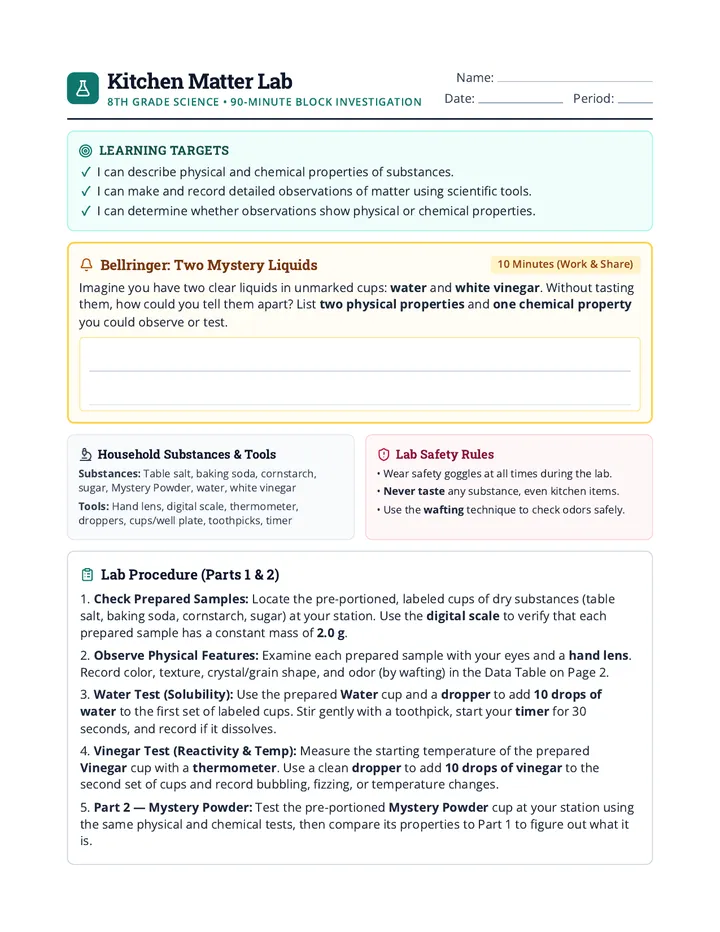
A student is given a sample of clear quartz crystals and asked to record detailed physical observations using scientific tools. Name two scientific tools the student could use and describe one specific physical property each tool measures or helps observe.
A student tests three known powders (A, B, C) and one unknown powder (U) with water, vinegar, and heat:
Organize the reaction data for Powders A, B, C, and U into the table below.
Powder
Water Test
Vinegar Test
Heat Test
Powder A
Powder B
Powder C
Powder U
Using the data you organized in Question 14, write a Claim-Evidence-Reasoning (CER) conclusion identifying Powder U . State your claim, cite at least two pieces of evidence from the tests, and explain how those physical and chemical properties identify the substance.
Matter Mastery Answer Key Teacher Resource • NC Check-In & EOG Science
Matter Mastery Answer Key
Grade 8 Science
15 Learning Targets Covered
Quick-Reference Answer Grid (Part A: Selected-Response)
B
C
A
B
B
B
C
A
B
B
C
B
Item-by-Item Explanations (Questions 1–7)
1. Correct Answer: B (Target: Define matter as anything that has mass and takes up space)
Even though air is invisible, the \(1.2\text{ g}\) increase on the balance proves it has mass, and the inflated balloon shows it occupies volume (space). Both criteria define matter.
2. Correct Answer: C (Target: Describe the difference between atoms and molecules)
An atom is a single basic unit of an element (Model X), whereas a molecule consists of two or more atoms chemically bonded together (Model Y, \(\text{H}_2\text{O}\)).
3. Correct Answer: A (Target: Distinguish between pure substances and mixtures)
Pure substances have a fixed composition and constant boiling point (Liquid 1: pure water). Mixtures have variable properties and can be separated physically, such as evaporating water to leave dissolved salt crystals behind (Liquid 2).
4. Correct Answer: B (Target: Describe how substances in a mixture are combined)
Substances in a mixture are combined physically, not chemically. Because no chemical bonds form, both the iron and sulfur keep their original physical properties.
5. Correct Answer: B (Target: Classify mixtures as homogeneous or heterogeneous)
Homogeneous mixtures appear uniform throughout with no visible separate parts (saltwater and brass). Trail mix and Italian dressing show distinct, separate components, making them heterogeneous.
6. Correct Answer: B (Target: Explain that mixtures can be separated by physical means)
Each component can be separated using physical properties: magnetism removes iron filings, filtration traps insoluble sand, and evaporation removes water to leave solid salt.
7. Correct Answer: C (Target: Determine whether observations show physical or chemical properties)
Reactivity with acid (producing gas bubbles and heat) describes how a substance changes into new substances—a chemical property. Mass, volume, and malleability (bending) are physical properties.
Matter Mastery Answer Key • Grade 8 Science Part A (8–12) & Part B Exemplars
Item-by-Item Explanations (Questions 8–12)
8. Correct Answer: A (Target: Describe physical and chemical properties; record observations with tools)
Density \(= \frac{\text{mass}}{\text{volume}} = \frac{27.0\text{ g}}{10.0\text{ cm}^3} = 2.7\text{ g/cm}^3\). Density is a physical property because measuring mass and volume does not alter the metal's chemical identity.
9. Correct Answer: B (Target: Observe and describe physical properties of crystalline solids)
Crystal geometry, edge angles, and luster (shiny vs. dull) are observable physical properties of crystalline solids.
10. Correct Answer: B (Target: Measure and record solubility as a physical property)
At \(20^\circ\text{C}\), \(36\text{ g}\) of table salt dissolved in \(100\text{ mL}\) of water compared to only \(9.6\text{ g}\) of baking soda, showing that solubility is a measurable, characteristic physical property.
11. Correct Answer: C (Target: Support that dissolving is a physical change)
Recovering the exact \(36\text{ g}\) of unchanged cubic salt crystals after evaporation proves no new substance formed; dissolving is reversible and physical.
12. Correct Answer: B (Target: Identify an unknown substance using characteristic properties)
The unknown powder matches cornstarch across every test: insoluble in water (cloudy), no reaction with vinegar, and turns dark blue-black with iodine.
Part B: Constructed-Response Scoring Guide & Exemplars
13. Tools & Physical Properties (2 pts) (Target: Record detailed observations using scientific tools)
Exemplar: A student could use a hand lens (or microscope) to observe crystal shape, luster, and sharp edges, and a digital balance to measure mass (or a graduated cylinder for volume via water displacement). Accept any two valid scientific tools paired with accurate physical properties.
14. Data Organization Table (2 pts) (Target: Collect and organize data to compare reactions)
Powder
Water Test
Vinegar Test
Heat Test
Powder A
Dissolves
No reaction
Melts and turns brown
Powder B
Dissolves
Fizzes
No change
Powder C
Does not dissolve
Fizzes
Turns gray
Powder U
Dissolves
Fizzes
No change
15. CER Conclusion (3 pts: 1 pt Claim, 1 pt Evidence, 1 pt Reasoning) (Target: Support conclusion with evidence and reasoning)
Exemplar: Claim: Powder U is Powder B. Evidence: Both Powder U and Powder B dissolve in water, fizz with vinegar, and show no change when heated. Reasoning: Because every pure substance has unique characteristic physical (solubility) and chemical (reactivity with vinegar and heat) properties, matching all three test results identifies Powder U as Powder B.
Matter Mastery Review Slides Grade 8 Science • NC Check-In & EOG
Matter Mastery Review
Properties, Mixtures, Solubility & Evidence-Based Lab Analysis
15 Learning Targets • Key Concepts & Lab Evidence • CER Strategy
Building Blocks of Matter
Matter, Atoms & Molecules
What Is Matter?
Anything that has mass and takes up space (volume).
Example: Air inside an inflated balloon increases the mass on a balance and fills space.
Atoms vs. Molecules
Atom: The smallest single unit of an element (e.g., 1 oxygen atom).Molecule: Two or more atoms chemically bonded together (e.g., \(\text{H}_2\text{O}\)).
EOG Tip: If particles are chemically bonded in a fixed ratio, they form a molecule or compound.
Classification of Matter
Pure Substances vs. Mixtures
Pure Substance
• Fixed, uniform composition throughout
• Constant boiling & melting points
• Cannot be separated by physical means
• Examples: Distilled water, pure oxygen, table salt
Mixture
• Substances combined physically , not chemically
• Each substance keeps its own properties
• Can be separated by physical methods
• Examples: Saltwater, trail mix, iron + sulfur
Evidence Check: Evaporating a clear liquid and finding white crystals proves it was a mixture!
Observable Patterns & Separation
Types of Mixtures & Physical Separation
Homogeneous Mixture
Looks completely uniform throughout; separate parts are not visible (e.g., saltwater, brass).
Heterogeneous Mixture
Different parts are visibly distinct or settle into layers (e.g., trail mix, oil & vinegar).
Physical Separation
Magnet: Pulls out magnetic iron filingsFilter: Traps insoluble solids like sandEvaporation: Leaves dissolved salt behind
Observing Matter
Physical vs. Chemical Properties
Physical Properties
Observed or measured without changing the substance's identity.
• Mass, volume & density
• Crystal shape & luster
• Solubility & melting point
• Malleability (bending)
Chemical Properties
Describe how a substance reacts to form a new substance.
• Fizzing/gas bubbles with acid
• Color change with iodine
• Flammability (burning)
• Temperature change in reaction
Lab Skills & Observations
Scientific Tools & Crystalline Solids
Hand Lens
Reveals crystal geometry, sharp edges, and surface luster (shiny vs. dull).
Digital Balance
Measures exact mass in grams (\(\text{g}\)) for density and solubility tests.
Graduated Cylinder
Measures liquid volume (\(\text{mL}\)) or solid volume by water displacement.
Formula Reminder: \(\text{Density} = \frac{\text{Mass}}{\text{Volume}}\) — a characteristic physical property!
Physical Change in Action
Solubility & Dissolving
Solubility
How much solute dissolves in a given amount of solvent at a specific temperature.
Different substances have different solubilities (e.g., \(36\text{ g}\) salt vs. \(9.6\text{ g}\) baking soda in \(100\text{ mL}\) water).
Why Is Dissolving Physical?
• No new substance is created
• Evaporating the water recovers the exact original crystals unchanged
Lab Conclusion Strategy
Identifying Unknowns with CER
1. Claim
State the identity of the unknown substance clearly and directly.
2. Evidence
Cite specific data from organized tables (solubility, vinegar, heat, iodine).
3. Reasoning
Explain that matching characteristic physical & chemical properties proves identity.
Ready for the Drill: Use your data tables carefully and back up every conclusion with evidence!