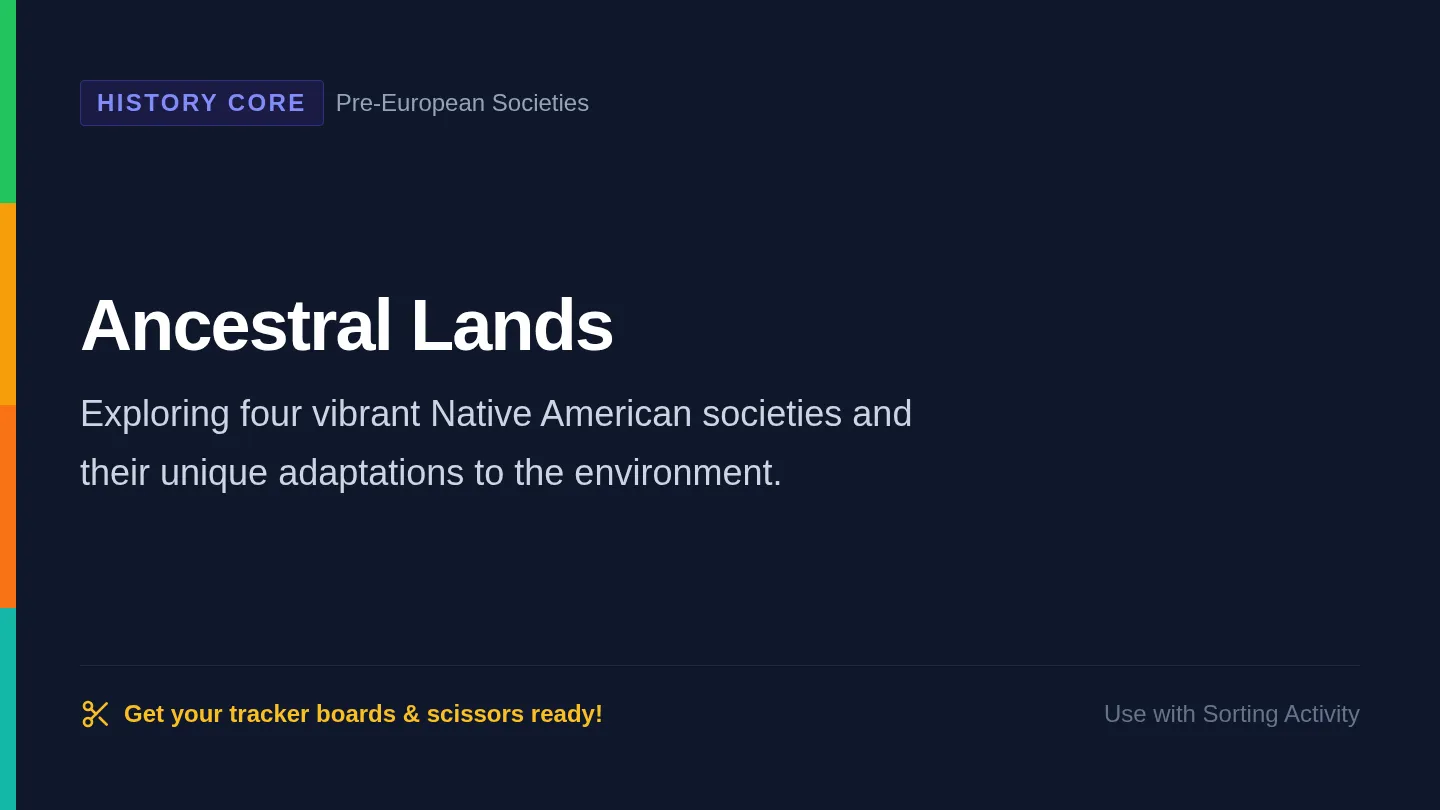
Hominin Quest Slides
// COGNITIVE REVOLUTION //
// PLEISTOCENE EPOCH //
Tribe Survival Challenge
V1.0
Hominin Quest
An interactive prehistoric survival game. Lead your tribe through extreme climate shifts, cultural discoveries, and archaeological mysteries. Will your legacy endure?
5 Key Concepts 5 Game Scenarios
Tribe Leaders: Ready Your Councils
Game Rules
Survival Guide
How to Play
- 1 Split the class into Tribe Teams. Each tribe starts with 10 Survival Points.
- 2 Review each scenario. Discuss the survival dilemma with your tribe council.
- 3 Cast your tribe's vote for Option A or Option B.
- 4 Earn points for smart decisions, and complete matching tasks to secure survival!
Key Vocabulary Words
Your decisions will depend on mastering these 5 core prehistoric concepts:
1. Hominin — Early human ancestor or relative.
2. Climate — Long-term weather patterns over time.
3. Archaeology — Study of past human life through artifacts.
4. Culture — Shared beliefs, customs, arts, and behaviors.
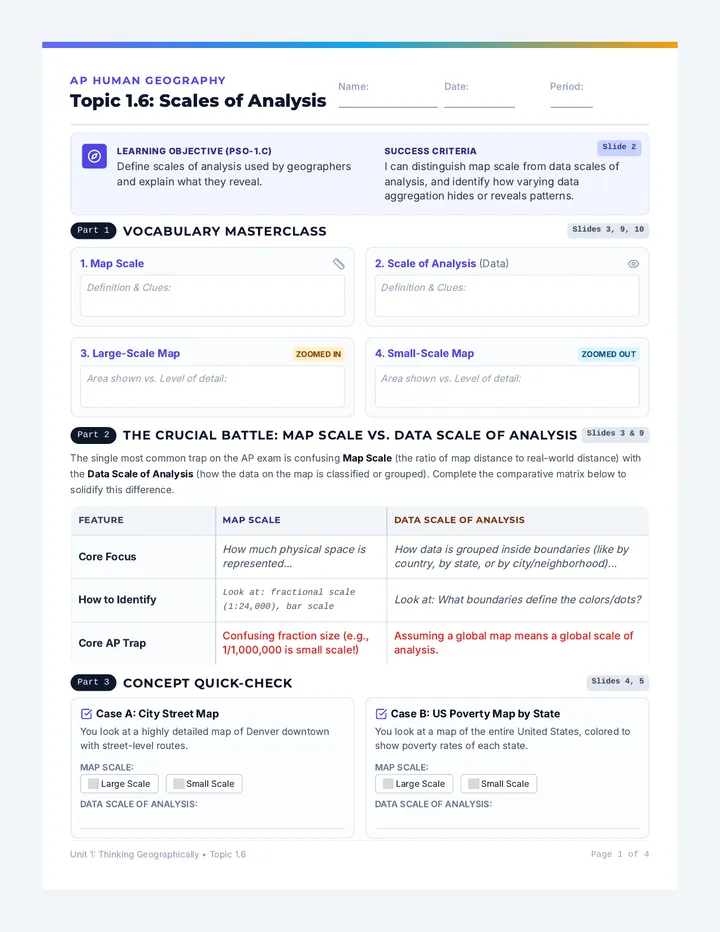
5. Civilization — Advanced, organized, settled human society.
Prepare your councils. First challenge is ahead! Tribe Status: Ready
Scenario 1: The Great Freeze
Concept: CLIMATE
The Ice Age Deepens
A Century-Long Winter Begins
Over several generations, the average regional temperature plummets. Heavy snow blocks old game paths, and frozen winds pierce your temporary hide tents. The local climate—the long-term weather patterns—is shifting drastically. If your tribe stays here unprepared, you will freeze.
CLIMATE DILEMMA
How will your tribe adapt to the rapidly shifting environmental conditions?
OPTION A
Migrate Southward
Pack up camp and move over the southern mountains to seek warmer, stable conditions. It is a risky, exhausting trek.
OPTION B
Build Rock Shelter Caves
Stay put. Reinforce local caves with massive limestone barriers, stoke fires, and develop thick multi-layered clothing.
Which strategy guarantees safety against harsh climate shifts? Vote now! Reward: +3 Survival Points
Scenario 2: The Forest Strangers
Concept: HOMININ
Ancient Relatives
An Encounter in the Mist
While searching for fresh water, your hunters discover tracks of another bipedal species. Hidden behind heavy branches, you observe them. They are muscular, have prominent brow ridges, and use sharp flint spears. This group is another hominin group—a close relative in our human evolutionary family tree.
HOMININ INTERACTION
How should your tribe interact with this neighboring early human species?
OPTION A
Initiate Trade & Cooperation
Approach slowly with peaceful body language, offering flint stones and dried berries in exchange for their fishing techniques.
OPTION B
Establish Territory Margins
Set up warning markers around your valley. Avoid direct contact to prevent conflict over hunting grounds and resources.
How does sharing knowledge with another hominin group affect survival? Vote now! Reward: +3 Survival Points
Scenario 3: The Buried Weapons
Concept: ARCHAEOLOGY
Unearthing Secrets
An Ancient Cache in the Mud
While digging for edible tubers along the riverbed, your youth uncover a cluster of strange, expertly-shaped obsidian handaxes buried deep under clay layers. Examining physical remains of previous human life like this is basic archaeology. These tools belong to a long-gone generation.
ARCHAEOLOGICAL STUDY
What will you do with this treasure trove of ancient technology and historical information?
OPTION A
Examine & Master the Craft
Carefully extract every piece, study how they were knapped, replicate the technique to upgrade your tribe's current arsenal.
OPTION B
Equip Immediately
Distribute the pre-made spears directly to your hunting party without wasting time investigating how they were designed or buried.
How does practicing archaeology benefit your long-term technological progress? Vote now! Reward: +3 Survival Points
Scenario 4: The Painted Cave
Concept: CULTURE
Beliefs & Expression
A Sanctuary of Clay & Ash
Deep within a twisting limestone cave, you find magnificent drawings of bison, deer, and hand stencils blown with red ochre. This sacred place tells the story of early human culture—their shared rituals, artistic expressions, beliefs, and way of understanding the universe.
CULTURAL PATH
How should your tribe integrate the power of culture into their daily survival?
OPTION A
Develop Painting & Rituals
Adopt the cave art tradition. Develop symbolic rituals and hunting songs to bind your tribe together and build collective memory.
OPTION B
Focus on Practical Tasks
Ignore the drawings. Focus all energy strictly on practical tasks: skinning animal hides and gathering timber for firewood.
Does rich culture strengthen social trust and cooperation in a crisis? Vote now! Reward: +3 Survival Points
Scenario 5: The Great Settlement
Concept: CIVILIZATION
The First Cities
Sowing the Seeds of Permanence
Your tribe has domesticated edible grains and developed advanced livestock containment. Families no longer need to wander the dangerous grasslands. You are on the verge of forming a true civilization—an organized, settled society with structured rules, divisions of labor, and a central village square.
CIVILIZATION GROWTH
How will you govern this new settled community to ensure order and fair sharing?
OPTION A
Build Granaries & Code of Rules
Construct massive communal mudbrick silos to store grain reserves and carve a simple legal code on an upright monument stone.
OPTION B
Rely on Individual Silos
Allow each family to build their own independent food bins without community regulations or shared rules. Keep government minimal.
What kind of systems make a complex civilization survive a bad harvest season? Vote now! Reward: +3 Survival Points
Tribe Verdict
Debrief
Did Your Tribe Survive?
Tribe Leaders, calculate your final Survival Score using your student worksheet.
Survival Status Scale:
- 🥇 22-25 Points: Legendary Civilization
- 🥈 18-21 Points: Resilient Hominin Tribe
- 🥉 15-17 Points: Barely Survived the Era
- 💀 Under 15 Points: Extinct Artifacts Only
Discussion Council
Reflect with your peers on how these concepts interact:
1. How does a changing climate impact where a hominin species lives?
2. Why does culture help humans form a large, complex civilization?
3. What is the role of archaeology in reconstructing these lost stories?
Excellent work, Tribe Councils! Complete your Quest Worksheet to finish. GAME COMPLETE
Survival Quest Worksheet
Student Field Guide
Level 1: Recall & Track
Hominin Quest
Prehistoric Survival Tracker & Vocabulary Log
Name: ___________
Date: ___________
Tribe Name: _____________________
Part 1: Tribe Quest Log & Points
Track your tribe's decisions during the slide game. Start with 10 Points. Record the choice made (A or B), explain your choice, and tally your points.
| Quest | Concept | Vote (A/B) | Why did your tribe select this? | Points +/- |
|---|
| Starting Survival Points Balance | 10 pts | | | |
| 1 | CLIMATE | ___ | __________________________________________ | ______ |
| 2 | HOMININ | ___ | __________________________________________ | ______ |
| 3 | ARCHAEOLOGY | ___ | __________________________________________ | ______ |
| 4 | CULTURE | ___ | __________________________________________ | ______ |
| 5 | CIVILIZATION | ___ | __________________________________________ | ______ |
| FINAL SURVIVAL POINTS TOTAL: | __________ | | | |
Part 2: Prehistoric Vocabulary Match-Up
Write the letter of the correct definition next to each core survival term.
___
1. Archaeology
___
2. Civilization
___
3. Climate
___
4. Culture
___
5. Hominin
A. Shared beliefs, traditions, languages, rituals, art, and learned behaviors of a distinct group.
B. Any member of the family of early human relatives or human ancestors who walked upright.
C. The scientific recovery and analytical study of fossil remains and artifacts from past human life.
D. An advanced, stable, settled human society marked by complex city structures and government.
E. The general weather and atmospheric conditions of a particular geographic region over long periods.
Quest Master Teacher Guide
Educator Guide
Teacher Resource
Quest Master Guide
Hominin Quest Game Facilitation & Answer Keys
Subject: Early Human History
Target Words: 5 Core Terms
Format: Interactive Game
Game Setup & Classroom Dynamics
Hominin Quest is an interactive vocabulary-acquisition game. Instead of passive memorization, students work in small groups ("Tribes") to navigate survival scenarios that illustrate the practical meanings of climate, hominin, archaeology, culture, and civilization.
Step 1: Divide and Name
Split students into teams of 3–5. Have them write their names and choose a creative prehistoric tribe name (e.g., The Flintcarvers or Saber-Tooth Clan) on Page 1 of their worksheets.
Step 2: Set the Stage
Project the Hominin Quest Slides. Give each tribe 1–2 minutes of discussion time per scenario to analyze the choices based on the core definition spotlighted.
Step 3: Vote & Score
Prompt tribes to lock in their choice on their tracker. Reveal the outcomes (see Page 2 of this guide), adjust their score balance, and prompt them to jot down their reasoning briefly.
Step 4: Individual Review
After finishing all 5 slides, have students complete Part 2 (Matching), Part 3 (Context Clues), and Part 4 (Sentences) individually or as a tribe team.
Pacing, Scoring, & Pedagogy
Approximate Session Duration: 45–60 minutes.
- Introduction & Rules (Slides 1-2): 5–7 minutes.
- Gameplay Scenarios (Slides 3-7): 20–25 minutes.
- Scoring and Debrief (Slide 8): 10 minutes.
- Worksheet Completion & Extension: 15 minutes.
Key Pedagogy Tip: Emphasize that there is no absolute "incorrect" choice. Rather, the point values represent the historical trade-offs between biological adaptation and social-cultural development.
Points Matrix
| Scenario | Opt A | Opt B |
|---|
| 1 (Climate) | +3 pts | +1 pt |
| 2 (Hominin) | +3 pts | +2 pts |
| 3 (Archaeology) | +3 pts |
Survival Vocabulary Flashcards
Prehistoric Lexicon Practice Fold-Over Double-Sided Cards
Survival Vocabulary Flashcards (Set A)
Cut along the solid black lines and fold down the middle dashed line. Glue the sides together to create heavy-duty, double-sided study cards.
Tribe Front
Hominin
[ hom-uh-nin ]
Card #1 Hominin Quest
Tribe Back
Definition
Any member of the biological family of early human relatives or upright-walking ancestors.
In a Sentence
"The archaeologists unhitched fossil footprints proving the early hominin walked upright."
Self-Test: Name one other hominin species!
Tribe Front
Climate
[ klahy-mit ]
Card #2 Hominin Quest
Tribe Back
Definition
The long-term weather and atmospheric conditions of a particular region over periods of decades or centuries.
In a Sentence
"As the global climate turned dry, grasslands replaced the lush forest landscapes."
Self-Test: Difference between weather and climate?
Tribe Front
Archaeology
[ ahr-kee-ol-uh-jee ]
Card #3 Hominin Quest
Tribe Back
Definition
The scientific study of past human life and history by retrieving and analyzing physical remains and artifacts.
In a Sentence
"Thanks to archaeology, we can study cave fireplaces built fifty thousand years ago."
Self-Test: Name two objects archaeologists dig up.
Turn page for Culture, Civilization, and Study Trackers Page 1 of 2
Prehistoric Lexicon Practice Fold-Over Double-Sided Cards
Survival Vocabulary Flashcards (Set B)
Cut along the solid black lines and fold down the middle dashed line. Glue the sides together to complete your survival set.
Tribe Front
Culture
[ kuhl-cher ]
Card #4 Hominin Quest
Tribe Back
Definition
The shared values, languages, traditions, arts, rituals, and learned behaviors that unite a group.
In a Sentence
"Painting beautiful bisons on the dark cave walls was an important expression of their culture."
Self-Test: Name one custom of your school's culture.