Hen Power Lesson Guide OH
Grade 5 Teacher Resource • Social Studies & ELA
Hen Power Lesson Guide
60-Minute Lesson
Focus: Responsibility & Problem Solving
Anchor Text:
One Hen: How One Small Loan Made a Big Difference
Katie Smith Milway (Author)
Theme & Setting:
Microfinance, Goal Setting, Community Impact (Ghana)
Target Standards:
CCSS.ELA-LITERACY.RL.5.1, RL.5.3, W.5.2, SL.5.1
Essential Questions
How can one responsible decision create positive change for an entire community?
What steps can a problem solver take when faced with limited resources?
Learning Objectives (SWBAT)
Analyze Kojo's problem-solving choices and their immediate and long-term results.
Define and apply vocabulary: microloan, follow-through, self-reliance, reinvest.
Design a personal goal-setting action plan modeled on Kojo's entrepreneurial grit.
Core Vocabulary in Context
Microloan A small sum lent to start an enterprise and build self-reliance.
Follow-Through Carrying out a commitment to completion despite hurdles.
Self-Reliance Relying on one's own abilities and efforts to meet needs.
Reinvestment Using earned profits to buy more assets and grow a project.
Lesson Flow & Pacing Guide (60 Min)
Phase
Time
Key Teacher Actions & Student Tasks
Materials
1. Hook & Problem
10 mins
The "Single Coin" challenge: turning a tiny resource into lasting value. Introduce microloans.
Slides 1–2
2. Interactive Read
15 mins
Read One Hen. Pause at pivotal moments: buying the hen, selling eggs, returning to school.
Anchor Text, Slides 3–4
3. Guided Analysis
15 mins
Model the Problem-Solving Matrix. Guide students to identify Kojo's obstacles and follow-through.
Reading Guide (p. 1)
4. Action Planning
15 mins
Students draft a Personal Responsibility Plan: set a goal, predict hurdles, and outline action steps.
Reading Guide (p. 2)
5. Wrap & Ticket
5 mins
Summarize the Ripple Effect. Students complete independent exit ticket assessing core concepts.
Exit Ticket Sheet
Hen Power Lesson Bundle • One Hen Instructional Resource Page 1 of 2
Facilitation Script & Pedagogy
Instructional Steps & Questioning Guide
Teacher Notes
Phase 1 Script: Launching the Concept of Microcredit
Hook (10 min)
Teacher Prompt: "Imagine you are given a single bean seed. You could eat it today, or you could plant it, water it daily, protect it from pests, and harvest twenty seeds next month. Which choice requires more responsibility? Today we will read about Kojo, a boy in Ghana whose mother pooled savings with other women to receive a tiny loan. Notice how Kojo treats that small opportunity."
Phase 2 Script: Guiding the Read-Aloud & Problem Solving Moments
Read & Discuss (15 min)
Pause Point 1 (When Kojo buys the brown hen): "Why didn't Kojo spend his few coins on candy, toys, or instant food? What does his choice reveal about his ability to plan ahead?"
Pause Point 2 (When Kojo sells extra eggs): "Kojo keeps some eggs for food, sells some, and saves money. What rule does he follow to ensure his project doesn't fail?"
Pause Point 3 (Returning to school as an older student): "How did solving his financial problem help him solve his educational goal?"
Deep-Dive Discussion Framework
Q1. Character Analysis: Responsibility vs. Luck
Did Kojo succeed because he was lucky, or because of daily habits? Point to two specific moments in the text where his follow-through mattered more than luck.
Expected Response: He gathered grain, kept the hen safe from predators, didn't eat the first eggs, and consistently saved his earnings in a wooden box.
Q2. Systems Thinking: The Community Ripple Effect
How did Kojo's personal enterprise change the lives of people who never touched his first hen?
Expected Response: He hired local workers, paid fair wages, supplied nutritious food to towns, paid taxes for schools/roads, and inspired others to start businesses.
Universal Design & Differentiation Strategies
Scaffolds & Supports (ELL / Developing)
Provide sentence starters for the matrix: "Kojo faced the problem of ____, so he decided to ____."
Use the visual flowchart on Slide 4 to support comprehension before independent writing.
Partner reading during the goal-setting section.
Extensions (Advanced Learners)
Calculate the exponential math of Kojo's flock (from 1 hen to 25, to hundreds).
Research real microfinance organizations like Kiva and compare to Kojo's story.
Write a letter from a village elder describing the farm's impact.
Hen Power Lesson Bundle • One Hen Instructional Resource Page 2 of 2
Hen Venture Slides OH
Grade 5 Literature & Leadership Social Entrepreneurship Unit
Based on Katie Smith Milway's Book
Hen Power:
One Small Loan, One Big Difference
How Kwabena Darko turned one brown hen into opportunity, education, and hope for an entire nation.
Key Focus: Responsibility Skills & Creative Problem-Solving Ready to Explore →
The Hook • Big Question Part 1 of 5
What Can You Do With Just a Few Coins?
Instant Choice
Spend it immediately on candy, snacks, or small trinkets.
Result: Gone by tomorrow morning.
Invested Choice
Buy a living resource that produces food, income, and new possibilities.
Result: Grows with daily care and follow-through.
Essential Question: How does personal responsibility turn a tiny starter resource into lasting community change?
Vocabulary In Action Words for Changemakers
Three Powerful Ideas to Know
Microloan
A small sum of money loaned to help someone start or grow a business when traditional banks say no.
Follow-Through
The daily discipline of completing tasks and keeping promises, even after the excitement wears off.
Reinvestment
Taking the money you earn and putting it right back into tools, animals, or education to build the future.
Kojo practiced all three ideas to transform his family's life.
Problem-Solving Sequence Kojo's Roadmap
From One Brown Hen to 900 Birds
1
The Hurdle
Cannot pay school fees after his father dies. Kojo must work to survive.
2
The Action
Borrows tiny loan to buy a hen. Feeds and protects it every single day.
3
The Reinvest
Sells surplus eggs, saves coins in a wooden box, and buys more hens.
4
The Goal Met
Returns to high school, studies agriculture, and builds a massive poultry farm!
Key Takeaway: Notice how Kojo didn't jump to step 4 on day one. Consistency unlocked the door.
Systems Thinking The Ripple Effect
How One Person's Responsibility Helps Others
01
Kojo Feeds His Family: Fresh eggs provide vital protein and nutrition.
02
Community Employment: Kojo hires dozens of neighbors who earn fair wages.
Flock Forward Reading Guide Name: Date:
Class / Period:
Literature & Responsibility Guide
One Hen: Problem-Solving & Responsibility Matrix
Grade 5 ELA
1 Part 1: Key Vocabulary in Action
Write the letter of the correct definition next to each vocabulary term.
___ 1. Microloan A. The discipline of finishing what you started despite hurdles.
___ 2. Follow-Through B. Using earned profits to purchase assets that multiply growth.
___ 3. Reinvestment C. A small loan provided to an entrepreneur without bank access.
___ 4. Self-Reliance D. Relying on one's own skills and persistent effort to thrive.
2 Part 2: Kojo's Problem-Solving Journey
Analyze how Kojo responded to major challenges in the book. Complete each row with your observations.
Turning Point A: The School Barrier Challenge 1
The Obstacle: Kojo loses his father and lacks money to pay required school fees.
Kojo's Responsible Choice:
Daily Follow-Through Required:
Turning Point B: The Extra Egg Decision Challenge 2
The Temptation: Eat all the eggs immediately or sell them for instant sweets.
Kojo's Reinvestment Strategy:
Long-Term Outcome:
Turning Point C: The Skeptical Bank Challenge 3
The Obstacle: Bank loan officers refuse to lend money to young rural farmers.
How Kojo Proved Responsibility:
The Village Impact:
Flock Forward Reading Guide • One Hen Comprehension Lab Page 1 of 2
Critical Thinking & Personal Application
Comprehension Analysis & Goal Blueprint
Grade 5 Writing
3 Part 3: Written Text Analysis
Question 1: Text Evidence of Follow-Through
Kojo didn't just buy a hen; he cared for it consistently. Describe at least two specific daily responsibilities Kojo performed to ensure his hen survived and laid eggs.
Question 2: Analyzing the "Ripple Effect"
How did Kojo's personal success eventually help other children in his village get an education? Explain the connection in your own words.
4 Part 4: My Personal "One Hen" Action Plan
Think of a goal or challenge in your school, home, or community. Plan your solution using Kojo's principles.
1. My Target Goal:
What specific skill or challenge do you want to accomplish?
2. My "One Hen" Starter Resource:
What small tool, habit, or 15 minutes do you already have?
3. Daily Follow-Through Commitment:
What will you do every single day without excuses?
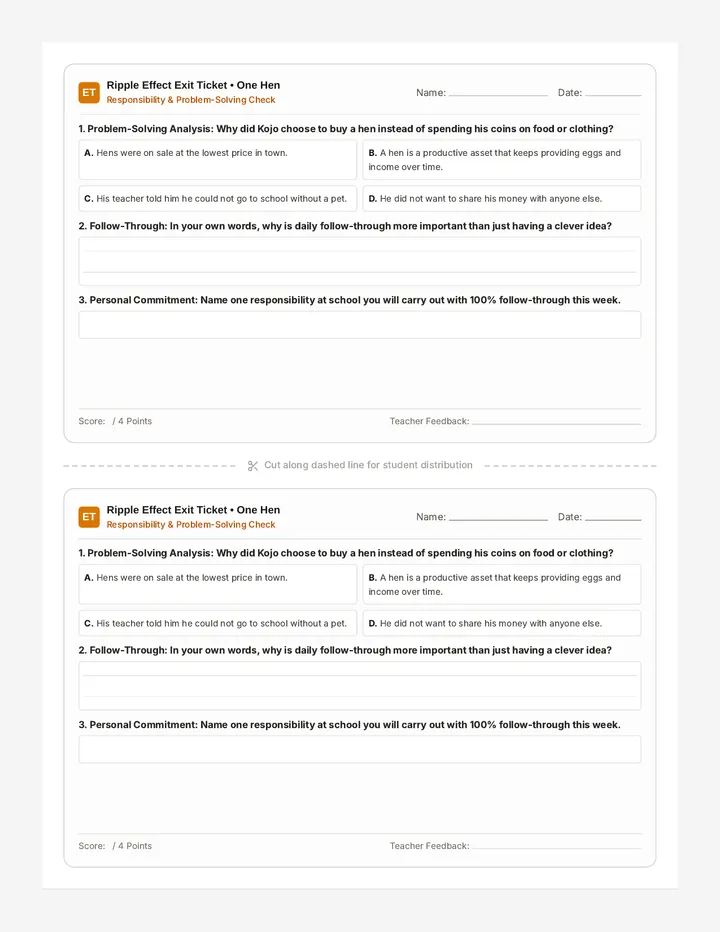
Ripple Effect Exit Ticket ET
Ripple Effect Exit Ticket • One Hen
Responsibility & Problem-Solving Check
Name: Date:
1. Problem-Solving Analysis: Why did Kojo choose to buy a hen instead of spending his coins on food or clothing?
A. Hens were on sale at the lowest price in town.
B. A hen is a productive asset that keeps providing eggs and income over time.
C. His teacher told him he could not go to school without a pet.
D. He did not want to share his money with anyone else.
2. Follow-Through: In your own words, why is daily follow-through more important than just having a clever idea?
3. Personal Commitment: Name one responsibility at school you will carry out with 100% follow-through this week.
Score: / 4 Points Teacher Feedback:
Cut along dashed line for student distribution
ET
Ripple Effect Exit Ticket • One Hen
Responsibility & Problem-Solving Check
Name: Date:
1. Problem-Solving Analysis: Why did Kojo choose to buy a hen instead of spending his coins on food or clothing?
A. Hens were on sale at the lowest price in town.
B. A hen is a productive asset that keeps providing eggs and income over time.
C. His teacher told him he could not go to school without a pet.
D. He did not want to share his money with anyone else.
2. Follow-Through: In your own words, why is daily follow-through more important than just having a clever idea?
3. Personal Commitment: Name one responsibility at school you will carry out with 100% follow-through this week.
Score: / 4 Points Teacher Feedback: