Explore how the Nile River shaped ancient Egyptian agriculture, society, and belief systems. This lesson guides 9th-grade students through reading comprehension, graphic organization, and critical analysis of geographic influence on history.
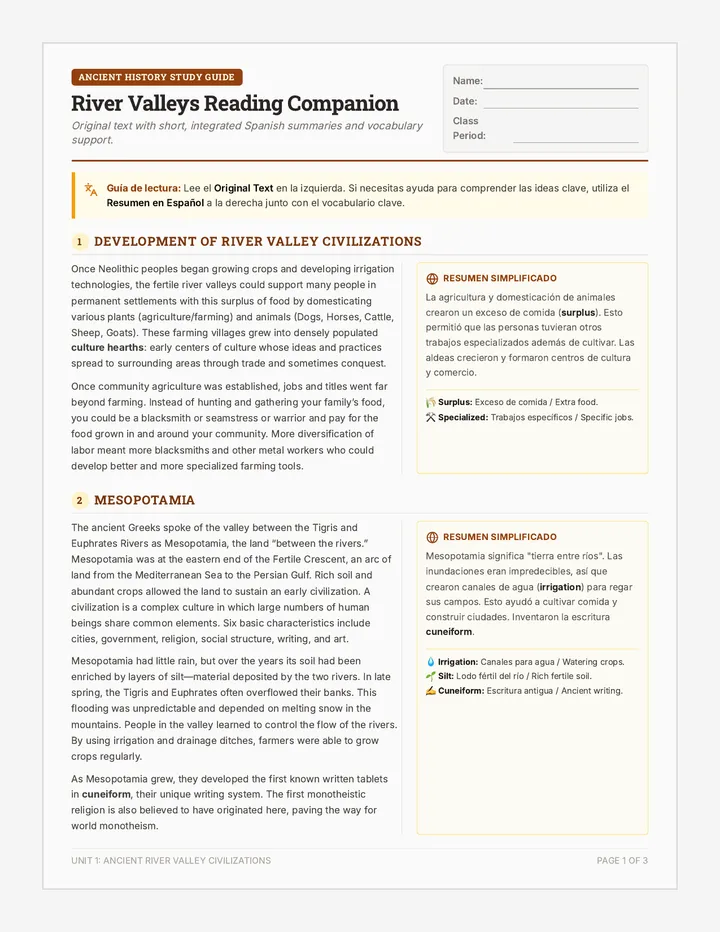
Análisis de Causa y Efecto: ¿Cómo influye directamente el entorno geográfico de una sociedad en la formación de su cosmovisión psicológica y espiritual? Contrasta las perspectivas egipcia y mesopotámica basándote en esta relación.
Parte D: La Voz de Kemet (Escritura Creativa Histórica)
Instrucciones: Ponte en el lugar de un agricultor del antiguo Egipto que vive durante la estación de Akhet. Escribe una breve oración, entrada de diario o carta expresando tus esperanzas o temores ante la inundación de este año. Debes incluir correctamente al menos tres (3) términos del vocabulario de la Parte A en tu escrito. Subraya los términos que utilices.
Ficha de Geografía del Nilo Página 2 de 2
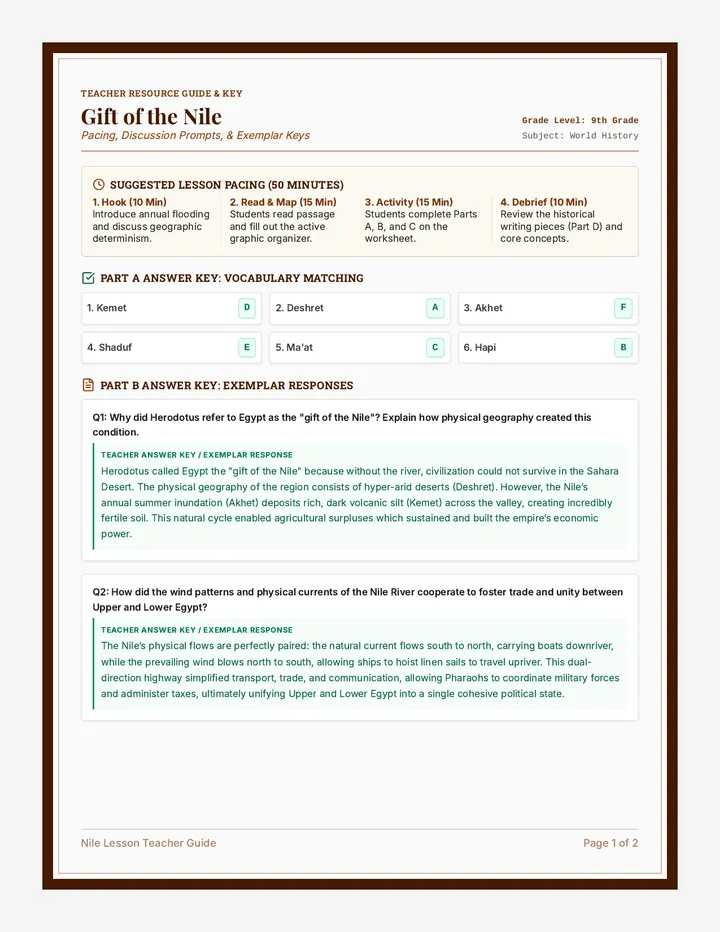
Part C Key: Geographical Analysis
Analysis Question: How does a society's geographic environment directly shape its psychological and spiritual worldview? Contrast the Egyptian and Mesopotamian outlooks based on this relationship.
Teacher Answer Key / Exemplar Response Geography dictates the predictability of daily survival, which in turn defines how a society interprets its gods. The Egyptians, blessed by the reliable and predictable Nile, viewed their gods as generous, reliable, and ordered, resulting in an optimistic focus on the afterlife and Ma'at. Conversely, Mesopotamians, constantly threatened by the chaotic, violent, and unpredictable flooding of the Tigris and Euphrates, viewed their gods as fickle and angry, leading to a grim worldview where the afterlife was a place of darkness and misery.
Part D: Historical Writing Rubric & Assessment Guide
Score student creative writing pieces based on historical accuracy, vocabulary deployment, and characterization.
Criteria
Exceeds (3 pts)
Meets (2 pts)
Needs Imp. (1 pt)
Vocabulary Integration
Includes >3 vocabulary terms correctly integrated and underlined.
Includes exactly 3 terms with minor context or alignment errors.
Includes fewer than 3 terms, or uses terms incorrectly.
Historical Authenticity
Strong immersion as a farmer; references actual physical tasks (shaduf, inundation, silt, planting).
Successfully adopts perspective; mentions the Nile, but lacks specific daily routine details.
Lacks connection to the historical context or farmer's identity.
Mechanics & Structure
Excellent flow, complete sentences, no mechanical errors.
Clear sentence structure; 1-2 minor spelling or grammatical errors.
Frequent structural errors that impede readability.