Eco Shootout Slides
🏀 THE REGENTS CHAMPIONSHIP
● LIVE MATCHDAY
🏀 TRASHKETBALL
🌱 ECOLOGY EDITION
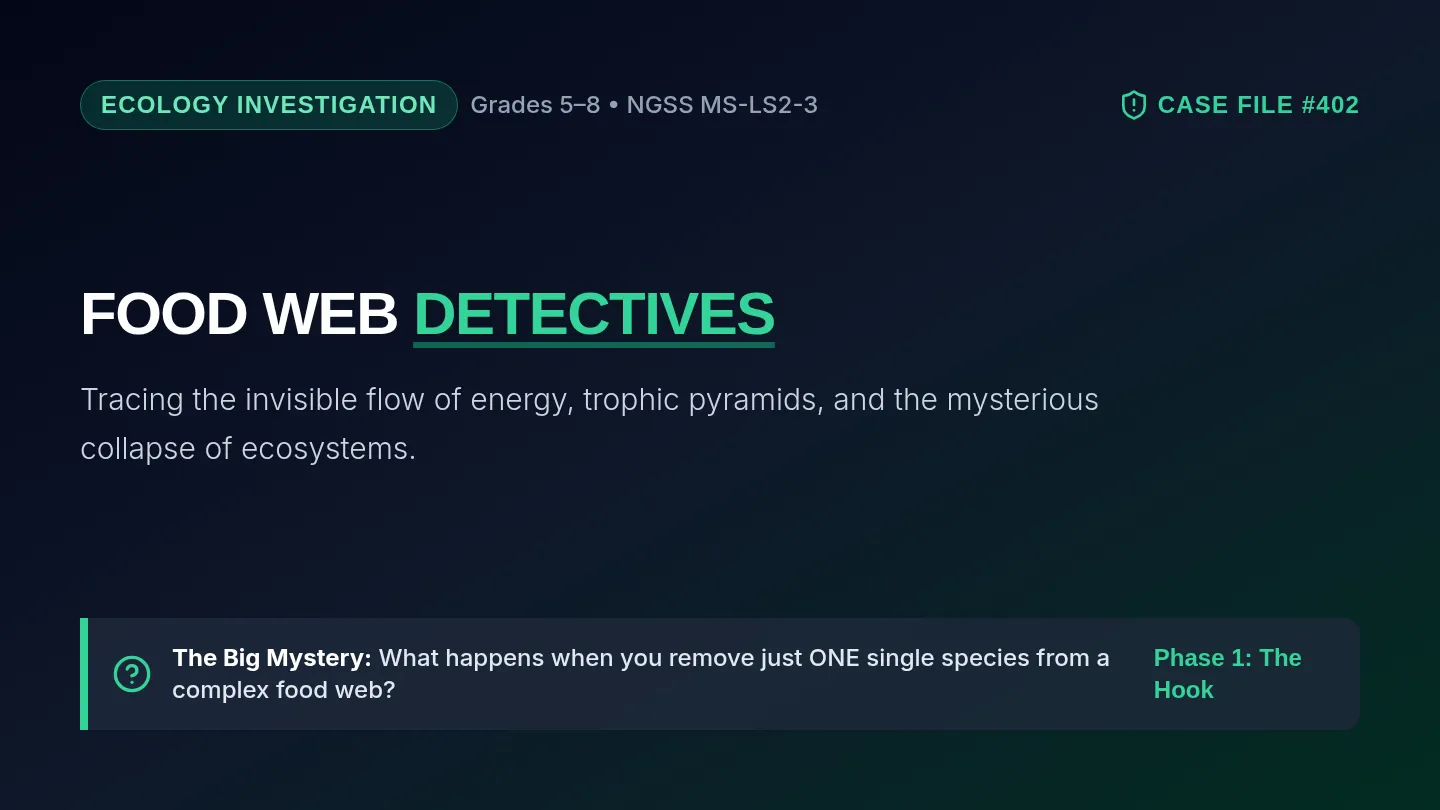
ECO SHOOTOUT!
Warm up your pencils, huddle with your team, and dominate the court with elite biological reasoning! 🏆
🦦 Keystone Stars
🔺 Biomass Pyramids
🚧 Habitat Breaks
📋 Draw up your tactical plans on the Game Worksheet! SLIDE 01 / 06
THE PLAYBOOK 2 PHASES TO VICTORY 🏁
⏱️
1. Silent Hustle
10-12 MINS
Unleash solo concentration! Work silently to map out answers on your arena playbook sheet.
✍️ Underline critical vocabulary terms.
❌ Cross out options and note why they fail.
🧠 Write evidence proving your logical pathway.
📣
2. Team Huddle
2-3 MINS
Bring the heads together! Defend your choices and make sure the whole team is ready to play.
🤝 Debate differences and reach a consensus.
🔄 Fix mistakes directly on your worksheets.
🎯 Lock in ONE final champion team answer.
⚠️ Referees will skip teams with uncompleted worksheets! SLIDE 02 / 06
RULES OF PLAY POINT BREAKDOWN 📊
🏀 THE SWISH
✔️ CORRECT CHOICE
Your team answers correctly and supports with valid explanation:
📋 Correct Answer +2 Points
🗑️ Made Trashket Shot DOUBLES (4 Total)
👟 THE HUSTLE
🔥 INCORRECT ANSWER
Your choice was off, but your team playbook annotations are elite:
✏️ Top-Tier Annotations +1 Hustle Point
🗑️ Made Shoot Attempt +1 Bonus Point
🚨
Technical Foul: Blank papers or silent team members who cannot explain their team's reasoning will lose points!
👟 Stay on your toes—any teammate can be called on to defend the play! SLIDE 03 / 06
R1 KEYSTONE ECOSYSTEMS
🏆 VALUE: 2 POINTS
🦦 Regents Challenge Play 1
The sea otter is a keystone species in Pacific kelp forests. If sea otters are removed from this ecosystem, which of the following is the most likely consequence?
A
The biodiversity of the ecosystem increases as other predators occupy the open ecological niche.
B
Urchin populations explode, leading to overgrazing and a dramatic collapse of the entire kelp forest.
C
Kelp plants adapt to live without support, multiplying rapidly and overpopulating the area.
D
Primary producers shift from kelp to photosynthetic phytoplankton with zero change to food chains.
📝 COACH'S NOTE
No lazy plays! Secure your team's hustle point by annotating:
⚡ Underline keystone.
⚡ Justify sea urchin rise.
⚡ Define kelp collapse.
SHOT CLOCK 90 SECONDS
🛡️ Guard your score! Review annotations with your team before shooting. SLIDE 04 / 06
R2 TROPHIC BOTTLENECKS
🏆 VALUE: 2 POINTS
🔺 Regents Challenge Play 2
The biomass pyramid of an ecosystem indicates the total dry weight of organisms at each trophic level. Why is the available biomass at the primary producer level dramatically larger than that of any other trophic level?
A
Decomposers return 90% of minerals directly to tertiary consumers, bypassing the primary producers.
B
Only approximately 10% of energy is transferred up each level; the rest is lost to metabolic processes and heat.
C
Primary producers possess a simpler cell structure and naturally weigh less per organism than consumers.
D
Secondary consumers actively destroy plant root systems, shifting total biomass to aquatic habitats.
🔺 THE ECO HEATMAP
TC (0.1%)
SC (1%)
PC (10%)
PRODUCERS (100%)
Where is the other 90% lost? Mark it down!
⚙️ THE 10% PLAY
📐 Diagram the energy loss vectors directly in your sketch box! SLIDE 05 / 06
R3 FRACTURED COURTS
🏆 VALUE: 2 POINTS
🚧 Regents Challenge Play 3
The installation of a high-speed highway cutting directly through a broad temperate forest creates habitat fragmentation. What is the most immediate negative ecological consequence of this human activity?
A
Gene flow between isolated animal populations decreases, reducing genetic variation over generations.
B
Ecotones are completely eliminated, leaving animals with fewer predator escape vectors.
C
Invasive weed species migrate directly to higher canopy layers, starving native mosses of sunlight.
D
Saprotrophic bacteria cease cellular respiration entirely due to increased local exhaust fumes.
🚧 THE FRACTION MAP
🌲 A
⚠️
BARRIER
🌲 B
Blocked paths freeze gene flow, decreasing biodiversity over time!
FINAL LOCK IN Who takes the championship shot? 🗑️🏀
🔥 Hustle points and shooting opportunities close immediately! SLIDE 06 / 06
Eco Shootout Worksheet
REPORTS PLAYBOOK Regents Biology
ECO SHOOTOUT
NAME:
DATE:
TEAM:
SCORE:
Game Playbook Objective
Complete silent independent work: annotate terms, eliminate wrong answers, and write reasoning. Incomplete papers lose shooting rights!
Base Question: +2 pts
Elite Annotations: +1 Hustle pt
ROUND 1 THE KEYSTONE SAVIOR (Ecology Standard B.3)
Value: 2 pts / Double on Shot
Q1. The sea otter is a keystone species in Pacific kelp forests. If sea otters are removed from this ecosystem, which of the following is the most likely consequence?
A
The biodiversity of the ecosystem increases as other predators occupy the open ecological niche.
B
Urchin populations explode, leading to overgrazing and a dramatic collapse of the entire kelp forest.
C
Kelp plants adapt to live without support, multiplying rapidly and overpopulating the area.
D
Primary producers shift from kelp to photosynthetic phytoplankton with zero change to food chains.
My Eliminations (Cross-Out Proof):
Explain why at least two choices are incorrect...
Biological Evidence / Defense:
ROUND 2 THE BIOMASS BOTTLENECK (Ecology Standard C.1)
Value: 2 pts / Double on Shot
Q2. The biomass pyramid of an ecosystem indicates the total dry weight of organisms at each trophic level. Why is the available biomass at the primary producer level dramatically larger than that of any other trophic level?
A
Decomposers return 90% of minerals directly to tertiary consumers, bypassing the primary producers.
B
Only approximately 10% of energy is transferred up each level; the rest is lost to metabolic processes and heat.
C
Primary producers possess a simpler cell structure and naturally weigh less per organism than consumers.
D
Secondary consumers actively destroy plant root systems, shifting total biomass to aquatic habitats.
Trophic Level Sketch / Annotations:
Draw energy pyramid & loss
State the 10% Law & Metabolic Loss Proof:
Playbook Core Standards: Energy pyramids & Keystone interactions Page 1 of 2
ECO SHOOTOUT PLAYBOOK Regents Biology Review Session
ROUND 3 FRACTURED HABITATS (Ecology Standard D.4)
Value: 2 pts / Double on Shot
Q3. The installation of a high-speed highway cutting directly through a broad temperate forest creates habitat fragmentation. What is the most immediate negative ecological consequence of this human activity?