| 23 – 35 min | Detailed Pictorial & Predictive Analysis | Audit sketches for ANSI line weights (dark object lines, light dimension lines). Verify that students include all 3 requirements: Size, Location, Geometry. Check stability torque logic. |
| 35 – 40 min | Peer Quality Check & Debrief | Rotate sheets for a 2-minute peer sign-off. Debrief: "Why do engineering firms mandate predictive modeling and detailed sketches before ordering tooling?" |
Misconception 1: Confusing Problem with Solution
Student: "The problem is that the cafeteria needs an acrylic caddy with 4 dividers."
Intervention: Remind them of the bookend example (text p. 70). The caddy is one solution; the problem is organizing and stabilizing tabletop items during dining.
Misconception 2: Equating "Rough" with "Sloppy"
Student: Scribbles an illegible line and calls it a rough sketch.
Intervention: Clarify that "rough" means unrefined in dimension and final detail, but must accurately communicate 3D form, balance, and spatial relationships (text p. 75).
Foundations of Engineering & Technology • Instructional Resource Turn to Page 2 for Analytic Rubric & Solution Benchmarks Page 1 of 2
Evaluation & Differentiation
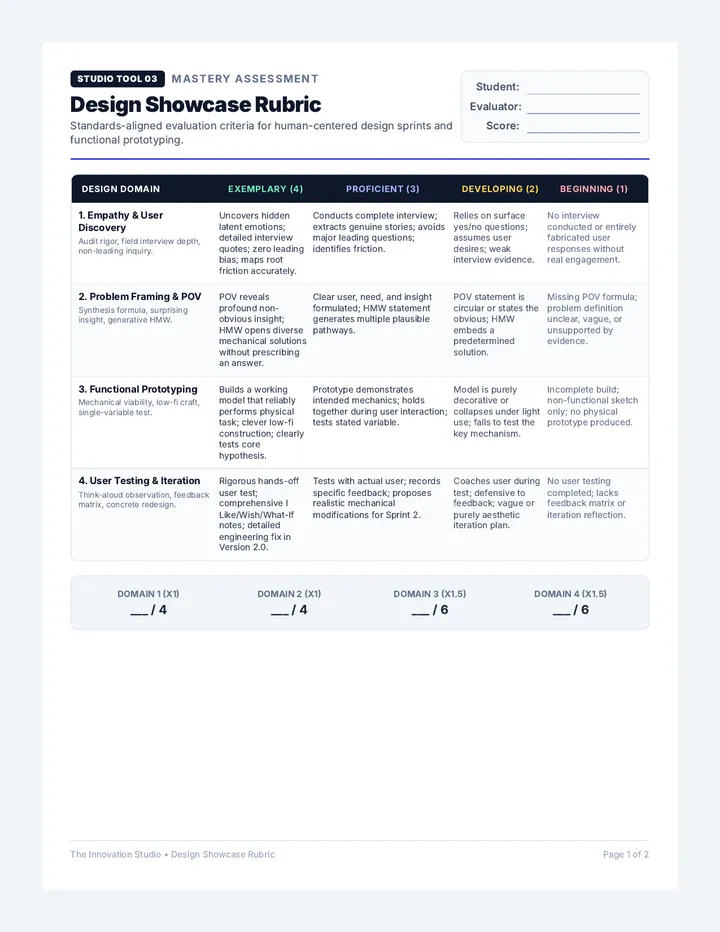
Total: 20 Points
| Dimension | 4 - Exemplary | 3 - Proficient | 2 - Developing | 1 - Novice |
|---|---|---|---|---|
| Problem & Constraints | Clear functional statement without solution bias; all 5 constraint categories accurately identified. | Functional statement; 4 of 5 constraint categories accurately addressed. | Confuses problem with physical solution; 2-3 constraints vague. | Incomplete statement; criteria/constraints missing. |
| Divergent Ideation | 3 markedly distinct concepts; viable what-if adaptation; active synergism evident. | 3 distinct rough sketches; acceptable what-if scenario. | Concepts are minor variations; what-if lacks engineering adaptation. | Fewer than 3 sketches; lack 3D form. |
| Optimization & Matrix | Thorough, objective scoring with weighted totals; refined sketch integrates multiple ideas. | Complete matrix with totals; refined sketch combines 2+ rough features. | Scores arbitrary; refined sketch duplicates one rough sketch. | Incomplete matrix; no synthesis evident. |
| Detailed Technical Sketch | Precise isometric or oblique; includes all 3 types of info (size, location, geometry); ANSI line hierarchy. | Accurate pictorial; includes size and location; object lines distinct from dimension lines. | Pictorial distorted; missing location dimensions; line weights inconsistent. | 2D flat sketch; missing dimensions and line standards. |
| Predictive Analysis & BOM | Accurate torque/stability reasoning; complete BOM with realistic school lab fabrication processes. | Plausible stability justification; BOM lists all main parts and materials. | Superficial stability explanation; BOM missing quantities or processes. | Analysis missing or unscientific; BOM incomplete. |
Model Problem Statement:
"Cafeteria condiment containers and sweetener packets currently scatter across dining tables, creating cleaning delays and frequent spills. A compact, easily sanitized holding system is needed to securely organize these specific items during meal service."
Typical Envelope Dimensions:
Key Technical Standards to Check:
Support / Scaffolding:
Provide printed 30° isometric dot paper underlays to slip under the detailed sketching box. Offer pre-measured dimension cards for the standard Heinz ketchup bottle and salt/pepper shakers.
Advanced Extension:
Have teams convert their pictorial sketch into a 3-view orthographic projection (front, top, right side) with a 45° projection line. In CAD, model as a solid model and run a draft angle analysis for injection molding.
Recommended 3-Minute Debrief Questions:
1. "Why do commercial engineers produce rough sketches before opening CAD software?" (Speed, divergent creativity, avoids premature commitment).
2. "What trade-off did your team confront between ease of cleaning and condiment security?" (Smooth open geometry vs deep snug pockets).
Foundations of Engineering & Technology • Instructional Resource Introduction to Engineering Design • Chapter 5 Page 2 of 2