Neolithic Revolution Slides
Pre-AP World History & Geography Unit 1: The Ancient Period
Key Concept 1.2 • Day 1
From Foraging Bands to Farming Villages
The Neolithic Revolution
Exploring the causes, geographic diffusion, and transformative demographic effects of plant and animal domestication.
Inquiry Focus
Why Settle Down?
Source Analysis
Docs 1 & 2 (Diamond)
Unit Starter Claim
Assess 1.2 Writing
Do Now Prompt
The Forager's Dilemma
5 Minutes Silent Thinking & Writing
Lifestyle A
The Nomadic Forager
- • Varied diet of wild game, roots, nuts, and berries
- • High mobility; works an estimated 15–20 hours per week
- • Vulnerable to seasonal food shortages; low population size
Paleolithic Era (~2.5 million BCE – 10,000 BCE)
Lifestyle B
The Sedentary Farmer
- • Consistent food surplus supporting larger families
- • Permanent villages, specialized trade, pottery, and tools
- • Intense physical labor, risk of famine, crowd diseases
Neolithic Era (~10,000 BCE – 3,000 BCE)
Discussion Question: If hunting and foraging provided a diverse diet with less physical labor, what caused humans across the globe to gamble on agriculture?
Goals & Standards
Learning Objective & Success Criteria
Pre-AP Framework LO 1.2
Unit 1 Learning Target
"I can identify the causes and effects of the Neolithic Revolution by analyzing historical and secondary sources."
1. Explain Causes
Identify how post-glacial climate warming, demographic population pressure, and biogeographic luck triggered farming.
Worksheet Section 1
2. Analyze Sources
Analyze Jared Diamond's arguments in Document 1 and interpret agricultural diffusion patterns in Document 2.
Worksheet Section 2 & Docs
3. Evaluate Claims
Formulate a nuanced, evidence-based thesis evaluating whether agriculture ended the hunter-gatherer lifestyle.
Assess 1.2 Writing Task
Classroom Focus: Track your understanding throughout today's notes and primary source exploration. Student Companion Page 1
Chronology & Periodization
From Deep Time to History
Scale: 3 Million Years vs. 5,000 Years
Prehistory
~3,000,000 BCE to 3,000 BCE (Before Written Records)
Recorded History
3,000 BCE to Present
Paleolithic (Old Stone Age) • 99% of History
Neolithic (10,000 BCE)
Ancient Age
Modern
~2.5M – 1M BCE
First Fire & Tools
Homo erectus controls fire; rough stone handaxes.
~12,000 BCE
Ice Age Thaws
Warming climate; wild cereals flourish naturally.
~10,000 BCE
Neolithic Shift
Domestication in Fertile Crescent, China, Andes.
~3,000 BCE
Invention of Writing
Cuneiform in Mesopotamia; surplus records.
Key Pre-AP Takeaway: For 99% of our history, humans lived as nomadic foragers. Agriculture was a radical, recent shift! LO 1.2 Chronology
Comparing Eras
Paleolithic vs. Neolithic Life
Continuity & Change Over Time
Category
Food Procurement
Settlement Type
Tools & Tech
Social Structure
Paleolithic "Old Stone"
Hunting game; gathering wild roots & nuts.
Nomadic bands (20–50); caves & hide tents.
Chipped flint stone, bone spears, fire.
Egalitarian; shared food; mobile kin bands.
Neolithic "New Stone"
Cultivating crops; domesticated livestock.
Sedentary farming villages (mudbrick homes).
Polished axes, grinding stones, pottery.
Labor specialization, leadership, hierarchy.
Continuity Check: Did farming replace foraging overnight? No; foraging continued alongside farming for millennia. Handout Page 9 Context
Guided Notes • Section 1
Three Core Causes of the Agricultural Shift
Write Bold Words in Worksheet
1. Climate Shift
"Environmental Pull"
- • Around 11,000 BCE, the retreat of glaciers brought warmer and wetter seasonal climates.
- • Annual wild grasses like wheat and barley began to flourish naturally across river floodplains.
2. Demography
"Demographic Push"
- • As foraging band populations expanded, local wild game and resources became depleted.
- • Human groups were forced to intensify food production from smaller, concentrated territories.
3. Biogeography
Diamond Thesis
- • Farming developed in only a few regions with wild plants suitable for cultivation (large seeds).
- • Required large herd animals (sheep, goats, pigs, and cattle) suitable for domestication.
Student Note-Taking: Fill in the 6 bolded terms under Section 1 on page 2 of your worksheet. Worksheet Page 2
Guided Notes • Section 2
Jared Diamond's Core Arguments (Doc 1)
Write Bold Words in Worksheet
1
Surplus & Civilization: Domestication was prerequisite to civilization because it created an agricultural surplus that freed specialists (craftspeople, soldiers, and leaders) from daily food procurement.
2
Demographic Explosion: Because farming societies underwent massive demographic expansion, about 88% of humans alive today speak languages belonging to just seven language families.
3
Eurasian Epicenters: These dominant language families trace back to two primary Eurasian centers: the Fertile Crescent and parts of China.
4
Geographic Causation: Diamond terms this geographic advantage biogeographic luck, arguing environment rather than human differences determined where farming began.
Student Note-Taking: Fill in the 6 bolded terms under Section 2 on page 2 of your worksheet. Worksheet Page 2
Geographic Analysis
Document 2: Ancient Origins vs. Modern Centers
Handout 1.2-INTRO (Page 9 Map)
Ancient Centers of Origin
Where wild plants and animals were independently domesticated:
- • Fertile Crescent: Wheat, barley, sheep, cattle
- • China (Yellow/Yangtze): Millet, rice, pigs
- • Mesoamerica & Andes: Maize, beans, potatoes
- • Sahel & West Africa: Sorghum, yams, African rice
Modern Agricultural Centers
Comparing the map patterns (Handout p. 10 Q3):
- • Where they Overlap: East Asia (China) remains one of the world's most productive zones.
- • Where they Do NOT Overlap: North American Midwest, Western Europe, and Australia—modern breadbaskets where farming was imported.
Geographic Insight: Agriculture originated where native species lived, but expanded to where soil and climate allowed massive scale!
Guided Notes • Section 3
The Two Paths of Agricultural Spread
Write Bold Words in Worksheet
Dominant Path (~88%)
Path 1: Demographic Migration
"Farmers Move and Expand"
- • Growing farming populations physically migrated into new lands.
- • Farmers carried their crops, herds, tools, and languages with them.
- • Gradually replaced or absorbed mobile foraging groups.
Result: Spread of Indo-European, Sino-Tibetan, and Bantu languages.
Less Common Path
Path 2: Cultural Adoption
"Foragers Adopt Farming"
- • Hunter-gatherers living along frontiers observed neighboring farmers.
- • Frontier foragers voluntarily settled down after acquiring domestic crops and livestock.
- • Maintained genetic continuity while adopting new agricultural tools.
Evidence: Skeletal continuity with sudden appearance of farming tools.
Student Note-Taking: Fill in the 3 bolded terms under Section 3 on page 2 of your worksheet. Worksheet Page 2
Pre-AP Source Exploration
Handout 1.2-INTRO: Document Analysis
15 Minutes Active Analysis
Student Directions
Turn to Workbook Pages 9 and 10
Begin your investigation of Jared Diamond's arguments and global agricultural geography.
1 Source 1: Diamond Text
Read the Nature excerpt on Page 9. Annotate Diamond's claims on biogeographic luck and the 7 language families.
Handout Page 9
2 Source 2: World Map
Examine the map on Page 9. Contrast the ancient centers of origin with modern high-yield breadbaskets.
Handout Page 9
3 Observe & Analyze
Answer Questions 1–4 on Page 10 (or Worksheet Page 3) using specific textual evidence from both sources.
Handout Page 10
Collaboration Protocol: Read with a partner, discuss the central claim of each paragraph, then record individual written responses. Handout 1.2-INTRO
Synthesis & Evaluation
Writing Like a Historian
Handout Page 10 Prompt 4
Sentence Stem 1 Complexity & Concession (Handout Q4)
"While domestication only occurred in a few areas, [ complete in worksheet ]."
Target: Contrast localized beginnings with worldwide demographic expansion.
Sentence Stem 2 Causation & Consequence Chain
"Humans began to farm about 10,000 years ago because [ cause ], so [ effect ]."
Target: Connect climatic warming or population pressure directly to sedentary villages.
Next Step: Turn to Page 4 of your packet to examine our unit starter claim! Assess 1.2 Introduction ➔
Assess 1.2 • Causation Claim
Unit 1 Starter Claim Investigation
Teacher Resource p. 194
Unit 1 Starter Claim
"Neolithic Revolution innovations ended the hunter-gatherer lifestyle."
Part A: Evidence to SUPPORT
- • Demographic Explosion: Surpluses led to rapid population growth that crowded out foragers.
- • Permanent Towns: Communities like Çatalhöyük & Jericho established permanent sedentary infrastructure.
- • Language Replacement: 88% of humans now speak languages spread by early farming migrations.
Part B: Evidence to CHALLENGE
- • Coexistence for Millennia: Foraging continued alongside agriculture for thousands of years.
- • Pastoral Nomadism: Many societies chose mobile herding rather than sedentary farming.
- • Environmental Limits: Tundra, desert, and tropical forests remained foraging domains.
Part C Task: Write a 1-to-3 sentence thesis that revises the claim using evidence from both columns!
Worksheet Page 4
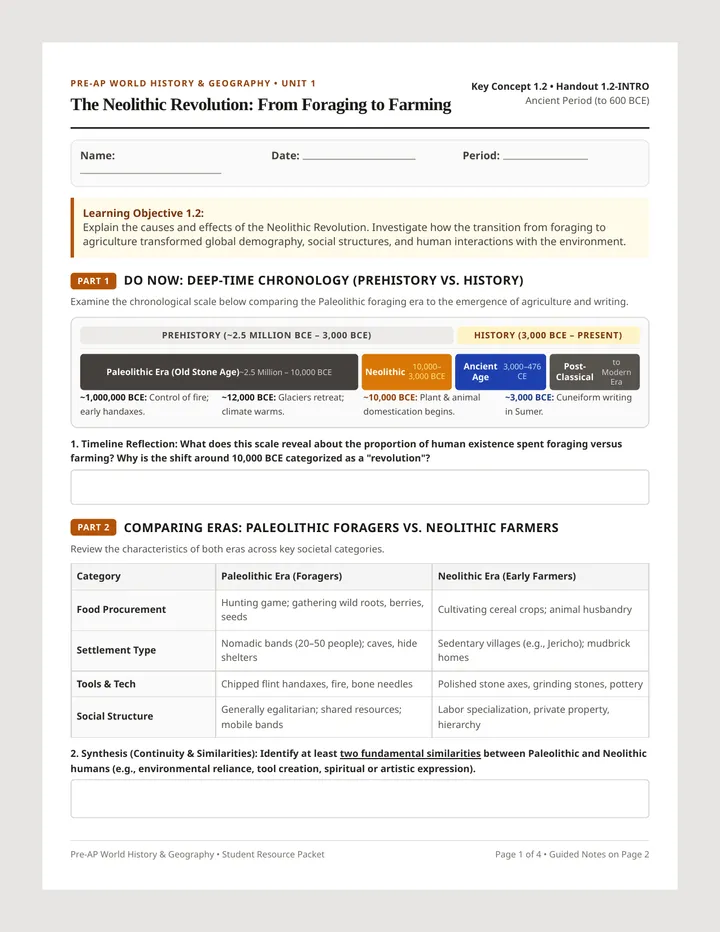
Neolithic Revolution Worksheet
Pre-AP World History & Geography • Unit 1
The Neolithic Revolution: From Foraging to Farming
Key Concept 1.2 • Handout 1.2-INTRO
Ancient Period (to 600 BCE)
Name:
Date:
Period:
Learning Objective 1.2:
Explain the causes and effects of the Neolithic Revolution. Investigate how the transition from foraging to agriculture transformed global demography, social structures, and human interactions with the environment.
Part 1
Do Now: Deep-Time Chronology (Prehistory vs. History)
Examine the chronological scale below comparing the Paleolithic foraging era to the emergence of agriculture and writing.
Prehistory (~2.5 Million BCE – 3,000 BCE)
History (3,000 BCE – Present)
Paleolithic Era (Old Stone Age)
~2.5 Million – 10,000 BCE
Neolithic
10,000–3,000 BCE
Ancient Age
3,000–476 CE
Post-Classical
to Modern Era
~1,000,000 BCE: Control of fire; early handaxes.
~12,000 BCE: Glaciers retreat; climate warms.
~10,000 BCE: Plant & animal domestication begins.
~3,000 BCE: Cuneiform writing in Sumer.
1. Timeline Reflection: What does this scale reveal about the proportion of human existence spent foraging versus farming? Why is the shift around 10,000 BCE categorized as a "revolution"?
Part 2
Comparing Eras: Paleolithic Foragers vs. Neolithic Farmers
Review the characteristics of both eras across key societal categories.
| Category | Paleolithic Era (Foragers) | Neolithic Era (Early Farmers) |
|---|
| Food Procurement | Hunting game; gathering wild roots, berries, seeds | Cultivating cereal crops; animal husbandry |
| Settlement Type | Nomadic bands (20–50 people); caves, hide shelters | Sedentary villages (e.g., Jericho); mudbrick homes |
| Tools & Tech | Chipped flint handaxes, fire, bone needles | Polished stone axes, grinding stones, pottery |
| Social Structure | Generally egalitarian; shared resources; mobile bands | Labor specialization, private property, hierarchy |
2. Synthesis (Continuity & Similarities): Identify at least two fundamental similarities between Paleolithic and Neolithic humans (e.g., environmental reliance, tool creation, spiritual or artistic expression).