Colony Founders Guided Notes
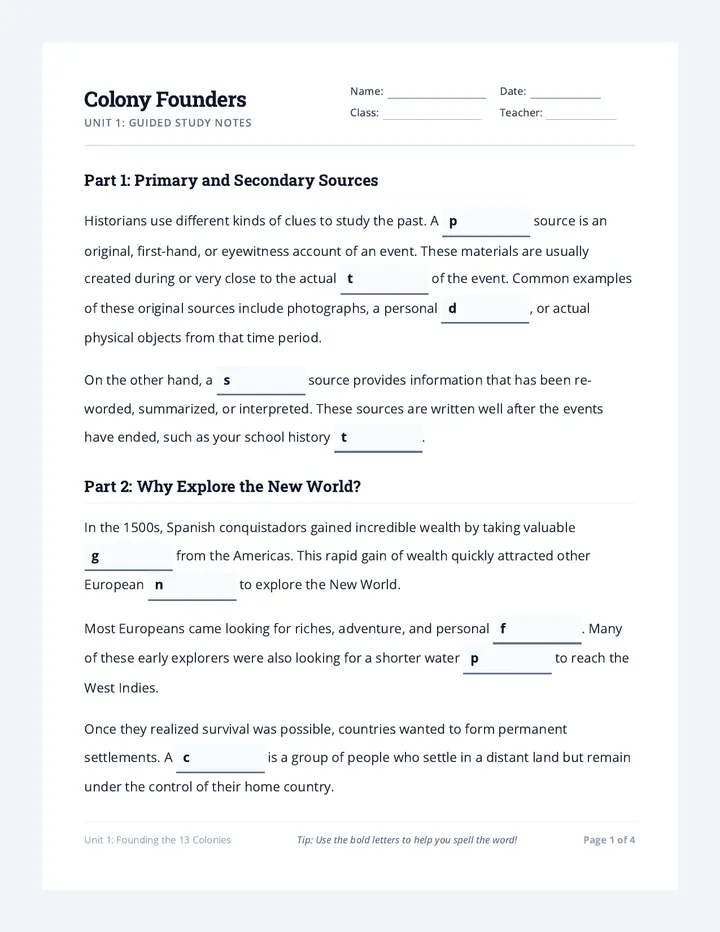
Colony Founders
Unit 1: Guided Study Notes
Name:
Date:
Class:
Teacher:
Part 1: Primary and Secondary Sources
Historians use different kinds of clues to study the past. A p source is an original, first-hand, or eyewitness account of an event. These materials are usually created during or very close to the actual t of the event. Common examples of these original sources include photographs, a personal d , or actual physical objects from that time period.
On the other hand, a s source provides information that has been re-worded, summarized, or interpreted. These sources are written well after the events have ended, such as your school history t .
Part 2: Why Explore the New World?
In the 1500s, Spanish conquistadors gained incredible wealth by taking valuable g from the Americas. This rapid gain of wealth quickly attracted other European n to explore the New World.
Most Europeans came looking for riches, adventure, and personal f . Many of these early explorers were also looking for a shorter water p to reach the West Indies.
Once they realized survival was possible, countries wanted to form permanent settlements. A c is a group of people who settle in a distant land but remain under the control of their home country.
Unit 1: Founding the 13 Colonies
Tip: Use the bold letters to help you spell the word!
Page 1 of 4
Unit 1: Founding the 13 Colonies
Guided Study Notes
Part 3: Jamestown (First English Settlement)
Starting a colony was incredibly expensive and risky. To help raise money, joint-stock c were formed to spread the financial risk among many owners.
In 1606, the Virginia Company received a royal c , which was written permission from the King of England to settle land in North America. They hired 105 men and boys, who successfully landed in the year 1 . To keep the struggling colony alive, Captain John Smith took control and forced colonists to work if they wanted to e .
Part 4: The New England Colonies
In 1620, a group of Pilgrims arrived in Massachusetts on a ship called the M . They left England to find r freedom. Before stepping ashore, they signed the Mayflower Compact to agree on a way to govern themselves.
Soon, other colonies formed in the north. In 1623, New Hampshire was founded primarily as a small f village. In 1630, a group called the Puritans settled in Massachusetts and built a society strictly based on biblical l .
Seeking more freedom, Thomas Hooker left Massachusetts to start the colony of C . Roger Williams was banished by the Puritans, so he bought land from Native Americans to start the colony of R Island.
Unit 1: Founding the 13 Colonies
Tip: Use the bold letters to help you spell the word!
Page 2 of 4
Unit 1: Founding the 13 Colonies
Guided Study Notes
Part 5: The Middle Colonies
The Dutch founded a successful colony along the Hudson River and called it New N . In 1664, England took over this valuable land and renamed it New Y . The Duke of York promised the Dutch settlers they could keep their property and practice their own r .
Nearby, the founders of New Jersey attracted new settlers by promising large tracts of land and religious f . In 1682, William Penn created the colony of Pennsylvania as a peaceful refuge for a group called the Q .
Part 6: The Southern Colonies
In 1632, Maryland was founded by Lord Baltimore as a safe place where C could practice their faith. In 1649, Maryland passed the Act of Toleration to protect religious t .
The King of England gave lands south of Virginia to eight friends, which eventually split into North and South C .
Georgia was the last English colony founded. It was created as a place where English d could settle and start a new life. Georgia also acted as a military b to protect South Carolina from Spanish Florida.
Unit 1: Founding the 13 Colonies
Tip: Use the bold letters to help you spell the word!
Page 3 of 4
Unit 1: Founding the 13 Colonies
Guided Study Notes
Part 7: Growing Population and Labor Demands
During colonial times, there was a massive amount of land but a very small p . Between the years 1607 and 1775, the number of people living in the colonies grew to over two and a half m .
To meet the high demand for labor on farms, landowners hired indentured s . These workers signed a contract agreeing to work for four to seven years to pay off the cost of their j to the New World. This system of labor brought nearly two-thirds of European colonists to America in the 1 s.
Part 8: Slavery in the Colonies
The first enslaved Africans were brought to Jamestown in the year 1 . This forced system of labor continued in the colonies and the United States for nearly two hundred and fifty y . At its peak, there were over four million people who were e in America.
Enslaved people were traded through a network of Atlantic shipping routes known as the T Trade. The brutal ocean voyage that brought enslaved Africans from Africa across the Atlantic was called the M Passage.
Unit 1: Founding the 13 Colonies
Tip: Use the bold letters to help you spell the word!
Page 4 of 4