Regional Realities Bellringer
History Bellringer: 5-Minute Task
REGIONAL REALITIES
Slavery Across the Thirteen British Colonies
Name:
Date:
Class Period:
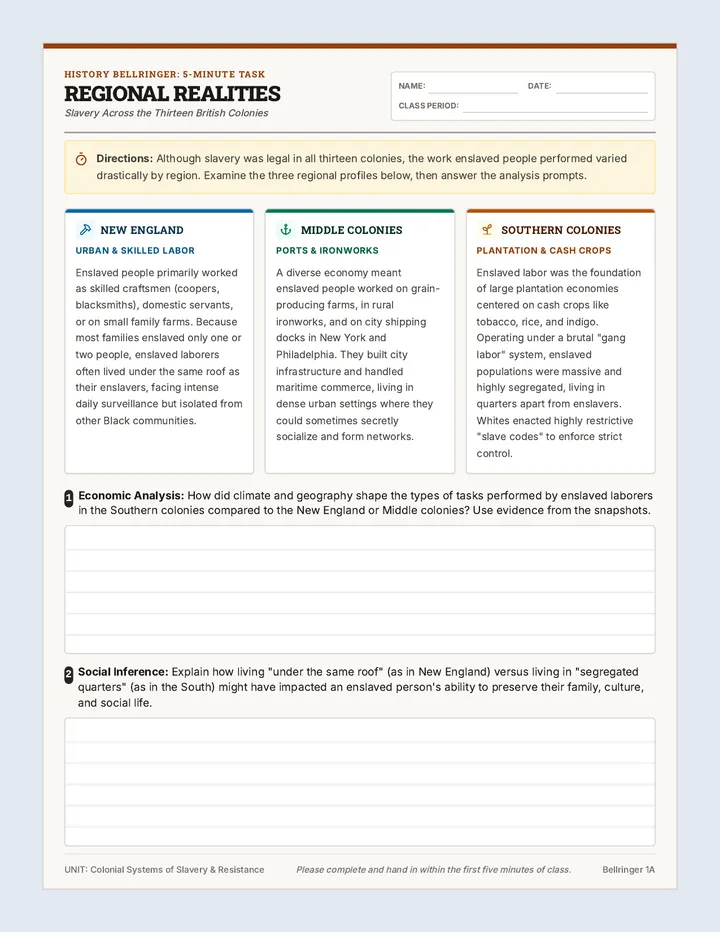
Directions: Although slavery was legal in all thirteen colonies, the work enslaved people performed varied drastically by region. Examine the three regional profiles below, then answer the analysis prompts.
New England
Urban & Skilled Labor
Enslaved people primarily worked as skilled craftsmen (coopers, blacksmiths), domestic servants, or on small family farms. Because most families enslaved only one or two people, enslaved laborers often lived under the same roof as their enslavers, facing intense daily surveillance but isolated from other Black communities.
Middle Colonies
Ports & Ironworks
A diverse economy meant enslaved people worked on grain-producing farms, in rural ironworks, and on city shipping docks in New York and Philadelphia. They built city infrastructure and handled maritime commerce, living in dense urban settings where they could sometimes secretly socialize and form networks.
Southern Colonies
Plantation & Cash Crops
Enslaved labor was the foundation of large plantation economies centered on cash crops like tobacco, rice, and indigo. Operating under a brutal "gang labor" system, enslaved populations were massive and highly segregated, living in quarters apart from enslavers. Whites enacted highly restrictive "slave codes" to enforce strict control.
1
Economic Analysis: How did climate and geography shape the types of tasks performed by enslaved laborers in the Southern colonies compared to the New England or Middle colonies? Use evidence from the snapshots.
2
Social Inference: Explain how living "under the same roof" (as in New England) versus living in "segregated quarters" (as in the South) might have impacted an enslaved person's ability to preserve their family, culture, and social life.
UNIT: Colonial Systems of Slavery & Resistance Please complete and hand in within the first five minutes of class. Bellringer 1A
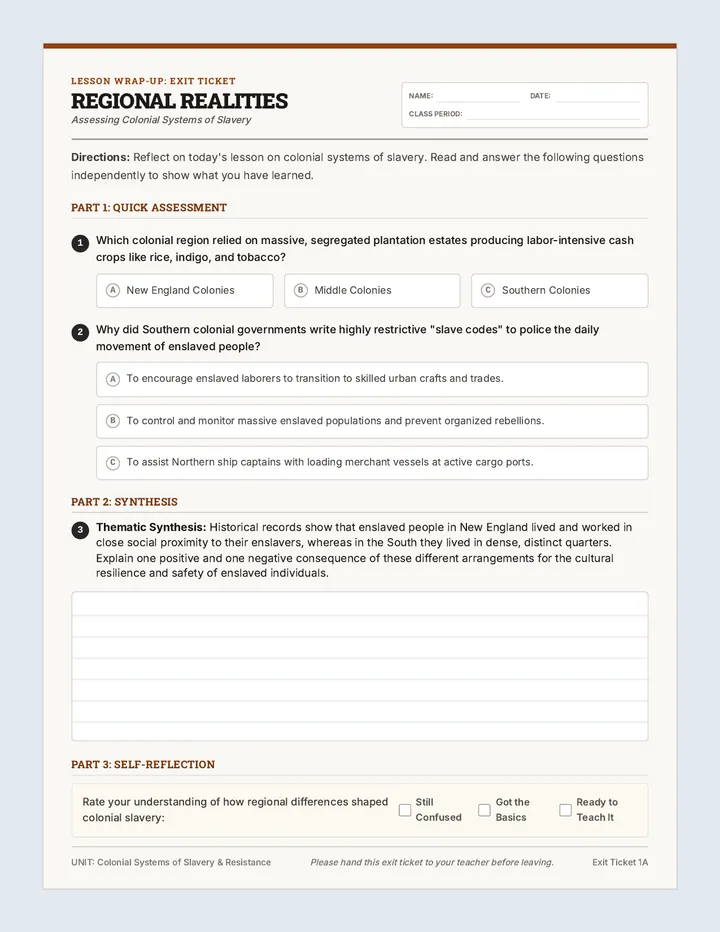
Regional Realities Exit Ticket
Lesson Wrap-Up: Exit Ticket
REGIONAL REALITIES
Assessing Colonial Systems of Slavery
Name:
Date:
Class Period:
Directions: Reflect on today's lesson on colonial systems of slavery. Read and answer the following questions independently to show what you have learned.
Part 1: Quick Assessment
1
Which colonial region relied on massive, segregated plantation estates producing labor-intensive cash crops like rice, indigo, and tobacco?
A New England Colonies
B Middle Colonies
C Southern Colonies
2
Why did Southern colonial governments write highly restrictive "slave codes" to police the daily movement of enslaved people?
A To encourage enslaved laborers to transition to skilled urban crafts and trades.
B To control and monitor massive enslaved populations and prevent organized rebellions.
C To assist Northern ship captains with loading merchant vessels at active cargo ports.
Part 2: Synthesis
3
Thematic Synthesis: Historical records show that enslaved people in New England lived and worked in close social proximity to their enslavers, whereas in the South they lived in dense, distinct quarters. Explain one positive and one negative consequence of these different arrangements for the cultural resilience and safety of enslaved individuals.
Part 3: Self-Reflection
Rate your understanding of how regional differences shaped colonial slavery:
Still Confused
Got the Basics
Ready to Teach It
UNIT: Colonial Systems of Slavery & Resistance Please hand this exit ticket to your teacher before leaving. Exit Ticket 1A