Rights or Liberties Presentation Slides Rights or Liberties?
The 14th Amendment & Equal Protection
Civics
Grades 9-10
Warm-up: Quick Write
"In your own words, what is the difference between a right and a liberty?"
Take 3 minutes to write your thoughts. Be prepared to share one example of each with the class.
5 MINUTES
Key Concepts
Civil Liberties
Protections FROM the government. Limits on what the government can do to you.
Freedom of Speech
Protection from Unreasonable Search
Civil Rights
Protections BY the government. Ensuring people are treated equally regardless of group status.
Right to Vote
Freedom from Discrimination
Video: Equal Protection
Crash Course Govt #29
Embedded media
SEGMENT 1
0:00 - 1:50
SEGMENT 2
7:00 - END
Watch For:
• The 14th Amendment's "Equal Protection Clause"
• The "State Action" Doctrine
• How definitions of rights change over time
The Sorting Hat
1
Read
Review each legal scenario card with your partner.
2
Sort
Place the card in the correct category on your T-Chart.
3
Justify
Explain WHY it belongs there using today's definitions.
Civil Liberty = Govt interference limit
Civil Right = Protected from discrimination
Closure: State Action
"If the Constitution only applies to the government (State Action), why can't a private company just ignore your civil rights?"
Core Concept
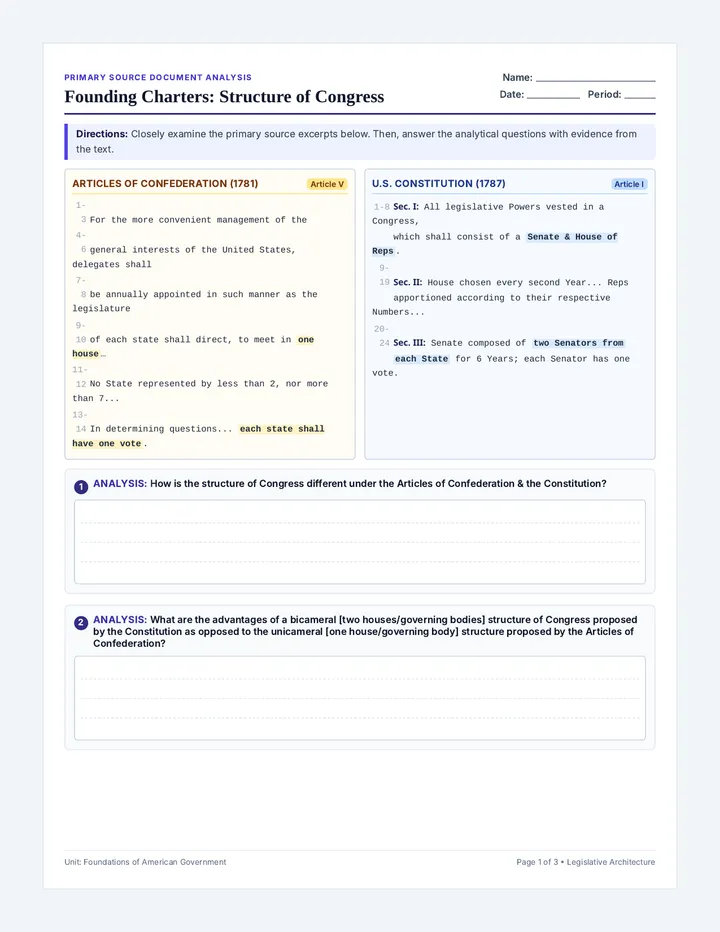
The 14th Amendment bans states from discriminating.
The Bridge
Federal laws (like the Civil Rights Act) apply these principles to private entities.
Sorting Hat Scenario Cards Document The Sorting Hat
Scenario Cards: Civil Liberties vs. Civil Rights
Scenario A
A local police officer enters a citizen's home and begins searching through drawers without a warrant or probable cause.
Scenario B
A large tech corporation refuses to interview a highly qualified candidate because of the candidate's religious background.
Scenario C
A group of students is arrested by city police for holding a peaceful protest on a public sidewalk across from City Hall.
Scenario D
A state legislature passes a law that makes it significantly more difficult for elderly and minority voters to cast their ballots.
Scenario E
A person is held in jail for three years without being told what crimes they are being charged with or seeing a judge.
Scenario F
A real estate agent tells a family they cannot buy a house in a specific neighborhood because of their national origin.
Scenario G
A public school requires all students to participate in a mandatory Christian prayer at the start of every school day.
Scenario H
A private bus company mandates that passengers of certain races must sit at the back of the bus.
Note to Teacher: Cut these cards out for student pairs or groups. Students will sort them into "Civil Liberty" or "Civil Right" and justify their choice on the T-Chart worksheet.
Sorting Hat T Chart Worksheet Document Sorting Hat T-Chart
Civics & Government: Civil Liberties vs. Civil Rights
Name:
Date:
Instructions
Review your scenario cards. For each scenario, decide if it is a Civil Liberty (protection from government interference) or a Civil Right (protection against discrimination/ensuring equality). Write the Scenario letter in the correct column and provide a brief justification for your choice.
Civil Liberties
Protections FROM government
Scenario
Justification:
Scenario
Justification:
Scenario
Justification:
Scenario
Justification:
Civil Rights
Protections BY government
Scenario
Justification:
Scenario
Justification:
Scenario
Justification:
Scenario
Justification:
Think: Does this protect an individual from the power of the state, or does it ensure groups are treated fairly?
Rights Liberties Teacher Guide Document Teacher Guide & Answer Key
Civics
Lesson: Rights or Liberties - Distinguishing Civil Concepts
Activity Key: Sorting Scenarios
Civil Liberties (From Govt)
Scenario A: Warrantless Search. (4th Amendment protection from govt).
Scenario C: Arrest for Protest. (1st Amendment protection from govt).
Scenario E: Habeas Corpus/Due Process. (6th/5th Amendment protection).
Scenario G: Prayer in Schools. (1st Amendment/Establishment Clause).
Civil Rights (By Govt)
Scenario B: Job Discrimination. (Title VII/Equal protection principles).
Scenario D: Voting Restrictions. (14th/15th/24th Amendments/Voting Rights Act).
Scenario F: Housing Discrimination. (Fair Housing Act/14th Amendment).
Scenario H: Private Bus Segregation. (Civil Rights Act of 1964).
Facilitation Guide
Addressing the "Private vs. State" Misconception
Students often think the 14th Amendment applies directly to their boss or a shopkeeper. Use the "State Action" doctrine from the video to clarify:
The 14th Amendment says "No State shall..."
Civil rights laws passed by Congress (like the 1964 Civil Rights Act) take those constitutional principles and apply them to private businesses.
Civil Liberties almost always involve the police, public schools, or lawmakers (the government).
Common Misconception
"Rights and liberties are the same thing."
Correction:
Liberties are "negative rights" (don't touch me), Rights are "positive rights" (ensure I'm included).
Discussion Prompt
"Why do we need both? Could we have a free society with only liberties and no civil rights protections?"