Cellular Harmony Lesson Plan Cellular Harmony
Lesson Plan: Animal vs. Plant Cells
Tier 1 Instruction
60 Minutes | 10th Grade Biology
Learning Objective
Students will be able to identify and differentiate between the key organelles and structures of animal and plant cells, and effectively collaborate with diverse peers to synthesize and present their findings.
Why This Matters
Understanding the fundamental differences between animal and plant cells is crucial for grasping broader biological concepts like photosynthesis and tissue specialization. This lesson also emphasizes collaboration with diverse peers, fostering an inclusive environment.
Preparation
Review slides and content.
Print Reading and Worksheet (1 per student).
Arrange desks for groups of 3-4.
Prepare random grouping method.
Review IEP/Behavior plans.
Required Materials
Cellular Harmony Slide Deck
Cellular Harmony Warm Up
Animal & Plant Cell Reading
Animal & Plant Cell Worksheet
Discussion Prompts & Cool Down
Markers, Pens, Whiteboard
Lesson Procedure
5 min
Warm Up: "What's the Buzz?"
Display warm-up questions on the projector. Students answer individually to activate prior knowledge. Briefly discuss responses as a class.
5 min
Introduction & Objectives
Use the slide deck to introduce objectives. Emphasize the importance of respectful and productive group collaboration, especially when working with new peers.
10 min
Random Grouping & Reading
Implement random grouping (e.g., count off). Ensure balanced support for ELL and IEP students. Distribute readings; groups read together and discuss unfamiliar vocabulary.
20 min
Guided Activity: Cell Comparison
Distribute worksheets. Groups work together using the reading as a resource. Teacher circulates to provide support, targeting ELL/IEP students for clarification.
15 min
Group Share Out & Discussion
Each group shares one key difference or fact. Facilitate whole-class discussion based on findings and collaborative experiences using the discussion prompts.
5 min
Cool Down: "Reflect & Connect"
Distribute cool down exit tickets. Students reflect individually on content and collaboration. Collect to gauge understanding.
Support Strategies
ELL Students (7)
• Provide visual aids (diagrams) for cell structures.
• Encourage use of bilingual dictionaries or glossaries.
• Pair with supportive peer models for reading.
IEP & Behavior (12)
• Chunk reading into smaller segments.
• Provide sentence starters for reflection questions.
• Frequent proximity and positive reinforcement for behavior.
Cellular Harmony Slide Deck Cellular Harmony
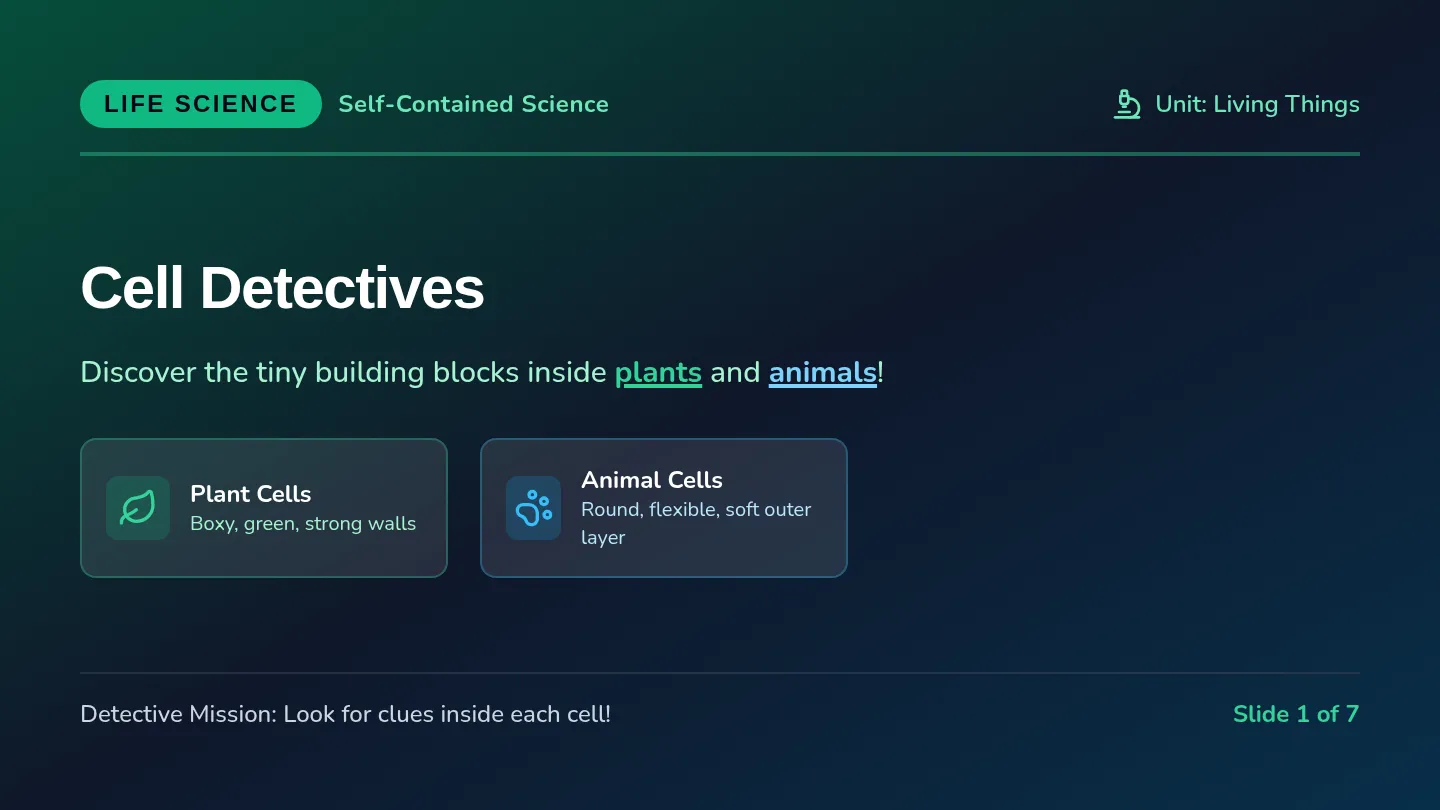
Today's Focus: Animal & Plant Cells
Biology | Grade 10
Our Goals Today
Science Objective
Identify and compare structures in animal and plant cells.
Life Skill
Collaborate effectively with all peers to share diverse ideas.
"Why it matters?"
Cells are the building blocks of life. Understanding them helps us understand ourselves and the world!
Respect and teamwork are key to today's success.
Team Up for Success!
1
Work with your new assigned group.
2
Every single idea is valuable !
3
Read together and complete the worksheet.
"The strength of the team is each individual member. The strength of each member is the team."
Spot the Differences
A
P
Look for these key indicators in your reading:
Cell Wall
Which cell has a rigid outer layer?
Chloroplasts
Where does food making happen?
Vacuoles
Compare the sizes and counts.
Shape
Rigid vs. Irregular & Flexible?
Share Your Discoveries!
Class Discussion
Recap: Amazing Cells!
Explored Cell Types
Identified Key Differences
Practiced Great Teamwork
GREAT JOB COLLABORATING!
Cellular Harmony Warm Up Activity What's the Buzz?
Cellular Harmony: Lesson Warm Up
Name:
Date:
Think about cells you've heard about or seen. Answer the questions below to get your brain buzzing!
1
What is a cell? Describe it in your own words.
2
Can you name any parts of a cell? If so, list them.
3
Do you think all cells are exactly the same? Why or why not? Animal and Plant Cell Reading Science Reading
Animal and Plant Cells
A Closer Look at Life's Building Blocks
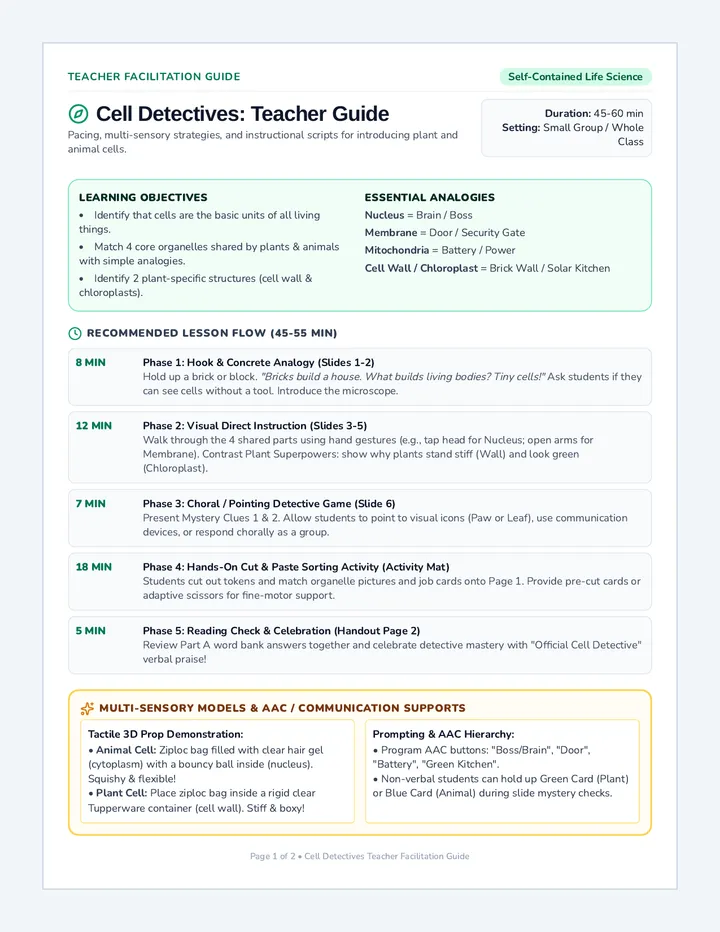
Imagine a brick house and a tent. Both are structures that provide shelter, but they are built very differently and have different features. In the same way, animal cells and plant cells are both fundamental units of life, but they have distinct structures that allow them to perform very different jobs.
The Basics: Eukaryotic Cells
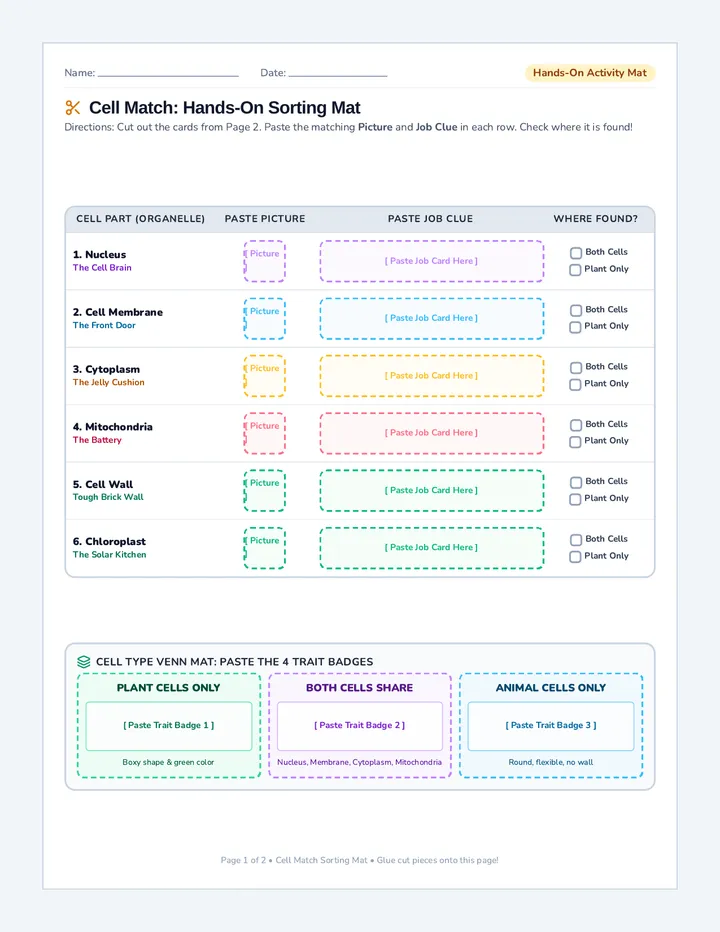
Both animal and plant cells are eukaryotic cells. This means they both have a nucleus, which acts like the cell's brain, controlling its activities and storing genetic material (DNA). They also share many other common features, including:
• Cell Membrane: A flexible barrier.
• Mitochondria: The "powerhouses."
• Cytoplasm: The jelly-like filler.
• Ribosomes: Protein makers.
• ER: Synthesis network.
• Golgi: Sorts and packages.
Unique Features of Plant Cells
Plant cells have a few special components that animal cells do not. These features are essential for a plant's ability to create its own food and maintain its rigid structure:
Cell Wall: This is a strong, rigid outer layer made primarily of cellulose. It provides structural support and protection, much like the frame of a house.Chloroplasts: These are the sites of photosynthesis. They contain a green pigment called chlorophyll, which captures sunlight to make food (glucose). This is why plants are called producers !Large Central Vacuole: Plant cells typically have one large central vacuole that can take up to 90% of the cell's volume. When full, it creates turgor pressure to keep the plant upright.
Unique Features of Animal Cells
Animal cells have their own set of unique features that reflect their diverse functions and their need for movement and flexibility. They lack a cell wall and chloroplasts, but they often have:
Centrioles: These small, cylindrical structures are involved in cell division in animal cells.Small Vacuoles: Unlike plants, animal cells may have several small, temporary vacuoles for storing water and waste, but they do not play a structural role.Irregular Shape: Without a rigid cell wall, animal cells tend to have more flexible and irregular shapes, allowing them to move and change form easily.
Animal and Plant Cell Worksheet Animal vs. Plant Cell Comparison
Guided Group Exploration
Group:
Names:
Instructions: Work with your group to answer the following questions using the provided reading material. Discuss your answers and make sure everyone understands before writing them down.
1 Part 1: Fill in the Blanks
Word Bank
Cell Wall Chloroplasts Vacuole Nucleus Mitochondria Photosynthesis Cellulose Irregular
1. Both animal and plant cells are eukaryotic, meaning they both have a which controls cell activities.
2. The "powerhouses" of both animal and plant cells are the , which produce energy.
3. Plant cells have a rigid outer layer called the , which provides support and protection.
4. This rigid outer layer in plant cells is primarily made of .
5. are unique to plant cells and are responsible for converting sunlight into food through a process called .
6. Animal cells have several small, temporary , while plant cells typically have one large central one.
7. Without a rigid cell wall, animal cells tend to have a more flexible and often shape.
2 Part 2: Comparison Table
Complete the table below, highlighting the differences and similarities.
Feature Animal Cell Plant Cell Cell Wall Chloroplasts Vacuole Shape Mitochondria
3 Part 3: Reflect and Connect
1. Why do you think it's important for plants to have chloroplasts and a cell wall, while animals do not?
2. Describe one thing you learned today about cells that you found surprising or interesting.
3. How did working with your group today help your learning? What was one challenge, and how did you overcome it?
Cellular Harmony Discussion Prompts Handout Group Discussion
Cellular Harmony: Reflection Prompts
Teacher Note: Use these prompts to facilitate small-group sharing first, followed by a whole-class discussion. Encourage students to provide specific examples from their group work.
Reflecting on Cell Knowledge
1. The Big Difference
What was the most significant difference you discovered between animal and plant cells? Why is it important?
2. Real-World Connections
Where might understanding these differences be useful? (Think: medicine, farming, or the environment).
3. Ongoing Curiosity
Are there any parts of cells that still confuse you or that you'd like to dive deeper into?
Reflecting on Collaboration
1. Team Strategy
How did your group work effectively today? What did you do to make sure everyone participated?
2. Handling Challenges
Were there challenges in working with new people? How did you handle listening or disagreeing respectfully?
3. The Power of Diversity
Why is it vital to work with different people you wouldn't normally choose? How does this help you later in life?
Ready to Share?
Prepare to share one key insight from your group discussion with the whole class!
Cellular Harmony Cool Down Activity Reflect & Connect
Cellular Harmony Exit Ticket
Student Name
Date
01 List two key differences between animal and plant cells:
02 What is one new vocabulary word or concept you learned?
03 How effectively did your group work together today?
Very Effectively
Somewhat Effectively
Needs Improvement
04 One thing you will remember about working with your group:
05 Group enjoyment scale (1 = Not at all, 5 = Very much):
1 2 3 4 5
Cellular Harmony Answer Key Answer Key
Cellular Harmony Lesson Materials
Teacher Use Only
Animal and Plant Cell Worksheet: Part 1
...meaning they both have a Nucleus which controls cell activities.
The "powerhouses" are the Mitochondria, which produce energy.
Plant cells have a rigid outer layer called the Cell Wall.
This rigid outer layer is primarily made of Cellulose.
Chloroplasts are unique to plant cells... process called Photosynthesis.
Animal cells have several small, temporary Vacuoles.
Animal cells tend to have a more flexible and often Irregular shape.
Worksheet Part 2: Comparison Table
Feature Animal Cell Plant Cell Cell Wall Absent Present (Support) Chloroplasts Absent Present (Food Maker) Vacuole Small, temporary, several One large central Shape Irregular, flexible Fixed, rectangular Mitochondria Present Present
Worksheet Part 3: Reflect & Connect
Importance of differences:
Plants need chloroplasts to make food (producers) and cell walls for structure (don't have bones). Animals eat food (consumers) and need to move (flexible shapes).
Cool Down / Exit Ticket
Key Differences:
Cell Wall (Present in plants/Absent in animals)
Chloroplasts (Present in plants/Absent in animals)
Vacuole size (Large central in plants/Small in animals)
Shape (Rectangular/fixed vs. Irregular/flexible)
Note: Collaboration reflections and "interesting facts" will vary by student. Use for assessing participation and critical thinking.