Lenny.com
Explore
Create
ActivitiesNewMathEnglish Language ArtsScience & EngineeringSocial StudiesGlobal LanguagesHealth & Physical EducationSpecial EducationCounseling & Life SkillsArts & CreativityESL
Lenny.com
Lenny.com
Explore
Create
ActivitiesNewMathEnglish Language ArtsScience & EngineeringSocial StudiesGlobal LanguagesHealth & Physical EducationSpecial EducationCounseling & Life SkillsArts & CreativityESL
Lenny.com
Lenny.com

Solutions

Lenny for EducatorsLenny for SchoolsLenny for Districts

Product

ExploreSign inCreateSupportAbout

Resources

Getting startedMTSS Acceleration Program

© 2026 Lenny Learning Inc.

TermsPrivacyAccessibility
LinkedInInstagramX
Lenny
Social StudiesSocial Studies PracticesLocation WordsMapsOrder EventsChronology and CausationEvaluating SourcesHistorical ThinkingGeography, Humans, & the EnvironmentAmerican Symbols and LandmarksCitiesStatesState CapitalsRegions of the United StatesGeographic SkillsPhysical GeographyHuman GeographyRegional GeographyGeography of AfricaGeography of AsiaGeography of EuropeGeography of OceaniaGeography of the AmericasSociety and Environment of EuropeSociety and Environment of AsiaSociety and Environment of The AmericasSociety and Environment of the Middle EastSociety and Environment of AfricaHistoryPrehistoryComparing Ancient River CivilizationsAncient MesopotamiaAncient Egypt and KushAncient South AsiaEarly ChinaGreeceRome and the Byzantine EmpireAncient World HistoryNative Peoples of North AmericaNative Peoples of Mesoamerica and South AmericaAfrican EmpiresMedieval AsiaMedieval EuropeThe Silk RoadMedieval HistoryIslamic EmpiresWorld ReligionsRenaissance PeriodAge of ExplorationThe Thirteen ColoniesThe American RevolutionUS History Early RepublicFounding of the United StatesUS History AntebellumUS Civil WarReconstruction PeriodThe Gilded AgeUS ImperialismWorld ImperialismWorld War IUS History 1920sGreat DepressionWorld War IIThe Cold WarUS History 1950-60sUS History 1960s-70sWorld History 20th CenturyContemporary US HistoryContemporary World HistoryHolidaysCivics and GovernmentCitizenshipGovernment FoundationsThe ConstitutionUS ConstitutionExecutive BranchLegislative BranchJudicial BranchState and LocalPolitical ParticipationPublic PolicyPolitical SystemsPower and AuthoritySocial MovementsDefining DevianceTheories of DevianceCrime and Criminal JusticeEconomicsBasic Economic PrinciplesSupply and DemandWhat is MoneyEconomic FundamentalsMicroeconomicsMacroeconomicsBanking and FinanceEconomic SystemsGlobal EconomicsCorporations and PowerThe Changing WorkplaceUnemployment and LaborClass and InequalitySocial MobilityGlobal InequalityPsychologyHistory of PsychologyPsychology as a ScienceBrain and Nervous SystemNeuroscience and BehaviorGenetics and BehaviorSleep and ConsciousnessSensory ProcessesPerceptual OrganizationClassical ConditioningOperant ConditioningObservational LearningCognitive LearningMemory ProcessesThinking and Problem SolvingLanguage and CognitionTheories of MotivationStress and CopingPrenatal and Infant DevelopmentChildhood DevelopmentAdolescent DevelopmentAdulthood and AgingSelf and IdentitySocial CognitionSocial InfluenceAttraction and RelationshipsGroup BehaviorPrejudice and DiscriminationAnxiety and Mood DisordersClinical PsychologyForensic PsychologyPhilosophy & EthicsIntroduction to PhilosophyMajor Philosophers & IdeasMind and Body ProblemFree Will vs DeterminismEthics & MoralityReligion & PhilosophyPolitical Philosophy

Campus Quest Academy

A structured, four-hour independent learning challenge for 7th grade students remaining on campus during field trip day. The curriculum blends core fall grade-level standards with real-world applications across mathematics, life science, English language arts, and world history.

CWCheyenne Watkins

Differentiation & Support Strategies

For Struggling Learners / IEP / 504:

  • Math: Provide printed horizontal number lines (-20 to +20) and sign reference rules (\(p - q = p + (-q)\)).
  • ELA: Allow students to dictate their CER responses or provide starter sentence frames.
  • Pacing: Permit completion of 3 of the 4 problems on Page 2 before moving to Page 3.

For Advanced / Fast Finishers:

  • Math: Challenge students to determine the overall average daily temperature change.
  • Science: Write a paragraph explaining how hydrothermal vent bacteria relate to early life on Earth.
  • History: Draw an illustrated caravanserai schematic map showing travel lodging.

Campus Quest Academy • Facilitator Guide Page 1 of 4

Answer Key & Scoring Guide

Module 1: Mathematics Solutions (25 Points Total)

Standards 7.NS.1, 7.NS.2, 7.NS.3

Part 1 Solutions (Student Packet Page 2: 13 Points Total) 7.NS.1 & 7.NS.2a

1. Polar Temperature Shifts (3 pts):

Expression: \(-15.4 + 9.6 - 11.8\)
Step 1: \(-15.4 + 9.6 = -5.8^\circ\text{C}\)
Step 2: \(-5.8 - 11.8 = \mathbf{-17.6^\circ\text{C}}\)
Final Temperature = -17.6°C

2. Sub-Ice Drone Elevation (3 pts):

Start: \(-42\frac{1}{2} = -\frac{170}{4}\text{ m}\); Ascends: \(+28\frac{3}{4} = +\frac{115}{4}\text{ m}\)
\(-\frac{170}{4} + \frac{115}{4} = -\frac{55}{4} = \mathbf{-13\frac{3}{4}\text{ m}}\) (or \(-13.75\text{ m}\))
New Elevation = -13¾ m (-13.75 m)

3. Additive Inverses (3 pts):

A. Required Change: \(\mathbf{+24^\circ\text{C}}\) (1 pt).
B. Reasoning (2 pts): By \(p + (-p) = 0\), opposite values cancel. Adding positive 24 to -24 yields 0 zero pairs, restoring the baseline.

4. Continuous Drilling Rate (4 pts):

Rate \(\times\) Time = \((-2.4\text{ m/hr}) \times 4.5\text{ hr}\)
\(2.4 \times 4.5 = 10.8\); negative \(\times\) positive = negative.
Total Depth Change = -10.8 meters

Part 2 Solutions (Student Packet Page 3: 12 Points Total) 7.NS.2b,d & 7.NS.3

5. Signed Fraction Division (2 pts):

\(\left(-\frac{5}{8}\right) \div \left(-\frac{15}{16}\right) = \left(-\frac{5}{8}\right) \times \left(-\frac{16}{15}\right)\)
Simplify: \(\frac{(-1) \times (-2)}{1 \times 3} = \mathbf{+\frac{2}{3}}\) (negative ÷ negative = positive).

6. Long Division Decimal Equivalents (3 pts):

A. \(\frac{5}{8}\): \(5 \div 8 = \mathbf{0.625}\) \(\rightarrow\) Terminating (remainder reaches 0).
B. \(-\frac{5}{6}\): \(-(5 \div 6) = \mathbf{-0.8\bar{3}}\) \(\rightarrow\) Repeating (digit 3 repeats infinitely).

7. Multi-Step Financial Ledger (7 pts):

A. Number Sentence (2 pts):
\(-185.50 + 750.00 + [4 \times (-62.75)] - 124.50 + [0.5 \times 196.00]\)

B. Computational Steps (3 pts):
• Fuel: \(4 \times (-62.75) = -251.00\)
• Refund: \(0.5 \times 196.00 = +98.00\)
• Credits: \(750.00 + 98.00 = +\$848.00\)
• Debits: \(-185.50 - 251.00 - 124.50 = -\$561.00\)
• Combine: \(848.00 - 561.00 = \mathbf{+\$287.00}\)

C. Status (2 pts): Surplus (+$287.00).

Campus Quest Academy • Math Answer Key (7.NS.1–3) Page 2 of 4

Answer Key & Scoring Guide

Module 2: Life Science Solutions (25 Points Total)

Standard MS-LS1

Part A: Organelle Command & Function Matching (8 Points: 2 pts each + 1 pt bonus)

1. Nucleus \(\rightarrow\) Letter B

The Executive Head Office & Blueprints containing DNA.

2. Mitochondria \(\rightarrow\) Letter D

The Power Plant producing cellular ATP energy.

3. Cell Membrane \(\rightarrow\) Letter A

The Security Guard regulating what enters and leaves.

4. Ribosomes \(\rightarrow\) Letter C

Assembly Line Workers synthesizing protein molecules.

Bonus Question Answer:

Chloroplast (also accept Cell Wall or Large Central Vacuole, though chloroplast is specific to photosynthesis).

Scoring Criteria: 1.5 points for matching the definition to organelle, 0.5 point for analogy letter match.

Part B: Cellular Transport & Osmosis Investigation (8 Points: 4 pts each beaker)

Beaker A (100% Distilled Pure Water):

1. Direction: Into the cell (2 pts).

2. Physical Result: Water rushes in down its concentration gradient. The cell expands, becomes firm and turgid, and pushes against its rigid cell wall. (In animal cells, it might lyse/burst, but in plant cells the wall prevents bursting) (2 pts).

Beaker B (20% Concentrated Saltwater):

1. Direction: Out of the cell (2 pts).

2. Physical Result: Water leaves the cytoplasm by osmosis toward the higher solute area. The cell loses volume, undergoes plasmolysis (cytoplasm shrivels and pulls away from the cell wall), causing wilting (2 pts).

Part C: Experimental Design & Variables (9 Points: 2 pts per variable, 3 pts prediction)

Independent Variable:

Water Temperature (°C)

Dependent Variable:

Circumference of balloon / CO₂ gas produced

Controlled Constants (Any 2):

Volume of water (100 mL), mass of yeast (5 g), flask size, duration (30 min).

Hypothesis Prediction & Biological Reasoning (3 pts):

Exemplar: Flask 3 (40°C) will produce the largest balloon because yeast enzymes function optimally in warm temperatures, accelerating cellular respiration. In contrast, 10°C is too sluggish, and 65°C will denature (kill/damage) the yeast enzymes, halting respiration completely.

Campus Quest Academy • Science Answer Key Page 3 of 4

Answer Key & Scoring Guide

Modules 3 & 4: ELA & World History Solutions

25 Pts ELA • 25 Pts History

Module 3: English Language Arts Keys (25 Points Total) RI.7.1, RI.7.4, W.7.9

Part A & B Objective Keys (13 Pts):

1. "Perpetual": [B] Unending (2 pts).

2. "Azoic hypothesis": [B] Life cannot survive without sunlight/warmth (2 pts).

3. Energy Process: Chemosynthesis (2 pts).

4. Physical Adaptation Quote: "cellular membranes have evolved specialized polyunsaturated fats to resist catastrophic hydrostatic crushing" (3 pts).

5. Extraterrestrial Connection: Since organisms thrive in sunless deep vents on chemical energy, life could exist under ice oceans on moons like Europa without sunlight (4 pts).

Part C: CER Rubric & Exemplar (12 Pts):

Claim (3 pts): Technological innovations in submersibles disproved the assumption that deep trenches are lifeless voids.

Evidence (4 pts): Paragraph 2 states that autonomous robotic submersibles documented "thriving communities of bioluminescent organisms, giant amphipods, and translucent snailfish."

Reasoning (5 pts): This evidence proves that extreme pressure and the complete absence of sunlight do not prevent living systems from thriving, directly disproving the 19th-century azoic theory through direct scientific observation.

Module 4: World History Keys (25 Points Total) Historical Analysis & Synthesis

Item / InnovationClassification (1 pt each)Primary Origin (1 pt each)
1. Woodblock Printing & PaperIdea / TechnologyChina
2. BuddhismIdea / Spiritual TeachingsIndia (spread to China/Central Asia)
3. Raw Silk & Fine PorcelainMaterial GoodChina
4. Algebra & Medical PharmacopeiaIdea / TechnologyMiddle East / Islamic World

Part B: Trade Logistics Keys (8 Pts):

1. Caravanserai Role: Protected travelers from banditry, provided water/fodder for camels, allowed merchants to rest and exchange cultural ideas safely across dangerous terrain.

2. High-Value Luxury Goods: High transportation costs across deserts made shipping cheap, bulky food uneconomical. Only high-value, lightweight commodities (silk, gems) yielded sufficient profit margin to justify travel risks.

Synthesis & Sign-Off Criteria (9 Pts):

Synthesis Prompt: Look for cross-disciplinary thinking. Full credit awarded if student names two subjects and accurately explains a shared analytical skill (e.g., using mathematical data to verify claims, evaluating experimental evidence, testing hypotheses).

Scoring Summary: Packet total is scored out of 100 points (25 pts per module). A score of 70+ indicates proficient grade-level mastery.

Campus Quest Academy • ELA & History Answer Key Page 4 of 4
You might also like

Problem Detective Assessment

Math Goal Mastery

A targeted sequence of progress monitoring assessments and evaluation guides designed to measure and document key IEP mathematics benchmarks, including multi-step word problems and multi-digit operations.

JD

Jenny Daniels

4
Division Mastery Assessment

Division Masters

A progress monitoring lesson focusing on multi-digit whole number division with dividends up to four digits. Students demonstrate conceptual understanding and computational fluency using visual models, partial quotients, or the standard algorithm.

JD

Jenny Daniels

2
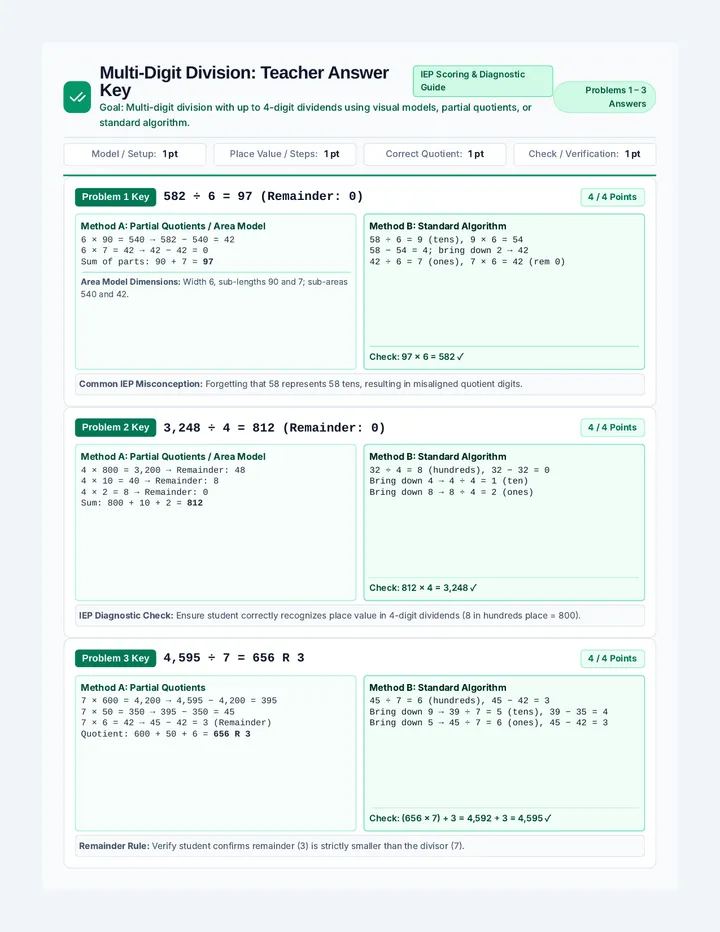
Division Mastery Answer Key

Division Mastery Answer Key

A 2-page teacher answer key and diagnostic error guide for the multi-digit division assessment, providing worked solutions across visual models, partial quotients, standard algorithms, and an IEP scoring rubric.

JD

Jenny Daniels

Business Blueprint Slides

Market Makers

A hands-on introductory curriculum that equips students with foundational business acumen and marketing savvy through practical entrepreneurial challenges, financial basics, and campaign design.

D

despinoza

9
Problem Detective Assessment

Problem Detectives

A targeted assessment and progress monitoring unit focused on multi-step word problem analysis. Students develop skills in determining what is being asked, filtering relevant details from distractors, and selecting sequential operations to solve real-world problems.

JD

Jenny Daniels

2
Division Mastery Assessment

Division Mastery Assessment

A 2-page print-ready IEP progress monitoring assessment featuring 6 multi-digit division problems with dividends up to four digits, visual model selection checkboxes, place-value alignment grid workspaces, and check-by-multiplication sections.

JD

Jenny Daniels

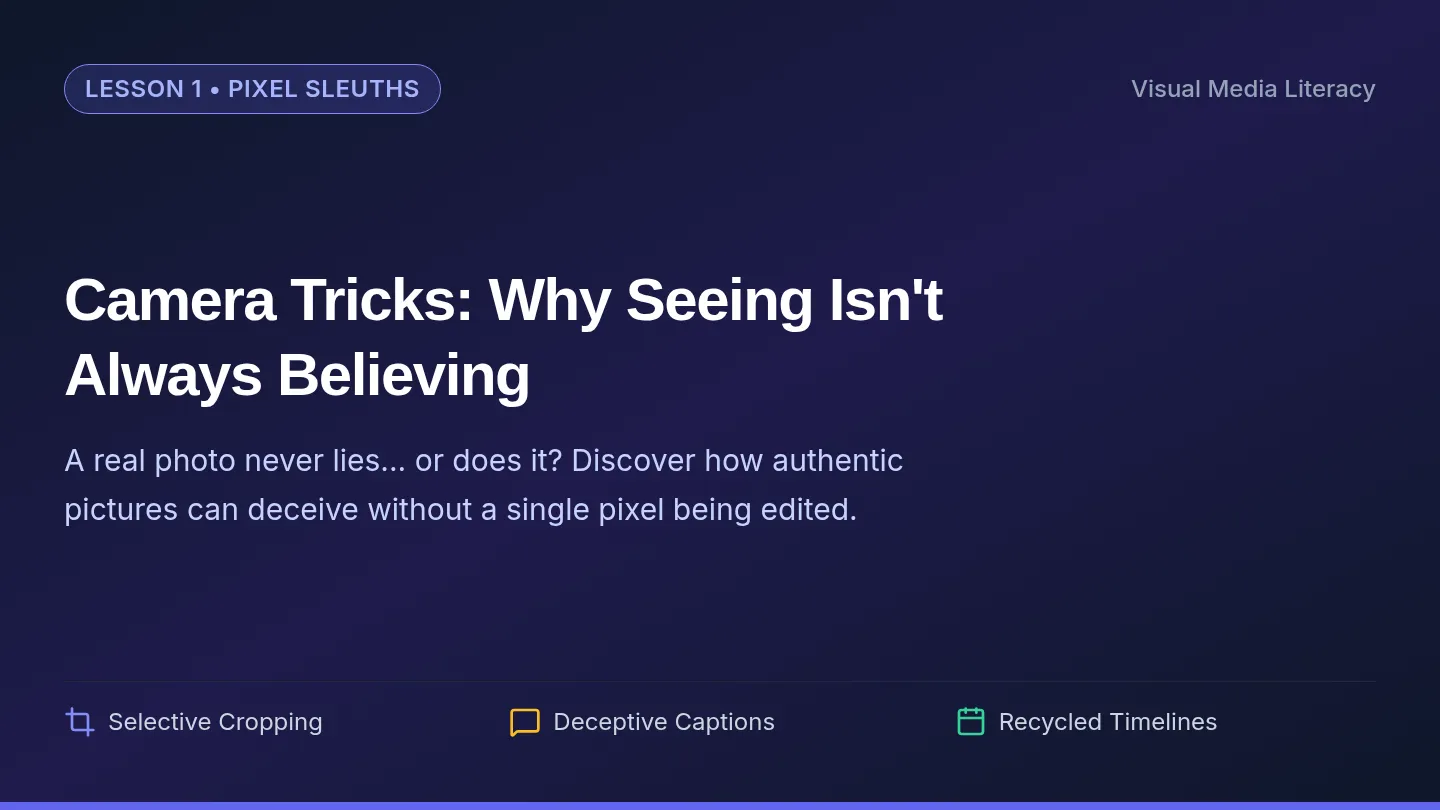
Camera Tricks Slides

Pixel Sleuths

A 3-part media literacy unit for middle school students on analyzing visual media, spotting manipulated photos, and verifying online sources using lateral reading.

Lenny Avatar
Lenny
9
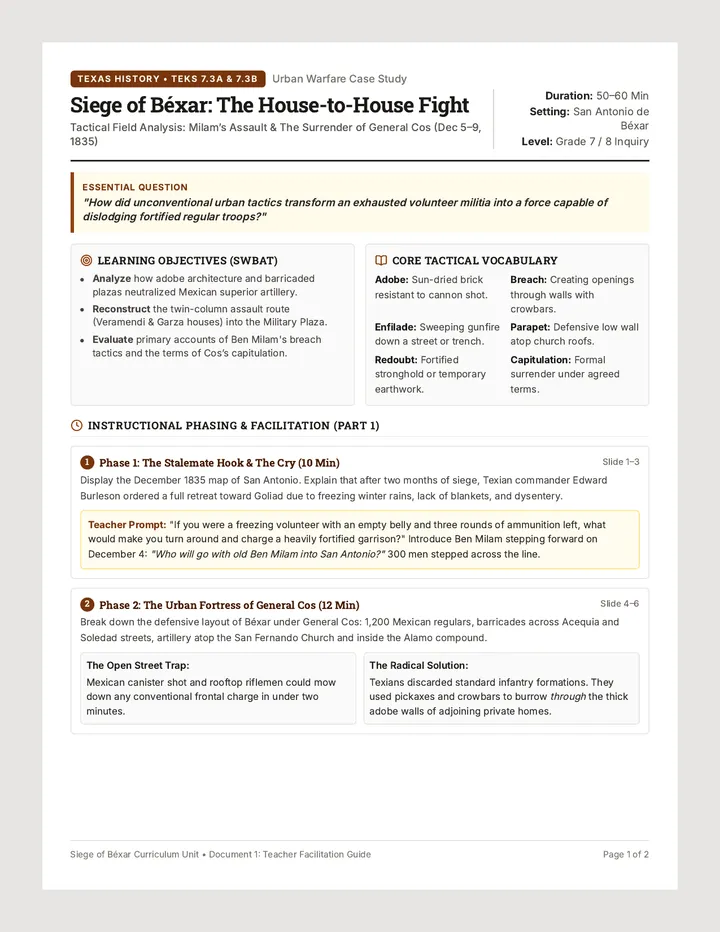
Winter Siege Lesson Plan

Breaching Bexar

A rigorous 8th-grade Texas History inquiry examining the December 1835 Siege of Béxar, where Texian volunteers led by Ben Milam executed house-to-house urban warfare to dislodge General Martín Perfecto de Cos's Mexican forces from San Antonio. Students analyze tactical primary sources, engineer breaches through adobe walls, and evaluate the strategic aftermath leading up to the Alamo.

FM

Felicia Monk

4
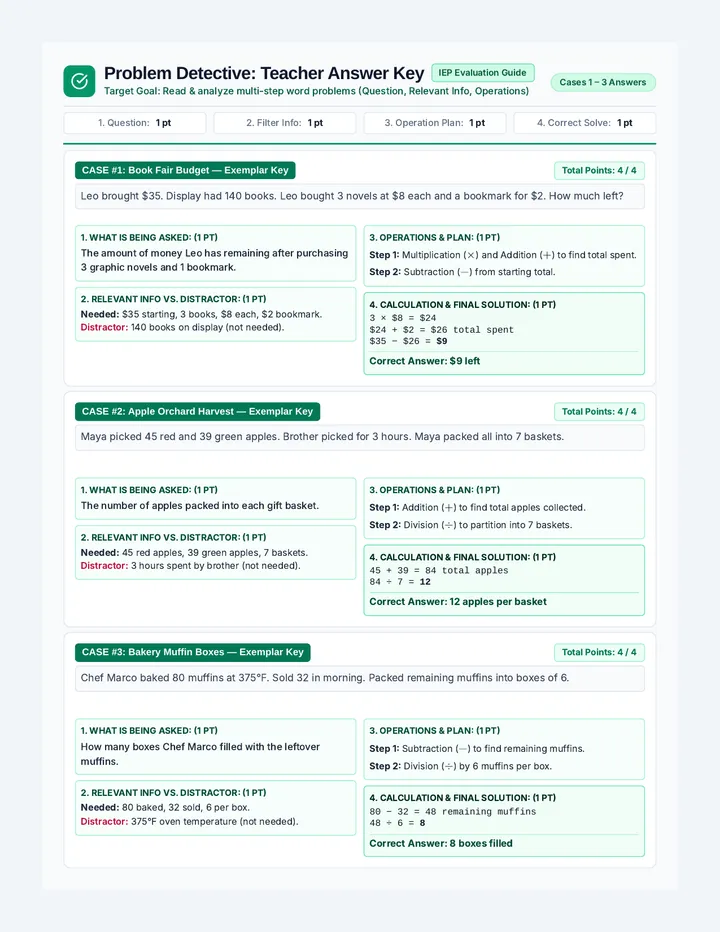
Problem Detective Answer Key

Problem Detective Answer Key

A 2-page teacher answer key and IEP scoring guide providing worked solutions, distractor analysis, operation pathways, and progress monitoring rubrics for all 6 word problem cases.

JD

Jenny Daniels

Two Step Targets Worksheet

Direction Detectives

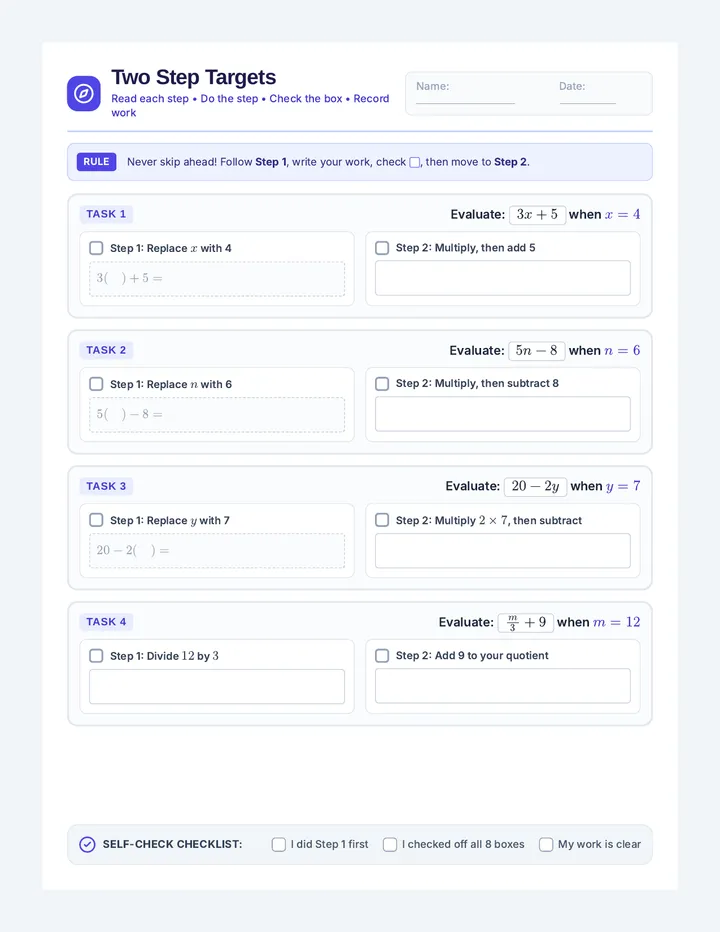
A scaffolded 7th-grade math practice sequence designed for special education learners, focusing on breaking down multi-step tasks into clear, bite-sized directions of 2 to 4 prompts. Students follow explicit written directions, track their progress with visual step checkpoints, and record each intermediate calculation.

J

jbrower

6
Ratio Remix Worksheet

Ratio Remix

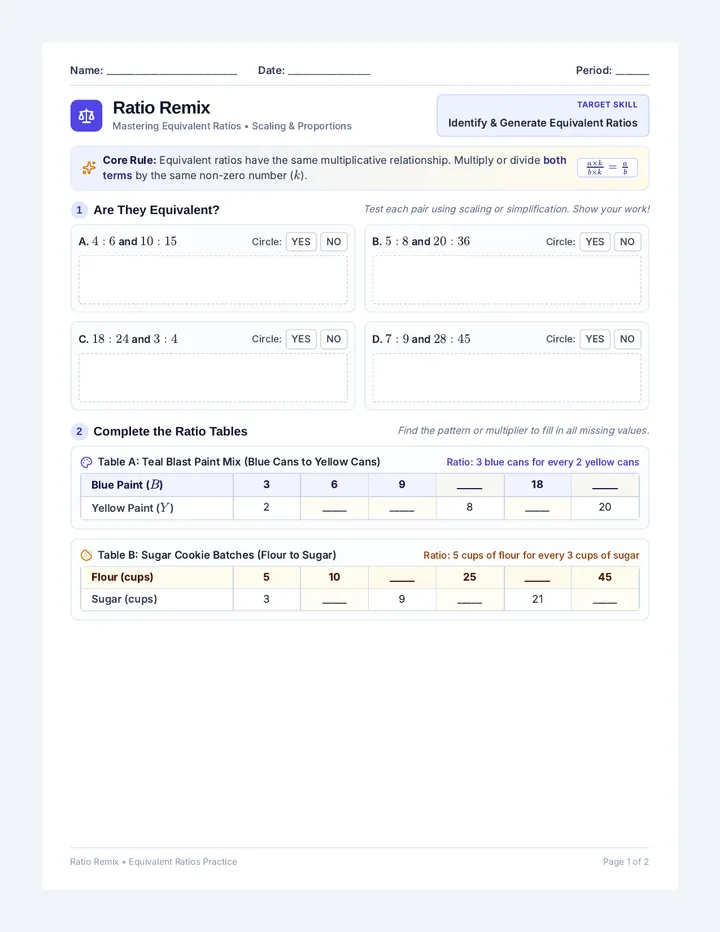
A comprehensive middle school math lesson on equivalent ratios, focusing on identifying, testing, and generating proportional relationships using scaling, ratio tables, and real-world problem-solving.

C

cary.stamps

2
Problem Detective Assessment

Problem Detective Assessment

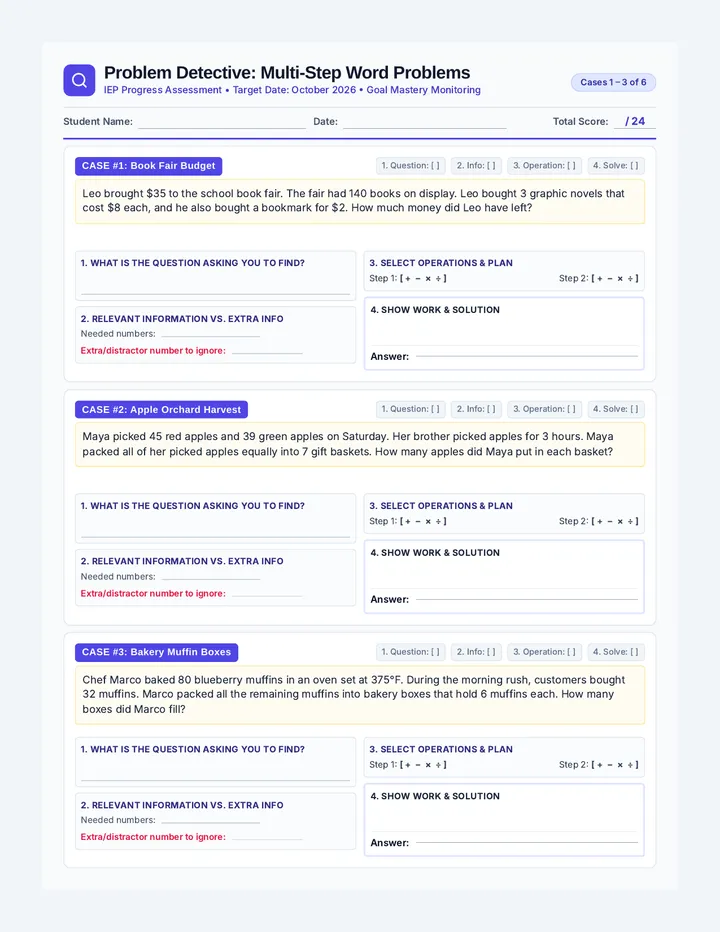
A 2-page print-ready progress monitoring assessment featuring 6 scaffolded multi-step word problems designed to evaluate student IEP goals in identifying the question, isolating relevant information, selecting correct operations, and computing solutions.

JD

Jenny Daniels