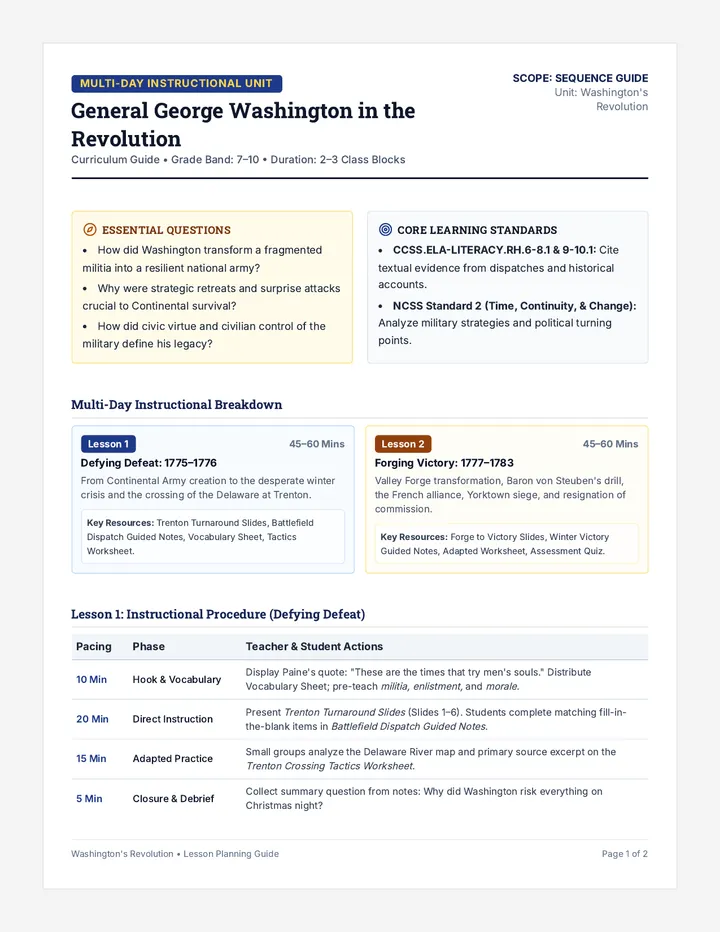
Boomer Blueprint Teacher Guide Boomer Blueprint: Teacher Guide
Standard: TN US.65 | 30-Minute Lesson Plan
Essential Question
How did the population explosion between 1946 and 1964 reshape the economic landscape and cultural identity of the United States?
Learning Objectives
Identify the causes of the Baby Boom generation.
Explain the economic impact of suburbanization and consumerism.
Analyze how Boomer culture influenced American entertainment and media.
Lesson Pacing (30 Minutes)
Time Section Activity 0:00 - 0:05 Hook "The Exploding Family" - Analyze a 1950s census chart. Brief discussion on why population spikes after war. 0:05 - 0:15 Direct Instruction Slide presentation on Economic and Cultural shifts. Students complete Guided Notes. 0:15 - 0:25 Guided Practice "The Suburban Dream" Activity - Analyzing a Levittown advertisement and Boomer-targeted marketing. 0:25 - 0:30 Closure Exit Ticket: One economic and one cultural impact summary. Review Study Guide.
Tennessee Connections (T)
Discuss the growth of Nashville's suburbs (Donelson) and the expansion of Oak Ridge as families sought housing post-WWII. Highlight the rise of the Memphis music scene (Sun Records) as Boomer teens created a new market for Rock and Roll.
Materials Checklist
Boomer Blueprint Slide Deck
Speaker Notes & Script
Guided Notes (Student Copy)
"The Suburban Dream" Activity
Primary Source & Visuals Bank
Answer Key & Study Guide
Boomer Blueprint Slides BOOMER BLUEPRINT
Reshaping American Economy & Culture (1946–1964)
The Population Spark
Post-War Reality
Returning WWII veterans (GI Bill benefits) lead to high marriage rates and early family formation.
The Numbers
76 million babies born between 1946 and 1964. At its peak, a baby was born every 7 seconds.
Economic Boom:
Source: U.S. Census Bureau, Historical Population Data (1960)
Economic Impact: Levittown
Mass Production of Housing: Assembly-line construction.
GI Bill Impact: Low-interest loans for veterans to buy homes.
The Interstate Highway Act (1956): Connecting suburbs to city jobs.
Consumer Ripple Effect
Cars
Appliances
Televisions
Groceries
Source: Levitt & Sons, Promotional Material (1949); Federal Aid Highway Act (1956)
Cultural Impact: The Tube
By 1960, 90% of US homes had a television.
Standardization of Culture: Everyone watched the same shows (I Love Lucy, Ed Sullivan).
Targeted Advertising: Marketers realized kids/teens had "discretionary income."
"Rock and Roll is here to stay!"
Teen Culture Emerges
Source: Nielsen Television Research, Annual Report (1960)
Tennessee (T) Impact
Music City & Sun Records
Nashville and Memphis became hubs for the new "Teen Culture." Boomers flocked to record stores to buy Elvis Presley (Sun Records, 1954) and country-rock crossovers.
Suburban Growth
The expansion of Oak Ridge and Nashville's ring of suburbs transformed TN from rural/agricultural to urban/residential.
Source: TN State Archives, Historical Development Records (1962)
Boomer Blueprint Guided Notes BOOMER BLUEPRINT
Guided Notes: US.65 Economic & Cultural Impact
Name: ____________________
Date: ____________________
I. The Population Spark
1. The Baby Boom refers to the period between ____________ and ____________.
2. A major cause was returning veterans using the ____________ ____________ to start families.
3. Approximately ____________ million babies were born during this era.
4. Economic result: More people created an immediate ____________ for new goods and services.
II. Economic Shift: Suburbanization
5. William Levitt revolutionized housing with ____________-____________ construction techniques.
6. ____________ houses were identical, affordable, and built in mass quantities.
7. The ________________________ Act of 1956 allowed people to live further from work.
The "Consumer Ripple": List 3 products that saw massive growth:
• ________________________________
• ________________________________
• ________________________________
III. Cultural Impact: Media & Identity
8. By 1960, __________% of American households owned a television.
9. Television led to the ____________ of culture, meaning everyone saw the same icons.
10. The emergence of the "teenager" as a consumer group led to the rise of ____________ music.
11. In Tennessee, the city of ____________ became a global hub for music production.
IV. Critical Thinking
How did the Baby Boom fundamentally change the physical layout of American cities? (Think about where people lived and how they traveled).
Boomer Blueprint Activity The Exploding Family
Population Data Analysis | Standard US.65
Name: ____________________
Date: ____________________
Document A: U.S. Live Births (1940–1970)
4.5M 3.0M 1.5M 0.0M
1940
1945
1946
1950
1955
1957*
1960
1964
1970
Year Births 1940 2.56M 1946 3.41M 1957 4.30M 1964 4.02M
*1957 represents the statistical peak of the Baby Boom.
1. Identify the percentage increase in births between 1940 and 1957. Why did this happen?
2. Based on the chart, which year marks the definitive "start" of the population boom? Cite specific data.
Economic and Cultural "Ripple"
3. Economic Impact: Imagine it is 1958. How would the massive number of toddlers (born in 1957) change what a local supermarket or department store decides to sell?
4. Cultural Impact: By the mid-1960s, the "Peak Boomers" became teenagers. How did their sheer numbers force the music and television industries to change?
Source: U.S. Department of Health, Education, and Welfare; National Center for Health Statistics, Vital Statistics of the United States (1970).
Boomer Blueprint Answer Key Boomer Blueprint: Answer Key
For Teacher Use Only | Standard US.65
Guided Notes Key
1. Timeline: 1946 and 1964
2. Cause: GI Bill (Servicemen's Readjustment Act)
3. Numbers: 76 million
4. Economic Result: Demand (or Consumer Demand)
5. Housing: Mass-production (or assembly-line)
6. Levittown: Tract houses (or prefabricated)
7. Highway Act: Interstate Highway Act of 1956
8. Ripple Products: Cars, Televisions, Washing Machines, Refrigerators, Baby Food (Accept any three logical items).
9. TV Owners: 90%
10. Culture Effect: Standardization (or Homogenization)
11. Music: Rock and Roll
12. TN City: Memphis (or Nashville)
Activity: The Exploding Family Key
Data Interpretation:
1. Increase: Roughly a 68% increase (from 2.56M to 4.30M). Reason: Post-war optimism, GI Bill benefits, early marriage, and stable economic conditions.
2. Start: 1946. Data shows a jump from 2.8M (1945) to 3.41M (1946)—a sudden spike of nearly 600,000 births in one year.
Synthesis Analysis:
3. Economic: Stores would stock more baby food, diapers, strollers, and toys. Construction companies would shift toward building schools and multi-bedroom suburban houses.
4. Cultural: The sheer size of the teenage population (The "Youth Bulge") made them the primary target for advertisers. This led to the rise of Rock and Roll (teen-specific music) and TV shows like *American Bandstand* that focused exclusively on teen tastes.
Critical Thinking Prompt (Rubric)
Model Response:
"The Baby Boom caused American cities to sprawl outward into suburbs. This shift required a massive expansion of roads and highways (Interstate Highway Act) and created a dependency on automobiles. It also moved the economic center from city downtowns to suburban shopping malls and housing developments."
Boomer Blueprint Speaker Notes Boomer Blueprint: Speaker Notes
Guided Script for 30-Minute Presentation
Slide 1: Title Slide (2 Minutes)
"Good morning/afternoon. Today we are looking at the 'Boomer Blueprint.' We're going to explore how a massive spike in population didn't just change the size of families—it fundamentally rebuilt the American economy and redefined our culture. We'll look at why this happened and how its legacy still surrounds us today, from the highways we drive on to the music we listen to."
Slide 2: The Spark (6 Minutes)
"The Baby Boom didn't happen in a vacuum. After WWII, soldiers returned home with a new sense of optimism. Thanks to the GI Bill, they had money for education and homes. This led to a 'marriage boom.' Think about the numbers: 76 million babies. That's a baby born every 7 seconds at the peak. Ask the students: If you're a business owner and you suddenly see millions of new babies, what are you going to start selling? (Wait for answers: food, diapers, clothes, toys)."
Slide 3: Economic Shift: Suburbs (10 Minutes)
"Now, where do all these families live? Cities were cramped. Enter William Levitt. He applied Henry Ford's assembly line to houses. Levittown is the prime example. It was the 'McDonald's of Housing.' Mention the Interstate Highway Act—Eisenhower saw it as a defense move, but it became the artery of the suburbs. It allowed dad to drive to the city while the family lived in the 'safe' green suburbs. This created the 'Consumer Ripple'—you didn't just buy a house; you needed a car to get there, a lawnmower for the yard, and a TV for the living room."
Slide 4: Cultural Impact: The Tube (8 Minutes)
"Culture follows the money. Television became the centerpiece of the Boomer home. By 1960, almost everyone had one. This created a 'standardized' culture. Before TV, people had local traditions. Now, a kid in Tennessee and a kid in New York are watching the same shows and wanting the same toys. Also, highlight the 'Teenager.' This was a new concept. Before, you were a child, then an adult. Now, there's a middle stage with its own music—Rock and Roll—and its own spending power."
Slide 5: Tennessee Impact (4 Minutes)
"Let's bring it home. Tennessee was at the heart of this. Memphis became the epicenter of the teenage revolution with Sun Records and Elvis. Nashville expanded rapidly. Areas like Donelson or Madison exploded as 'bedroom communities.' The transition from a state of small farmers to a state of suburban commuters happened right during this window."
Total timing: 30 minutes. Use these prompts to facilitate discussion during the direct instruction portion of the lesson.
Boomer Blueprint Primary Sources Primary Source Portfolio
Annotated Documents & Legislation for US.65
1. Servicemen's Readjustment Act (GI Bill)
Date: June 22, 1944
"An Act to provide Federal Government aid for the readjustment in civilian life of returning World War II veterans." This legislation fueled the housing and education boom.
https://www.archives.gov/milestone-documents/gi-bill
2. Levittown Housing Advertisement
Date: July 1949 (Levitt & Sons)
Promotional material highlighting the affordability and modern features of the new suburban developments.
https://www.loc.gov/item/2004677943/
3. Federal Aid Highway Act of 1956
Date: June 29, 1956
Legislation authorizing the construction of the Interstate Highway System, which decentralized American cities.
https://www.archives.gov/legislative/features/gw-highway
4. Life Magazine: "The Lucky Generation"
Date: August 31, 1959
Article detailing the growing economic power and distinct consumer spending habits of American teenagers.
https://books.google.com/books?id=FFMEAAAAMBAJ
5. Census Bureau Report: 1960 Population Profile
Date: 1960
Statistical data showing the massive population growth and the "youth bulge" in American demographics.
https://www.census.gov/library/publications/1960/dec/pc-s1-1.html
6. Sun Records: "That's All Right" (Elvis Presley)
Date: July 19, 1954
Archival record of the first commercial release by Elvis Presley, representing the rise of rock and roll culture.
https://www.sunrecords.com/artists/elvis-presley/
Note: Historical visual links are contained in the separate Visuals Bank resource as requested. These documents provide the primary textual and legal foundation for the lesson.
Boomer Blueprint Visuals Bank Visuals Bank: Part I
Curated Historical Visuals for TN Standard US.65
1. Levittown Aerial View (1948)
Shows the repetitive grid of post-war tract housing.
https://www.loc.gov/item/95513229/
2. Philco Predicta Television (1958)
Iconic mid-century modern technology design.
https://americanhistory.si.edu/collections/search/object/nmah\_713603
3. 1957 Chevrolet Bel Air (1957)
The quintessential symbol of 50s car culture.
https://www.gmheritagecenter.com/
4. Swanson TV Dinner Ad (1954)
The impact of TV on family dining habits.
https://americanhistory.si.edu/collections/search/object/nmah\_1317585/
5. Elvis Presley on Ed Sullivan (1956)
The intersection of TV and Rock and Roll.
https://www.edsullivan.com/artists/elvis-presley/
6. McDonald’s Golden Arches (1953)
First franchise in Phoenix, AZ; rise of fast food.
https://www.mcdonalds.com/us/en-us/about-us/history.html
7. Hula Hoop Craze (1958)
Example of mass-marketed toys for Boomer kids.
https://www.si.edu/spotlight/1950s/hula-hoop
8. Drive-In Movie Theater (1955)
Outdoor entertainment centered on car culture.
https://catalog.archives.gov/id/541913
9. Barbie Doll Launch (1959)
Targeted marketing to young Boomer girls.
https://americanhistory.si.edu/collections/search/object/nmah\_1213600
10. I Love Lucy Cast Photo (1951)
Standardized suburban family image on TV.
https://www.loc.gov/item/2012649065/
Visuals Bank: Part II
11. Polio Vaccine Newspaper (1955)
Medical advancement protecting the Boomer generation.
https://americanhistory.si.edu/collections/search/object/nmah\_1446627
Boomer Blueprint Study Guide Boomer Blueprint: Study Guide
Mastery of TN Standard US.65
Key Vocabulary & Terms
Baby Boom:
The significant increase in birth rate between 1946 and 1964.
GI Bill:
The 1944 law providing veterans with low-interest home loans and education.
Suburbanization:
The movement of people from cities to residential areas on the outskirts.
Levittown:
The first mass-produced housing development, symbolizing the 1950s suburb.
Consumerism:
The preoccupation of society with the acquisition of consumer goods.
Interstate Highway Act:
1956 law authorizing 41,000 miles of highway, fueling suburban growth.
Economic Impacts
Demand for housing led to assembly-line construction.
Rise of "Consumer Ripple": Increased spending on cars and TVs.
Expansion of middle class via stable post-war jobs.
Cultural Impacts
Standardization of culture through television.
Development of a distinct "Teenage" market.
Rise of Rock and Roll (Elvis, Sun Records).
Tennessee Connection (T)
Memphis: Center of Rock and Roll revolution (Sun Records). Nashville/Oak Ridge: Rapid suburban expansion, transforming from rural to urban lifestyles.
Mastery Check
Complete these analysis questions to verify your understanding.
1. How did the GI Bill act as the "engine" for the Baby Boom population spike?
2. Why is William Levitt often compared to Henry Ford in the context of the American economy?
3. Explain how television led to the "homogenization" or standardization of American culture.
4. How did the emergence of the 1950s "Teenager" create a new economic market?
Boomer Blueprint Study Guide | Tennessee US.65 Alignment