Lenny.com
Explore
Create
ActivitiesNewMathEnglish Language ArtsScience & EngineeringSocial StudiesGlobal LanguagesHealth & Physical EducationSpecial EducationCounseling & Life SkillsArts & CreativityESL
Lenny.com
Lenny.com
Explore
Create
ActivitiesNewMathEnglish Language ArtsScience & EngineeringSocial StudiesGlobal LanguagesHealth & Physical EducationSpecial EducationCounseling & Life SkillsArts & CreativityESL
Lenny.com
Lenny.com

Solutions

Lenny for EducatorsLenny for SchoolsLenny for Districts

Product

ExploreSign inCreateSupportAbout

Resources

Getting startedMTSS Acceleration Program

© 2026 Lenny Learning Inc.

TermsPrivacyAccessibility
LinkedInInstagramX
Lenny
Science & EngineeringLife ScienceLiving ThingsAnimalsPlantsBody SystemsTraitsAdaptationsCellsEcosystemsHeredityGenes to TraitsCell DivisionPhysicsComparing MaterialsShapes and PropertiesMagnetsMagnetismLightSoundLight and SoundMatterStates of MatterChanges of StateMixturesPhysical and Chemical ChangeHeating and CoolingHeat and Thermal EnergyEnergyForce and MotionElectrical CircuitsAtoms and MoleculesPeriodic TableMotion in One DimensionMotion in Two DimensionsScalars and VectorsForces and Laws of MotionCircular Motion and GravityMomentum and ImpulseWork, Energy, and PowerWavesElectromagnetic WavesGeometric OpticsElectricity and MagnetismSimple Harmonic MotionThermodynamicsNuclear PhysicsEarth Science & AstronomyWeatherWater CycleRocks and MineralsFossilsEarth's FeaturesEarth's ResourcesEarth's StructureWeather and ClimateEarth EventsFossils and Geologic TimePlate TectonicsHuman ImpactsAstronomyChemistryUnits and MeasurementAtomic StructurePeriodic TrendsChemical BondingNomenclatureMolecular StructureIntermolecular ForcesThe MoleStoichiometryProperties of GasesSolutionsChemical ReactionsBalancing EquationsEnergy ChangesRates of ReactionsEquilibriumAcids and BasesQuantum ModelBiologyClassificationCell StructureThe Chemistry of LifeBiomoleculesCellular TransportCell EnergyCell Growth and DivisionDNAProtein SynthesisMeiosis and Sexual ReproductionPatterns of InheritanceMulticellular OrganismsEvolutionEcologyBiodiversityComputer ScienceAlgorithms and Computational ThinkingProgramming LanguagesComputing SystemsNetworks and InternetData AnalysisCybersecurityAI and Machine LearningSoftware Design and DevelopmentBlockchainEngineering & AIDesigning ExperimentsEngineering PracticesDesign ThinkingEngineering Design ProcessMechanical EngineeringElectrical EngineeringMaterials and StructuresCAD and 3D DesignRoboticsArtificial Intelligence BasicsVibe CodingMachine LearningAI Ethics and SocietySystems ThinkingEntrepreneurship & InnovationEntrepreneurial MindsetBusiness Idea DevelopmentBusiness Plan BasicsMarketing & Customer DiscoveryFinancial Management for Startups

Ecosystem Dynamics Review

A comprehensive four-day review sequence preparing high school biology students for the Quarter 1 Interim Assessment on biogeochemical cycles, energy flow, community interactions, and population ecology.

Ttiffany.holman

Ecosystem Dynamics Review

A comprehensive four-day review sequence preparing high school biology students for the Quarter 1 Interim Assessment on biogeochemical cycles, energy flow, community interactions, and population ecology.

Ttiffany.holman

Combustion releases long-sequestered geologic carbon directly into the atmosphere as carbon dioxide gas.

Extra Practice (Drought Cascade): Lack of water reduces plant photosynthesis and biomass (producers decline) → Herbivores suffer starvation, water deficit, and population decline → Carnivore population crashes due to prey scarcity.

Exit Ticket Key:

  • Prompt A: Bacteria fix unusable gaseous \(N_2\) into biologically available nitrates (\(NO_3^-\)) that plants incorporate into amino acids/proteins.
  • Prompt B: Decomposers prevent chemical stagnation; they recycle locked nitrogen into soil and convert organic carbon into \(CO_2\) via decay.

Biology IA Review Packet • Teacher Answer Key Day 1 Key • Page 1 of 4

Teacher Scoring Guide • Day 2 of 4 ANSWER KEY

Day 2: Ecological Hierarchy & 10% Rule

Standards: Biotic/abiotic distinction, food web arrows, trophic energy efficiency.

Packet Pages: 4–6 • Interim Q17–Q26

1-2 Biotic vs Abiotic & Hierarchy Ladder (Packet Page 4)

Classification Keys

Do Now Classification:

• Water Temp: Abiotic

• Green Algae: Biotic

• Dissolved \(O_2\): Abiotic

• Bass Fish: Biotic

Teacher note: Emphasize that dissolved \(O_2\) is a chemical molecule (non-living), despite being required by living fish.

Hierarchy Ladder (Smallest to Largest):

1. Organism: Single individual (One single bass).

2. Population: All members of ONE species (All Lake Michigan bass).

3. Community: ALL interacting living species (Bass + algae + frogs).

4. Ecosystem: Living community + non-living environment (Lake abiotic + biotic).

3 Food Web Analysis & Golden Arrow Rule (Packet Page 5)

IA Standards 22–24

1. Same Trophic Level Analysis (IA Q23):

Exemplar Answer: Both the mouse and the grasshopper are primary consumers (herbivores). They both feed directly on the primary producer (grass), which means they occupy the exact same second trophic level (Tier 2: Primary Consumers) in this ecosystem.

2. Tracing Four-Step Energy Pathway to Hawk:

Grass (Producer) → Grasshopper (Primary) → Sparrow (Secondary) → Hawk (Tertiary/Apex)

Alternate correct pathway: Grass → Mouse → Snake → Hawk (Both demonstrate 4 sequential trophic steps).

4-6 10% Rule Math, Exam Item & Exit Ticket (Packet Page 6)

Calculations & Misconceptions

Pyramid Calculation Math:

Producers: 10,000 kcal (100%)

Primary: 1,000 kcal (10%)

Secondary: 100 kcal (1%)

Tertiary: 10 kcal (0.1%)

Rule: Move decimal one place left for each higher level (\(\times 0.10\)).

IA Exam Item (Q24 Marine Web):

Correct Answer: C. 4

Chain: Kelp (Level 1) → Sea urchin (Level 2) → Sea otter (Level 3) → Killer whale (Level 4).

Common error: Counting arrows instead of organisms, or forgetting kelp is Level 1.

Day 2 Exit Ticket Model Responses:

  • Prompt A: \(80,000 \text{ kcal} \times 0.10 = \mathbf{8,000 \text{ kcal}}\) are incorporated into rabbit tissue biomass.
  • Prompt B: The remaining 90% (72,000 kcal) is converted and lost as thermal energy (heat) during cellular respiration, muscle movement, maintaining body temperature, and excreted waste.

Biology IA Review Packet • Teacher Answer Key Day 2 Key • Page 2 of 4

Teacher Scoring Guide • Day 3 of 4 ANSWER KEY

Day 3: Symbiosis, Niches & Keystone Species

Standards: Inter-species interactions, competitive exclusion, native vs non-native dynamics.

Packet Pages: 7–9 • Interim Q27–Q35

1-2 Symbiosis Symbols & Case Files (Packet Page 7)

Interaction Scoring

Case Study ScenarioOrg. 1Org. 2Relationship TypeScoring Criterion
Mistletoe & Tree+-PARASITISMMistletoe robs sap; host tree is harmed.
Orchids & Trees+0COMMENSALISMOrchid gains light; tree is completely unharmed.
Bees & Flowers++MUTUALISMBee gets food; flower achieves reproduction.

3-4 Niches, Keystone & Invasive Species (Packet Page 8)

IA Standards 31–35

Niches vs Competitive Exclusion:

Niche Partitioning (IA 31): Coexistence achieved by dividing microhabitats/resources (e.g. warblers feeding in distinct vertical zones of spruce trees).

Competitive Exclusion (IA 32): Two species requiring the exact same limiting resource cannot coexist; one outcompetes and displaces the other.

Keystone vs Invasive Contrast:

Keystone (Sea Otter): Native organism with disproportionately large stabilizing effect. Removal triggers trophic cascade and habitat collapse.

Invasive (Non-Native): Introduced organism without natural predators; overconsumes resources and collapses native biodiversity.

5-7 IA Exam Items & Exit Ticket (Packet Page 9)

Exemplars & Reasoning

IA Practice Q1 (33): C. Keystone species

The collapse of kelp and total species count confirms the sea otter's outsized ecological importance.

IA Practice Q2 (35): B. Few natural predators

Unchecked population growth allows invasive species to exhaust resources needed by native species.

Extra Practice (Zebra Mussels): Under competitive exclusion, two organisms cannot occupy identical plankton-filtering niches. Zebra mussels reproduce explosively and deplete the plankton stock before slow-developing larval fish can adapt or switch food sources.

Day 3 Exit Ticket Model Responses:

  • Prompt A: In mutualism (+/+), both species gain biological advantages (e.g. clownfish & anemone: protection and nutrient exchange). In commensalism (+/0), one benefits while the host experiences zero impact (e.g. barnacles on whales: transport to feeding zones).
  • Prompt B: A keystone species is a beneficial native organism that maintains structural biodiversity; an invasive species is an introduced organism that disrupts ecological balance and harms native populations.

Biology IA Review Packet • Teacher Answer Key Day 3 Key • Page 3 of 4

Teacher Scoring Guide • Day 4 of 4 ANSWER KEY

Day 4: Population Dynamics & CRQ Scoring

Standards: Carrying capacity (K), predator lag, fossil superposition, constructed responses.

Packet Pages: 10–12 • Interim Q36–Q43

1-2 Limiting Factors & Carrying Capacity (Packet Page 10)

Concept Scoring

Do Now Classification:

• Contagious Virus: Dependent

• Major Hurricane: Independent

• Food Competition: Dependent

• Wolf Hunting: Dependent

Rule of thumb: Density-dependent factors intensify as population density increases.

Carrying Capacity (K) & Crash (IA 37–38):

Definition: Maximum population supported sustainably by ecosystem resources.

Overshoot & Crash: Populations exceeding K degrade their resource base faster than regeneration permits; famine and mortality trigger a steep population crash.

3-4 Predator-Prey Oscillations & Fossil Strata (Packet Page 11)

IA Standards 39–40

Why Predator Peaks Lag Behind Prey:

Predator reproduction takes time; female predators must acquire excess nutritional energy from abundant prey before gestating and weaning young. When prey crashes, predators do not starve immediately.

Fossil Strata & Ancestry (IA 39–40):

Law of Superposition: Deepest layer (Layer 4) contains the OLDEST fossils (Fossil Z); surface layer contains the youngest.

Homologous Structures: Similar skeletal morphology in Fossils Y and Z indicates divergence from a shared common ancestor.

5-6 CRQ Scoring Rubrics & Final Audit (Packet Page 12)

Crucial Assessment Scoring

CRQ 41: Food Web Construction (2 pts) Criteria: Correct Flow & Hierarchy

Full Credit (2 pts): Includes 5+ organisms across 3+ trophic levels (e.g. Holly/Grass → Rabbit/Deer → Wolf/Hawk). All arrows point toward the organism consuming the energy. Zero backwards arrows.

CRQ 43: Wolf Removal Cascade (2 pts) Criteria: 2+ Specific Populations

Full Credit (2 pts): (1) Deer and rabbit populations rapidly increase due to loss of apex predator control; (2) Surging herbivore density causes severe overgrazing of holly trees and grasses, leading to habitat loss, soil erosion, and subsequent herd starvation.

Final Review Question Model Response:

"Why does energy flow one way, while matter cycles?" Solar energy constantly enters ecosystems, flows through trophic levels, and is irreversibly lost to space as metabolic heat (Second Law of Thermodynamics), requiring continuous sun input. In contrast, matter (atoms like C, N, H, O) cannot be created or destroyed (Conservation of Mass); decomposers and biogeochemical cycles recycle the exact same atoms endlessly.

Biology IA Review Packet • Teacher Answer Key Day 4 Key • Page 4 of 4

You might also like

Helix Studio Slides

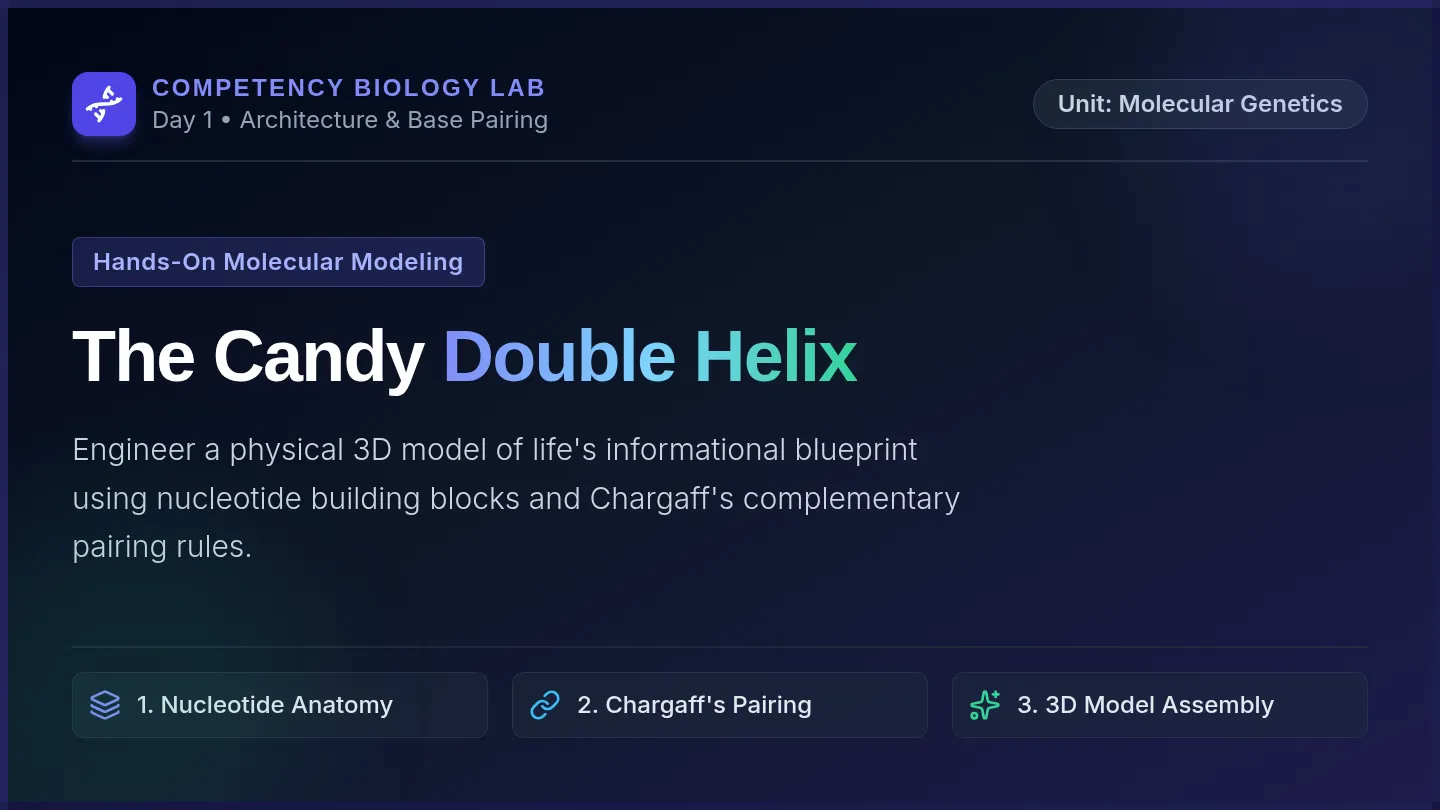
Candy Code Sequence

A multi-day competency-based biology sequence exploring DNA architecture, complementary base pairing, and semi-conservative replication through tactile candy modeling and evidence-based assessment.

TM

Teri Minami

6
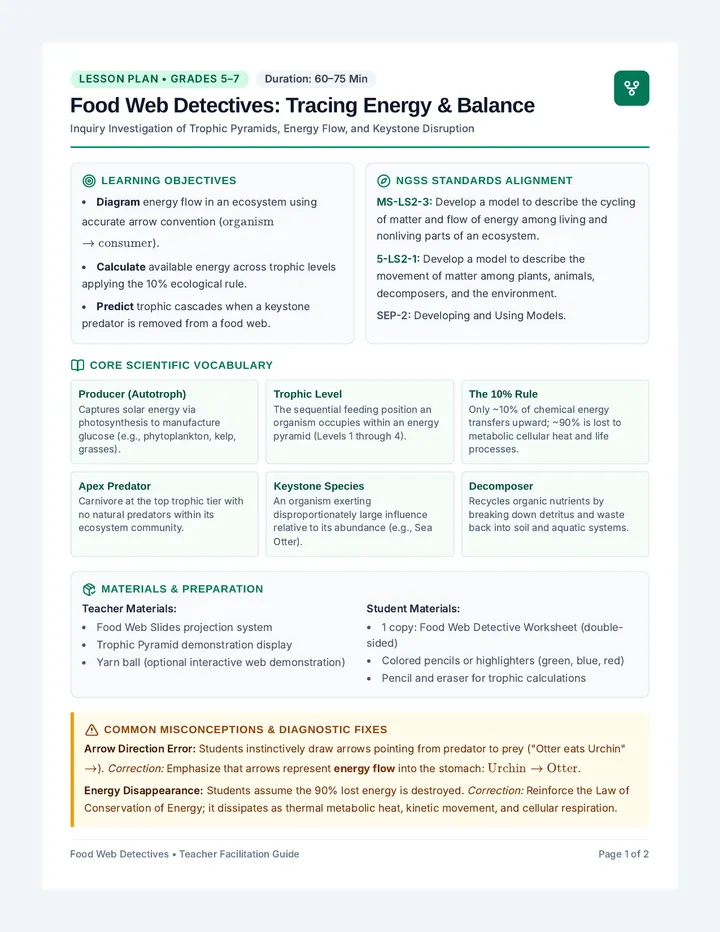
Food Web Lesson Plan

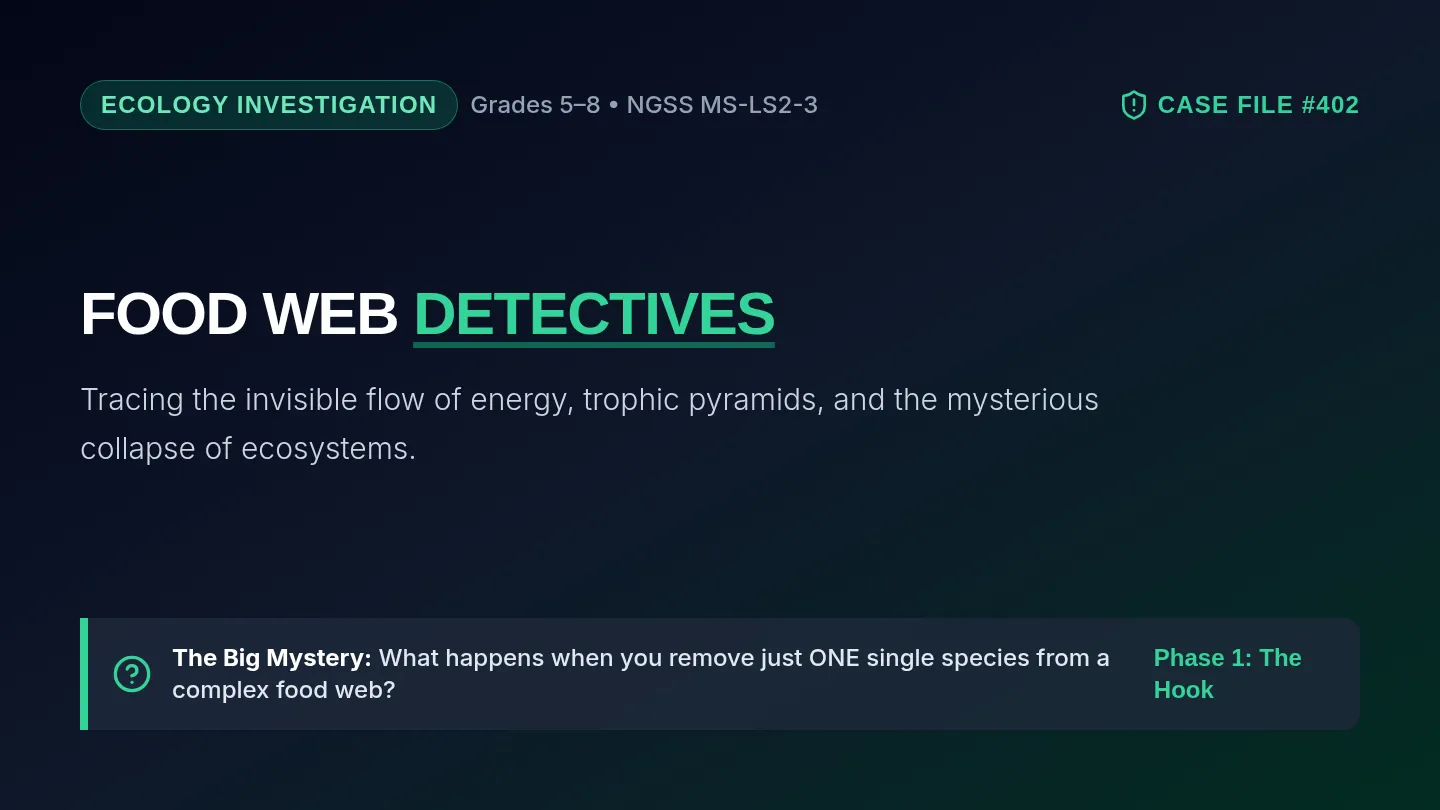
Food Web Detectives

An inquiry-driven science lesson exploring trophic levels, energy transfer, and ecosystem stability for upper elementary and middle school learners. Students trace energy flow through food webs and investigate the ripple effects of keystone species disruption.

Lenny Avatar
Lenny
4
Food Web Answer Key

Food Web Answer Key

A 2-page teacher answer key and scoring guide providing complete solutions, exemplar student responses, diagnostic notes, and an analytic rubric for the Food Web Detective investigation.

Lenny Avatar
Lenny
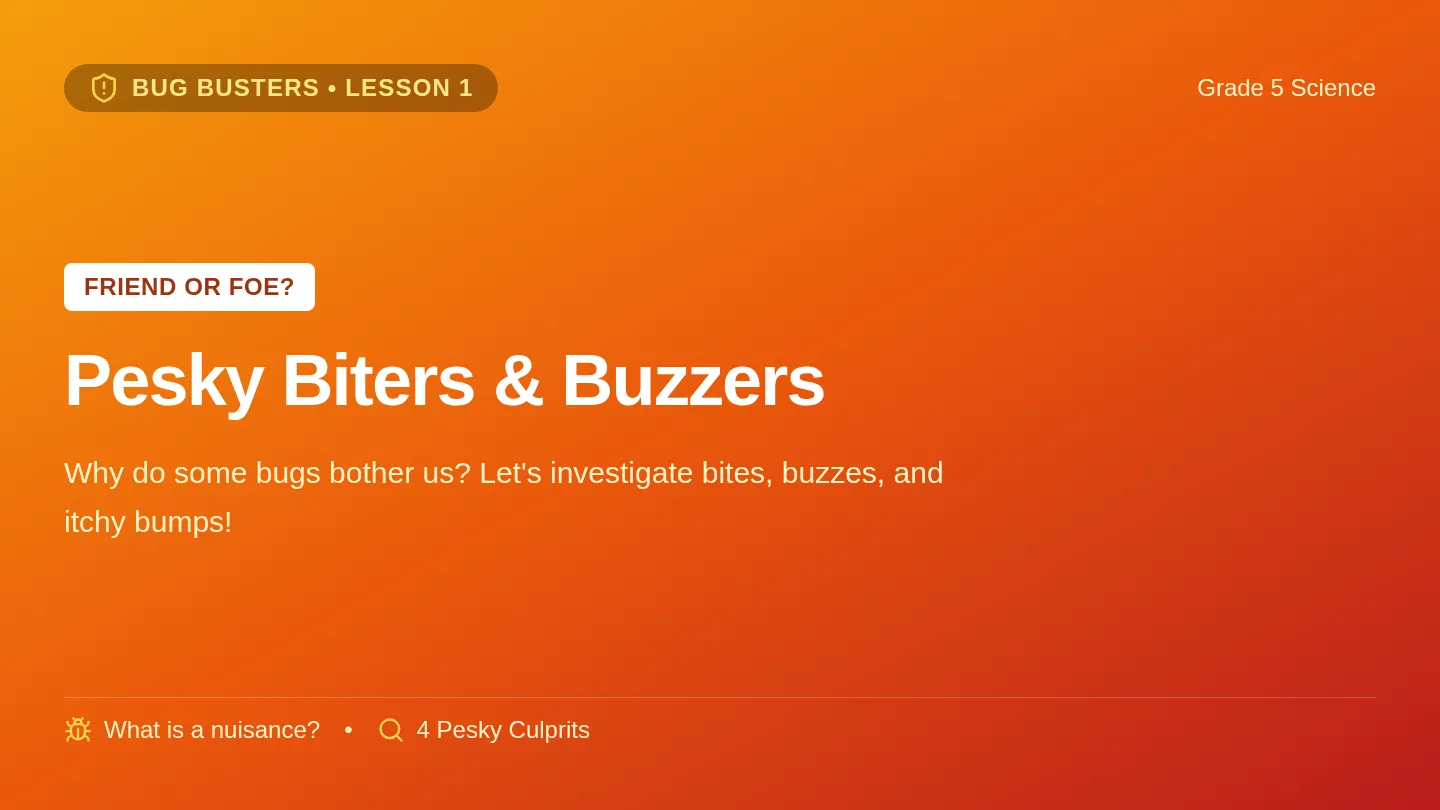
Pesky Biters Slides

Bug Busters

A two-part fifth-grade science sequence investigating how insects can be annoying nuisances, bite and sting, and damage crops and homes. Specially scaffolded with high-visual supports, decodable text chunks, and guided practice for lower-literacy learners.

Lenny Avatar
Lenny
11
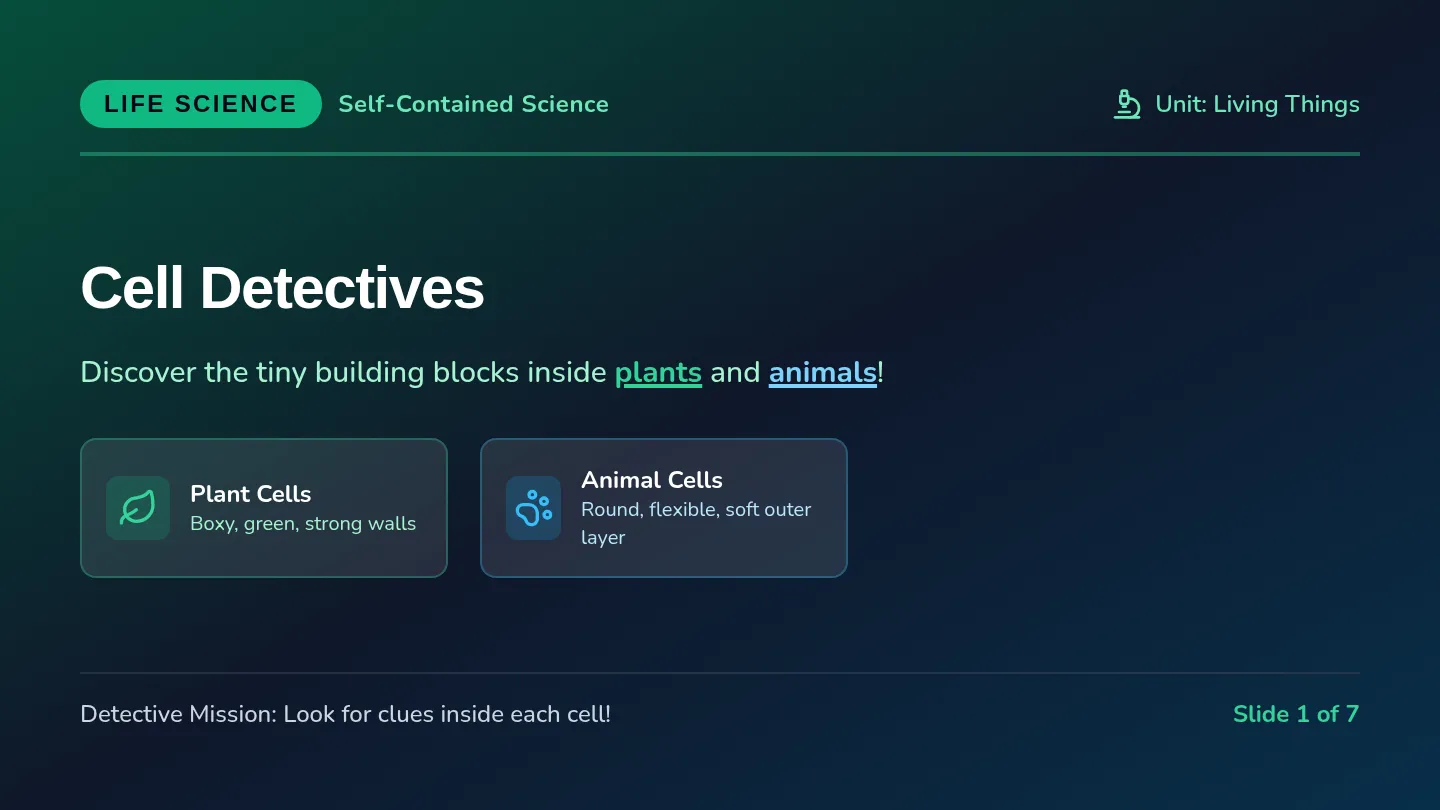
Cell Detectives Slides

Cell Detectives

A foundational life science lesson introducing plant and animal cells for self-contained classrooms, featuring high-contrast visual diagrams, simple analogies, and hands-on matching.

CF

Carissa Fenner

4
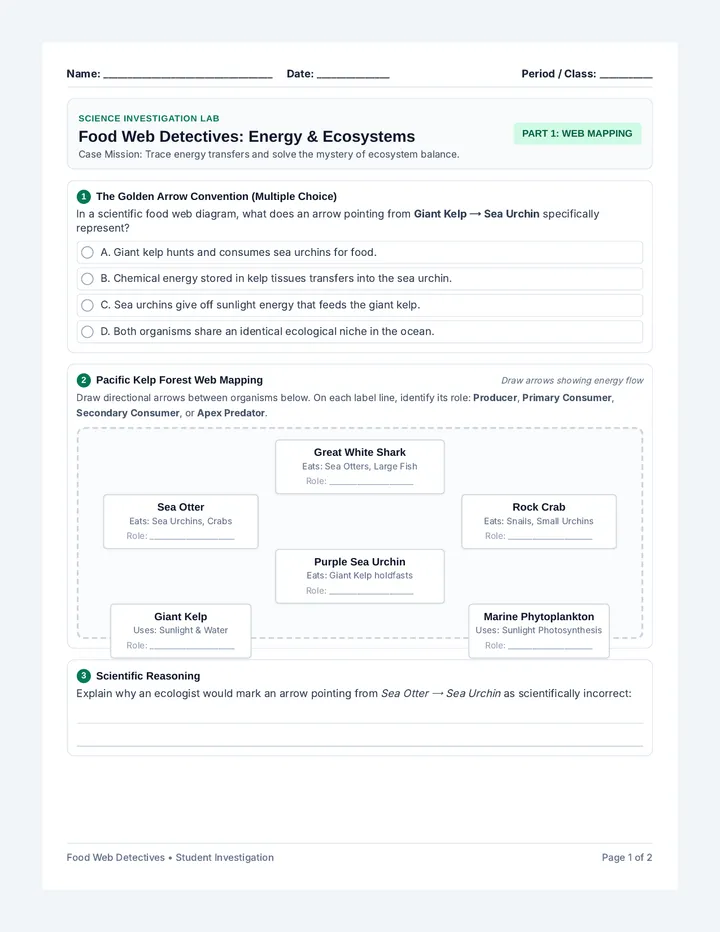
Food Web Detective Worksheet

Food Web Detective Worksheet

A 2-page hands-on student investigation worksheet featuring food web arrow mapping, trophic level energy calculations using the 10% rule, and a keystone species disruption case study.

Lenny Avatar
Lenny
Helix Studio Slides

Candy Code Sequence

A multi-day competency-based biology sequence exploring DNA architecture, complementary base pairing, and semi-conservative replication through tactile candy modeling and evidence-based assessment.

TM

Teri Minami

4
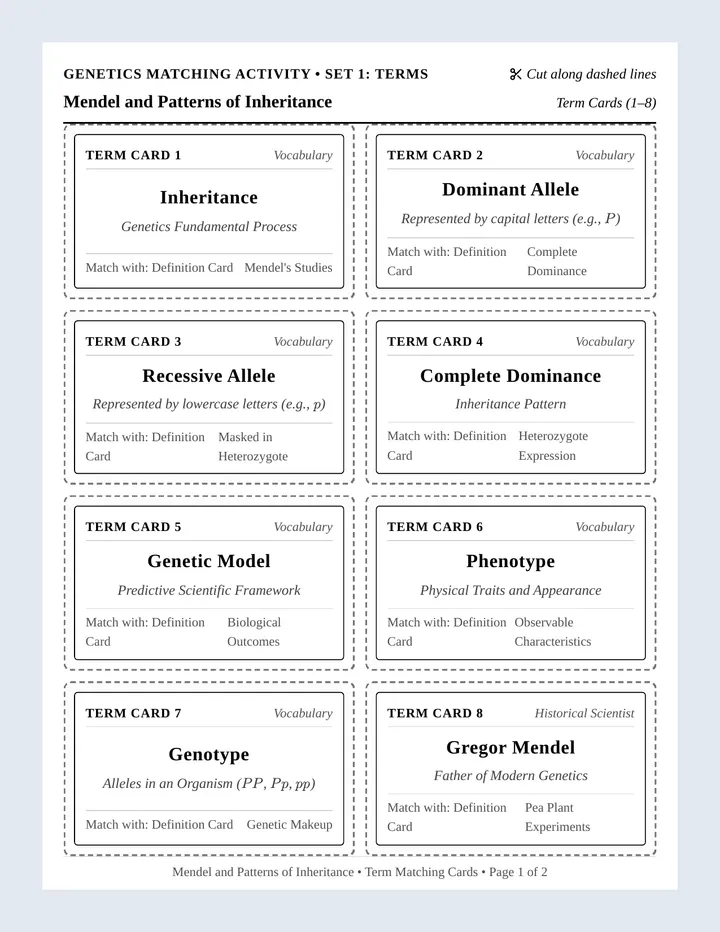
Mendel Inheritance Matching Cards

Mendel Inheritance

An introductory genetics lesson exploring Gregor Mendel's foundational pea plant experiments, inheritance patterns, allele types, genotype versus phenotype, and complete dominance.

MB

Marsha Bolden

4
Food Web Slides

Food Web Slides

A 6-slide presentation deck introducing trophic levels, energy flow arrow rules, the 10% energy pyramid, and keystone species trophic cascades with vivid visuals and inquiry prompts.

Lenny Avatar
Lenny
Habitability Blueprint Slides

Life Beyond Limits

A one-week interdisciplinary astrobiology sequence investigating Earth's habitability, extreme biological adaptations across eleven Earth species, and the plausibility of life on other celestial bodies.

M

Megan.Tanner

7
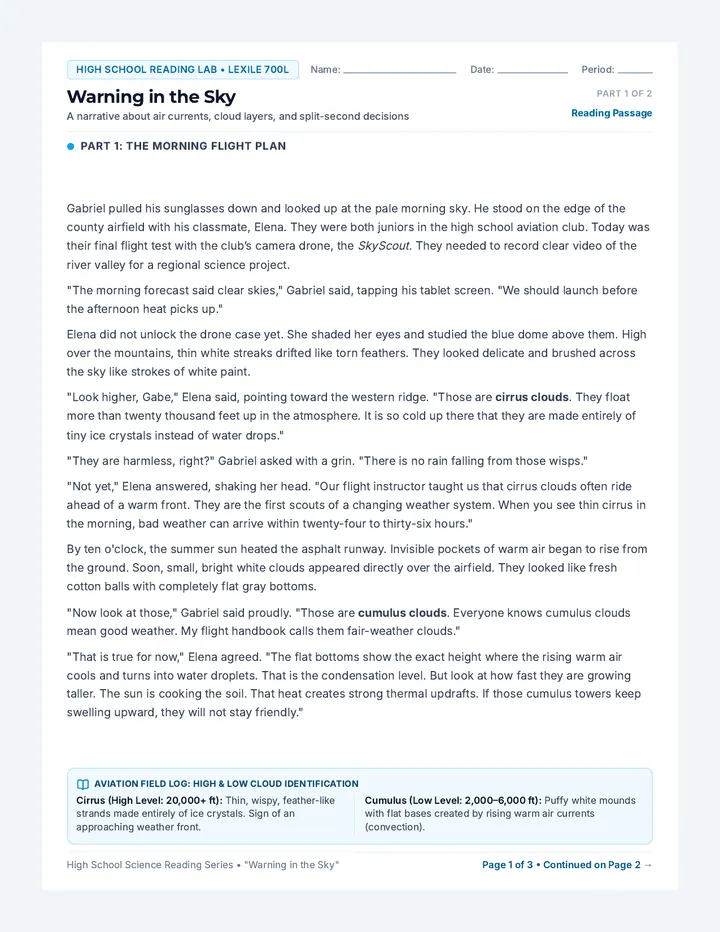
Warning Sky Cloud Passage

Cloud Watchers

An instructional reading and earth science lesson exploring cloud classification and atmospheric conditions through high-interest narrative text tailored for high school readers.

EB

Emily Bear

2
Food Web Lesson Plan

Food Web Lesson Plan

A comprehensive teacher facilitation guide for an inquiry-based science lesson on food webs, trophic levels, and ecosystem balance. Includes NGSS standards, pacing, misconceptions, and differentiation strategies.

Lenny Avatar
Lenny