Autumn Changes Reading Worksheet Autumn Changes
4th Grade Reading Comprehension • Informational Text
Name:
Date:
Reader Strategy: Each paragraph has a number tag ¶ 1. Look for these tags when answering questions!
3-Minute Read
Vocabulary Spotlight (Words to Know)
Chlorophyll noun
The bright green chemical in leaves that absorbs sunlight to make food.
Pigment noun
A natural colored substance that gives plants their red, yellow, or orange color.
Dormancy noun
A deep resting period when a plant pauses growth to stay alive through cold winter.
• The Secret Life of Autumn Trees •
¶ 1
Summer Food Factories
During spring and summer, green leaves work like busy food kitchens for the tree. Leaves are packed with a green pigment called chlorophyll . Chlorophyll catches bright sunlight. It blends that sunlight with water from the soil and carbon dioxide from the air to make sweet sugars. Because trees make so much chlorophyll in summer, the leaves stay bright green for months.
¶ 2
Hidden Colors Wake Up
As autumn arrives in September and October, days get shorter and temperatures drop. Trees sense that there is less sunshine each afternoon. In response, they slowly shut down their food kitchens. The green chlorophyll begins to fade away. When the green disappears, other warm pigments that were hidden all summer can finally be seen! Yellow, gold, and orange leaves light up the forest.
¶ 3
Resting for the Winter
Why do trees drop their leaves instead of holding onto them? In winter, frozen ground makes it almost impossible for roots to drink water. If trees kept broad leaves, the chilly winter wind would dry them out completely. To protect itself, the tree grows a corky layer of cells at the base of each leaf stem. The leaves fall gently to the ground, and the tree enters dormancy until spring warmth returns.
Reading Check: I finished reading all three paragraphs and underlined key clues.
Turn to Page 2
Comprehension Check
Show What You Know • Refer Back to the Text
Student:
Part 1
Key Details (Fill in the circle)
1. According to ¶ 1, what main job does chlorophyll do for a tree?
A It stops cold winter winds from blowing branches down.
B It catches bright sunlight to make food for the tree.
C It freezes water in the soil so the tree can rest.
2. In ¶ 2, why do yellow and orange colors appear in autumn?
A The green chlorophyll fades, letting hidden pigments show through.
B The tree pulls colorful paint up from the cold underground soil.
C Strong autumn wind turns green leaves into brand-new yellow ones.
Part 2
Cause and Effect Match
CAUSE (Why it happens)
Autumn brings shorter days, cooler nights, and less direct sunshine.
EFFECT (What happens next)
Complete the sentence below:
The tree stops making , so leaves change color.
Part 3
Written Response
Look back at ¶ 3 for clues
Question: Why is dropping leaves in autumn actually helpful to a tree during cold winter weather?
Sentence Starter: "Dropping leaves helps the tree in winter because..."
Self-Check: How do you feel about your reading today?
Need help Getting there I got it!
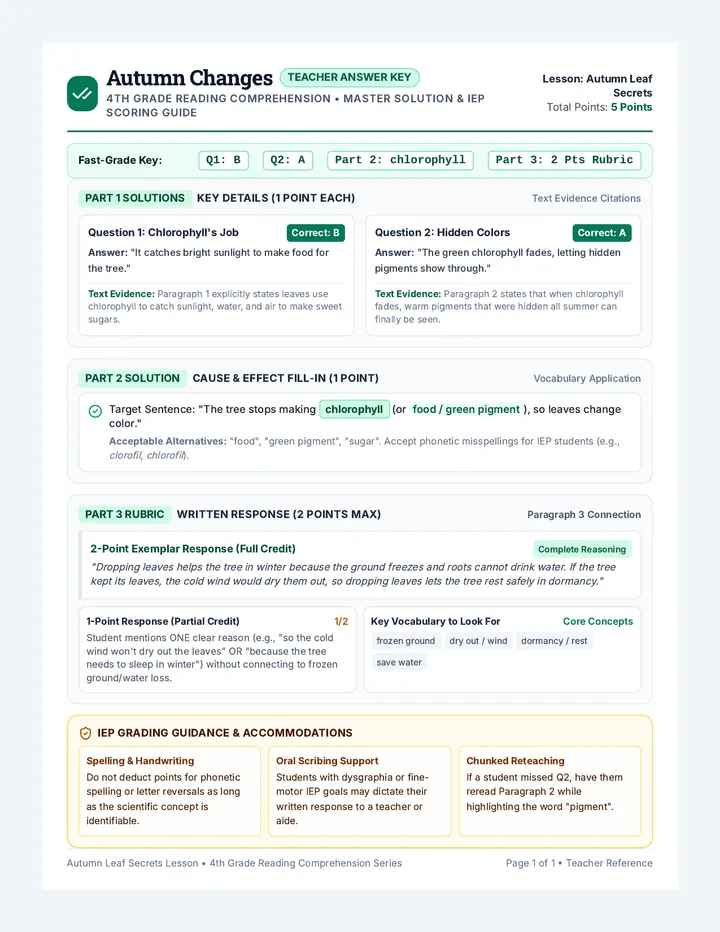
Autumn Changes Answer Key Autumn Changes
TEACHER ANSWER KEY
4th Grade Reading Comprehension • Master Solution & IEP Scoring Guide
Lesson: Autumn Leaf Secrets
Total Points: 5 Points
Fast-Grade Key:
Q1: B Q2: A Part 2: chlorophyll Part 3: 2 Pts Rubric
Part 1 Solutions
Key Details (1 Point Each)
Text Evidence Citations
Question 1: Chlorophyll's Job Correct: B
Answer: "It catches bright sunlight to make food for the tree."
Text Evidence: Paragraph 1 explicitly states leaves use chlorophyll to catch sunlight, water, and air to make sweet sugars.
Question 2: Hidden Colors Correct: A
Answer: "The green chlorophyll fades, letting hidden pigments show through."
Text Evidence: Paragraph 2 states that when chlorophyll fades, warm pigments that were hidden all summer can finally be seen.
Part 2 Solution
Cause & Effect Fill-In (1 Point)
Vocabulary Application
Target Sentence: "The tree stops making chlorophyll (or food / green pigment), so leaves change color."
Acceptable Alternatives: "food", "green pigment", "sugar". Accept phonetic misspellings for IEP students (e.g., clorofil , chlorofil ).
Part 3 Rubric
Written Response (2 Points Max)
Paragraph 3 Connection
2-Point Exemplar Response (Full Credit) Complete Reasoning
"Dropping leaves helps the tree in winter because the ground freezes and roots cannot drink water. If the tree kept its leaves, the cold wind would dry them out, so dropping leaves lets the tree rest safely in dormancy."
1-Point Response (Partial Credit) 1/2
Student mentions ONE clear reason (e.g., "so the cold wind won't dry out the leaves" OR "because the tree needs to sleep in winter") without connecting to frozen ground/water loss.
Key Vocabulary to Look For Core Concepts
frozen ground dry out / wind dormancy / rest save water
IEP Grading Guidance & Accommodations
Spelling & Handwriting Do not deduct points for phonetic spelling or letter reversals as long as the scientific concept is identifiable.
Oral Scribing Support Students with dysgraphia or fine-motor IEP goals may dictate their written response to a teacher or aide.
Chunked Reteaching If a student missed Q2, have them reread Paragraph 2 while highlighting the word "pigment".
Autumn Secrets Slides Grade 4 Science & Reading Informational Text Exploration
Guided Lesson
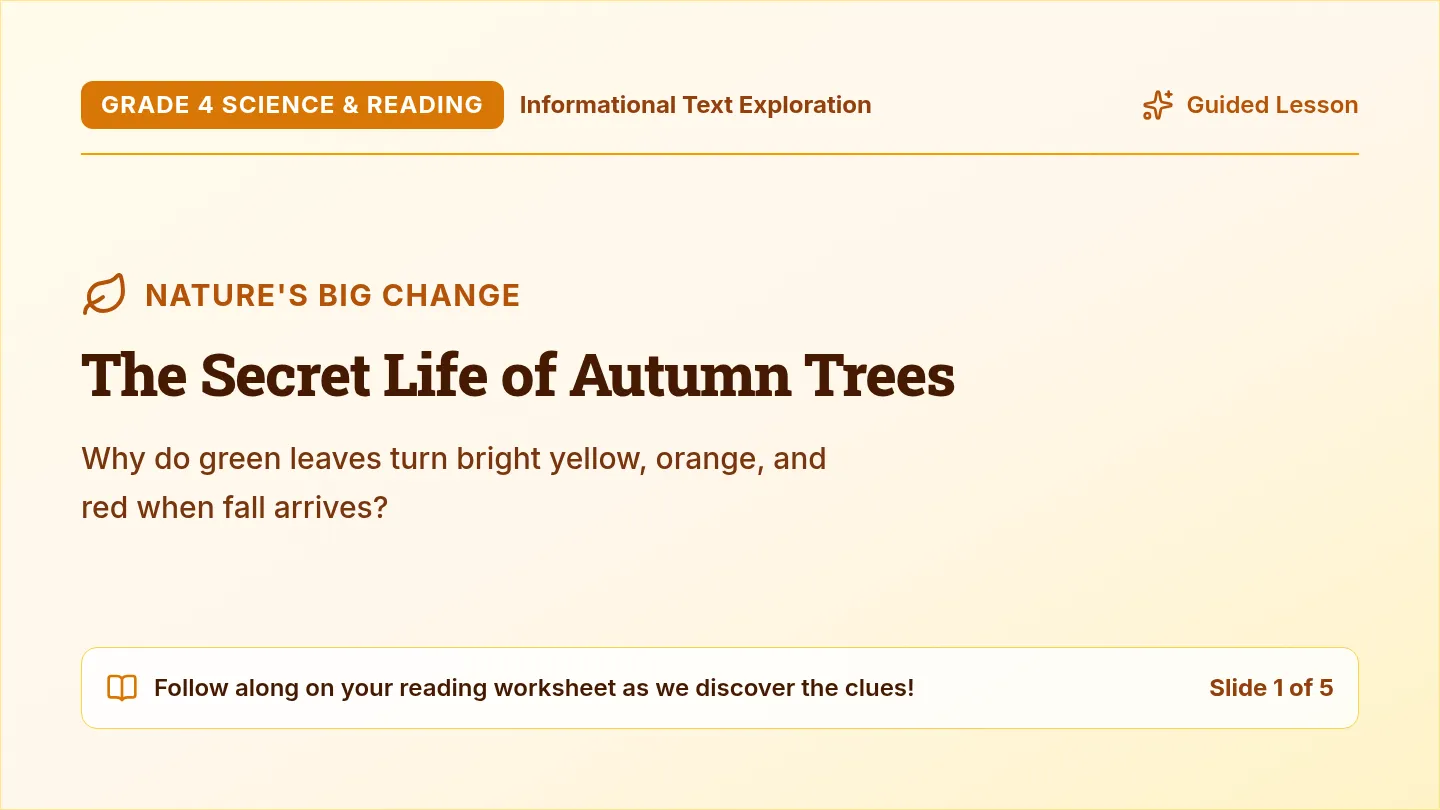
Nature's Big Change
The Secret Life of Autumn Trees
Why do green leaves turn bright yellow, orange, and red when fall arrives?
Follow along on your reading worksheet as we discover the clues!
Slide 1 of 5
Vocabulary Spotlight
Three Important Words
Word Bank
¶ 1 Clue
Chlorophyll
(CLOR-o-fill)
The bright green substance in leaves that catches sunlight to make food.
¶ 2 Clue
Pigment
(PIG-ment)
A natural coloring chemical that gives plants their red, yellow, or gold colors.
¶ 3 Clue
Dormancy
(DOR-man-see)
A deep resting period when trees pause growth to survive cold winter months.
Look for these words highlighted in your reading passage. Slide 2 of 5
Paragraph 1 Spring & Summer Science
The Green Food Factory
What Leaves Do in Summer:
Packed with bright green chlorophyll .
Absorbs warm sunlight all day long.
Makes sweet sugars to feed the whole tree!
Key Takeaway
Leaves stay green all summer because the tree keeps making fresh chlorophyll!
Question 1 Hint: Look closely at what chlorophyll catches to help the tree make food.
Ready to see what happens when autumn days grow shorter? Slide 3 of 5
Paragraph 2 Autumn Transition
Hidden Colors Wake Up
The Autumn Clues:
Days get shorter with less sunshine.The tree slowly shuts down its food kitchen.
The green chlorophyll begins to fade away.
The Big Reveal!
Yellow and orange pigments were in the leaves all summer long!
When the bright green fades, the hidden colors finally shine through.
Question 2 asks why these warm colors appear in fall. Slide 4 of 5
Paragraph 3 Winter Survival
Ready for a Winter Nap
Why drop the leaves?
Frozen soil makes it hard to drink water.
Chilly winter wind would dry broad leaves out.
Dropping leaves saves moisture inside the tree!
Scientific Term