Photosynthesis (Inputs → Outputs):
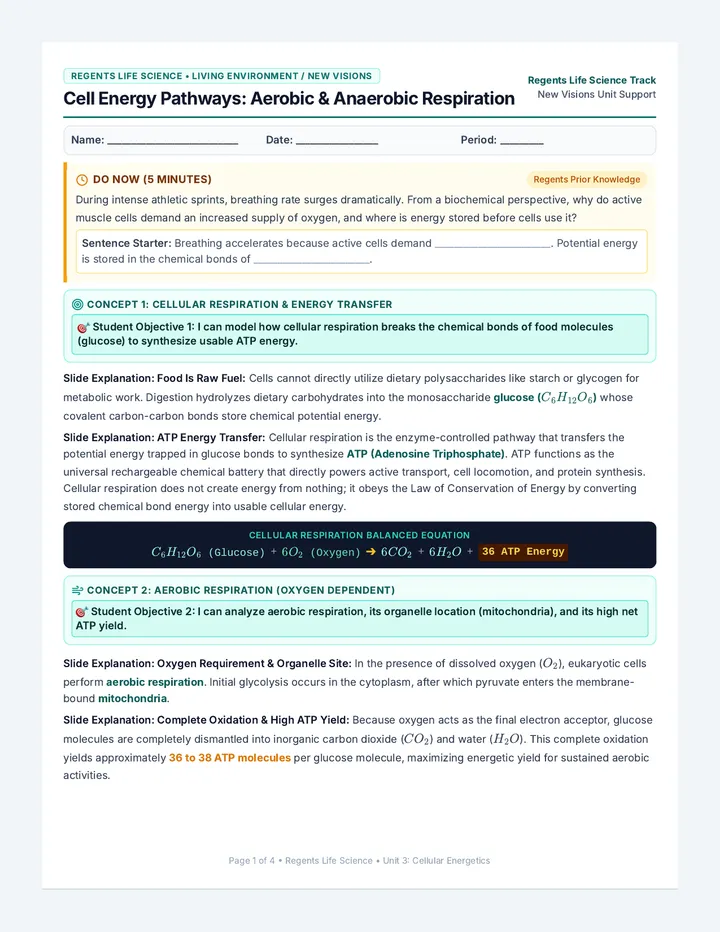
\(6CO_2 + 6H_2O + \text{Sunlight} \longrightarrow C_6H_{12}O_6 + 6O_2\)
Aerobic Respiration (Inputs → Outputs):
\(C_6H_{12}O_6 + 6O_2 \longrightarrow 6CO_2 + 6H_2O + \text{ATP}\)
Unit: Cellular Processes • Day 1: Aerobic Respiration Page 1 of 4
Timed Section: 17 Minutes Student Activity: NYS Statewide Life Science Questions
Any unfinished questions are to be answered for homework and due at our next class meeting.
Directions: Answer each question using scientific evidence from today's lesson. Questions 1–3 contain sentence starters designed as exemplar models to show you how to structure thorough 8th-grade science explanations for Questions 4–13.
Question 1 (Exemplar Model • NYS MS-LS1-7) Inputs & Mitochondria
State the two chemical substances that animal cells must take in from their environment to perform aerobic respiration, and identify the cell organelle where this reaction takes place.
Sentence Starter (Exemplar): To perform aerobic respiration, animal cells must take in ________________________ and ________________________, and this process occurs inside the ________________________.
Question 2 (Exemplar Model • NYS MS-LS2-3) Conservation of Matter
During aerobic cellular respiration, a cell uses one glucose molecule (\(C_6H_{12}O_6\)) and six oxygen molecules (\(6O_2\)). Explain why the total number of carbon, hydrogen, and oxygen atoms in the waste products (\(CO_2\) and \(H_2O\)) must equal the total number of atoms that entered the cell.
Sentence Starter (Exemplar): The total number of atoms in the products must equal the inputs because the law of conservation of matter states that atoms can never be ________________________, but only ________________________.
Question 3 (Exemplar Model • NYS MS-LS1-7 / MS-LS2-3) Photosynthesis Connection
How do the waste products exhaled by humans during aerobic respiration directly support the survival of green plants in the environment?
Sentence Starter (Exemplar): When humans exhale, they release the waste product ________________________, which green plants absorb and use during ________________________ to produce new food.
Question 4 (NYS Statewide Life Science) Energy Conversion
Which form of energy is stored in the chemical bonds of glucose, and into what primary form of usable cellular energy is it converted during aerobic respiration?
Question 5 (NYS Statewide Life Science) Ecosystem Cycling
A student sets up a sealed glass jar containing an aquatic snail, green pondweed (Elodea), and water under bright light. Explain why both organisms are able to survive together in the sealed container.
Question 6 (NYS Statewide Life Science) Gas Exchange
Identify the gas that enters human lung capillaries from the air to be delivered to body cells for aerobic respiration.
Turn page for Questions 7 through 13 • 17-minute timer running Page 2 of 4
Student Activity (Continued) • Questions 7–13
Reminder: Unfinished items due next class
Question 7 (NYS Statewide Life Science) Plant Mitochondria
A student claims: "Only animals do cellular respiration, while plants only do photosynthesis." Explain why this student's claim is scientifically incorrect.
Question 8 (NYS Statewide Life Science) Subscript Atom Accounting
Glucose has the formula \(C_6H_{12}O_6\). Using the subscript for carbon, how many total carbon atoms are released in the waste gas carbon dioxide (\(CO_2\)) when one complete glucose molecule is broken down?
Question 9 (NYS Statewide Life Science) Experimental Investigation
Scientists place germinating pea seeds in an insulated flask with a digital thermometer and carbon dioxide sensor. Over 24 hours, the temperature increases slightly and \(CO_2\) levels rise. What biological process explains these two observations?
Question 10 (NYS Statewide Life Science) Human Body Systems
Explain how the circulatory system (blood flow) and the respiratory system (breathing) cooperate to supply your leg muscle cells with what they need for aerobic respiration.
Question 11 (NYS Statewide Life Science) Conservation of Energy
When cells break the chemical bonds of glucose, not all of the stored chemical energy is captured as ATP. In what form is the remaining energy released into the organism's body?
Question 12 (NYS Statewide Life Science) Environmental Impact
Large forests are often called the "lungs of our planet." Explain how widespread deforestation (cutting down trees) could disrupt the global balance of gases required for aerobic respiration.
Question 13 (NYS Statewide Life Science • Synthesis) Matter Cycle Trace
Trace a single atom of carbon: Describe how it starts as part of a \(CO_2\) molecule exhaled by a rabbit, enters a clover plant, and eventually becomes part of an energy-carrying molecule in a deer.
CHALLENGE QUESTION (High Academic Performer Extension) Honors / Deep Thinking
If a healthy green plant is sealed inside a dark chamber with plentiful water and carbon dioxide, predict what will happen to its rates of photosynthesis and aerobic respiration over a week. Explain how this demonstrates that the sustainable cycle of matter and energy requires a continuous input of sunlight energy.
Turn to Page 4 for Word Wall Matching & Exit Ticket Page 3 of 4
Vocabulary Mastery & Synthesis
Assessment Check
Word Wall Matching: Match each academic term with its correct scientific definition. 6 Points
1. Aerobic Respiration [ ]
2. Mitochondria [ ]
3. Photosynthesis [ ]
4. Glucose (\(C_6H_{12}O_6\)) [ ]
5. ATP Energy [ ]
6. Conservation Law [ ]
A. The cellular "powerhouse" organelle where aerobic reactions occur.
B. High-energy food sugar made by plants serving as chemical fuel for cells.
C. Reusable cellular "battery" packets powering muscle movement and growth.
D. Process where plant chloroplasts use sunlight to turn \(CO_2\) and water into food.
E. Process using oxygen to break down food molecules and release energy.
F. Principle stating atoms are never destroyed, only rearranged into new molecules.
Exit Ticket Question: Synthesis & Application Demonstrate Mastery
In 2–3 complete sentences, explain how the sun's energy ultimately powers the movement of your leg muscles when you walk, connecting the roles of plants, food (glucose), and mitochondria.
Activity Completion Check:
All 13 questions completed Challenge question attempted Word Wall & Exit Ticket completed
Unit: Cellular Processes • Day 1: Aerobic Respiration Page 4 of 4
Fotosíntesis (Entradas → Salidas):
\(6CO_2 + 6H_2O + \text{Luz Solar} \longrightarrow C_6H_{12}O_6 + 6O_2\)
Respiración Aeróbica (Entradas → Salidas):
\(C_6H_{12}O_6 + 6O_2 \longrightarrow 6CO_2 + 6H_2O + \text{ATP}\)
Unidad: Procesos Celulares • Día 1: Respiración Aeróbica (Español) Página 1 de 4
Sección Cronometrada: 17 Minutos Actividad del Estudiante: Preguntas de Ciencias de NYS
Cualquier pregunta no terminada debe responderse de tarea y entregarse en nuestra próxima reunión de clase.
Instrucciones: Responde cada pregunta utilizando evidencia científica. Las preguntas 1–3 contienen inicios de oración diseñados como modelos ejemplares para ayudarte a estructurar respuestas completas en las preguntas 4–13.
Pregunta 1 (Modelo Ejemplar • NYS MS-LS1-7) Entradas y Mitocondrias
Indica las dos sustancias químicas que las células animales deben absorber de su entorno para realizar la respiración aeróbica, e identifica el orgánulo celular donde ocurre esta reacción.
Inicio de Oración (Ejemplar): Para realizar la respiración aeróbica, las células animales deben tomar ________________________ y ________________________, y este proceso ocurre dentro de las ________________________.
Pregunta 2 (Modelo Ejemplar • NYS MS-LS2-3) Conservación de la Materia
Durante la respiración aeróbica, una célula utiliza una molécula de glucosa (\(C_6H_{12}O_6\)) y seis de oxígeno (\(6O_2\)). Explica por qué la cantidad total de átomos en los productos de desecho (\(CO_2\) y \(H_2O\)) debe ser igual a la cantidad de átomos que entraron a la célula.
Inicio de Oración (Ejemplar): La cantidad total de átomos debe ser igual porque la ley de conservación de la materia establece que los átomos nunca se pueden ________________________, sino únicamente ________________________.
Pregunta 3 (Modelo Ejemplar • NYS MS-LS1-7 / MS-LS2-3) Conexión con Fotosíntesis
¿Cómo apoyan directamente la supervivencia de las plantas verdes los productos de desecho exhalados por los humanos durante la respiración aeróbica?
Inicio de Oración (Ejemplar): Cuando los humanos exhalan, liberan el desecho ________________________, el cual las plantas verdes absorben y utilizan durante la ________________________ para producir nuevo alimento.
Pregunta 4 (Ciencias de la Vida NYS) Conversión de Energía
¿Qué tipo de energía se almacena en los enlaces químicos de la glucosa y en qué forma principal de energía utilizable se transforma durante la respiración aeróbica?
Pregunta 5 (Ciencias de la Vida NYS) Ciclo en Ecosistemas
Un estudiante coloca en un frasco sellado un caracol acuático, una planta de estanque (Elodea) y agua bajo luz brillante. Explica por qué ambos organismos sobreviven juntos en el frasco sellado.
Pregunta 6 (Ciencias de la Vida NYS) Intercambio de Gases
Identifica el gas que ingresa a los capilares pulmonares humanos desde el aire para ser llevado a las células para la respiración aeróbica.
Turn page for Questions 7 through 13 • 17-minute timer running Página 2 de 4
Actividad del Estudiante (Continuación) • Preguntas 7–13
Recordatorio: Lo no terminado es de tarea
Pregunta 7 (Ciencias de la Vida NYS) Mitocondrias en Plantas
Un estudiante afirma: "Solo los animales realizan respiración celular, mientras que las plantas solo realizan fotosíntesis." Explica por qué esta afirmación es incorrecta.
Pregunta 8 (Ciencias de la Vida NYS) Conteo de Átomos y Subíndices
La glucosa tiene la fórmula \(C_6H_{12}O_6\). Usando el subíndice del carbono, ¿cuántos átomos totales de carbono se liberan en el gas dióxido de carbono (\(CO_2\)) al descomponerse una molécula de glucosa?
Pregunta 9 (Ciencias de la Vida NYS) Investigación Experimental
Unos científicos colocan semillas de guisante en germinación en un termo aislado con un termómetro y sensor de dióxido de carbono. En 24 horas, sube la temperatura y aumentan los niveles de \(CO_2\). ¿Qué proceso biológico explica esto?
Pregunta 10 (Ciencias de la Vida NYS) Sistemas del Cuerpo
Explica cómo el sistema circulatorio (sangre) y el sistema respiratorio (respiración) cooperan para suministrar a las células musculares de tus piernas lo necesario para la respiración aeróbica.
Pregunta 11 (Ciencias de la Vida NYS) Conservación de Energía
Cuando las células rompen los enlaces químicos de la glucosa, no toda la energía se captura como ATP. ¿En qué forma se libera el resto de la energía al cuerpo del organismo?
Pregunta 12 (Ciencias de la Vida NYS) Impacto Ambiental
Los grandes bosques se llaman los "pulmones de nuestro planeta". Explica cómo la deforestación generalizada (talar árboles) podría alterar el equilibrio global de gases requeridos para la respiración aeróbica.
Pregunta 13 (Ciencias de la Vida NYS • Síntesis) Rastreo del Ciclo
Rastrea un solo átomo de carbono: Describe cómo inicia como parte de una molécula de \(CO_2\) exhalada por un conejo, ingresa a una planta de trébol y finalmente llega a una molécula portadora de energía en un venado.
PREGUNTA DE DESAFÍO (Extensión Académica) Pensamiento Profundo
Si una planta verde se sella en una cámara oscura con abundante agua y dióxido de carbono, predice qué ocurrirá con sus tasas de fotosíntesis y respiración aeróbica a lo largo de una semana. Explica cómo esto demuestra que el ciclo sostenible requiere un aporte continuo de luz solar.
Pasa a la Página 4 para el Muro de Palabras y Boleto de Salida Página 3 de 4
Dominio de Vocabulario y Síntesis
Evaluación Formativa
Muro de Palabras: Empareja cada término académico con su definición científica correcta. 6 Puntos
1. Respiración Aeróbica [ ]
2. Mitocondria [ ]
3. Fotosíntesis [ ]
4. Glucosa (\(C_6H_{12}O_6\)) [ ]
5. Energía ATP [ ]
6. Ley de Conservación [ ]
A. Orgánulo "central de energía" de la célula donde ocurre la respiración aeróbica.
B. Azúcar de alta energía fabricado por plantas que sirve de combustible celular.
C. Paquetes de energía recargables que impulsan el movimiento y crecimiento muscular.
D. Proceso donde cloroplastos usan luz solar para transformar \(CO_2\) y agua en alimento.
E. Proceso que usa oxígeno para descomponer alimento y liberar energía.
F. Principio que establece que los átomos nunca se destruyen, solo se reorganizan.
Pregunta de Boleto de Salida: Síntesis y Aplicación Demuestra tu Dominio
En 2–3 oraciones completas, explica cómo la energía solar finalmente impulsa el movimiento de los músculos de tus piernas al caminar, conectando los roles de las plantas, los alimentos (glucosa) y las mitocondrias.
Verificación de Finalización:
13 preguntas completadas Desafío intentado Muro y Boleto completados
Unidad: Procesos Celulares • Día 1: Respiración Aeróbica (Español) Página 4 de 4
Oxygen (\(O_2\))
Subscript 2 = 2 Oxygen atoms
Water (\(H_2O\))
2 Hydrogens + 1 Oxygen = 3 atoms
Carbon Dioxide (\(CO_2\))
1 Carbon + 2 Oxygens = 3 atoms
Glucose (\(C_6H_{12}O_6\))
6 C + 12 H + 6 O = 24 atoms
NYS Standard Boundary Rule: Do NOT teach high school algebraic equation balancing! Instead, guide students to count total atoms on each side of the reaction arrow: Inputs (\(C_6H_{12}O_6 + 6O_2\)) have 6 Carbons, 12 Hydrogens, and 18 Oxygens. Outputs (\(6CO_2 + 6H_2O\)) have exactly 6 Carbons, 12 Hydrogens, and 18 Oxygens. Every atom is accounted for!
Do Now Solution:
Leg muscle cells need vastly more usable energy (ATP). Cells demand extra oxygen to perform aerobic respiration inside mitochondria, breaking down glucose faster to recharge ATP to power leg muscles for movement.
Official Activity Answers (Questions 1–6) Exemplars & Rubrics
Q1 (Inputs & Mitochondria Exemplar): MS-LS1-7 • 2 pts
Completed Starter: "To perform aerobic respiration, animal cells must take in glucose and oxygen, and this process occurs inside the mitochondria."
Q2 (Conservation of Matter Exemplar): MS-LS2-3 & MS-PS1-5 • 2 pts
Completed Starter: "The total number of atoms must equal the inputs because the law of conservation of matter states that atoms can never be created or destroyed, but only rearranged into new molecules (6 Carbons, 12 Hydrogens, 18 Oxygens)."
Q3 (Cyclic Photosynthesis Connection Exemplar): MS-LS1-7 / MS-LS2-3 • 2 pts
Completed Starter: "When humans exhale, they release the waste product carbon dioxide (\(CO_2\)), which green plants absorb and use during photosynthesis to produce new food (glucose) and oxygen."
Q4 (Chemical to ATP Energy): MS-LS1-7 • 1 pt
Glucose stores chemical bond energy. It is converted into usable ATP (cellular chemical energy) to power muscle movement, growth, and cellular repair, with remaining energy released as heat.
Q5 (Snail & Elodea Ecosystem): MS-LS2-3 • 2 pts
The plant does photosynthesis using light and the snail's exhaled \(CO_2\), releasing \(O_2\). The snail inhales that \(O_2\) for aerobic respiration, recycling gases in a closed loop.
Q6 (Gas Exchange): MS-LS1-7 • 1 pt
Oxygen gas (\(O_2\)) enters lung capillaries and is pumped by blood to body cells.
Teacher Facing Guide • Day 1: Aerobic Respiration Page 2 of 3
Day 1 Complete Key
Q7 (Plants Respire): Plants have mitochondria and respire 24/7 to break down glucose for cellular work and growth.
Q8 (Carbon Count): Exactly 6 Carbon atoms exit as 6 molecules of \(CO_2\). Atoms are conserved.
Q9 (Pea Seeds): Cellular respiration releases \(CO_2\) and thermal heat.
Q10 (Body Systems): Respiratory inhales \(O_2\); circulatory delivers \(O_2\) & glucose to muscles and returns \(CO_2\).
Q11 (Heat): Uncaptured energy is released as body heat.
Q12 (Deforestation): Reduces global \(O_2\) output and raises \(CO_2\).
Q13 (Trace): Rabbit \(CO_2\) → Clover photosynthesis → Glucose → Deer eating → Deer ATP!
⭐ Challenge Question Key (Honors / High Performer Extension): 3 pts
Exemplar Response: Without sunlight, photosynthesis stops immediately because light energy is required to combine \(CO_2\) and \(H_2O\) into glucose. Aerobic respiration will continue temporarily using stored glucose/starch reserves, but once stored food is exhausted, respiration stops and the plant dies. This proves that matter recycling requires an uninterrupted external flow of solar energy.
Word Wall Matching Master Key (Page 4 Activity): 6 pts (1 pt each)
1 → E
2 → A
3 → D
4 → B
5 → C
6 → F
Exit Ticket Exemplar & Rubric (Page 4): 4 pts Total
Sample Response: "Sunlight energy is captured by plants during photosynthesis to convert carbon dioxide and water into glucose. When humans eat food containing glucose, our digestive system absorbs it and our blood delivers it to leg muscle cells. Inside the mitochondria, aerobic respiration uses oxygen to release that chemical energy as ATP to power muscle contraction."
Scoring Rubric: 1 pt: Identifies sunlight captured by plants in photosynthesis • 1 pt: Connects food/glucose intake • 1 pt: Identifies mitochondria / aerobic respiration releasing ATP • 1 pt: Connects ATP to muscle movement.
Pacing & Homework Collection:
Administer Word Wall & Exit Ticket during final 7 minutes. Collect packets or verify completion. Students who did not complete Questions 4–13 must complete them for homework due at the next class meeting.
Teacher Facing Guide • Day 1: Aerobic Respiration Page 3 of 3
1. Animal Muscle Cells
Sprint emergency: Muscles split food molecules into smaller carbon waste molecules and energy (much less).
\(\text{Food} \longrightarrow \text{Carbon Waste Molecules} + \text{Energy (Much Less)}\)
2. Single-Celled Organisms (Yeast)
Baking bread & habitats: Food is split into \(CO_2\) gas, smaller carbon waste molecules, and energy (much less).
\(\text{Food} \longrightarrow CO_2\text{ Gas} + \text{Waste Molecules} + \text{Energy (Much Less)}\)
Matter is 100% conserved: Atoms in food = Atoms in waste products!
Zero Oxygen Required Slide 5 of 10
Handout Page 2 • Timed Student Activity
Official Pacing & Homework Policy
"Any unfinished questions are to be answered for homework and due at our next class meeting."
Studying from home? Review slides 7–10 and type your responses directly into your Google Classroom assignment!
Questions 1–3: Exemplar models with sentence starters.
Questions 4–13: NYS statewide life science practice items.
17-Minute Timer Running Slide 6 of 10
Handout Page 2 • Exemplar Models 1 & 2
Question 1 (Animal Muscle Waste)
Why do human muscle cells switch to anaerobic respiration during sprinting, and what molecules build up?
Starter: "Muscle cells switch to anaerobic respiration because the blood cannot deliver enough [oxygen], causing animal cells to produce [smaller carbon-containing waste molecules]."
Question 2 (Yeast Products & Expansion)
Why does yeast make bread dough rise and expand?
Starter: "The yeast performs fermentation, producing smaller waste molecules and releasing bubbles of [carbon dioxide (\(CO_2\)) gas] that cause dough to expand."
Use These Exemplars as Models Slide 7 of 10
Handout Page 2 • Exemplar 3 & Questions 4–6
Question 3 (Exemplar: Energy Comparison)
Starter: "Aerobic respiration is much more efficient because it produces much more energy, while anaerobic respiration only releases much less energy from each food molecule."
Question 4
Cells perform anaerobic respiration when oxygen is in short supply or unavailable.
Question 5
With oxygen = much more energy; Without oxygen = much less energy.
Question 6
Bacteria ferment milk sugars into smaller carbon waste molecules to make yogurt.
Turn to Handout Page 3 Slide 8 of 10
Handout Page 3 • Questions 7–10
Q7: Waste Comparison
Yeast releases \(CO_2\) gas and carbon waste molecules. Muscles produce carbon waste molecules without releasing gas.
Q8: Swamp Mud Bacteria
Zero dissolved oxygen! Anaerobic bacteria survive by releasing energy from food molecules without oxygen.
Q9: Conservation of Atoms
All atoms in food molecules are conserved and rearranged into smaller waste molecules. Zero atoms are lost!
Q10: Expanding Balloon
Yeast ferments sugar in warm water, releasing carbon dioxide (\(CO_2\)) gas that inflates the bottle's balloon.
NYS Intermediate Life Science Practice Slide 9 of 10
Handout Page 3 • Questions 11–13 & Homework
Q11: Oxygen Debt
Post-race panting brings \(O_2\) to break down accumulated waste molecules in muscles.
Q12: Evolution Advantage
Aerobic produces much more energy to power large, active animal bodies!
Q13: Human Limits
Anaerobic produces much less energy, which cannot sustain heart/brain long-term.
Google Classroom Homework Checklist
1. Complete all unanswered questions from your printed packet.
2. Check that your sentences use key terms: anaerobic respiration, fermentation, carbon waste molecules, carbon dioxide.
3. Submit your completed work on Google Classroom before our next class meeting!
Lesson 2 Complete • Keep as Permanent Study Record Slide 10 of 10
When oxygen is in short supply or unavailable, cells release energy from food molecules by anaerobic respiration. This process yields much less energy than aerobic respiration and leaves behind distinct waste products:
Animal Muscle Cells:
\(\text{Food (Glucose)} \longrightarrow \text{Carbon Waste Molecules} + \text{Energy (Much Less)}\)
Smaller carbon waste molecules accumulate in overworked muscles.
Yeast & Microorganisms:
\(\text{Food (Glucose)} \longrightarrow CO_2 \text{ Gas} + \text{Carbon Waste Molecules} + \text{Energy (Much Less)}\)
Carbon dioxide gas bubbles cause bread dough to rise.
Unit: Cellular Processes • Day 2: Anaerobic Respiration Page 1 of 4
Timed Section: 17 Minutes Student Activity: NYS Statewide Life Science Questions
Any unfinished questions are to be answered for homework and due at our next class meeting.
Directions: Answer each question using scientific evidence. Questions 1–3 contain sentence starters designed as exemplar models to guide your written explanations for Questions 4–13.
Question 1 (Exemplar Model • NYS MS-LS1-7) Animal Muscle Energy
During heavy sprinting, why do human leg muscle cells switch from aerobic to anaerobic respiration, and what type of molecules build up as a result?
Sentence Starter (Exemplar): Muscle cells switch to anaerobic respiration because the blood cannot deliver enough ________________________, causing animal cells to produce smaller carbon-containing waste molecules.
Question 2 (Exemplar Model • NYS MS-LS1-7) Yeast Fermentation Products
When baker's yeast is mixed with warm water and sugar in bread dough, the dough rises. Identify the anaerobic process occurring and name the gas product that causes the dough to expand.
Sentence Starter (Exemplar): The yeast performs fermentation, breaking down food without oxygen to produce smaller waste molecules and release bubbles of carbon dioxide (\(CO_2\)) gas that cause dough to expand.
Question 3 (Exemplar Model • NYS MS-LS1-7 / MS-LS2-3) Relative Energy Comparison
Compare the relative amount of cellular energy released from one single molecule of food (glucose) during aerobic respiration versus anaerobic respiration.
Sentence Starter (Exemplar): Aerobic respiration is much more efficient because it produces much more energy, while anaerobic respiration only releases much less energy from each food molecule.
Question 4 (NYS Statewide Life Science) Oxygen Conditions
Under what conditions of oxygen availability will animal cells and certain microorganisms release energy from food using anaerobic pathways?
Question 5 (NYS Statewide Life Science) Relative Energy Yield
A scientist observes cells breaking down food with oxygen present, and then observes identical cells when oxygen is removed. Compare the amount of usable energy released under these two conditions (use the phrases "much more energy" and "much less energy").
Question 6 (NYS Statewide Life Science) Food Science Application
Yogurt is made when harmless bacteria ferment natural milk sugars without oxygen. What type of waste molecules produced by the bacteria give yogurt its tart flavor and thick texture?
Turn page for Questions 7 through 13 • 17-minute timer running Page 2 of 4
Student Activity (Continued) • Questions 7–13
Reminder: Unfinished items due next class
Question 7 (NYS Statewide Life Science) Waste Product Contrast
State one major difference between the waste products formed by single-celled yeast during fermentation and the waste products formed in human muscle cells during fermentation.
Question 8 (NYS Statewide Life Science) Bacterial Anaerobic Habitats
Deep beneath the mud at the bottom of a swamp, there is zero dissolved oxygen. Explain how certain bacteria are able to release energy from food molecules to survive in this environment.
Question 9 (NYS Statewide Life Science) Conservation of Matter
During anaerobic energy release, one glucose molecule (\(C_6H_{12}O_6\)) is rearranged into smaller waste molecules. Explain why the total count of carbon, hydrogen, and oxygen atoms remains exactly the same before and after the reaction.
Question 10 (NYS Statewide Life Science) Experimental Apparatus
A rubber balloon is fitted over the neck of an airtight bottle containing warm water, sugar, and yeast. After 30 minutes, the balloon inflates. Identify the gas that caused the balloon to expand.
Question 11 (NYS Statewide Life Science) Physiology / Recovery
Why does a runner continue to breathe heavily for several minutes after finishing a race, even though they have stopped running?
Question 12 (NYS Statewide Life Science) Evolutionary Advantage
Why was the evolution of aerobic respiration a major advantage for large, active multicellular organisms like animals, compared to relying only on anaerobic respiration?
Question 13 (NYS Statewide Life Science • Synthesis) Synthesis Comparison
Explain why a human being cannot survive indefinitely by using only anaerobic respiration, even if they eat unlimited amounts of food.
CHALLENGE QUESTION (High Academic Performer Extension) Honors / Deep Thinking
Yeast cells can perform aerobic respiration when oxygen is present, but switch to anaerobic fermentation when oxygen is depleted. If oxygen is suddenly completely removed from a sealed yeast culture, predict whether the yeast will need to consume food (glucose) faster or slower to keep producing the same total amount of cellular energy. Justify your reasoning using the concept of relative energy yield.
Turn to Page 4 for Word Wall Matching & Exit Ticket Page 3 of 4
Vocabulary Mastery & Synthesis
Assessment Check
Word Wall Matching: Match each academic term with its correct scientific definition. 6 Points
1. Anaerobic Respiration [ ]
2. Fermentation [ ]
3. Carbon Waste Molecules [ ]
4. Carbon Dioxide (\(CO_2\)) [ ]
5. Energy Yield [ ]
6. Conservation Law [ ]
A. Emergency anaerobic pathway used by cells to release energy without oxygen.
B. Waste gas produced by single-celled organisms during anaerobic fermentation.
C. Principle stating all atoms in food are conserved and rearranged into waste products.
D. Releasing energy from food molecules when oxygen is depleted or not available.
E. Concept that anaerobic releases much less energy while aerobic releases much more.
F. Smaller organic molecules formed when glucose is split apart without oxygen.
Exit Ticket Question: Synthesis & Application Demonstrate Mastery
In 2–3 complete sentences, explain why leg muscle cells switch to anaerobic respiration during an all-out sprint, describe what waste molecules accumulate, and contrast the relative amount of energy released compared to aerobic respiration.
Activity Completion Check:
All 13 questions completed Challenge question attempted Word Wall & Exit Ticket completed
Unit: Cellular Processes • Day 2: Anaerobic Respiration Page 4 of 4
Células Musculares Animales:
\(\text{Alimento} \longrightarrow \text{Desechos con Carbono} + \text{Energía (Mucha Menos)}\)
Se forman moléculas de desecho en músculos sobrecargados.
Levaduras y Microorganismos:
\(\text{Alimento} \longrightarrow CO_2 \text{ Gas} + \text{Desechos con Carbono} + \text{Energía (Mucha Menos)}\)
Burbujas de gas dióxido de carbono hacen crecer la masa de pan.
Unidad: Procesos Celulares • Día 2: Respiración Anaeróbica (Español) Página 1 de 4
Sección Cronometrada: 17 Minutos Actividad del Estudiante: Preguntas de Ciencias de NYS
Cualquier pregunta no terminada debe responderse de tarea y entregarse en nuestra próxima reunión de clase.
Instrucciones: Responde cada pregunta utilizando evidencia científica. Las preguntas 1–3 contienen inicios de oración diseñados como modelos ejemplares para guiar tus explicaciones escritas en las preguntas 4–13.
Pregunta 1 (Modelo Ejemplar • NYS MS-LS1-7) Energía Muscular Animal
Durante un sprint intenso, ¿por qué las células musculares de las piernas cambian de respiración aeróbica a anaeróbica y qué tipo de moléculas se acumulan?
Inicio de Oración (Ejemplar): Las células musculares cambian a respiración anaeróbica porque la sangre no puede entregar suficiente ________________________, haciendo que las células animales produzcan moléculas de desecho más pequeñas que contienen carbono.
Pregunta 2 (Modelo Ejemplar • NYS MS-LS1-7) Productos de Fermentación
Cuando la levadura se mezcla con agua tibia y azúcar en la masa de pan, la masa crece. Identifica el proceso anaeróbico y nombra el gas que hace inflar la masa.
Inicio de Oración (Ejemplar): La levadura realiza fermentación, descomponiendo el alimento sin oxígeno para producir desechos y liberar burbujas de gas dióxido de carbono (\(CO_2\)) que hacen crecer la masa.
Pregunta 3 (Modelo Ejemplar • NYS MS-LS1-7 / MS-LS2-3) Comparación de Energía
Compara la cantidad relativa de energía celular liberada a partir de una sola molécula de alimento durante la respiración aeróbica frente a la respiración anaeróbica.
Inicio de Oración (Ejemplar): La respiración aeróbica es mucho más eficiente porque produce mucha más energía, mientras que la respiración anaeróbica solo libera mucha menos energía de cada molécula de alimento.
Pregunta 4 (Ciencias de la Vida NYS) Condiciones de Oxígeno
¿Bajo qué condiciones de disponibilidad de oxígeno liberan energía los animales y ciertos microorganismos utilizando vías anaeróbicas?
Pregunta 5 (Ciencias de la Vida NYS) Rendimiento Relativo
Un científico observa células descomponiendo alimento con oxígeno y luego sin oxígeno. Compara la cantidad de energía liberada en ambas condiciones (usa las frases "mucha más energía" y "mucha menos energía").
Pregunta 6 (Ciencias de la Vida NYS) Aplicación en Alimentos
El yogur se elabora cuando bacterias fermentan los azúcares naturales de la leche sin oxígeno. ¿Qué tipo de moléculas de desecho formadas por las bacterias le dan al yogur su textura espesa y sabor agrio?
Turn page for Questions 7 through 13 • 17-minute timer running Página 2 de 4
Actividad del Estudiante (Continuación) • Preguntas 7–13
Recordatorio: Lo no terminado es de tarea
Pregunta 7 (Ciencias de la Vida NYS) Contraste de Desechos
Indica una diferencia importante entre los productos de desecho formados por levaduras unicelulares y los formados en células musculares humanas durante la fermentación.
Pregunta 8 (Ciencias de la Vida NYS) Hábitats Bacterianos Anaeróbicos
En el fondo del lodo de un pantano, hay cero oxígeno disuelto. Explica cómo ciertas bacterias pueden liberar energía de las moléculas de alimento para sobrevivir en este entorno.
Pregunta 9 (Ciencias de la Vida NYS) Conservación de Materia
Durante la liberación anaeróbica de energía, una molécula de glucosa (\(C_6H_{12}O_6\)) se reorganiza en moléculas de desecho más pequeñas. Explica por qué el conteo de átomos se mantiene igual.
Pregunta 10 (Ciencias de la Vida NYS) Aparato Experimental
Se coloca un globo sobre la boca de una botella hermética con agua tibia, azúcar y levadura. Después de 30 minutos, el globo se infla. Identifica el gas que causó que se inflara.
Pregunta 11 (Ciencias de la Vida NYS) Fisiología y Recuperación
¿Por qué un corredor continúa respirando fuertemente durante varios minutos después de cruzar la meta, a pesar de estar completamente quieto?
Pregunta 12 (Ciencias de la Vida NYS) Ventaja Evolutiva
¿Por qué la evolución de la respiración aeróbica fue una gran ventaja para organismos multicelulares activos y grandes, frente a depender únicamente de la respiración anaeróbica?
Pregunta 13 (Ciencias de la Vida NYS • Síntesis) Comparación de Síntesis
Explica por qué un ser humano no podría sobrevivir indefinidamente utilizando únicamente respiración anaeróbica, incluso si consumiera cantidades ilimitadas de alimento.
PREGUNTA DE DESAFÍO (Extensión Académica) Pensamiento Profundo
Las levaduras realizan respiración aeróbica cuando hay oxígeno, pero cambian a fermentación cuando este se agota. Si se elimina todo el oxígeno de un cultivo sellado de levadura, predice si las levaduras necesitarán consumir alimento (glucosa) más rápido o más lento para seguir produciendo la misma cantidad de energía celular. Justifica tu predicción con el concepto de rendimiento relativo de energía.
Pasa a la Página 4 para el Muro de Palabras y Boleto de Salida Página 3 de 4
Dominio de Vocabulario y Síntesis
Evaluación Formativa
Muro de Palabras: Empareja cada término académico con su definición científica correcta. 6 Puntos
1. Resp. Anaeróbica [ ]
2. Fermentación [ ]
3. Desechos con Carbono [ ]
4. Dióxido de Carbono [ ]
5. Rendimiento Energía [ ]
6. Ley de Conservación [ ]
A. Vía anaeróbica de emergencia para liberar energía celular sin oxígeno.
B. Gas de desecho liberado por organismos unicelulares durante la fermentación.
C. Principio que establece que todos los átomos del alimento se conservan en desechos.
D. Liberación de energía del alimento cuando el oxígeno escasea o está ausente.
E. La vía anaeróbica libera mucha menos energía que la vía aeróbica.
F. Moléculas orgánicas más pequeñas formadas al romper alimento sin oxígeno.
Pregunta de Boleto de Salida: Síntesis y Aplicación Demuestra tu Dominio
En 2–3 oraciones completas, explica por qué las células musculares de tus piernas cambian a respiración anaeróbica durante un sprint intenso, qué moléculas de desecho se acumulan y contrasta la cantidad relativa de energía liberada frente a la respiración aeróbica.
Verificación de Finalización:
13 preguntas completadas Desafío intentado Muro y Boleto completados
Unidad: Procesos Celulares • Día 2: Respiración Anaeróbica (Español) Página 4 de 4
Teacher Facing Guide • Day 2: Anaerobic Respiration Page 1 of 3
Teacher Mini-Lesson: Fermentation Subscripts & Atom Conservation
Reading Subscripts in Anaerobic Reactions: When one glucose molecule (\(C_6H_{12}O_6\)) is broken down without oxygen, all 6 Carbon atoms, 12 Hydrogen atoms, and 6 Oxygen atoms are conserved and rearranged into smaller carbon-containing waste molecules (and \(CO_2\) in yeast):
Carbon Atoms
Input: 6 C in Glucose → Output: 6 C in Waste Products
Hydrogen Atoms
Input: 12 H in Glucose → Output: 12 H in Waste Products
Oxygen Atoms
Input: 6 O in Glucose → Output: 6 O in Waste Products
Middle School Standard Boundary: Students only count and verify atoms to prove conservation of matter; do not require algebraic coefficients or half-reaction redox balancing.
Do Now Solution:
Muscle cells switch to anaerobic respiration (fermentation). Animals and microorganisms release energy from food molecules without oxygen to produce quick bursts of usable energy, producing smaller carbon-containing waste molecules that accumulate in muscle tissue.
Official Activity Answers (Questions 1–6) Exemplars & Rubrics
Q1 (Animal Muscle Energy Exemplar): MS-LS1-7 • 2 pts
Completed Starter: "Muscle cells switch to anaerobic respiration because the blood cannot deliver enough oxygen gas, causing animal cells to produce smaller carbon-containing waste molecules."
Q2 (Yeast Fermentation Products Exemplar): MS-LS1-7 • 2 pts
Completed Starter: "The yeast performs fermentation, breaking down food without oxygen to produce smaller waste molecules and release bubbles of carbon dioxide (\(CO_2\)) gas that cause dough to expand."
Q3 (Energy Efficiency Comparison Exemplar): MS-LS1-7 / MS-LS2-3 • 2 pts
Completed Starter: "Aerobic respiration is much more efficient because it produces much more energy, while anaerobic respiration only releases much less energy from each food molecule."
Q4 (Oxygen Condition): MS-LS1-7 • 1 pt
When oxygen is in short supply or not available (depleted or absent).
Q5 (Relative Energy Yield): MS-LS1-7 • 2 pts
Key Answer: Cells with oxygen produce much more energy, while cells without oxygen produce much less energy from the same amount of food molecules.
Q6 (Food Science Application): MS-LS1-7 • 1 pt
Smaller carbon-containing waste molecules (organic acids) produced as waste products by fermenting bacteria.
Teacher Facing Guide • Day 2: Anaerobic Respiration Page 2 of 3
Day 2 Complete Key
Q7 (Waste Products): Yeast produces \(CO_2\) gas and carbon waste molecules. Muscles produce carbon waste molecules without gas.
Q8 (Mud Bacteria): Anaerobic bacteria release energy from food without needing dissolved oxygen.
Q9 (Atom Conservation): Glucose atoms are rearranged into smaller waste molecules. All atoms are conserved.
Q10 (Balloon): Inflated by carbon dioxide (\(CO_2\)) gas from yeast fermentation.
Q11 (Oxygen Debt): Inhales extra \(O_2\) to break down muscle waste and restore normal state.
Q12 (Evolution Advantage): Aerobic produces much more energy to power large, active animal bodies.
Q13 (Human Limits): Much less energy cannot sustain heart/brain, and waste accumulation is toxic.
⭐ Challenge Question Key (Honors / High Performer Extension): 3 pts
Exemplar Response: Yeast cells must consume food (glucose) much faster without oxygen. Because anaerobic fermentation yields much less energy per food molecule than aerobic respiration, the cells must break down many more food molecules per second to produce the same total amount of cellular energy required to stay alive.
Word Wall Matching Master Key (Page 4 Activity): 6 pts (1 pt each)
1 → D
2 → A
3 → F
4 → B
5 → E
6 → C
Exit Ticket Exemplar & Rubric (Page 4): 4 pts Total
Sample Response: "During an all-out sprint, blood cannot supply oxygen fast enough to muscles, so cells switch to anaerobic respiration to keep producing energy. This emergency pathway breaks down glucose to release much less energy than aerobic respiration, producing smaller carbon-containing waste molecules that build up in the muscle tissue."
Scoring Rubric: 1 pt: Identifies oxygen shortage during sprint • 1 pt: Explains switch to anaerobic respiration/fermentation • 1 pt: Identifies that it releases much less energy • 1 pt: Mentions accumulation of smaller carbon-containing waste molecules.
Pacing & Homework Collection:
Administer Word Wall & Exit Ticket during final 7 minutes. Collect packets or verify completion. Students who did not complete Questions 4–13 must complete them for homework due at the next class meeting.
Teacher Facing Guide • Day 2: Anaerobic Respiration Page 3 of 3