Bubble Science Slides
Grades 3–5 Science Lab
The Scientific Method
Hands-On Investigation
Bubble Science Showdown
Testing Store-Bought Solution vs. Homemade Dish Soap & Water: Which mixture blows the biggest bubble dome?
Form a Hypothesis
Measure in Centimeters
Analyze Evidence
Scientific Thinking
The 6 Steps of the Scientific Method
How Scientists Explore
1
Ask a Question
Identify a clear, testable question about the physical world.
2
Make a Hypothesis
Predict an outcome using the "If... then... because..." format.
3
Plan a Fair Test
Change only ONE variable while keeping all others constant.
4
Collect Data
Perform multiple trials and record metric measurements.
5
Analyze & Graph
Look for patterns, compare averages, and visualize numbers.
6
Draw Conclusion
State your claim with scientific evidence and reasoning.
Scientists repeat tests multiple times to make sure results are reliable!
Steps 1 & 2
The Big Question & Your Hypothesis
Starting the Investigation
Investigation Question
Which solution blows the bubble with the largest dome diameter: store-bought or dish soap & water?
A good scientific question is testable and can be measured with numbers!
Hypothesis Formula
IF we blow bubbles on a wet surface with both solutions,
THEN [Store-Bought / Homemade Soap] will make larger bubbles,
BECAUSE [state your scientific reason]!
Turn and talk with your lab partner: What is your prediction and why?
Remember: In science, a hypothesis doesn't have to be "right"—it just needs to be tested honestly!
Step 3
Designing a Fair Test: Variables
Control is Key
Independent Variable
What We CHANGE
The liquid recipe:
- Solution A (Store-Bought)
- Solution B (Dish Soap & Water)
Only change 1 thing!
Dependent Variable
What We MEASURE
The bubble dome diameter:
- Measured in centimeters (cm)
- Across the widest circular footprint
Accurate metric data!
Controlled Variables
What Stays the SAME
Keep these identical every time:
- Same straw size & angle
- Same desk / tray surface
- Same slow, gentle breath
Guarantees a fair showdown!
Question: What would happen to our results if one student blew hard and another blew gently? Unfair test!
Step 4
The Bubble Ring Measurement Method
Lab Technique
1
Wet the Desk
Spread a thin 20 cm circle of the test solution onto the smooth desk or tray. Bubbles pop instantly on dry surfaces!
2
Dip & Contact
Dip the end of your straw 2 cm into the solution cup. Place the wet straw tip flat against your wet desk circle.
3
Blow Slow Dome
Exhale slowly and steadily. Watch the hemisphere dome grow until it POPs! Never inhale through the straw!
4
Measure Wet Ring
Look closely at the wet soapy ring left behind. Lay your metric ruler across the widest diameter and record in cm!
Lab Safety Rule: ONLY blow air OUT through the straw! Keep soapy hands away from eyes. Wipe up spills immediately!
Steps 5 & 6
Analyze Data & Form Your Conclusion
C-E-R Framework
C
Claim
State your direct, one-sentence answer to the investigation question.
"Solution A [or B] created larger bubble domes than Solution B [or A]."
E
Evidence
Give the exact numeric data and averages you measured in lab.
"Solution A had an average diameter of __ cm, while Solution B averaged __ cm across 3 trials."
R
Reasoning
Connect the science concept: why did this happen?
"The soap film stretched wider because the solution's ingredients lowered water's surface tension..."
Scientists always prove their claims with actual numerical evidence!
Scientific Concept
The Science Behind the Suds!
Surface Tension & Evaporation
The Bubble Sandwich
A bubble is a thin film made of three microscopic layers:
1. Outer layer of soap molecules
2. Middle layer of liquid water
3. Inner layer of soap molecules
Soap lowers the water's surface tension, allowing it to stretch into elastic spheres!
Why Do Bubbles Pop?
-
Evaporation: The middle water layer dries out in the air, tearing the film.
-
Gravity: Liquid drains toward the bottom, making the dome top ultra-thin.
-
Commercial Secret: Store-bought bubbles often include glycerin to trap water and slow evaporation!
Ready, Scientists? Grab your lab packs and let's test our hypotheses!
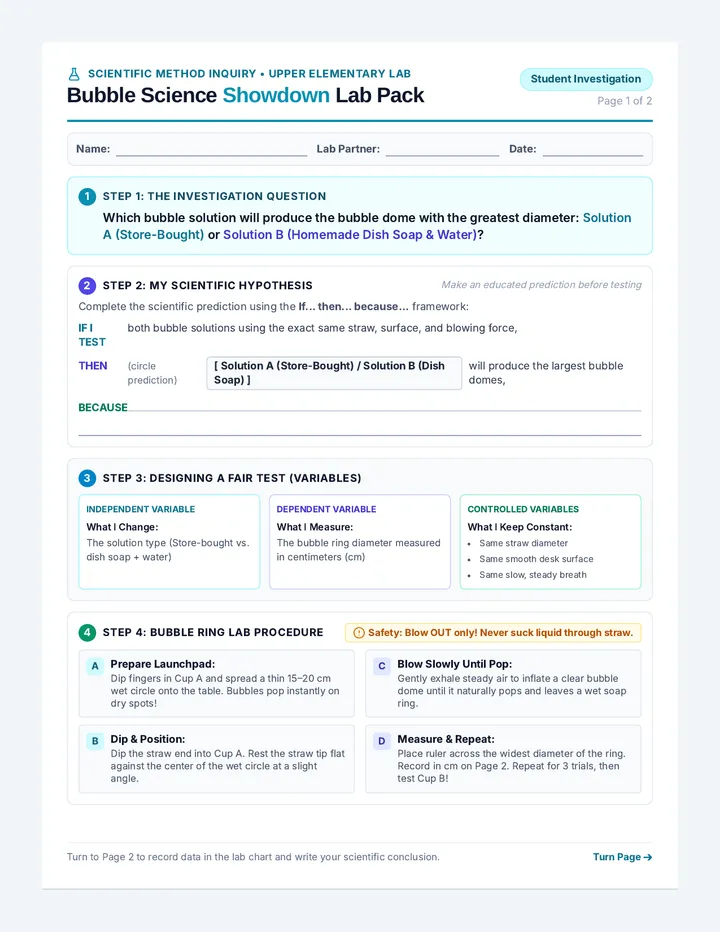
Bubble Showdown Lab Pack
Scientific Method Inquiry • Upper Elementary Lab
Bubble Science Showdown Lab Pack
Student Investigation
Page 1 of 2
Name:
Lab Partner:
Date:
1
Step 1: The Investigation Question
Which bubble solution will produce the bubble dome with the greatest diameter: Solution A (Store-Bought) or Solution B (Homemade Dish Soap & Water)?
2
Step 2: My Scientific Hypothesis
Make an educated prediction before testing
Complete the scientific prediction using the If... then... because... framework:
IF I TEST both bubble solutions using the exact same straw, surface, and blowing force,
THEN (circle prediction) [ Solution A (Store-Bought) / Solution B (Dish Soap) ] will produce the largest bubble domes,
BECAUSE
3
Step 3: Designing a Fair Test (Variables)
Independent Variable
What I Change:
The solution type (Store-bought vs. dish soap + water)
Dependent Variable
What I Measure:
The bubble ring diameter measured in centimeters (cm)
Controlled Variables
What I Keep Constant:
- Same straw diameter
- Same smooth desk surface
- Same slow, steady breath
4
Step 4: Bubble Ring Lab Procedure
Safety: Blow OUT only! Never suck liquid through straw.
A
Prepare Launchpad:
Dip fingers in Cup A and spread a thin 15–20 cm wet circle onto the table. Bubbles pop instantly on dry spots!
B
Dip & Position:
Dip the straw end into Cup A. Rest the straw tip flat against the center of the wet circle at a slight angle.
C
Blow Slowly Until Pop:
Gently exhale steady air to inflate a clear bubble dome until it naturally pops and leaves a wet soap ring.
D
Measure & Repeat:
Place ruler across the widest diameter of the ring. Record in cm on Page 2. Repeat for 3 trials, then test Cup B!
Turn to Page 2 to record data in the lab chart and write your scientific conclusion. Turn Page ➔
5
Step 5: Lab Data Collection & Analysis
Scientist: Page 2 of 2