Towering Titans Reading Passage
PaleoQuest Field Report Earth Science • Grade 5
Informational Text
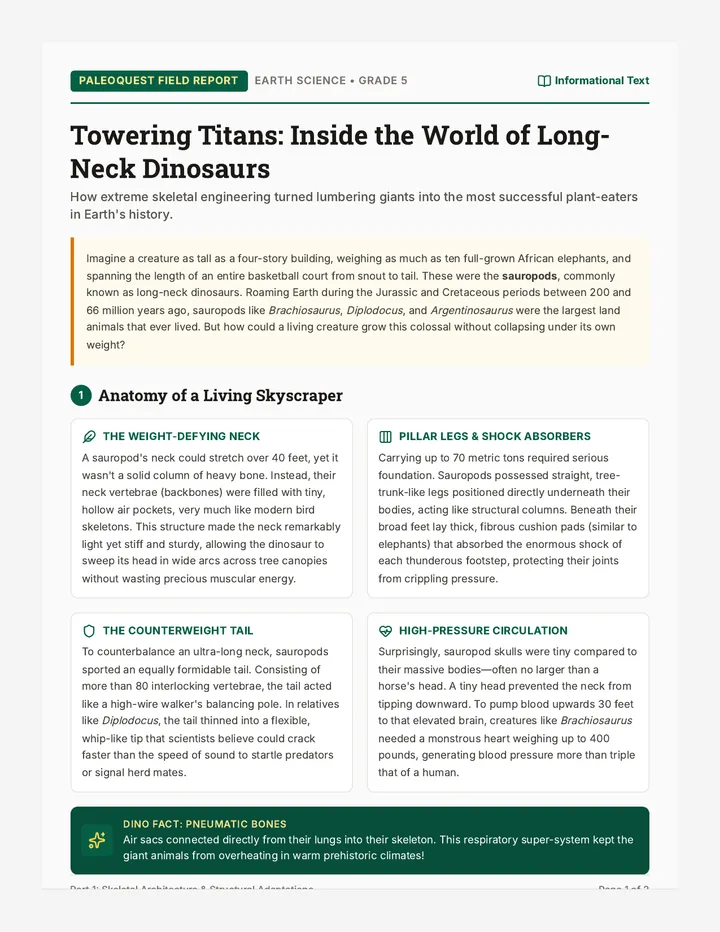
Towering Titans: Inside the World of Long-Neck Dinosaurs
How extreme skeletal engineering turned lumbering giants into the most successful plant-eaters in Earth's history.
Imagine a creature as tall as a four-story building, weighing as much as ten full-grown African elephants, and spanning the length of an entire basketball court from snout to tail. These were the sauropods, commonly known as long-neck dinosaurs. Roaming Earth during the Jurassic and Cretaceous periods between 200 and 66 million years ago, sauropods like Brachiosaurus, Diplodocus, and Argentinosaurus were the largest land animals that ever lived. But how could a living creature grow this colossal without collapsing under its own weight?
1
Anatomy of a Living Skyscraper
The Weight-Defying Neck
A sauropod's neck could stretch over 40 feet, yet it wasn't a solid column of heavy bone. Instead, their neck vertebrae (backbones) were filled with tiny, hollow air pockets, very much like modern bird skeletons. This structure made the neck remarkably light yet stiff and sturdy, allowing the dinosaur to sweep its head in wide arcs across tree canopies without wasting precious muscular energy.
Pillar Legs & Shock Absorbers
Carrying up to 70 metric tons required serious foundation. Sauropods possessed straight, tree-trunk-like legs positioned directly underneath their bodies, acting like structural columns. Beneath their broad feet lay thick, fibrous cushion pads (similar to elephants) that absorbed the enormous shock of each thunderous footstep, protecting their joints from crippling pressure.
The Counterweight Tail
To counterbalance an ultra-long neck, sauropods sported an equally formidable tail. Consisting of more than 80 interlocking vertebrae, the tail acted like a high-wire walker's balancing pole. In relatives like Diplodocus, the tail thinned into a flexible, whip-like tip that scientists believe could crack faster than the speed of sound to startle predators or signal herd mates.
High-Pressure Circulation
Surprisingly, sauropod skulls were tiny compared to their massive bodies—often no larger than a horse's head. A tiny head prevented the neck from tipping downward. To pump blood upwards 30 feet to that elevated brain, creatures like Brachiosaurus needed a monstrous heart weighing up to 400 pounds, generating blood pressure more than triple that of a human.
Dino Fact: Pneumatic Bones Air sacs connected directly from their lungs into their skeleton. This respiratory super-system kept the giant animals from overheating in warm prehistoric climates!
Part 1: Skeletal Architecture & Structural Adaptations Page 1 of 2
Paleontological Investigation Sauropod Behavior & Ecosystems
2
Life as a Walking Vegetarian Factory
Surviving at titan size meant one continuous mission: finding food. An adult sauropod had to consume between 500 to 1,000 pounds of foliage every single day. Because forests were packed with giant ferns, ancient cycads, and tall needle-bearing conifers, sauropods developed remarkable feeding routines that set them apart from modern grazing herbivores.
Rake and Gulp
Sauropods had peg-like or spoon-shaped teeth designed exclusively for stripping needles and fronds off branches. They couldn't chew! They swallowed branches whole, letting internal digestion do the work.
Gizzard Stones
Many species swallowed smooth stones called gastroliths. Trapped in a muscular gizzard chamber, these tumbling stones acted like an internal mill, pulverizing tough plant fibers into mush.
Herd Trackways
Fossil footprints (trackways) prove that sauropods migrated in large social herds. Walking in groups protected vulnerable juveniles from apex carnivores like Allosaurus.
Meet the Titan Specialists
Brachiosaurus High Canopy Browser
With front legs longer than its back legs, its neck naturally pointed upright like a giraffe. It specialized in grazing towering treetops 40 to 50 feet above the ground.
Diplodocus Horizontal Vacuum
Carrying its neck almost horizontally to the ground, this 90-foot giant swung its head low across swampy riverbanks, mowing down ferns over vast areas like a prehistoric lawnmower.
Field Vocabulary
Sauropod:
A long-necked, long-tailed herbivorous dinosaur with pillar-like legs.
Gastroliths:
Smooth stones swallowed into the stomach to grind fibrous plants.
Vertebrae:
The interlocking series of bones forming the spine and neck.
Think Like a Paleontologist
- Text Evidence: Why would a solid, heavy neck bone have made life difficult or impossible for a giant sauropod?
- Compare & Contrast: How did Brachiosaurus and Diplodocus share the same habitat without competing for the exact same food?
- Scientific Inference: Why did traveling in herds provide an evolutionary advantage to young sauropods?
Part 2: Herbivorous Lifestyles, Feeding Mechanics & Ecology Page 2 of 2
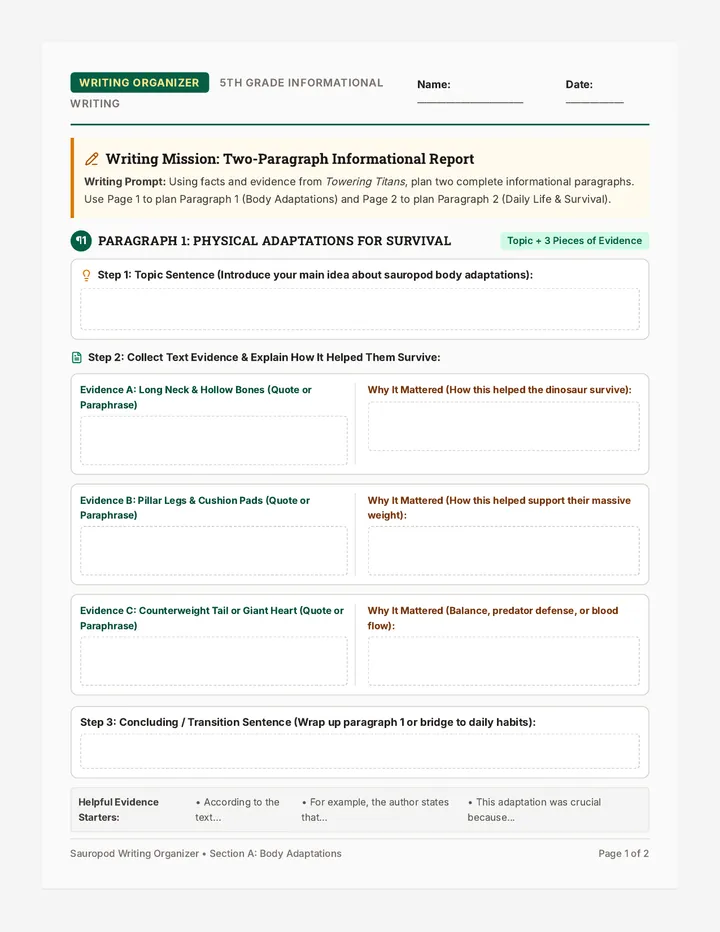
Sauropod Paragraphs Graphic Organizer
Writing Organizer 5th Grade Informational Writing
Name: ______________________
Date: ____________
Writing Mission: Two-Paragraph Informational Report
Writing Prompt: Using facts and evidence from Towering Titans, plan two complete informational paragraphs. Use Page 1 to plan Paragraph 1 (Body Adaptations) and Page 2 to plan Paragraph 2 (Daily Life & Survival).
¶1
Paragraph 1: Physical Adaptations for Survival
Topic + 3 Pieces of Evidence
Step 1: Topic Sentence (Introduce your main idea about sauropod body adaptations):
Step 2: Collect Text Evidence & Explain How It Helped Them Survive:
Evidence A: Long Neck & Hollow Bones (Quote or Paraphrase)
Why It Mattered (How this helped the dinosaur survive):
Evidence B: Pillar Legs & Cushion Pads (Quote or Paraphrase)
Why It Mattered (How this helped support their massive weight):
Evidence C: Counterweight Tail or Giant Heart (Quote or Paraphrase)
Why It Mattered (Balance, predator defense, or blood flow):
Step 3: Concluding / Transition Sentence (Wrap up paragraph 1 or bridge to daily habits):
Helpful Evidence Starters: • According to the text... • For example, the author states that... • This adaptation was crucial because...
Sauropod Writing Organizer • Section A: Body Adaptations Page 1 of 2
Section B: Daily Life & Ecological Habits Paragraph 2 Planning & Self-Check
¶2
Paragraph 2: Daily Life, Diet, & Herd Survival
Diet, Digestion, & Herds
Step 1: Topic Sentence (Introduce how sauropods spent their daily lives finding food and surviving):
Step 2: Collect Text Evidence on How They Ate and Lived:
Evidence A: Diet & Raking Teeth (What and how they ate)
Why It Mattered (How they fueled up to 1,000 lbs daily):
Evidence B: Gastroliths / Gizzard Stones (Digestion strategy)
Why It Mattered (How they broke down plants without chewing):
Evidence C: Herd Migration & Trackways (Social behavior)
Why It Mattered (Protection against carnivores like Allosaurus):
Step 3: Concluding Sentence (Final memorable takeaway about these prehistoric giants):
5th Grade Informational Writer's Self-Check Checklist:
Both paragraphs have clear topic sentences.
Cited at least 3 specific facts from the text in each.
Used scientific terms (gastroliths, vertebrae, herd).
Capitalized dinosaur names and checked punctuation.