Sky Detective Teacher Guide • Mission 01 Turn page for Solutions & Fast-Brain Challenges ➡️
Sky Detective Guide • Mission 01
Cheat-Sheet 1.2
Burst 1 Solutions: Asphalt Barefoot Test Physics Hack
The Parking Lot: Dark asphalt absorbs almost all solar wavelengths, concentrating thermal energy in the top 2 millimeters. Water reflects much of the light and constantly circulates the heat down deep, staying cool to touch.
Sky Clue: Hot air expands and rises, creating a tiny low-pressure pocket. Cooler, heavier air pushes in from the sides, creating a gentle breeze.
Burst 2 Solutions: Cricket & Conversion Math Dolbear's Code
Cricket Temperature: 32 chirps + 40 = 72°F (room temperature!). Kids will be stunned that bugs do algebra.
Celsius to Fahrenheit: \(25^\circ\text{C} \times 1.8 = 45\); \(45 + 32 = \mathbf{77^\circ\text{F}}\). (Great kite-flying weather!).
Brain-Buster: When it dips below 40°F, crickets stop chirping completely because their muscle enzymes become too cold to contract! They do not chirp negative numbers.
Burst 3 Solutions: The Heavy Air Barometer Storm Detective
Kite Flying Verdict: YES, fly your kite! A rising barometer means dense, dry, high-pressure air is sinking. Sinking air squashes clouds and stops rain. The sun will warm the chilly morning air into a crisp, breezy, beautiful kite afternoon.
Burst 4 Solutions: Daily Temperature Rise Diurnal Prediction
Friday Peak: Mon–Thu average daily rise is exactly 27°F. Friday's low was 50°F. Predicted afternoon high = \(50 + 27 = \mathbf{77^\circ\text{F}}\)!
Fast-Brain Bonus Riddle: The Moon Weather Paradox
The Moon gets blasted by the exact same bright sunshine as Earth. But why is there zero wind, zero clouds, and zero weather on the Moon?
The Solution: The Moon has virtually no atmosphere! You need gas molecules to absorb heat and create pressure differences. Without air, there is no weather machine!
Sky Detective Teacher Guide • Mission 01 Next Mission: Wild Wind Chasers 💨
🙋 Stand in the Wind Trick
Stand with your back to the wind and stick both arms straight out:
Your LEFT HAND points toward the stormy low pressure! Your RIGHT HAND points toward sunny fair weather!
Quick Thought Experiment:
If you spin a globe and drop a drop of water from the North Pole down, does it slide straight or spiral into a curve? Why?
Burst 4 • 14 Min
[ ] Field Test Logged
| # | Name | Speed | What to Look For Outdoors |
|---|---|---|---|
| 0 | Calm | 0 mph | Smoke goes straight up; leaves don't move a millimeter. |
| 2 | Light Breeze | 4–7 mph | You feel wind on your face; leaves rustle gently. |
| 4 | Moderate Breeze | 13–18 mph | Dust blows around; small branches dance on trees. |
| 6 | Strong Breeze | 25–31 mph | Large branches sway; umbrellas turn inside out! |
| 8 | Gale Force | 39–46 mph | Twigs snap off trees; super hard to walk into wind! |
What are trees/flags doing?
Estimated Beaufort Number:
Where is wind coming from?
✓ Sky Detective Mission 02 Certified! All 4 wind burst badges completed
Chief Forecaster Badge:
Burst 4: Outdoor window or yard for live Beaufort wind logging.
Sky Detective Teacher Guide • Mission 02 Turn page for Solutions & Mount Washington Records ➡️
Sky Detective Guide • Mission 02
Cheat-Sheet 2.2
Burst 1 Solutions: Anemometer Physics Gadget Math
Why It Spins: The cup with its hollow cavity facing the wind catches high aerodynamic drag (\(C_d \approx 1.4\)). The cup moving backward has its rounded aerodynamic bottom slicing through the air with far lower drag (\(C_d \approx 0.4\)). The difference in force causes torque and spins the shaft.
RPM Formula: 30s count \(\times 2\) gives full Rotations Per Minute. In a light breeze (5 mph), expect ~40–60 RPM on a low-friction straw build.
Burst 2 Solutions: The Beach Breeze Flip Convection Flip
Nighttime Land Breeze: Sand cools down super fast once the sun sets. Water holds its warmth. So at night, the warmer air is actually over the ocean! That warm ocean air floats up, and cool heavy air from the land rushes out to sea. The breeze flips from Land to Ocean!
Burst 3 Solutions: Spinning Earth & Water Drops Coriolis Rule
Spinning Globe Water Drop: As the globe spins counter-clockwise, a water droplet pulled south toward the equator curves to the right because the equator surface is rotating faster beneath it.
Hand Rule: Stand with back to the wind. Left hand = Low pressure (storms). Right hand = High pressure (sunshine). This is the famous Buys Ballot's Law!
Burst 4 Solutions: Beaufort Scale Field Spy Visual Decoder
Sir Francis Beaufort created this scale in 1806 for British naval sailing ships. Kids don't need fancy electronics to measure wind speed—just observing whether dust flies (Force 4) or large branches sway (Force 6) gives meteorological precision!
Fast-Brain Bonus Riddle: Mount Washington's 231 MPH Monster Wind
On April 12, 1934, scientists atop Mount Washington measured a wind gust of 231 mph—fast enough to blow a railroad car right off its tracks! Why are mountain tops so insanely windy?
The Solution (The Garden Hose Trick): When you squeeze your thumb over the end of a garden hose, the water squirts out crazy fast! Air moving over a mountain gets squeezed between the mountaintop and the dense atmosphere above. Squeezing air makes it accelerate like a rocket!
Sky Detective Teacher Guide • Mission 02 Next Mission: Cloud Detective Clues 🌧️
| Diff 5°C |
|---|
| 16°C (61°F) | 90% | 81% | 71% | 63% | 54% |
| 18°C (64°F) | 91% | 82% | 73% | 65% | 57% |
| 20°C (68°F) | 91% | 83% | 74% | 67% | 59% |
Quick Humidity Read: Dry = 20°C, Wet = 17°C (Diff = 3°C)
RH:
%
Burst 4 • 16 Min
[ ] Storm Solved
Secret Fact: Lightning and thunder happen at the exact same split-second! Lightning heats the air to 50,000°F (5× hotter than the sun!), making air explode outward into a shockwave boom. But while Light travels instantly (186,000 miles/sec), Sound is a slowpoke, crawling only 1 mile every 5 seconds (or 1 km every 3 seconds)!
⚡ The Flash-to-Bang Formula
Distance (Miles) = Seconds counted ÷ 5
Count: "One thundercloud, two thunderclouds, three..." until the BOOM!
🏃 Storm Radar Math Challenge
Flash 1: 15s count =15 ÷ 5 = 3 miles
Flash 2 (5 min later): 5s count =5 ÷ 5 = 1 mile!
Is storm approaching or leaving?
Wind Vane:From Northeast 🧭
Barometer:Falling Rapidly 📉
Psychrometer:85% Humidity 💧
Your Official 24-Hour Weather Forecast:
Why? (Wind + Pressure + Humidity Clue):
★ Master Forecaster Graduate! Thunder, lightning & station verified
Chief Forecaster Gold Seal:
Burst 2: Clean juice carton, 2 thermometers, shoelace/gauze, water.
Burst 3: Cold can from fridge, paper towel, humidity chart.
Burst 4: Flash-to-Bang stopwatches, gold seal/stamp.
Sky Detective Teacher Guide • Mission 03 Turn page for Solutions & Storm Radar Keys ➡️
Sky Detective Guide • Mission 03
Cheat-Sheet 3.2
Burst 1 Solutions: Hair & Animal Senses Hair Science
Why Hair Stretches: Hair keratin is rich in hydrogen bonds. When humidity rises, water molecules bind inside the protein chain, swelling and lengthening the strand by up to 2.5%.
Animals & Low Pressure: Animals feel barometric drops in their inner ears and smell pungent moist soil odors before humans see clouds. Wet air holds scent molecules closer to the ground, alerting animals that a squall is imminent.
Burst 2 Solutions: Psychrometer Evaporative Chill Chill Proof
Why It Cools Down: Water molecules cannot turn into gas without energy. They steal kinetic thermal energy directly from the glass bulb of the thermometer, causing the liquid column inside to contract and drop. Slower evaporation = higher humidity.
Burst 3 Solutions: Relative Humidity & Sweaty Soda Chart Solution
Chart Mystery Lookup: Dry Bulb = 20°C, Wet Bulb = 17°C (Difference = 3°C). Reading the chart: row 20°C \(\rightarrow\) column Diff 3°C = 74% Relative Humidity.
Sweaty Can Solution: The can chills the thin shell of air touching it below its dewpoint. Chilled air cannot hold its vapor load, so moisture condenses out onto the surface as liquid dew!
Burst 4 Solutions: Thunder & Lightning Distance & Forecast Flash-to-Bang Radar
Flash-to-Bang Math: Flash 1 was \(15 \div 5 = \mathbf{3\text{ miles}}\). Flash 2 was \(5 \div 5 = \mathbf{1\text{ mile}}\). The storm traveled 2 miles in 5 minutes! It is approaching fast (moving toward the station at 24 mph!).
The 30/30 Safety Rule: If the count is under 30 seconds (6 miles), seek sturdy indoor shelter immediately. Stay inside for 30 minutes after the last thunderclap.
24-Hour Forecast: Heavy steady rain/thunder, gusty northeast winds, rapid cooling, lasting 24 hours.
Fast-Brain Bonus Riddle: Ping-Pong in the Clouds!
Why do huge ice balls (hailstones) fall out of the sky in the middle of a hot summer afternoon? And why are hailstones layered in rings inside just like an onion?
The Solution: Violent thunderstorm updrafts blast raindrops 40,000 feet into the freezing stratosphere where they freeze into ice. They fall down, get coated in fresh liquid raindrops, and get blasted back up again! Every round-trip bounce adds a new ring of ice, like a celestial game of ping-pong, until gravity finally pulls them down!
Sky Detective Teacher Guide • Mission 03 Sequence Complete • All Detectives Certified! 🎓
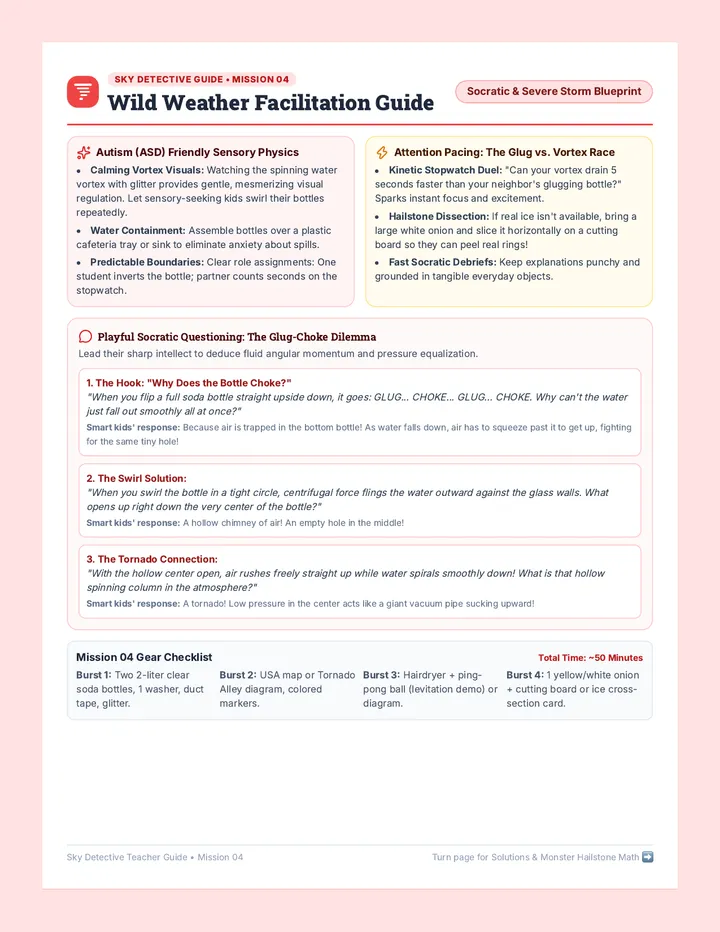
⚖️ The Terminal Velocity Battle
When does the hailstone finally fall out of the sky to the ground?
When the hailstone becomes too heavy for the cloud's updraft winds to support, gravity wins!
Burst 4 • 14 Min
[ ] Rings Counted
If you slice open a fresh hailstone with adult help (or inspect an onion), you will see concentric rings! Clear ice rings form when freezing is slow in wet cloud layers; cloudy milky rings form when water freezes instantly, trapping tiny air bubbles.
🧅 Ring Detective Math
You slice open a golf-ball sized hailstone and count 5 distinct ring pairs (clear + milky). How many round trips through the freezing cloud did it take?
Trips in Cloud:
🏆 The World Record Monster
In 2003, a hailstone in Aurora, Nebraska weighed almost 2 pounds (907 g) with an 18.75-inch circumference!
How fast did the thunderstorm updraft have to be blowing to hold a 2-pound ice ball up in the sky?
Estimated Updraft:
mph
★ Wild Weather Master Certified! Tornado vortex & hailstone onion decoded
Lead Meteorologist Seal:
Burst 4: 1 yellow/white onion + cutting board or ice cross-section card.
Sky Detective Teacher Guide • Mission 04 Turn page for Solutions & Monster Hailstone Math ➡️
Sky Detective Guide • Mission 04
Cheat-Sheet 4.2
Burst 1 Solutions: The Vortex Drain Race Fluid Mechanics
The Drain Timing: A stationary inverted bottle typically takes 20–25 seconds to glug out. A properly swirled vortex tube empties in 7–9 seconds—nearly 3× faster!
The Reason: The spinning funnel creates a central hollow core of low pressure. Displaced air from the lower bottle can continuously stream up through the center of the whirlpool while the spinning water clings to the walls, eliminating the glug-choke blockage.
Burst 2 Solutions: Tornado Alley Geography Climatology
Why No Tornadoes on Mountains: Mountain ranges physically break up the smooth, horizontal flow of the low-level jet stream. Their rough friction causes turbulence that disrupts the organized rotating updraft (mesocyclone) needed for twisters to stay intact. Flat plains allow massive, uninterrupted temperature and moisture boundaries (drylines and cold fronts) to collide cleanly.
Burst 3 Solutions: Cloud Ping-Pong & Freezing Levels Atmospheric Updrafts
Summer Hail Paradox: Even when surface air is 85°F, air cools at roughly 3.5°F to 5.4°F per 1,000 feet. At 40,000 feet, the top of a supercell storm is -40°F! The intense updraft acts like a hairdryer blowing a ping-pong ball upward, keeping the ice suspended until its terminal velocity exceeds the updraft force.
Burst 4 Solutions: The Onion Ring Dissection Hailstone Anatomy
5 Ring Pairs = 5 Round Trips: Each trip down coats the hailstone in supercooled liquid water, and each trip up freezes it solid. Alternating clear (wet growth) and milky (dry/rime growth) rings record its journey like tree growth rings!
Aurora World Record Updraft: To hold up a 1.93-pound (907 g) hailstone with an 18.75-inch circumference, the supercell updraft was calculated to exceed 100 to 120 mph (160–190 km/h)!
Fast-Brain Bonus Riddle: The 1930s Dust Bowl Mystery
During the 1930s Dust Bowl, huge black clouds of dirt swept all the way from Texas to the Atlantic Ocean. Why didn't prairie dirt blow away for thousands of years before farmers arrived?
The Solution: Deep-rooted wild prairie grasses naturally anchored the topsoil! When farmers plowed up the native grasses and a severe drought hit, the barren, powdery soil was defenseless against gale-force prairie winds!
Sky Detective Teacher Guide • Complete 4-Module Master Sequence All 4 Missions Complete • Station Mastery Achieved! 🏆