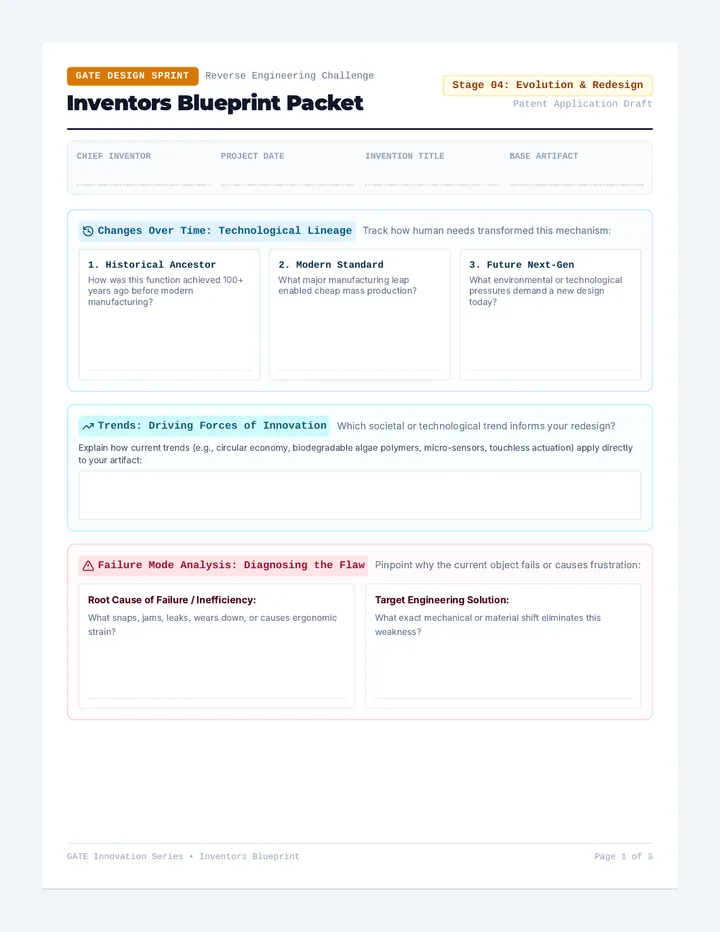
Stage 03: Synthesis
Cognitive Rigor Audit
Unanswered Questions: Curiosities & Hidden Anomalies
What manufacturing mark, mystery groove, or unexplained component cannot be understood just by looking at it? What question remains unresolved?
Across Disciplines: Cross-Curricular Convergence
Materials Chemistry:
Why was this specific polymer or metal chosen over lighter or cheaper alternatives?
Human Ergonomics:
How does the object accommodate human finger grip, fatigue, and tactile feedback?
Ethics: Durability, Repairability, & Waste
Is this object designed to be easily repaired when one part breaks, or designed to be thrown away? What ethical obligations does the manufacturer have?
Multiple Perspectives: Stakeholder Analysis How would each stakeholder evaluate this design?
4th Grade Student
Priority: ease of use, durability under rough handling.
Factory Manufacturer
Priority: injection mold speed, minimal raw part costs.
Ecology Recycler
Priority: ease of sorting mixed plastics and metals.
GATE Innovation Series • Kaplan Depth & Complexity Page 3 of 3
Ethics & Engineering Trade-Offs Every design choice has consequences:
Trade-off A: Cost vs Longevity
Does your redesign make the object more expensive to manufacture? Why is this justified?
Trade-off B: Environmental Impact
Can components be disassembled and recycled at end-of-life without specialized tools?
Empirical Testing Matrix: Proving Performance How will you test your prototype against the original?
| Test Variable | Experimental Protocol | Measurable Benchmark of Success |
|---|---|---|
| 1. Durability Drop Test | Drop 10 times from 1.5m table height onto tile floor. | |
| 2. Fatigue Cycle Test | Actuate mechanism 500 consecutive cycles rapidly. | |
| 3. Ergonomic Grip Test | Blindfolded user comfort & slip resistance rating (1–10). |
GATE Innovation Series • Inventors Blueprint Page 3 of 3
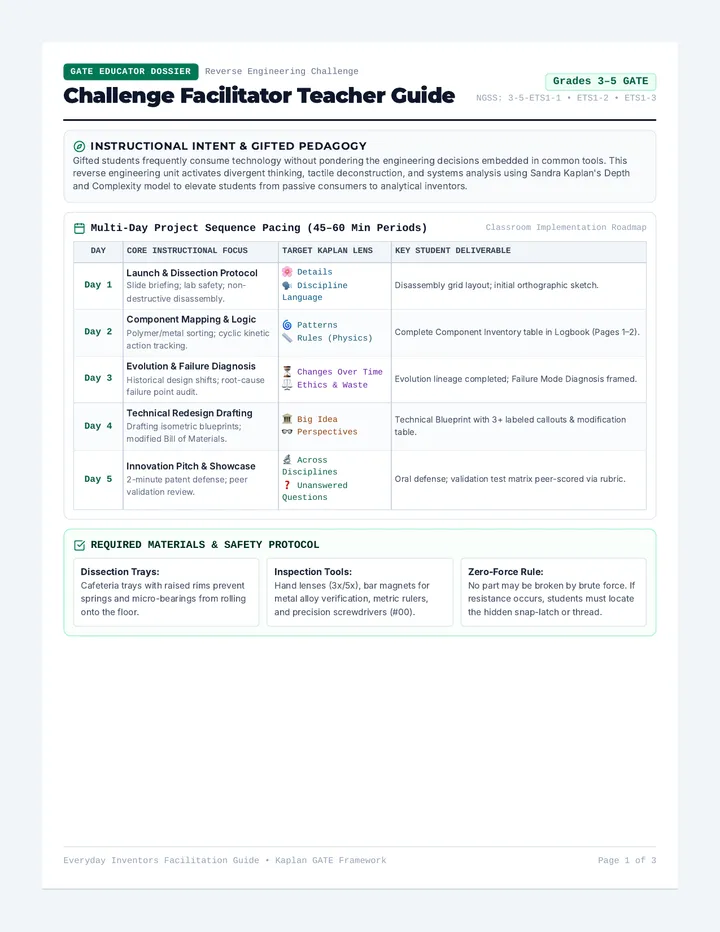
Everyday Inventors Facilitation Guide • Kaplan GATE Framework Page 1 of 3
Facilitation Toolkit
High-Order Questioning
🌸 DETAILS:
"Look closely at the surface finish. Why is the exterior grip textured with ribbed elastomer while the internal cam cylinder is polished smooth? How does friction dictate texture?"
🌀 PATTERNS:
"Trace the sequence of kinetic energy transfer. If you cycle this mechanism 10,000 times, which exact contact point experiences the highest recurring cyclic fatigue?"
📏 RULES:
"What physical law prevents this mechanism from functioning if you remove the spring? What balance of normal force, elasticity, and atmospheric pressure makes the fluid pump work?"
⏳ CHANGES OVER TIME:
"In 1920, this tool was forged from heavy brass. Today it is injection-molded polystyrene. How did mass manufacturing democratize access, and what durability trade-offs were accepted?"
⚖️ ETHICS:
"Is this artifact engineered for planned obsolescence? If the internal spring jams, can a 9-year-old service it, or is the user forced to discard the entire object into a landfill?"
👓 PERSPECTIVES:
"How would a left-handed user, an arthritic senior, and a factory robot assembling 1,000 units an hour critique this current latch mechanism differently?"
Misconception 1: "Adding electronic screens or solar panels makes everything better."
Intervention: Guide GATE students toward mechanical elegance. Challenge them: "Can you solve this failure point purely through clever geometry, material substitution, or physics without adding lithium batteries?"
Misconception 2: "Plastic is always cheap and bad; metal is always better."
Intervention: Discuss weight, chemical corrosion resistance, and self-lubricating polymers like Delrin/Nylon that outlast metals in humid pump environments.
Scaffolding (Grade 3 or Novice):
Assign simpler single-axis artifacts (retractable ballpoint pen, glue stick twist base). Provide pre-printed numbered tray templates for part sorting.
Extension (Grade 5 Advanced):
Assign compound fluid or gear artifacts (trigger spray bottle with ball valves, rotary sharpener). Require a quantified lifecycle carbon audit or full CAD sketch.
Everyday Inventors Facilitation Guide • Kaplan GATE Framework Page 2 of 3
Assessment & Exemplars
Evaluation Standards
| Criteria | 1: Developing | 2: Proficient | 3: Advanced GATE Innovator |
|---|---|---|---|
| 1. Teardown & Inventory | |||
| 🌸 Details / Discipline | Misses sub-assemblies; vague material tags (e.g. "metal thing"). | All parts cataloged with accurate material types and basic roles. | Flawless teardown; isolates micro-components; precise engineering nomenclature. |
| 2. Kaplan Synthesis | |||
| 🌀 Patterns / 📏 Rules / ⚖️ Ethics | Superficial answers; lists motion without explaining energy transfer. | Connects physical laws (Hooke's law, friction) and ethical trade-offs. | Deep systems critique; identifies hidden manufacturing marks and multiple stakeholder tensions. |
| 3. Technical Redesign | |||
| ⏳ Changes / 🏛️ Big Idea | Cosmetic change only (new color, logo); does not solve root failure. | Solves identified failure point with realistic material or part substitution. | Ingenious mechanical enhancement; comprehensive Bill of Materials; authentic patent claim. |
| 4. Validation & Defense | |||
| 🔬 Empirical Testing | Vague test ideas (e.g. "see if it works better"); unsubstantiated pitch. | Defines 3 measurable tests with controlled variables and benchmarks. | Rigorous test protocol with fatigue/stress tests; convincingly defends cost vs sustainability. |
Teacher Reference Exemplar: Retractable Ballpoint Pen Case Study Gold Standard Key
Teardown Inventory Breakdown:
Exemplar Redesign: "The Infinite Biopen"
Everyday Inventors Facilitation Guide • Kaplan GATE Framework Page 3 of 3