AI Detective Squad Teacher Guide Grade 4 • Digital Literacy & Critical Thinking
AI Detective Squad: Teacher Guide
20-Minute Teacher-Led Lesson • Zero Student Login Required
Duration
20 Mins
Core Learning Objectives
Identify a Claim: Spot what an AI claims to be a true fact.Check Evidence: Cross-check robot statements with reliable facts.Trust vs. Question: Explain why to trust, doubt, or reject output.Honest Authorship: Learn rules for original writing & disclosure.
Required Classroom Materials
Classroom Projector + AI Detective Slides
1 Bot Busters Partner Activity sheet per student pair
1 Bot Busters Exit Ticket slip per student
Classroom Anchor Chart: Honest Author Pledge
Highlighter and pencil for each student
20-Minute Pacing Schedule
0:00 - 3:00 The Hook AI is a guesser, not a knower
3:00 - 8:00 Think-Aloud Cheetah Claim & fact-check
8:00 - 14:00 Partner Mission Bee Case turn-and-talk
14:00 - 17:00 Honest Author Original writing & credit
17:00 - 20:00 Exit Ticket Independent check
Scripted Teacher Think-Aloud: "The Cheetah Case" (5 Mins)
Project Slide 3
AI Chatbot Text: "Cheetahs are the fastest animals on land. They can run up to 150 miles per hour, making them faster than sports cars, because they have rocket-shaped tails."
Step 1: Spot the Claim. "Detectives, I'm putting on my detective hat. A claim is what the robot wants me to believe is true. I see two claims here: (1) cheetahs run 150 mph, and (2) their tails act like rockets. Notice how polite and confident the AI sounds!"
Step 2: Check Evidence. "Now I cross-check. AI doesn't have eyes or real memories; it predicts words like autocomplete! I open our classroom science encyclopedia. It states: 'Cheetahs sprint at top speeds between 60 to 70 mph.' It also notes their tail acts like a rudder for steering, not a rocket."
Step 3: Trust or Question? "I do NOT trust this statement! I QUESTION it because the numbers are exaggerated by more than double, and the rocket tail is made up. In AI language, when a computer invents fake facts that sound real, we call that a hallucination ."
AI Detective Squad • Grade 4 Teacher Guide Page 1 of 2
Partner Facilitation & Honest Author Policy
Instructional Supports
Partner Protocol: "The Honeybee Case" (6 Mins)
Pair students into "Fact-Checking Partner Duos." Student A reads the AI text aloud; Student B reads the verified Field Guide clue.
Sentence Frames for Discussion
"The robot makes the claim that..." "Our evidence clue shows that..." "I question this statement because..." "Part of this is true, but part is fake because..."
Common 4th Grade Misconceptions
"If it sounds smart, it must be true": AI writes fluent grammar even when factually wrong.All-or-Nothing thinking: AI often mixes true facts with fake details in the same sentence!
Classroom Standards: Original Student Writing & AI Disclosure
Anchor Rule
Explain to students that writers use their own brains to create original work. If a teacher ever authorizes AI brainstorming assistance in future lessons, 4th graders must follow these 3 rules:
1. My Words, My Brain
AI can never write your paragraphs. You may brainstorm ideas, but every sentence must be written in your own voice.
2. Check Every Fact
Never put a fact from AI into your writing without proving it in a book or trusted website first.
3. Give Honest Credit
If permitted to use AI for ideas, add a Disclosure Note at the top of your paper: "AI helped me brainstorm ideas."
Exit Ticket Quick-Scan Criteria (3 Minutes)
Skill Proficient (Meets Standard) Needs Re-Teaching Identify Claim Accurately identifies the specific statement made by the AI. Quotes unrelated text or misses the core assertion. Check Evidence Compares AI text against the provided evidence card facts. Ignores evidence; relies on gut feeling. Trust or Question Decides with valid reasoning citing the discrepancy or truth. Says "I trust it because it sounds real." Honest Author Explains why claiming AI work as one's own is dishonest. Confuses brainstorming with copying.
AI Detective Squad • Grade 4 Teacher Guide Page 2 of 2
AI Detective Slides Grade 4 AI Literacy Mission
20-Minute Challenge
AI Detective Squad:
Trust It or Question It?
AI can write like a human, but it doesn't think like a human. Learn how to spot claims, check evidence, and be an honest author!
Spot the Claim
•
Check the Evidence
•
Explain Your Verdict
The 3 Clues of Fact-Checking
Step-by-Step System
1
Spot the Claim
What is the AI stating as a true fact? Look for numbers, dates, or bold statements.
Ask: "What does it assert?"
2
Check Evidence
Compare the robot statement with trusted books, experts, or reliable science guides.
Ask: "Does proof agree?"
3
Trust or Question?
Explain your reason. Is it verified true, partly true, or a complete hallucination?
Ask: "Why do I doubt or trust?"
💡 Remember: AI models guess words based on patterns. They do not know what is real!
Teacher Model
Case #1: The Cheetah Mystery
Watch & Listen
AI Chatbot Output
"Cheetahs can sprint up to 150 miles per hour, beating race cars, because their tails act like rocket boosters."
🚩 Claim: Runs 150 mph due to rocket tail.
Science Field Guide (Verified Fact)
"Cheetahs run at top speeds of 60 to 70 mph. Their tails act as a rudder to balance and steer while turning."
✅ Evidence: 60-70 mph, tail is for steering balance.
Detective Verdict: QUESTION IT!
AI doubled the real speed and invented rocket tails. That is an AI hallucination !
Partner Investigation
Case #2: The Honeybee Mystery
6 Minutes
Read Together
"Honeybees do a waggle dance to show other bees where flowers are. They also build glass windows into hives to let in sunlight."
🔍 Spot: Which part sounds true? Which part sounds questionable?
Partner Discussion Frames
"The AI claims that bees..." "Our evidence clue proves that..." "I question this statement because..."
🎯 Fill out your Bot Busters Activity Sheet with your partner now!
Bot Busters Partner Activity AI Detective Squad • Partner Case File #02
The Honeybee Mystery
Investigation Time 6 Minutes
Detective 1:
Detective 2:
Date:
Suspect Exhibit A: AI Chatbot Answer Unverified Text
"Honeybees communicate by doing a 'waggle dance' that shows other bees the exact direction and distance to flower fields. They also build tiny glass windows into their hives so baby bees can see the morning sun."
1 Identify the Claims: What is the robot asserting as facts?
Write the two separate claims made by the AI in the boxes below:
Claim A (About communication):
Claim B (About hive construction):
2 Check Evidence: Verified Nature Science Field Guide
Verified Facts
Clue #1: Bee Dancing Scientists verified that bees do indeed dance in figure-eight patterns to communicate solar angle and distance to nectar sources.
Clue #2: Hive Building Bees construct hexagonal cells solely from beeswax produced by glands on their abdomen. Hives are pitch black inside; bees have no glass.
3 Detective Verdict: Do you trust or question the AI?
Check one box and explain your reasoning using evidence:
Fully Trust Question / Partly Untrue Completely Reject
Explain your verdict: Why do you trust or question this statement? (Use specific clues):
Detective Takeaway: Why is it dangerous that AI mixed a real fact with a fake detail?
Be ready to share!
AI Detective Squad • Partner Mission File Keep in Detective Folder
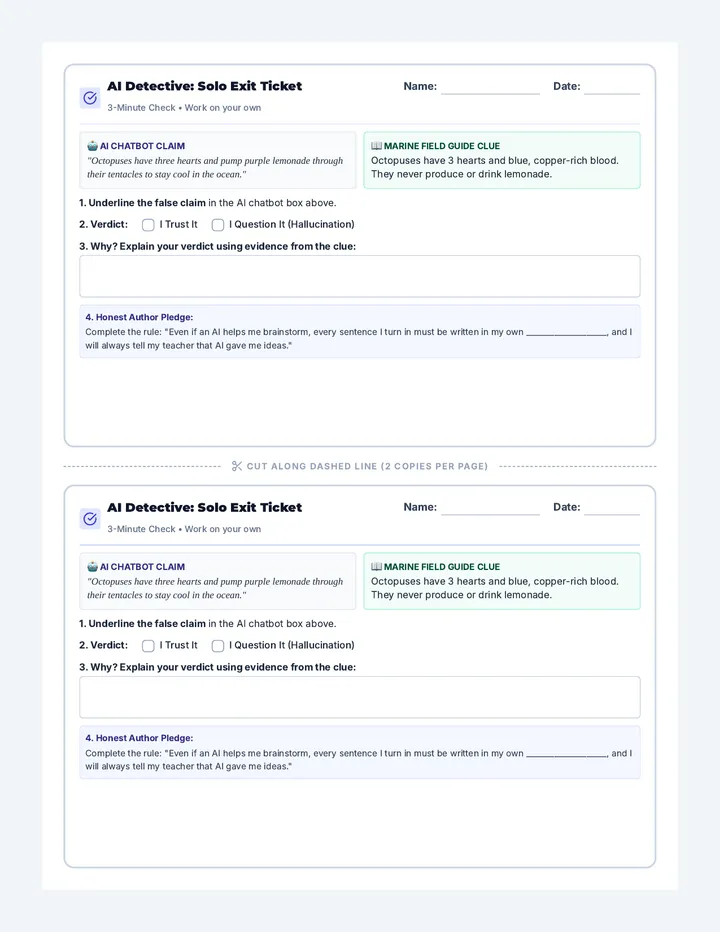
Bot Busters Exit Ticket AI Detective: Solo Exit Ticket
3-Minute Check • Work on your own
Name:
Date:
🤖 AI Chatbot Claim
"Octopuses have three hearts and pump purple lemonade through their tentacles to stay cool in the ocean."
📖 Marine Field Guide Clue
Octopuses have 3 hearts and blue, copper-rich blood. They never produce or drink lemonade.
1. Underline the false claim in the AI chatbot box above.
2. Verdict: I Trust It I Question It (Hallucination)
3. Why? Explain your verdict using evidence from the clue:
4. Honest Author Pledge:
Complete the rule: "Even if an AI helps me brainstorm, every sentence I turn in must be written in my own ____________________, and I will always tell my teacher that AI gave me ideas."
Cut Along Dashed Line (2 Copies Per Page)
AI Detective: Solo Exit Ticket
3-Minute Check • Work on your own
Name:
Date:
🤖 AI Chatbot Claim
"Octopuses have three hearts and pump purple lemonade through their tentacles to stay cool in the ocean."
📖 Marine Field Guide Clue
Octopuses have 3 hearts and blue, copper-rich blood. They never produce or drink lemonade.
1. Underline the false claim in the AI chatbot box above.
2. Verdict: I Trust It I Question It (Hallucination)
3. Why? Explain your verdict using evidence from the clue:
4. Honest Author Pledge:
Complete the rule: "Even if an AI helps me brainstorm, every sentence I turn in must be written in my own ____________________, and I will always tell my teacher that AI gave me ideas."
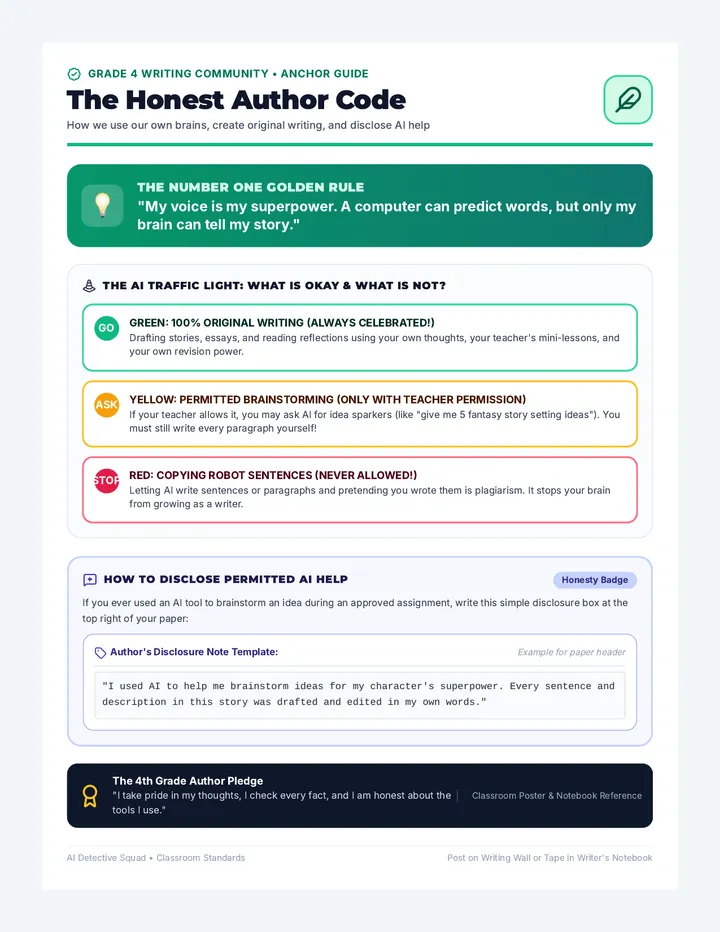
Honest Author Classroom Poster Grade 4 Writing Community • Anchor Guide
The Honest Author Code
How we use our own brains, create original writing, and disclose AI help
💡
The Number One Golden Rule
"My voice is my superpower. A computer can predict words, but only my brain can tell my story."
The AI Traffic Light: What Is Okay & What Is Not?
GO
Green: 100% Original Writing (Always Celebrated!)
Drafting stories, essays, and reading reflections using your own thoughts, your teacher's mini-lessons, and your own revision power.
ASK
Yellow: Permitted Brainstorming (Only With Teacher Permission)
If your teacher allows it, you may ask AI for idea sparkers (like "give me 5 fantasy story setting ideas"). You must still write every paragraph yourself!
STOP
Red: Copying Robot Sentences (Never Allowed!)
Letting AI write sentences or paragraphs and pretending you wrote them is plagiarism. It stops your brain from growing as a writer.
How to Disclose Permitted AI Help
Honesty Badge
If you ever used an AI tool to brainstorm an idea during an approved assignment, write this simple disclosure box at the top right of your paper:
Author's Disclosure Note Template: Example for paper header
"I used AI to help me brainstorm ideas for my character's superpower. Every sentence and description in this story was drafted and edited in my own words."
The 4th Grade Author Pledge "I take pride in my thoughts, I check every fact, and I am honest about the tools I use."
Classroom Poster & Notebook Reference
AI Detective Squad • Classroom Standards Post on Writing Wall or Tape in Writer's Notebook