Unit 3 Chapter 7-Vision Evidence Prompt Worksheet
CKLA Grade 3 • Unit 3: Human Body
Chapter 7: Eyes and Vision
Constructed Response
Name:
Date:
Score:
Constructed Response Prompt
In Chapter 7, Dr. Kwan Si-Yu states: "You may be surprised to learn that the eye does not really see objects. Instead, it sees the light that reflects off objects."
Explain how light travels through the parts of the eye and reaches the brain so that we can see. Include at least two specific pieces of text evidence from Chapter 7 to describe what happens along the way.
Text Evidence Word Bank
cornea pupil lens retina rods & cones optic nerve
Evidence Starters
- • "According to the text, light first passes..."
- • "On page 58, the author explains that..."
- • "This proves that the brain..."
3rd Grade Evidence Checklist:
Restated & answered prompt 2+ facts from Chapter 7 Capital letters & periods
Chapter 7: Eyes and Vision • Reading & Writing Standard RI.3.1 Single-Prompt Response
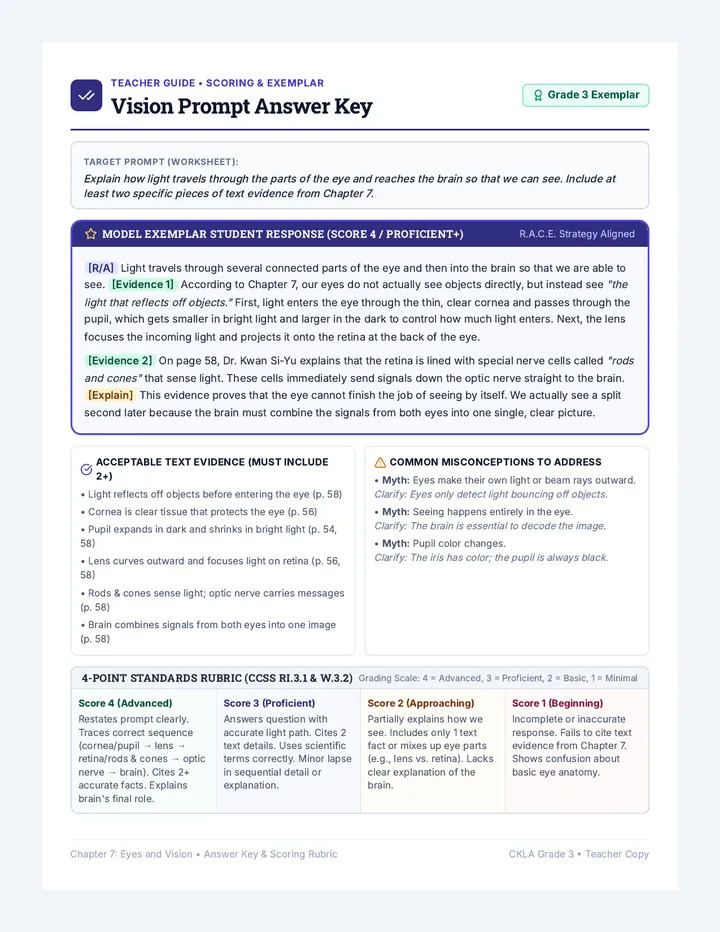
Vision Prompt Answer Key
Teacher Guide • Scoring & Exemplar
Vision Prompt Answer Key
Grade 3 Exemplar
Target Prompt (Worksheet):
Explain how light travels through the parts of the eye and reaches the brain so that we can see. Include at least two specific pieces of text evidence from Chapter 7.
Model Exemplar Student Response (Score 4 / Proficient+) R.A.C.E. Strategy Aligned
[R/A] Light travels through several connected parts of the eye and then into the brain so that we are able to see. [Evidence 1] According to Chapter 7, our eyes do not actually see objects directly, but instead see "the light that reflects off objects." First, light enters the eye through the thin, clear cornea and passes through the pupil, which gets smaller in bright light and larger in the dark to control how much light enters. Next, the lens focuses the incoming light and projects it onto the retina at the back of the eye.
[Evidence 2] On page 58, Dr. Kwan Si-Yu explains that the retina is lined with special nerve cells called "rods and cones" that sense light. These cells immediately send signals down the optic nerve straight to the brain. [Explain] This evidence proves that the eye cannot finish the job of seeing by itself. We actually see a split second later because the brain must combine the signals from both eyes into one single, clear picture.
Acceptable Text Evidence (Must include 2+)
- • Light reflects off objects before entering the eye (p. 58)
- • Cornea is clear tissue that protects the eye (p. 56)
- • Pupil expands in dark and shrinks in bright light (p. 54, 58)
- • Lens curves outward and focuses light on retina (p. 56, 58)
- • Rods & cones sense light; optic nerve carries messages (p. 58)
- • Brain combines signals from both eyes into one image (p. 58)
Common Misconceptions to Address
- • Myth: Eyes make their own light or beam rays outward.
Clarify: Eyes only detect light bouncing off objects.
- • Myth: Seeing happens entirely in the eye.
Clarify: The brain is essential to decode the image.
- • Myth: Pupil color changes.
Clarify: The iris has color; the pupil is always black.
4-Point Standards Rubric (CCSS RI.3.1 & W.3.2) Grading Scale: 4 = Advanced, 3 = Proficient, 2 = Basic, 1 = Minimal
Score 4 (Advanced)
Restates prompt clearly. Traces correct sequence (cornea/pupil → lens → retina/rods & cones → optic nerve → brain). Cites 2+ accurate facts. Explains brain's final role.
Score 3 (Proficient)
Answers question with accurate light path. Cites 2 text details. Uses scientific terms correctly. Minor lapse in sequential detail or explanation.
Score 2 (Approaching)
Partially explains how we see. Includes only 1 text fact or mixes up eye parts (e.g., lens vs. retina). Lacks clear explanation of the brain.
Score 1 (Beginning)
Incomplete or inaccurate response. Fails to cite text evidence from Chapter 7. Shows confusion about basic eye anatomy.
Chapter 7: Eyes and Vision • Answer Key & Scoring Rubric CKLA Grade 3 • Teacher Copy