Lenny.com
Explore
Create
ActivitiesNewMathEnglish Language ArtsScience & EngineeringSocial StudiesGlobal LanguagesHealth & Physical EducationSpecial EducationCounseling & Life SkillsArts & CreativityESL
Lenny.com
Lenny.com
Explore
Create
ActivitiesNewMathEnglish Language ArtsScience & EngineeringSocial StudiesGlobal LanguagesHealth & Physical EducationSpecial EducationCounseling & Life SkillsArts & CreativityESL
Lenny.com
Lenny.com

Solutions

Lenny for EducatorsLenny for SchoolsLenny for Districts

Product

ExploreSign inCreateSupportAbout

Resources

Getting startedMTSS Acceleration Program

© 2026 Lenny Learning Inc.

TermsPrivacyAccessibility
LinkedInInstagramX
Lenny

Social Influence

Mechanisms of conformity, obedience, and persuasion within group dynamics. Examines how social norms and authority figures shape individual behavior and decision-making.

Social StudiesSocial Studies PracticesLocation WordsMapsOrder EventsChronology and CausationEvaluating SourcesHistorical ThinkingGeography, Humans, & the EnvironmentAmerican Symbols and LandmarksCitiesStatesState CapitalsRegions of the United StatesGeographic SkillsPhysical GeographyHuman GeographyRegional GeographyGeography of AfricaGeography of AsiaGeography of EuropeGeography of OceaniaGeography of the AmericasSociety and Environment of EuropeSociety and Environment of AsiaSociety and Environment of The AmericasSociety and Environment of the Middle EastSociety and Environment of AfricaHistoryPrehistoryComparing Ancient River CivilizationsAncient MesopotamiaAncient Egypt and KushAncient South AsiaEarly ChinaGreeceRome and the Byzantine EmpireAncient World HistoryNative Peoples of North AmericaNative Peoples of Mesoamerica and South AmericaAfrican EmpiresMedieval AsiaMedieval EuropeThe Silk RoadMedieval HistoryIslamic EmpiresWorld ReligionsRenaissance PeriodAge of ExplorationThe Thirteen ColoniesThe American RevolutionUS History Early RepublicFounding of the United StatesUS History AntebellumUS Civil WarReconstruction PeriodThe Gilded AgeUS ImperialismWorld ImperialismWorld War IUS History 1920sGreat DepressionWorld War IIThe Cold WarUS History 1950-60sUS History 1960s-70sWorld History 20th CenturyContemporary US HistoryContemporary World HistoryHolidaysCivics and GovernmentCitizenshipGovernment FoundationsThe ConstitutionUS ConstitutionExecutive BranchLegislative BranchJudicial BranchState and LocalPolitical ParticipationPublic PolicyPolitical SystemsPower and AuthoritySocial MovementsDefining DevianceTheories of DevianceCrime and Criminal JusticeEconomicsBasic Economic PrinciplesSupply and DemandWhat is MoneyEconomic FundamentalsMicroeconomicsMacroeconomicsBanking and FinanceEconomic SystemsGlobal EconomicsCorporations and PowerThe Changing WorkplaceUnemployment and LaborClass and InequalitySocial MobilityGlobal InequalityPsychologyHistory of PsychologyPsychology as a ScienceBrain and Nervous SystemNeuroscience and BehaviorGenetics and BehaviorSleep and ConsciousnessSensory ProcessesPerceptual OrganizationClassical ConditioningOperant ConditioningObservational LearningCognitive LearningMemory ProcessesThinking and Problem SolvingLanguage and CognitionTheories of MotivationStress and CopingPrenatal and Infant DevelopmentChildhood DevelopmentAdolescent DevelopmentAdulthood and AgingSelf and IdentitySocial CognitionSocial InfluenceAttraction and RelationshipsGroup BehaviorPrejudice and DiscriminationAnxiety and Mood DisordersClinical PsychologyForensic PsychologyPhilosophy & EthicsIntroduction to PhilosophyMajor Philosophers & IdeasMind and Body ProblemFree Will vs DeterminismEthics & MoralityReligion & PhilosophyPolitical Philosophy

Videos

How Propaganda and Prejudice Led to the Holocaust

How Propaganda and Prejudice Led to the Holocaust

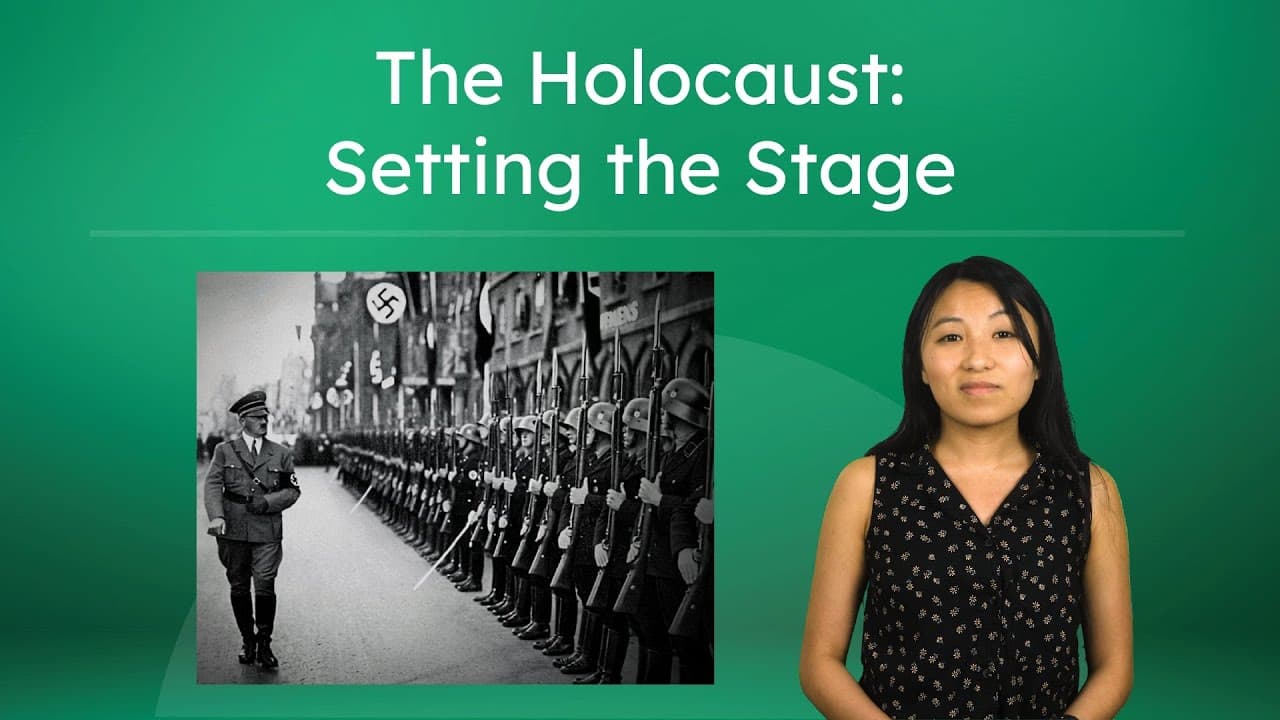
This educational video provides a crucial historical overview of the conditions in Europe and Germany that precipitated the Holocaust. Opening with archival footage from the Nuremberg Trials, it defines the Holocaust as the systematic state-sponsored murder of six million Jews and millions of others by the Nazi regime. The video juxtaposes the vibrant, diverse, and integrated lives of Jewish Europeans before the war with the rising tide of antisemitism that Adolf Hitler and the Nazi Party weaponized to gain power. The content explores key historical themes including the history of antisemitism in Europe (referencing the Dreyfus Affair and pogroms), the economic and political instability of post-WWI Germany, and the systematic use of propaganda. It details how the Nazis used newspapers, posters, and films to dehumanize Jewish people, blaming them for Germany's loss in World War I and economic hardships. The video specifically analyzes the psychological mechanisms of scapegoating and how constant exposure to hateful messaging normalized prejudice among ordinary citizens. For educators, this resource serves as an essential foundation for a unit on World War II or the Holocaust. It moves beyond simple dates and battles to explain the *why* and *how* of genocide, focusing on the gradual erosion of democratic norms and the power of propaganda. It provides excellent opportunities to discuss media literacy, the dangers of stereotyping, and the fragility of civil rights, making it highly relevant for history, civics, and social emotional learning curriculums.

Miacademy & MiaPrep Learning ChannelMiacademy & MiaPrep Learning Channel

11mins 50s

How Decolonization Reshaped the World After WWII

How Decolonization Reshaped the World After WWII

This educational video explores the complex and often violent process of decolonization that reshaped the world following World War II. It examines how European powers lost control of their empires in Asia and Africa, highlighting the distinct paths to independence taken by nations such as India, China, Kenya, and Algeria. The narrative contrasts negotiated transfers of power with brutal wars of liberation, providing specific historical examples of the human cost involved in these transitions. Key themes include the impact of the Cold War on emerging nations, the concept of neo-imperialism, and the psychological dimensions of colonization as articulated by thinkers like Frantz Fanon. The video also discusses the phenomenon of reverse migration, where colonized peoples moved to Europe to rebuild war-torn infrastructure, facing racism and discrimination in the process. It connects these historical events to cultural shifts, such as the rejection of Western dress codes and the influence of immigrant musicians on Western pop culture. For educators, this video serves as a powerful resource for teaching 20th-century World or European History. It moves beyond simple dates and maps to address the nuances of post-colonial infrastructure, the economic dependence created by foreign aid systems, and the lasting legacy of partition violence. The video provides graphic primary source quotes that can spark deep classroom discussions about human rights, the ethics of war, and the ongoing challenges faced by the Global South.

CrashCourseCrashCourse

13mins 23s

How Authoritarian Socialism Controls Truth and Economies

How Authoritarian Socialism Controls Truth and Economies

This educational video provides a deep dive into the mechanisms of authoritarian socialism, exploring how these regimes control both information and economies. The narrator, Justin, begins by examining the psychological tools used by authoritarian systems, specifically propaganda and cognitive dissonance, to manipulate citizens' perception of reality. The video explains how truth is often subverted to maintain the status quo and the authority of the state, using the famous "2+2=5" analogy to illustrate how political pressure can force individuals to accept falsehoods.

Miacademy & MiaPrep Learning ChannelMiacademy & MiaPrep Learning Channel

12mins 18s

How Authoritarian Regimes Rise and Rule

How Authoritarian Regimes Rise and Rule

This video provides a comprehensive overview of authoritarianism, defining it as a political system characterized by highly centralized power and the suppression of individual liberties. The narrator, Jen, begins by inviting viewers to imagine life under such a regime—where surveillance is constant, free speech is curtailed, and dissent is punished. The video distinguishes between traditional views of dictatorship and modern evolutions, such as China's "authoritarian capitalism," which challenges the assumption that economic freedom requires democratic governance. The content delves into the psychological and sociological mechanisms that allow these regimes to rise, often explaining that they emerge slowly during times of crisis when fearful populations are willing to trade civil liberties for safety. It details the specific tools authoritarian leaders use to maintain control, including the dismantling of checks and balances, the manufacturing of constant emergencies, and the use of propaganda to manipulate emotional responses rather than rational ones. Ideal for high school civics and government classes, this video serves as a powerful prompt for discussing the fragility of democracy. It explains complex concepts like "scapegoating," the "enemy image," and the "aggregate citizen," helping students understand how leaders can exploit social divisions to consolidate power. The video concludes by emphasizing that a healthy society must balance collective goals with individual freedoms, offering a clear contrast to the oppressive systems described.
Miacademy & MiaPrep Learning ChannelMiacademy & MiaPrep Learning Channel

10mins 23s

How World War I Innovations Created Modern Consumer Culture

How World War I Innovations Created Modern Consumer Culture

This educational video explores the profound cultural and economic shifts that occurred in Western society following World War I, specifically focusing on the transition into the "Roaring Twenties." It connects the technological innovations and propaganda techniques developed during the war to the rise of modern consumer culture, mass marketing, and changing social norms. The narrator explains how wartime advancements in infrastructure, such as electricity and transportation, laid the groundwork for a boom in consumer goods, while psychological tactics used to sell the war were repurposed by figures like Edward Bernays to sell products.

Miacademy & MiaPrep Learning ChannelMiacademy & MiaPrep Learning Channel

11mins 1s

How Railroads Reshaped Time, Space, and Society

How Railroads Reshaped Time, Space, and Society

In this episode of Crash Course World History, John Green explores the Industrial Revolution through the specific lens of the railroad. Rather than focusing solely on the mechanics of steam engines, the video delves into the profound sociological and psychological shifts caused by rail travel, drawing heavily from Wolfgang Schivelbusch's book 'The Railway Journey'. It examines how railroads fundamentally altered human perceptions of time, space, and nature, introducing concepts like standard time zones and the 'annihilation of time and space.' The video investigates the cultural anxiety that accompanied this technological leap. It discusses how high-speed travel changed the way people looked at landscapes—turning detailed nature into a blur—and how it influenced social behaviors, such as reading on public transport to avoid conversation. The narrative also covers the medical history of 'railway spine,' a precursor to the diagnosis of traumatic neurosis, illustrating how new technologies often bring new fears and psychological categories. Ideally suited for high school history and sociology students, this video serves as a powerful tool for connecting past technological revolutions to current ones. By comparing the disruption of the railroad to the disruption of the internet and smartphones, John Green helps students understand that the anxiety surrounding rapid technological change is a recurring historical theme. It challenges the notion that all change equals progress, encouraging critical thinking about innovation.

CrashCourseCrashCourse

12mins 31s

Materials

Leadership Theories Analytical Report

Leadership Theories Analytical Report

A six-page executive analytical report evaluating the Classical Five leadership paradigms: Trait, Behavioral, Situational, Transformational, and Transactional. The text is crafted with original, natural scholarly prose, dynamic sentence burstiness, nuanced case examples, APA 7th edition in-text citations, and structured four-sentence minimum paragraphs to ensure academic integrity and authenticity.

U

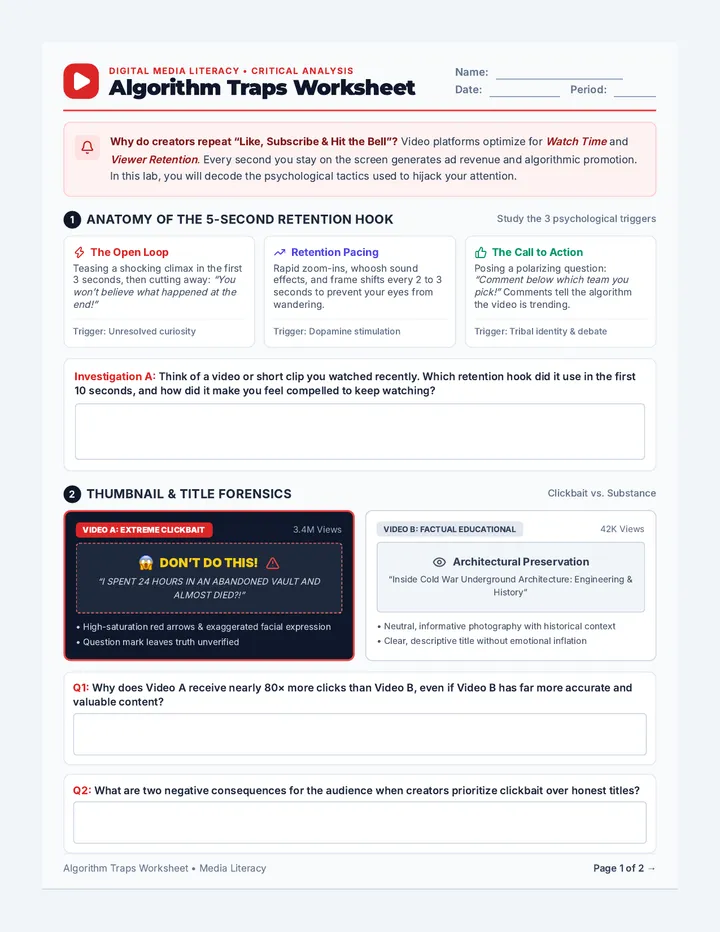
Algorithm Traps Worksheet

Algorithm Traps Worksheet

A two-page media literacy worksheet that helps students deconstruct online video hooks, algorithmic retention tactics, and the monetization behind 'like and subscribe' culture, culminating in an ethical content design challenge.

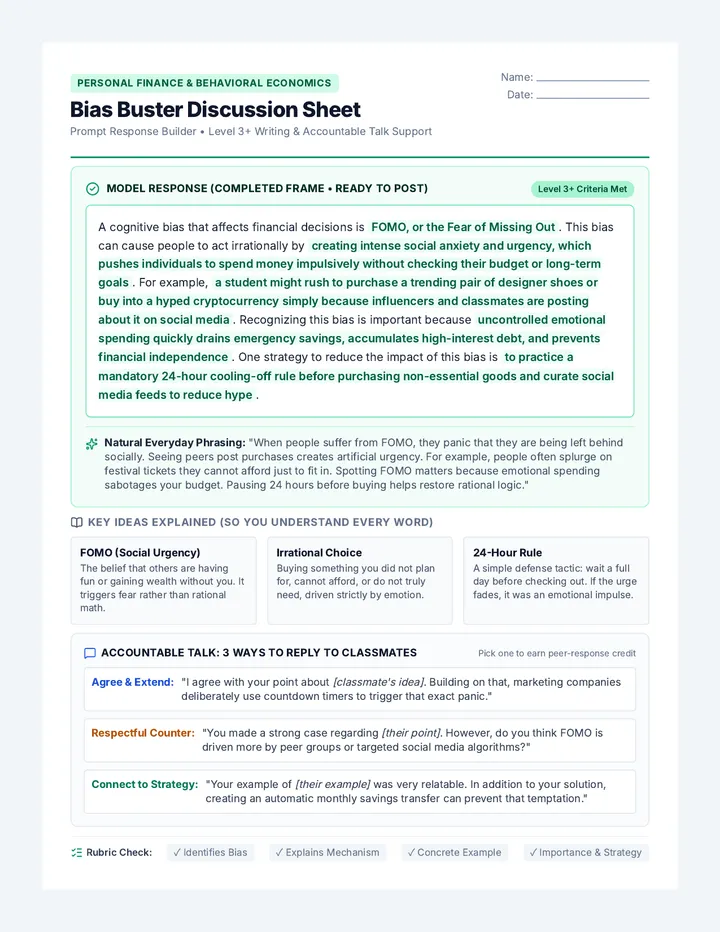
Bias Buster Discussion Sheet

Bias Buster Discussion Sheet

A structured discussion prep and sentence-frame response guide for students addressing how cognitive biases like FOMO drive irrational financial decisions, complete with Level 3+ exemplar models, vocabulary support, and Accountable Talk reply stems.

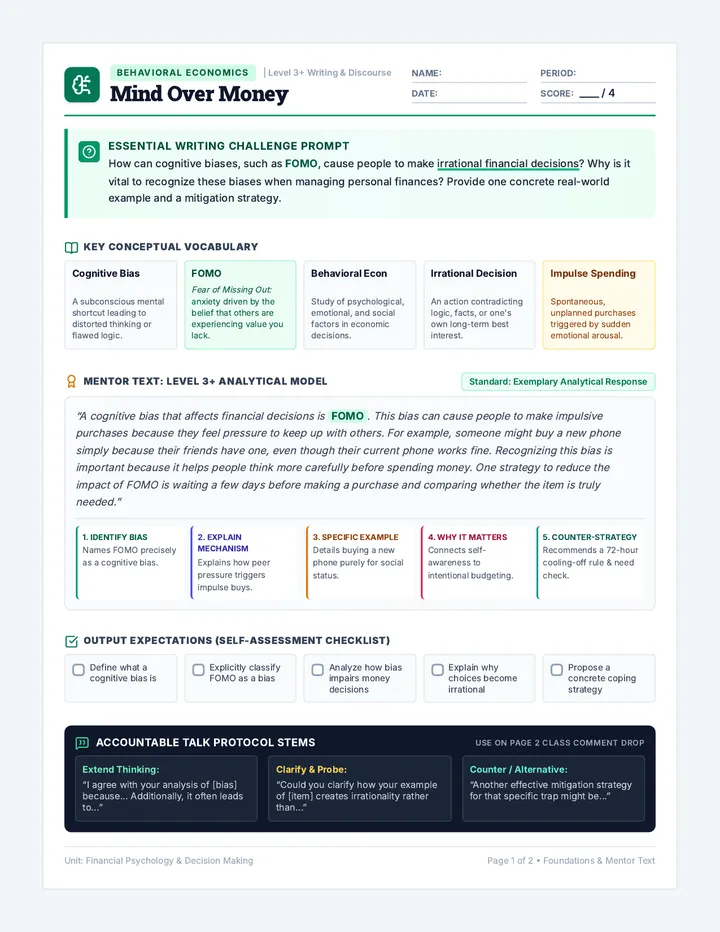
Mind Over Money Worksheet

Mind Over Money Worksheet

A two-page behavioral economics writing worksheet and peer comment drop guide exploring how cognitive biases like FOMO drive irrational financial decisions. Includes key vocabulary, an annotated Level 3+ exemplar, sentence frames, structured student writing lines, and an accountable talk peer-feedback station.

Sequences

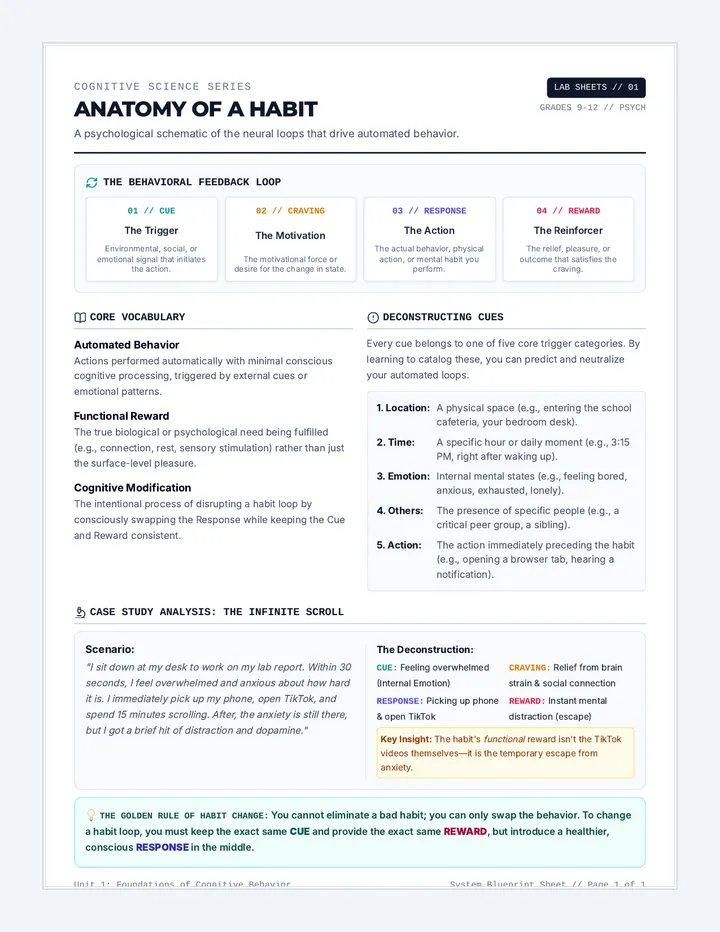
Anatomy of a Habit Guide & Vocabulary Sheet

Habit Architects

A three-part cognitive psychology series designed for Grades 9-12. Students learn the science of automation, explore how to isolate triggers and cravings, redesign unhelpful routines, and restructure their environments to make habit modification effortless.

DC

Diane Celona

19
Blueprint Curriculum Syllabus

Social Brain Blueprint

A comprehensive 5-part curriculum exploring social neuroscience through a macro social work lens, focusing on systemic change, practitioner wellbeing, and collective action.

DE

Dr. Erick Clinton Lear

16
Curriculum Blueprint Document v2

History Horizon Sequence

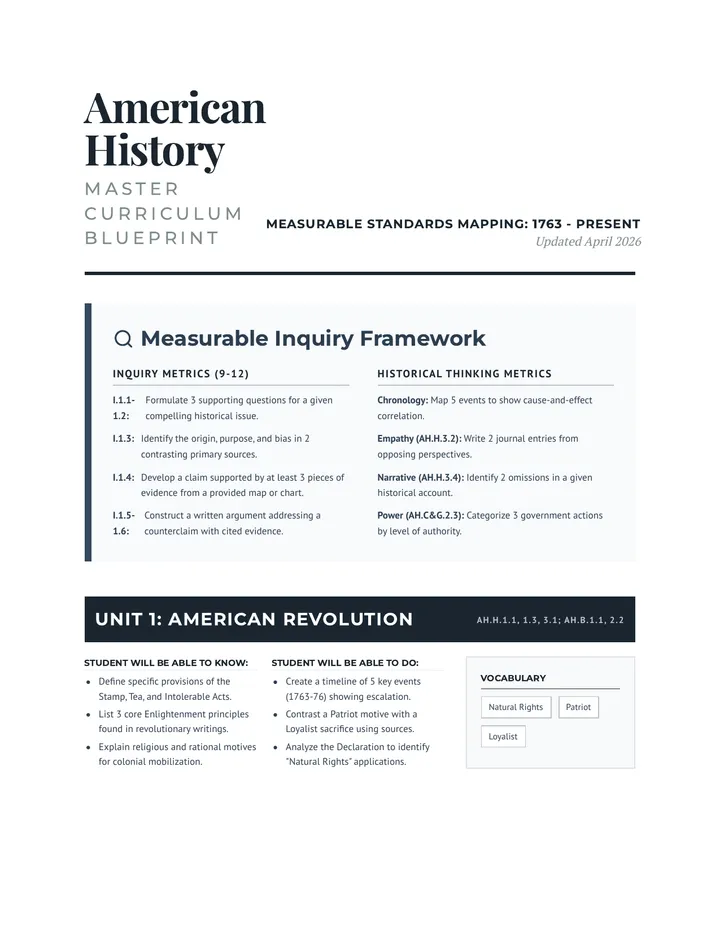
A comprehensive high school curriculum plan for American History, covering 13 units from the American Revolution to the modern era, aligned with North Carolina Social Studies standards.

AK

Amity Kea

21
Archetype Playbook Slides Extension

Game Changers

A 4-week unit exploring the construction of heroism and villainy in sports through media analysis, persuasive writing, and investigative interview techniques. Students will analyze how public perception is shaped and ultimately create their own investigative podcast script.

W

william.whitlow

46
Titans Intro Slides

Titan Leadership

A comprehensive study of leadership, civil rights, and social ethics through the lens of the film Remember the Titans.

MK

Marlyce Kemp

7
Resisting Hype Slides

Decoding the Feed

A comprehensive 4-part sequence on media literacy, digital algorithms, bias, journalism, and health-related media messaging. Designed using multiple distinct teaching styles—including Direct Instruction, Collaborative Stations, and Project-Based Inquiry—to help middle and high school students decode modern media and its impact on behavior.

DN

Donna Nelson

8

Lessons

Justice Gallery Investigation Worksheet

Justice Gallery Case Files

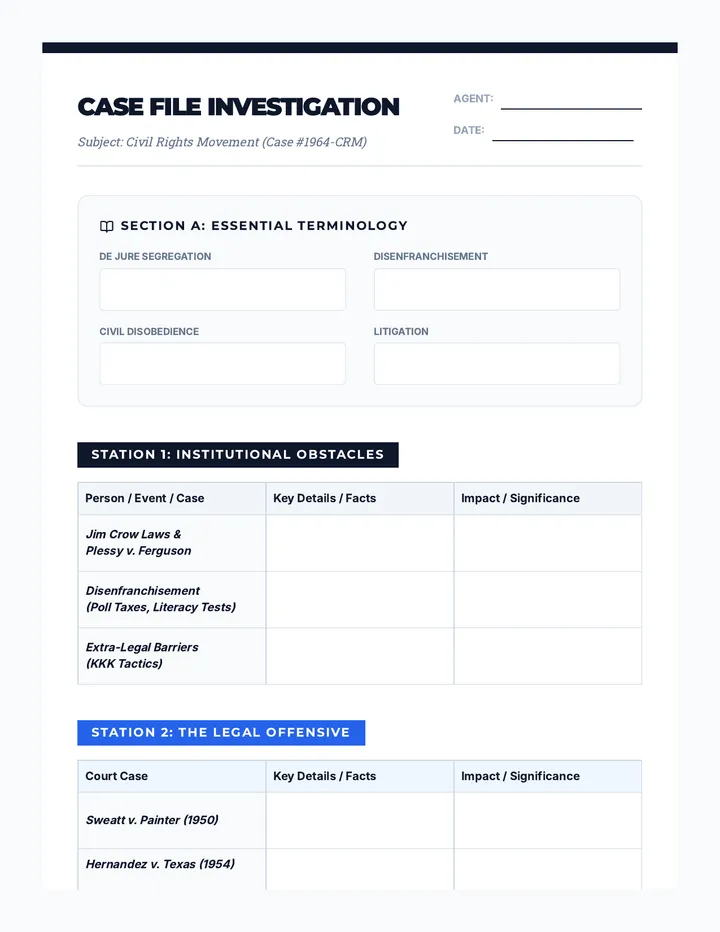
A comprehensive lesson on the Civil Rights Movement featuring gallery stations and a guided investigation worksheet. Students analyze institutional obstacles, legal strategies, non-violent and militant tactics, and the expansion of the movement to other marginalized groups.

CE

Chelsea Elliott

25
Power Play Lesson Plan

The Power Play

A deep dive into the social psychology of power, exploring how leadership styles, social influence, and ethical frameworks shape historical and modern societies. Students analyze case studies of authority and resistance to understand the mechanics of influence.

CL

Chrissy Longley

6
TikTok Influence Slides

Viral Influence

An exploration of TikTok's psychological and marketing influence, focusing on algorithmic power, social proof, and peer-driven trends through modeled annotation practices.

AR

Ashley Robbins

7
Ad Anatomy Slides

Ad Anatomy Decoding Persuasion

A lesson exploring 10 key advertising techniques used to influence consumer behavior, based on the Ad Anatomy Field Guide.

AR

Ashley Robbins

9
Sugar Rush Standoff Worksheet

Tactical Tantrums and Peace

This lesson uses a relatable analogy of a candy store tantrum to introduce the complex historical concept of appeasement, helping students understand why giving in to aggression can lead to greater conflict.

D

dfleisch

5
Guilty Feelings Handout

The Psychology of Guilt

A deep dive into social psychology research exploring how guilt functions as a targeted social mechanism rather than a broad emotional state. Students will analyze academic text, define complex vocabulary, and evaluate the specific behavioral consequences of guilt.

AP

Alexis Paolini

8