Lenny.com
Explore
Create
ActivitiesNewMathEnglish Language ArtsScience & EngineeringSocial StudiesGlobal LanguagesHealth & Physical EducationSpecial EducationCounseling & Life SkillsArts & CreativityESL
Lenny.com
Lenny.com
Explore
Create
ActivitiesNewMathEnglish Language ArtsScience & EngineeringSocial StudiesGlobal LanguagesHealth & Physical EducationSpecial EducationCounseling & Life SkillsArts & CreativityESL
Lenny.com
Lenny.com

Solutions

Lenny for EducatorsLenny for SchoolsLenny for Districts

Product

ExploreSign inCreateSupportAbout

Resources

Getting startedMTSS Acceleration Program

© 2026 Lenny Learning Inc.

TermsPrivacyAccessibility
LinkedInInstagramX
Lenny

Major Philosophers & Ideas

Core tenets of Western and Eastern philosophical traditions, focusing on ethics, logic, and existentialism. Examines the contributions of major thinkers from Socrates to modern theorists to develop critical reasoning and moral frameworks.

Social StudiesSocial Studies PracticesLocation WordsMapsOrder EventsChronology and CausationEvaluating SourcesHistorical ThinkingGeography, Humans, & the EnvironmentAmerican Symbols and LandmarksCitiesStatesState CapitalsRegions of the United StatesGeographic SkillsPhysical GeographyHuman GeographyRegional GeographyGeography of AfricaGeography of AsiaGeography of EuropeGeography of OceaniaGeography of the AmericasSociety and Environment of EuropeSociety and Environment of AsiaSociety and Environment of The AmericasSociety and Environment of the Middle EastSociety and Environment of AfricaHistoryPrehistoryComparing Ancient River CivilizationsAncient MesopotamiaAncient Egypt and KushAncient South AsiaEarly ChinaGreeceRome and the Byzantine EmpireAncient World HistoryNative Peoples of North AmericaNative Peoples of Mesoamerica and South AmericaAfrican EmpiresMedieval AsiaMedieval EuropeThe Silk RoadMedieval HistoryIslamic EmpiresWorld ReligionsRenaissance PeriodAge of ExplorationThe Thirteen ColoniesThe American RevolutionUS History Early RepublicFounding of the United StatesUS History AntebellumUS Civil WarReconstruction PeriodThe Gilded AgeUS ImperialismWorld ImperialismWorld War IUS History 1920sGreat DepressionWorld War IIThe Cold WarUS History 1950-60sUS History 1960s-70sWorld History 20th CenturyContemporary US HistoryContemporary World HistoryHolidaysCivics and GovernmentCitizenshipGovernment FoundationsThe ConstitutionUS ConstitutionExecutive BranchLegislative BranchJudicial BranchState and LocalPolitical ParticipationPublic PolicyPolitical SystemsPower and AuthoritySocial MovementsDefining DevianceTheories of DevianceCrime and Criminal JusticeEconomicsBasic Economic PrinciplesSupply and DemandWhat is MoneyEconomic FundamentalsMicroeconomicsMacroeconomicsBanking and FinanceEconomic SystemsGlobal EconomicsCorporations and PowerThe Changing WorkplaceUnemployment and LaborClass and InequalitySocial MobilityGlobal InequalityPsychologyHistory of PsychologyPsychology as a ScienceBrain and Nervous SystemNeuroscience and BehaviorGenetics and BehaviorSleep and ConsciousnessSensory ProcessesPerceptual OrganizationClassical ConditioningOperant ConditioningObservational LearningCognitive LearningMemory ProcessesThinking and Problem SolvingLanguage and CognitionTheories of MotivationStress and CopingPrenatal and Infant DevelopmentChildhood DevelopmentAdolescent DevelopmentAdulthood and AgingSelf and IdentitySocial CognitionSocial InfluenceAttraction and RelationshipsGroup BehaviorPrejudice and DiscriminationAnxiety and Mood DisordersClinical PsychologyForensic PsychologyPhilosophy & EthicsIntroduction to PhilosophyMajor Philosophers & IdeasMind and Body ProblemFree Will vs DeterminismEthics & MoralityReligion & PhilosophyPolitical Philosophy

Videos

Why the 1848 Revolutions Swept Europe and Failed

Why the 1848 Revolutions Swept Europe and Failed

This educational video from Crash Course European History explores the tumultuous year of 1848, a time when a wave of revolutions swept across Europe. Narrated by John Green, the video dissects the complex web of causes behind these uprisings, ranging from the devastation of the Irish Potato Famine and the "Hungry Forties" to the social and economic dislocations caused by the Industrial Revolution. It explains how traditional agrarian systems were failing and how new political ideologies like liberalism, nationalism, and socialism began to challenge the established monarchical order. The video provides a detailed tour of the specific revolutionary movements in France, the German states, the Austrian Empire, Italy, and Poland. It introduces key historical figures such as Louis Napoleon, Klemens von Metternich, and Karl Marx, while explaining pivotal concepts like the "springtime of Nations" and the friction between different revolutionary classes. The narrative highlights how the initial successes of these revolutions were often undone by internal disunity between middle-class liberals and working-class radicals, allowing conservative forces to reassert control. For educators, this resource serves as an excellent synthesis of 19th-century European political history. It helps students understand the connection between economic hardship and political action, the difficulty of coalition-building in politics, and the origins of modern political spectrums. The video concludes by asking critical historical questions about the value of revolution, noting that while many political goals failed, the revolutions successfully ended serfdom in Austria, changing the lives of millions.
CrashCourseCrashCourse

16mins 25s

Exploring Native Worldviews Through Humor and Reciprocity

Exploring Native Worldviews Through Humor and Reciprocity

This episode of Crash Course Native American History, hosted by Che Jim, explores the foundational elements of Indigenous worldviews, challenging the pervasive stereotype of the "stoic Indian." The video argues that humor, play, and laughter are not just entertainment but are "Good Medicine"—sacred tools for healing, resilience, and community building. It examines how Native American cultures have historically used humor to cope with trauma, subvert colonial power structures, and maintain social harmony, citing examples from the sacred clowns of the Pueblo people to modern indigenous comedy troupes like the 1491s.

CrashCourseCrashCourse

11mins 11s

Defining Heroes and Traitors in American History

Defining Heroes and Traitors in American History

This educational video explores the complex and often subjective definitions of "hero" and "traitor" through three distinct case studies from American history. The narrator challenges students to look beyond simple definitions and consider how historical context, personal values, and perspective shape these labels. The video examines John Adams' controversial defense of British soldiers after the Boston Massacre, Colonel John Chivington's role in the horrific Sand Creek Massacre, and Carry Nation's radical "hatchetations" during the temperance movement. The video delves into deep ethical questions about justice, duty, and morality. It asks students to evaluate whether John Adams was a traitor to the colonial cause or a hero of justice for defending the enemy. It contrasts Chivington's self-proclaimed heroism in protecting settlers with the brutal reality of massacring peaceful Cheyenne and Arapaho people. Finally, it analyzes Carry Nation's crusade against alcohol, asking if her violent methods undermined her virtuous goals. Each segment includes pauses for reflection and specific guiding questions. Teachers can use this video to foster critical thinking and historical analysis skills. It serves as an excellent anchor for lessons on the American Revolution, Native American history, or the Prohibition era. By presenting historical figures who defy easy categorization, the video encourages students to engage with nuance and ambiguity. It is particularly useful for sparking debates about the rule of law, the ethics of war, and the validity of different protest methods.

Miacademy & MiaPrep Learning ChannelMiacademy & MiaPrep Learning Channel

11mins 30s

How the American Revolution Actually Happened

How the American Revolution Actually Happened

In this fast-paced and nuanced overview of the American Revolution, John Green moves beyond a simple timeline of battles to explore the complex causes and contradictory outcomes of the war. The video connects the end of the Seven Years' War and British debt to the imposition of taxes like the Stamp Act and Townshend Acts, explaining how these economic pressures catalyzed a desire for self-governance. It distinguishes between the "War for Independence" and the actual "Revolution," challenging viewers to consider how revolutionary the event truly was for different groups of people. Key themes include the intellectual roots of the revolution in the Enlightenment, specifically the ideas of John Locke and Immanuel Kant regarding liberty and property rights. The video critically examines the hypocrisy inherent in the founding era, contrasting the soaring rhetoric of "all men are created equal" with the reality of slavery and the exclusion of women and non-property owners from political power. It highlights that for many—especially slaves, women, and the poor—the power structure remained largely unchanged despite the overthrow of the monarchy. For educators, this video serves as an excellent tool for teaching critical historical analysis rather than just rote memorization. It prompts students to evaluate historical narratives, understand the difference between political independence and social revolution, and discuss the complexities of the Founding Fathers. The content supports lessons on the Declaration of Independence, the influence of philosophical movements on political action, and the evolution of American democratic ideals.

CrashCourseCrashCourse

11mins 27s

How Renaissance Art and Literature Changed the World

How Renaissance Art and Literature Changed the World

This educational video takes students on a journey through a virtual museum to explore the profound cultural shifts of the Renaissance. It contrasts the art and literature of the Middle Ages—characterized by religious themes and flat, stylized figures—with the explosion of Realism, Humanism, and Individualism during the Renaissance. Through detailed analyses of masterpieces by Leonardo da Vinci, Michelangelo, and Raphael, the video demonstrates how artists used techniques like linear perspective and shading to celebrate the human form and experience. The video also examines the literary revolution led by figures like Dante Alighieri and William Shakespeare. It highlights the shift from Latin to vernacular languages, making literature accessible to the common person, and the move toward exploring complex human emotions and everyday experiences rather than just religious doctrine. Key concepts such as Secularism—the separation of institutions from religious beliefs—are defined and applied to show how society began questioning authority and valuing individual potential. Ideal for World History and Art History classes, this video serves as an engaging multimedia text. It helps students visualize abstract historical concepts through famous works of art. Teachers can use this video to anchor discussions on how cultural values are reflected in art, the importance of the printing press and vernacular language in spreading ideas, and the lasting impact of Renaissance thinking on modern views of human potential and individuality.

Miacademy & MiaPrep Learning ChannelMiacademy & MiaPrep Learning Channel

12mins

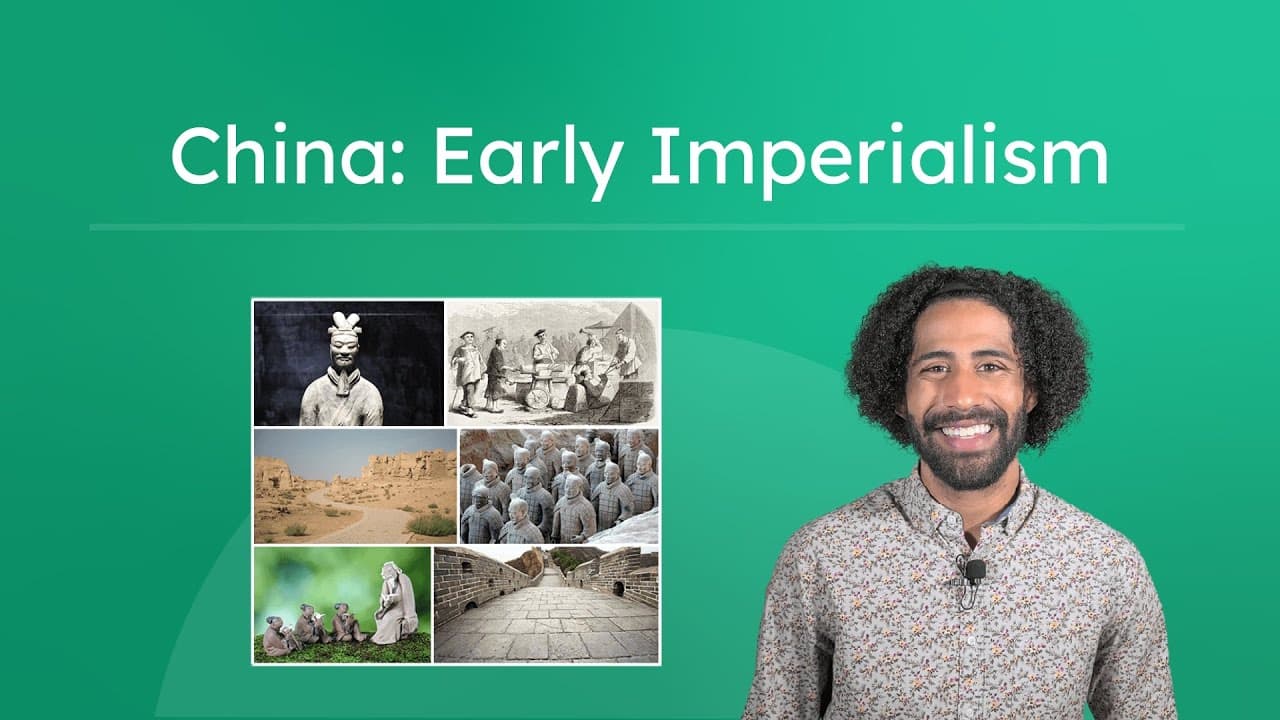
Early Imperial China: The Silk Road, Legalism, and the Qin Dynasty

Early Imperial China: The Silk Road, Legalism, and the Qin Dynasty

This educational video provides an engaging overview of Early Imperial China, focusing on the Qin and Han Dynasties. Hosted by an energetic presenter with a robot sidekick named Mia, the video breaks down complex historical concepts into accessible segments. It explores major technological advancements like paper-making and iron tools, explains the massive cultural and economic impact of the Silk Road, and introduces the strict political philosophy of Legalism that shaped the government structure. The narrative connects these historical events to modern concepts, using analogies like comparing the Silk Road to the internet to help students grasp the importance of cultural exchange. It covers key figures like Emperor Qin Shi Huang and his Terracotta Army, while also discussing the social mobility available through education in ancient China compared to other ancient civilizations. The video concludes by touching on the fall of the Han Dynasty and the subsequent Three Kingdoms period. Teachers can use this video as a core component of a World History unit on Ancient Civilizations. It offers excellent opportunities for classroom discussions on trade, government systems, and the difference between rule by strict law versus moral leadership. The clear pauses for questions make it interactive, allowing educators to check for understanding and encourage critical thinking about how ancient innovations and philosophies still influence the world today.

Miacademy & MiaPrep Learning ChannelMiacademy & MiaPrep Learning Channel

9mins 44s

Materials

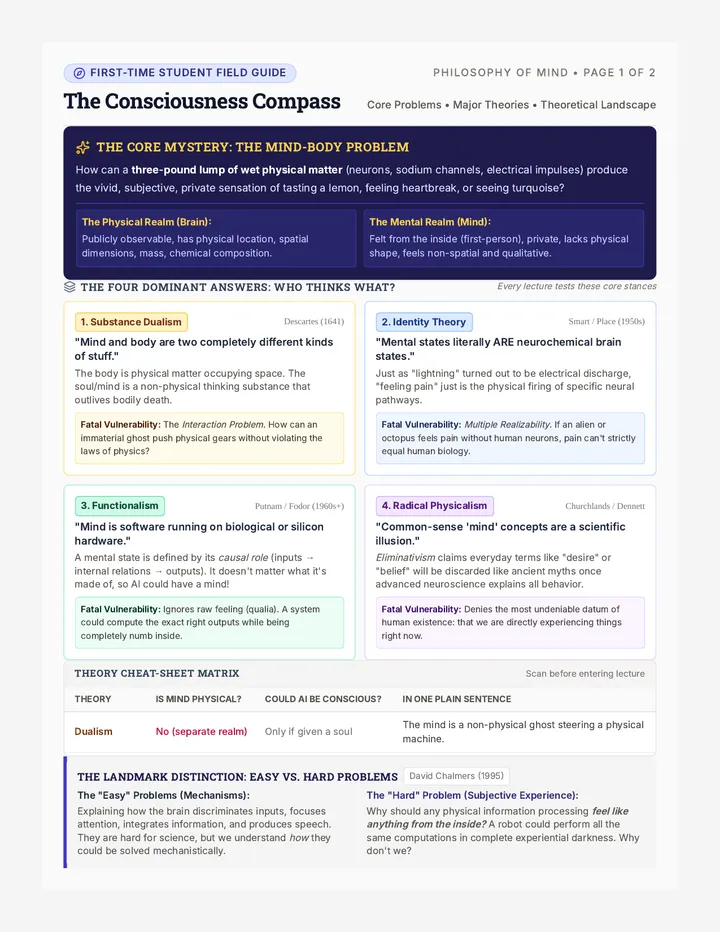
Consciousness Compass Reference Guide

Consciousness Compass Reference Guide

A comprehensive, plain-language two-page introductory field guide to the philosophy of mind. Covers the core mind-body problem, the four primary theoretical positions, the Easy vs. Hard problem distinction, the four legendary thought experiments, essential lecture jargon, and an active listening framework for first-time students.

ES

Eslem Serdar

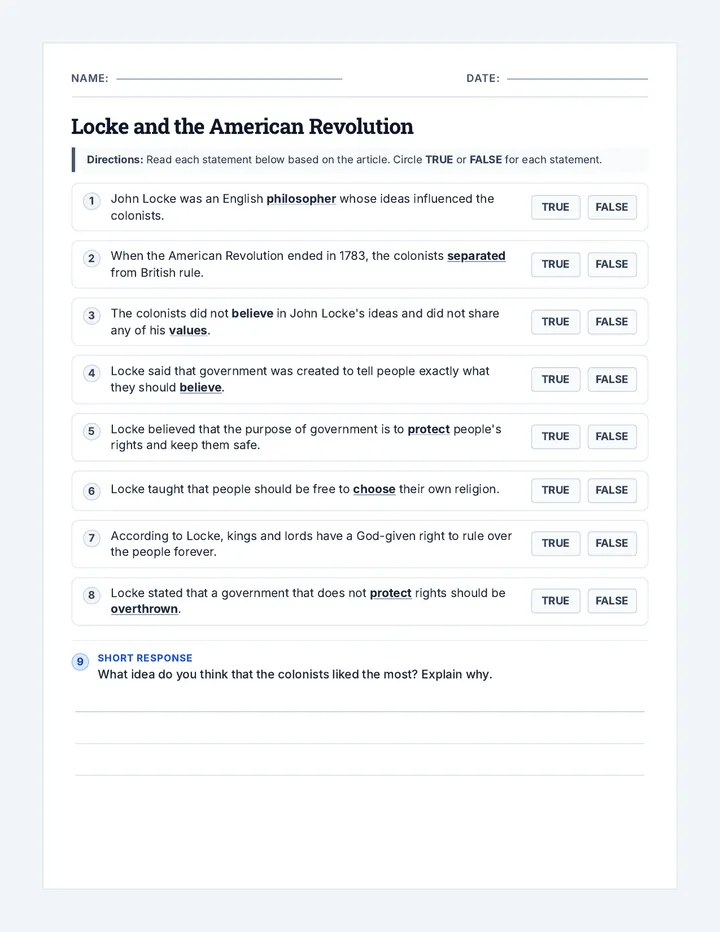
Revolutionary Ideas Worksheet

Revolutionary Ideas Worksheet

A foundational True or False reading comprehension worksheet on John Locke and the American Revolution, including an added short open-response question for student reflection.

CM

Christie Mercuri

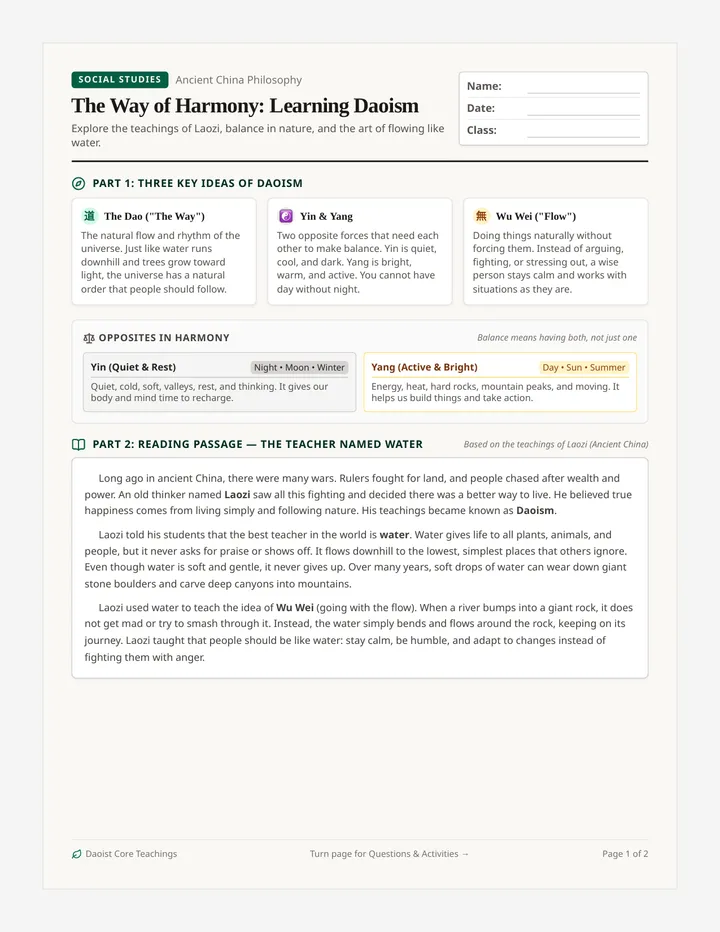
Way of Harmony Worksheet

Way of Harmony Worksheet

An accessible two-page printable student worksheet on Daoism featuring simplified reading passages, foundational concepts (the Dao, Yin and Yang, and Wu Wei), clear text-dependent questions, and balance-matching activities.

M

meagan_asp

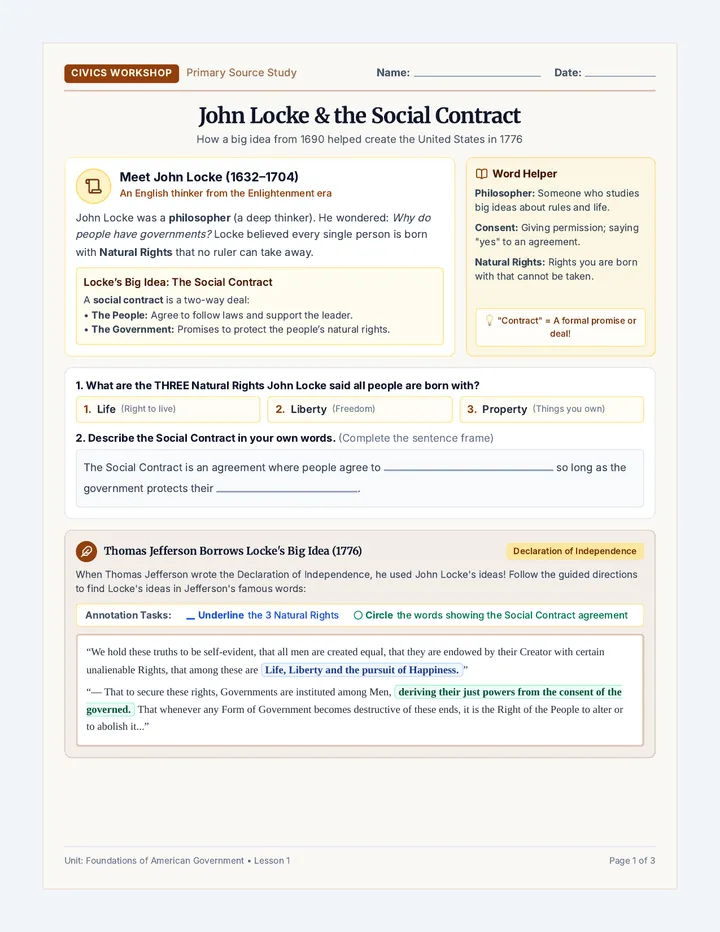
Social Contract Worksheets

Social Contract Worksheets

A three-page scaffolded civics worksheet packet exploring John Locke's Social Contract and its influence on Thomas Jefferson's Declaration of Independence, featuring chunked primary source excerpts, vocabulary word banks, guided annotation symbols, and scaffolded sentence frames.

GE

Genevieve Eubanks

Modern World Fall Inquiry Benchmark

Modern World Fall Inquiry Benchmark

A seven-slide model inquiry presentation demonstrating an exemplary project response for the Fall Inquiry Benchmark, featuring the user's provided composite image of Plato, Socrates, and Aristotle as the sole image on the mentorship connection slide (Slide 3).

KT

Kyle Trocolla

Renaissance Genius Worksheet

Renaissance Genius Worksheet

A comprehensive two-page Renaissance review worksheet covering key historical figures, influential patrons, humanist philosophy, artistic innovations, and cultural achievements with matching, vocabulary application, and analytical short answers.

MM

Michele Magee

Sequences

Master Organizer Slides

Think Like Aristotle

A four-part series for middle schoolers on Aristotelian logic and philosophy, focusing on categorization, reasoning, and ethics, with a historical tie-in to Alexander the Great.

DB

Danielle Burham

21
The Imaginer Teacher Guide

The Imaginer Plato Logic

A four-day introductory logic and philosophy sequence for middle schoolers focusing on Plato's 'Thinking Style.' Students explore the Allegory of the Cave, perception vs. reality, and the Theory of Forms through the lens of 'The Imaginer,' culminating in a visual analysis game.

DB

Danielle Burham

12
Soulful Cyphers Lesson Plan

We Gon’ Be Alright- A Century of Black Excellence

A comprehensive 6-lesson Black History Month curriculum for 5th-8th graders, exploring historical excellence, emotional expression, and community through the lens of five core values: Virtus, Kenkyo, Sankofa, Ubuntu, and Ganas. Inspired by a century of resilience and brilliance.

JS

Joleen Shillingford

18
Thirteen Friends Worksheet

Democratic Foundations

A series of lessons exploring the foundational documents and processes of the United States government, from the birth of the nation to the creation of modern laws.

SB

Stephanie Bizeur

40
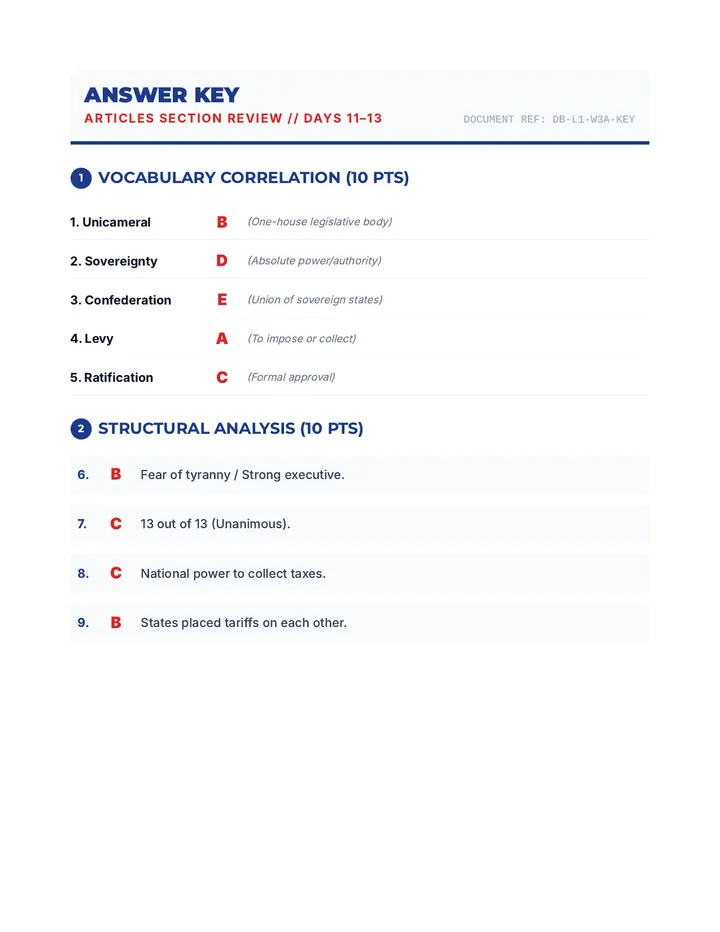
Articles Section Review Key

Democracy Blueprint

A comprehensive 90-day independent study program for high school government, covering everything from philosophical foundations to modern policy and civic participation.

LF

Lindsey Foulks

35
Roots of Republicanism Reader

Foundations of Freedom Remediation Packet

A 7-day comprehensive remediation sequence focused on the philosophical, historical, and individual foundations of American government. Designed for students needing mastery of TEKS 1 and 12B, the unit features structured readers, skill-building worksheets, and a cumulative assessment.

CE

Chelsea Elliott

16

Lessons

Crown and Covenant Teacher Guide

Crown and Covenant

A pre-reading lesson on the Divine Right of Kings and European Absolutism, preparing 10th-grade students with crucial background knowledge through a close reading of King James I and Louis XIV.

T

timothy.nixon

8
Reason for Revolution Worksheet V4 Refined Final

Architects of Liberty

A lesson exploring how Enlightenment philosophers like Locke, Montesquieu, and Voltaire influenced the founding documents and structure of the United States government.

KB

Kenneth Brown

10
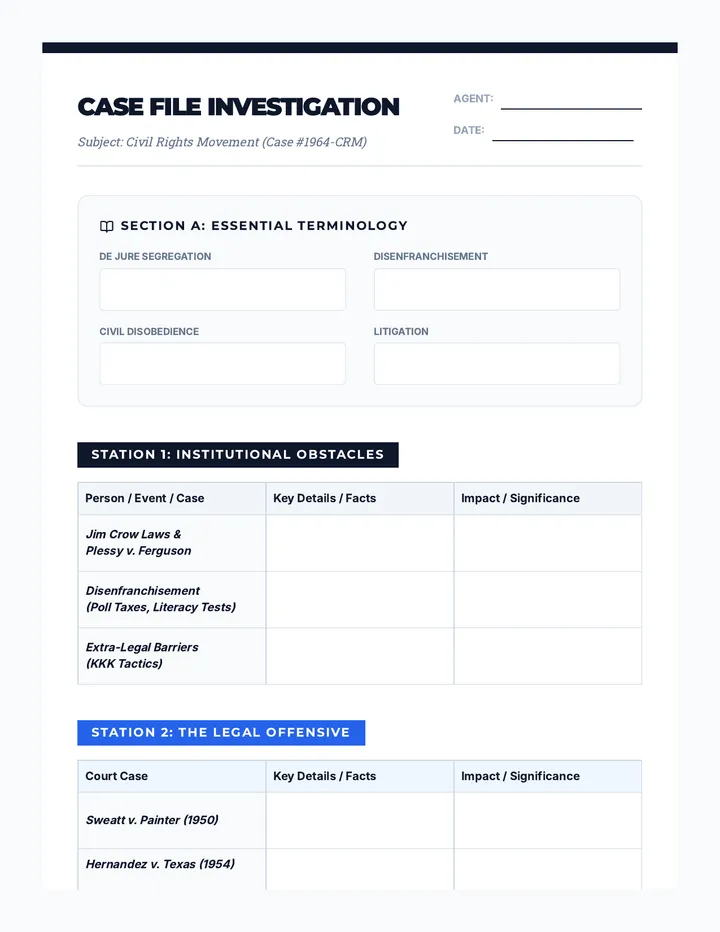
Justice Gallery Investigation Worksheet

Justice Gallery Case Files

A comprehensive lesson on the Civil Rights Movement featuring gallery stations and a guided investigation worksheet. Students analyze institutional obstacles, legal strategies, non-violent and militant tactics, and the expansion of the movement to other marginalized groups.

CE

Chelsea Elliott

25
Convention Blueprint Reading Handout

Convention Blueprint

A lesson exploring the 1787 Constitutional Convention, the roles of key Framers like James Madison, and the fundamental principles of American government including federalism, republicanism, and separation of powers.

SA

Senta Agnello-Shelton

17
Chronicle Study Guide Student

Modern Era Mastery

A comprehensive review and assessment package covering World History from the Enlightenment through the Cold War, aligned with state standards.

AH

Ashley Hopf

16
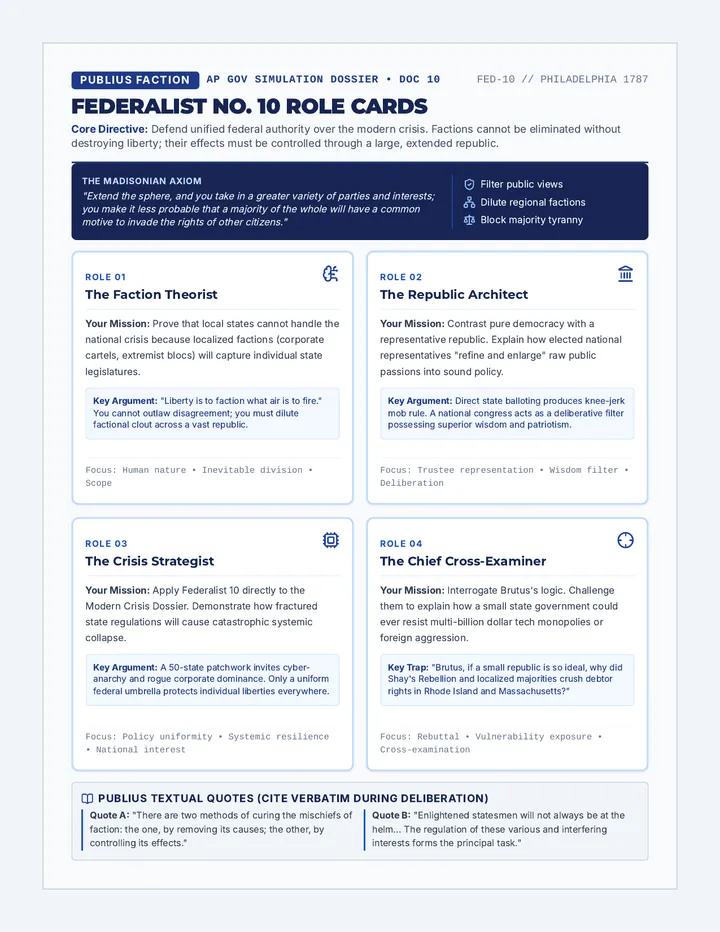
Faction Showdown Role Cards

Faction Showdown

A high-stakes AP Government classroom simulation that pits Madisonian Federalists against Anti-Federalist Brutus factions over a modern national crisis. Students deploy foundational constitutional arguments to deliberate federal power, faction control, and state sovereignty.

K

kpitcher

5