Lenny.com
Explore
Create
ActivitiesNewMathEnglish Language ArtsScience & EngineeringSocial StudiesGlobal LanguagesHealth & Physical EducationSpecial EducationCounseling & Life SkillsArts & CreativityESL
Lenny.com
Lenny.com
Explore
Create
ActivitiesNewMathEnglish Language ArtsScience & EngineeringSocial StudiesGlobal LanguagesHealth & Physical EducationSpecial EducationCounseling & Life SkillsArts & CreativityESL
Lenny.com
Lenny.com

Solutions

Lenny for EducatorsLenny for SchoolsLenny for Districts

Product

ExploreSign inCreateSupportAbout

Resources

Getting startedMTSS Acceleration Program

Newsletters

School Funding Newsletter

© 2026 Lenny Learning Inc.

TermsPrivacyAccessibility
LinkedInInstagramX
Lenny

US Imperialism

Late 19th-century expansionism, including the Spanish-American War, the annexation of Hawaii, and interventionist policies in Latin America and Asia. Examines the economic, strategic, and ideological motivations behind American territorial acquisition.

Social StudiesSocial Studies PracticesLocation WordsMapsOrder EventsChronology and CausationEvaluating SourcesHistorical ThinkingGeography, Humans, & the EnvironmentAmerican Symbols and LandmarksCitiesStatesState CapitalsRegions of the United StatesGeographic SkillsPhysical GeographyHuman GeographyRegional GeographyGeography of AfricaGeography of AsiaGeography of EuropeGeography of OceaniaGeography of the AmericasSociety and Environment of EuropeSociety and Environment of AsiaSociety and Environment of The AmericasSociety and Environment of the Middle EastSociety and Environment of AfricaHistoryPrehistoryComparing Ancient River CivilizationsAncient MesopotamiaAncient Egypt and KushAncient South AsiaEarly ChinaGreeceRome and the Byzantine EmpireAncient World HistoryNative Peoples of North AmericaNative Peoples of Mesoamerica and South AmericaAfrican EmpiresMedieval AsiaMedieval EuropeThe Silk RoadMedieval HistoryIslamic EmpiresWorld ReligionsRenaissance PeriodAge of ExplorationThe Thirteen ColoniesThe American RevolutionUS History Early RepublicFounding of the United StatesUS History AntebellumUS Civil WarReconstruction PeriodThe Gilded AgeUS ImperialismWorld ImperialismWorld War IUS History 1920sGreat DepressionWorld War IIThe Cold WarUS History 1950-60sUS History 1960s-70sWorld History 20th CenturyContemporary US HistoryContemporary World HistoryHolidaysCivics and GovernmentCitizenshipGovernment FoundationsThe ConstitutionUS ConstitutionExecutive BranchLegislative BranchJudicial BranchState and LocalPolitical ParticipationPublic PolicyPolitical SystemsPower and AuthoritySocial MovementsDefining DevianceTheories of DevianceCrime and Criminal JusticeEconomicsBasic Economic PrinciplesSupply and DemandWhat is MoneyEconomic FundamentalsMicroeconomicsMacroeconomicsBanking and FinanceEconomic SystemsGlobal EconomicsCorporations and PowerThe Changing WorkplaceUnemployment and LaborClass and InequalitySocial MobilityGlobal InequalityPsychologyHistory of PsychologyPsychology as a ScienceBrain and Nervous SystemNeuroscience and BehaviorGenetics and BehaviorSleep and ConsciousnessSensory ProcessesPerceptual OrganizationClassical ConditioningOperant ConditioningObservational LearningCognitive LearningMemory ProcessesThinking and Problem SolvingLanguage and CognitionTheories of MotivationStress and CopingPrenatal and Infant DevelopmentChildhood DevelopmentAdolescent DevelopmentAdulthood and AgingSelf and IdentitySocial CognitionSocial InfluenceAttraction and RelationshipsGroup BehaviorPrejudice and DiscriminationAnxiety and Mood DisordersClinical PsychologyForensic PsychologyPhilosophy & EthicsIntroduction to PhilosophyMajor Philosophers & IdeasMind and Body ProblemFree Will vs DeterminismEthics & MoralityReligion & PhilosophyPolitical Philosophy

Videos

Innovation, Mass Culture, and the Ethics of Progress (1880-1914)

Innovation, Mass Culture, and the Ethics of Progress (1880-1914)

This video explores the dynamic period between 1880 and 1914, often called the Progressive Era or the Belle Époque, examining the explosion of scientific and technological innovation that defined the age. It details how industrial powers like Britain, the United States, and Germany funded research and public health initiatives, highlighting key figures like Josephine Cochrane, George Soper, and Madame C.J. Walker. The narrative explains the shift from a survival-based economy to a consumer culture driven by mass media, advertising, and the rise of the middle class. The video delves into the complex relationship between capitalism, industrialization, and popular culture, illustrating how wealthy industrialists influenced scientific progress and how businesses shaped consumer desires. Crucially, it also addresses the darker side of this era, discussing the rise of pseudosciences like phrenology and eugenics. It explains how scientific language was misused to justify racism, oppression, and unethical experimentation, grounding these concepts in the historical context of Social Darwinism. For educators, this resource serves as an excellent synthesis of early modern history, connecting technological advancements with social and ethical questions. It challenges students to consider the moral implications of progress, asking the big-picture question: "Just because we can, does it mean we should?" It is particularly useful for World History and U.S. History units on the Industrial Revolution, providing diverse examples of inventors and prompting critical thinking about the double-edged sword of scientific discovery.
Miacademy & MiaPrep Learning ChannelMiacademy & MiaPrep Learning Channel

11mins 20s

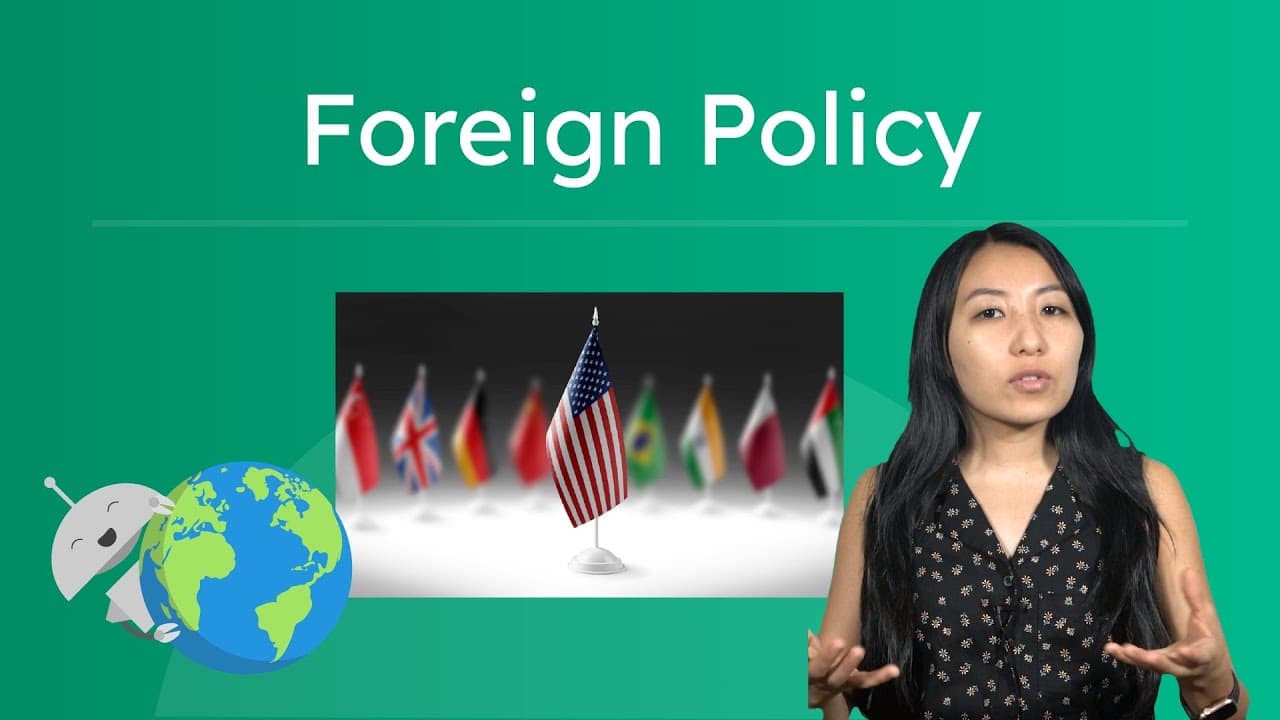
Evolution of US Foreign Policy: From Isolation to Superpower

Evolution of US Foreign Policy: From Isolation to Superpower

This educational video provides a comprehensive overview of United States foreign policy, tracing its evolution from the nation's founding to the modern era. It begins by establishing the Constitutional roles of the Executive, Legislative, and Judicial branches in crafting foreign policy, clarifying the balance of power between the President and Congress. The narrative then moves chronologically, highlighting George Washington's initial advice of isolationism and the shift toward interventionism through the Monroe Doctrine, territorial expansion, and the World Wars. The video explores the US's transition into a global superpower during the 20th century, covering the Cold War, the containment of communism, and post-9/11 military engagements. It also addresses contemporary issues such as foreign aid, trade deficits with nations like China, the rise of new economic powers like India, and global challenges like climate change and nuclear proliferation. The content emphasizes how historical events have shaped current diplomatic relationships and military presence worldwide. Designed for civics and history classrooms, this resource helps students connect historical precedents to current events. It concludes with a strong message about civic engagement, encouraging students to understand these complex issues so they can participate effectively in the democratic process through voting and debate. The video is an excellent tool for teaching the practical application of checks and balances and the history of America's role on the world stage.

Miacademy & MiaPrep Learning ChannelMiacademy & MiaPrep Learning Channel

9mins 54s

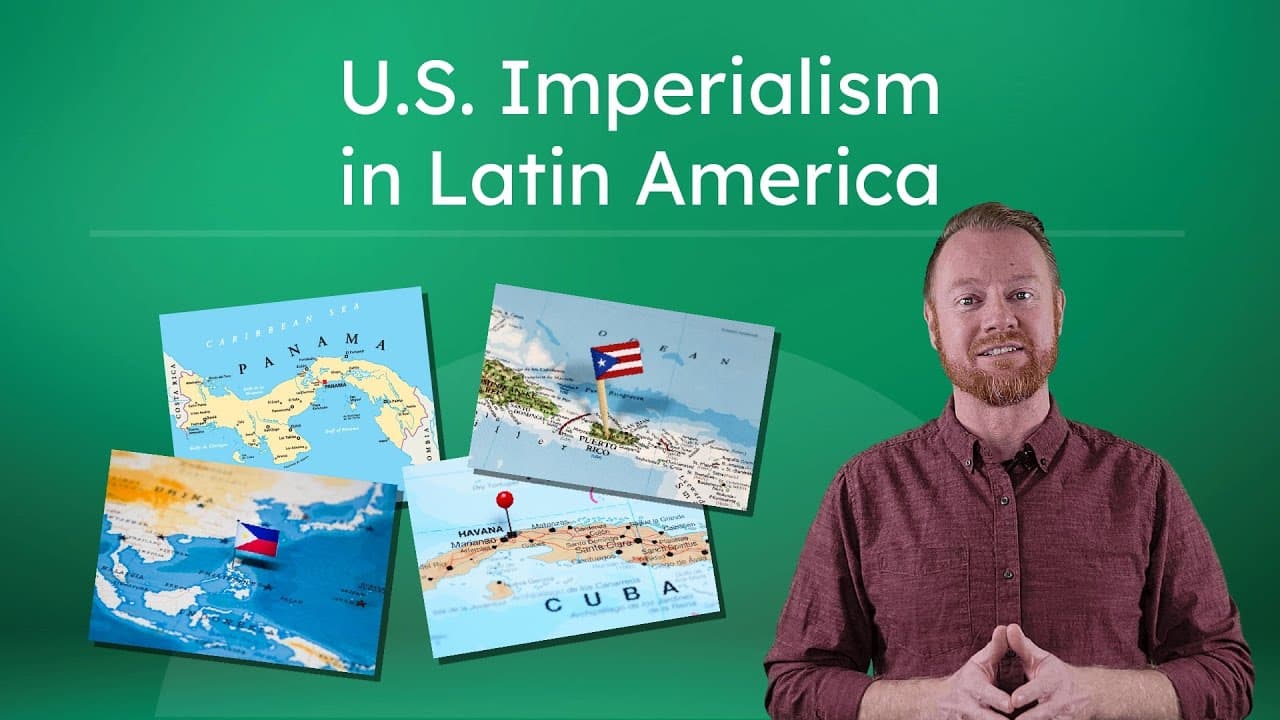
The Rise of American Imperialism in Latin America

The Rise of American Imperialism in Latin America

This educational video provides a comprehensive overview of United States imperialism in Latin America during the late 19th and early 20th centuries. It explores the transition of the U.S. from a developing nation to a global imperial power, using the Spanish-American War of 1898 as a central turning point. The narrator connects everyday items like bananas and sugar to complex historical events, making the geopolitical motivations of the era accessible to students. Key themes include the economic and security motivations behind imperialism, the Monroe Doctrine, the concept of "Big Stick Diplomacy," and the Roosevelt Corollary. The video details specific historical events such as the explosion of the USS Maine, the acquisition of territories like Puerto Rico and the Philippines, and the political maneuvering behind the construction of the Panama Canal. It also addresses the influence of European expansion (the Scramble for Africa) on American foreign policy decisions. For educators, this video serves as an excellent anchor for units on US History or World History. It effectively breaks down the "why" behind historical events—linking business interests and national security to foreign intervention. The inclusion of guiding questions and clear definitions of terms like "Imperialism" and "Big Stick Diplomacy" makes it a ready-made resource for structuring classroom discussions and reinforcing vocabulary.

Miacademy & MiaPrep Learning ChannelMiacademy & MiaPrep Learning Channel

10mins 53s

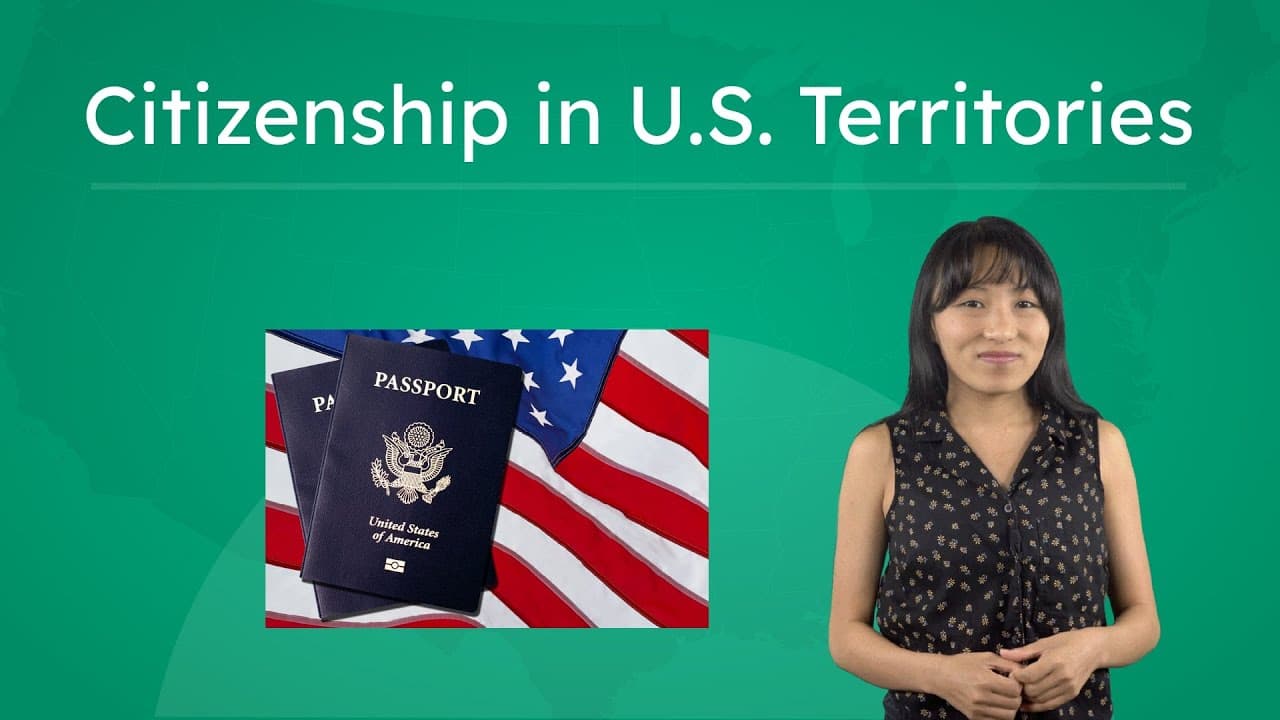
Exploring U.S. Territories and Citizenship Rights

Exploring U.S. Territories and Citizenship Rights

This educational video provides a comprehensive overview of United States territories, clarifying the legal and political distinctions between states and territories. Hosted by a presenter interacting with an animated character named Mia, the video explores the geography, history of acquisition, and cultural makeup of five major U.S. territories: Puerto Rico, Guam, the U.S. Virgin Islands, the Northern Mariana Islands, and American Samoa. It specifically addresses the complex issue of citizenship, explaining why people born in these territories are generally U.S. citizens but lack full voting rights in federal elections. A significant portion of the video is dedicated to the unique case of American Samoa, where residents are U.S. nationals rather than citizens. The video presents a balanced examination of the arguments for and against granting birthright citizenship to American Samoans, weighing civil rights principles against concerns over preserving traditional cultural land ownership and customs (Fa'a Samoa). This deep dive helps students understand that citizenship laws are nuanced and deeply intertwined with history and culture. This resource is highly valuable for Civics, U.S. Government, and U.S. History classrooms. It helps students dismantle the misconception that the U.S. ends at the borders of the 50 states and introduces critical concepts such as sovereignty, federal representation, and the rights of citizens versus nationals. The content is structured with clear pause points and guiding questions, making it an excellent tool for prompting classroom debates about democracy, equality, and cultural preservation.

Miacademy & MiaPrep Learning ChannelMiacademy & MiaPrep Learning Channel

11mins 39s

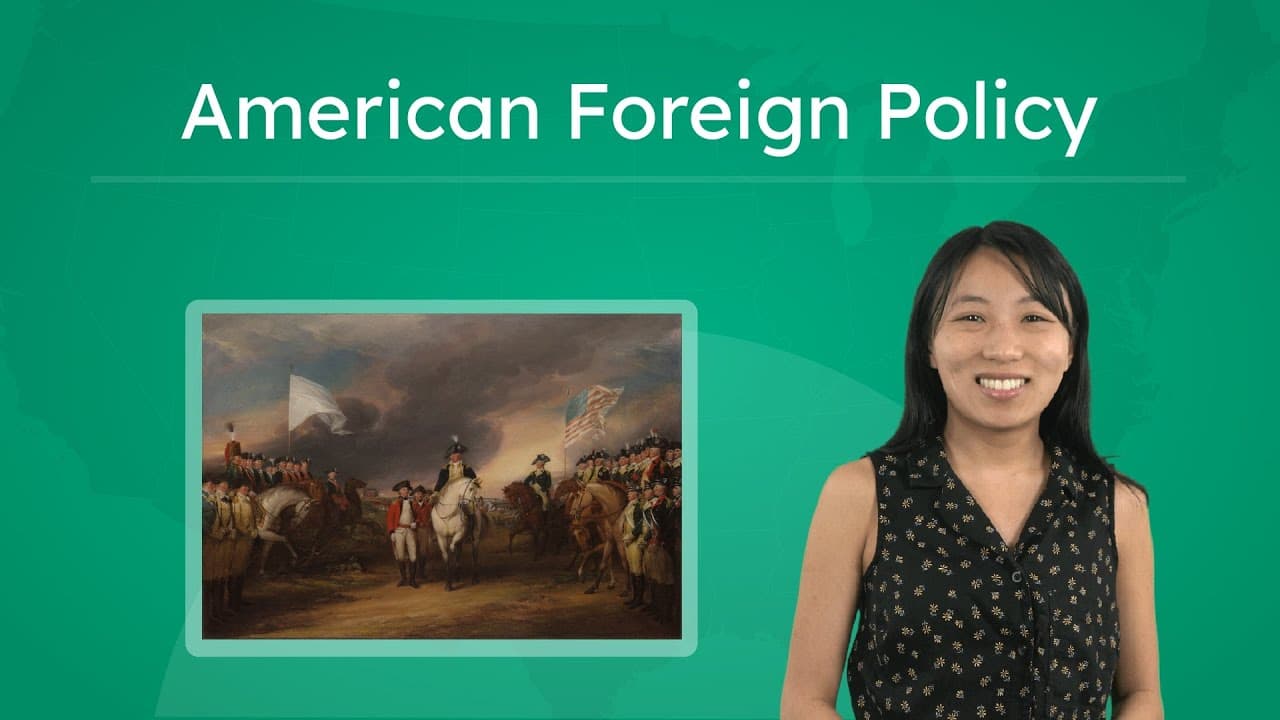
How U.S. Foreign Policy Evolved: Isolationism to Imperialism

How U.S. Foreign Policy Evolved: Isolationism to Imperialism

This educational video explores the evolution of United States foreign policy throughout the 19th and early 20th centuries, using an engaging analogy of a teenager going through different life phases. The narrator breaks down complex political concepts into three main categories: Isolationism, Interventionism, and Imperialism. By comparing a nation's growth to human development, the video makes abstract historical strategies accessible and relatable for students.

Miacademy & MiaPrep Learning ChannelMiacademy & MiaPrep Learning Channel

12mins 18s

How US Expansion Reshaped the Environment

How US Expansion Reshaped the Environment

This educational video explores the profound environmental consequences of United States westward expansion and industrial development from the 19th century through the 1930s. Using the dramatic backdrop of the Dust Bowl as a hook, the narrator guides viewers through a historical journey that examines how human settlement, farming practices, and resource extraction altered the physical landscape. The video connects historical events like the decimation of the bison population and the clearing of forests in the Pacific Northwest to ecological principles, illustrating the direct link between human activity and environmental health. Key themes include the interaction between humans and their environment, the unintended consequences of technological and agricultural progress, and the rise of the conservation movement. The video specifically highlights the causes of the Dust Bowl, the ecological role of keystone species like bison and bees, and the political response to environmental degradation led by figures like Theodore Roosevelt. It contrasts the destructive practices of the era with the establishment of the National Park system, fostering a discussion on stewardship and sustainability. For educators, this resource serves as an excellent bridge between Social Studies and Science curriculums. It effectively visualizes abstract historical concepts through primary source photography and engaging reenactments, making the environmental costs of expansion tangible for students. The built-in pause points and guiding questions provide ready-made opportunities for classroom discussion, checking for understanding, and critical thinking about how past environmental decisions continue to shape our world today.

Miacademy & MiaPrep Learning ChannelMiacademy & MiaPrep Learning Channel

11mins 57s

Materials

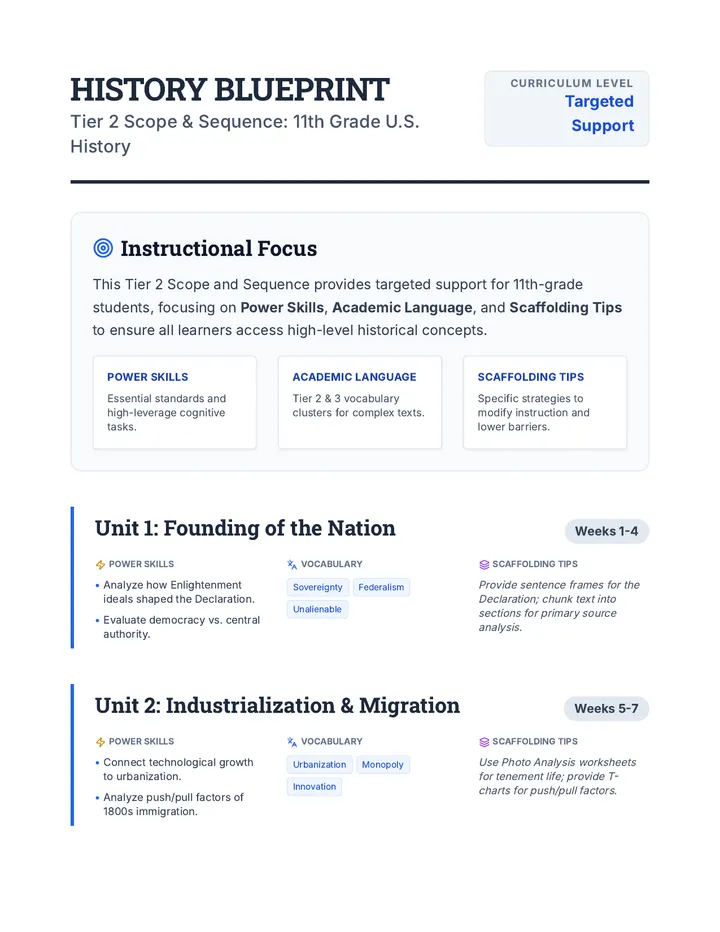
History Blueprint Scope and Sequence

History Blueprint Scope and Sequence

An updated Tier 2 Scope and Sequence for 11th Grade U.S. History, now including specific scaffolding tips for each unit alongside power skills and academic vocabulary. The layout is optimized for teacher reference with instructional strategies tailored for targeted support.

D

dfleisch

Sequences

Unity Roadmap Teacher Guide

Unity and Growth

A modified Modern US History curriculum (Founding to Present) for Tier 2 and 3 special education students, based on Grade 11 Social Studies standards. Focuses on government, industrialization, world wars, and civil rights.

D

dfleisch

26
Reconstruction Reckoning Worksheet

Modern America

A comprehensive journey through United States history from the aftermath of the Civil War to the contemporary era, exploring the social, political, and economic shifts that shaped the modern nation.

DP

Darren Polamalu

18
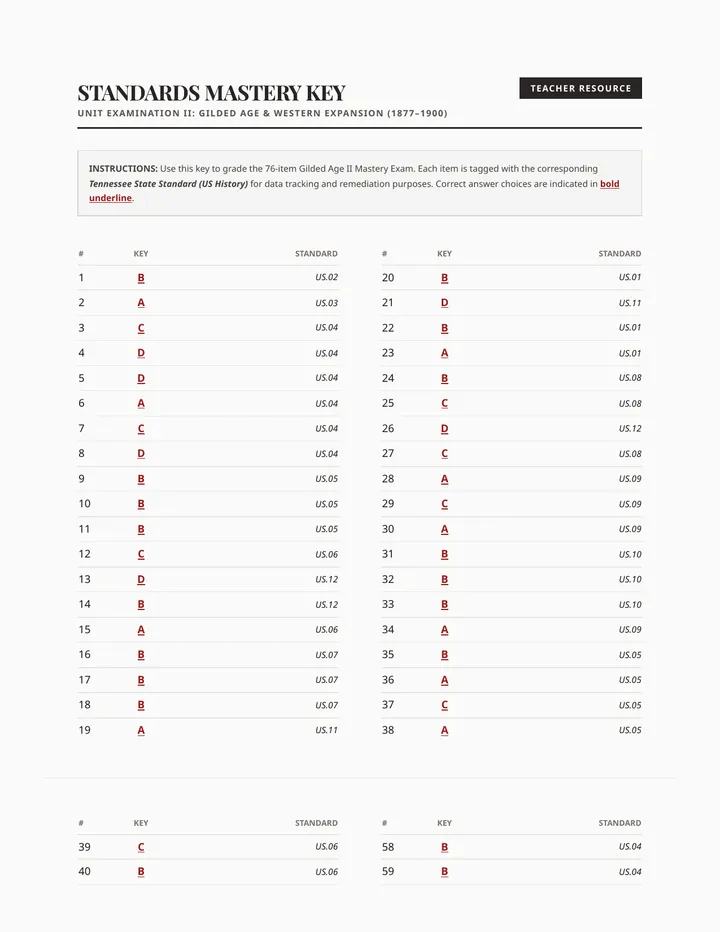
Gilded Age II Standards Key

Modern America Mastery

A comprehensive curriculum sequence covering late 19th and early 20th-century American history, focusing on economic transformation, Western expansion, global imperialism, and the impact of the Great War.

A

Andrew

29
Gilded Age WICOR Handout

History Hustle

A comprehensive US History EOC review sequence designed for AVID classrooms, utilizing WICOR strategies to master key eras from the Gilded Age through modern turning points.

ES

Erin Sims

15
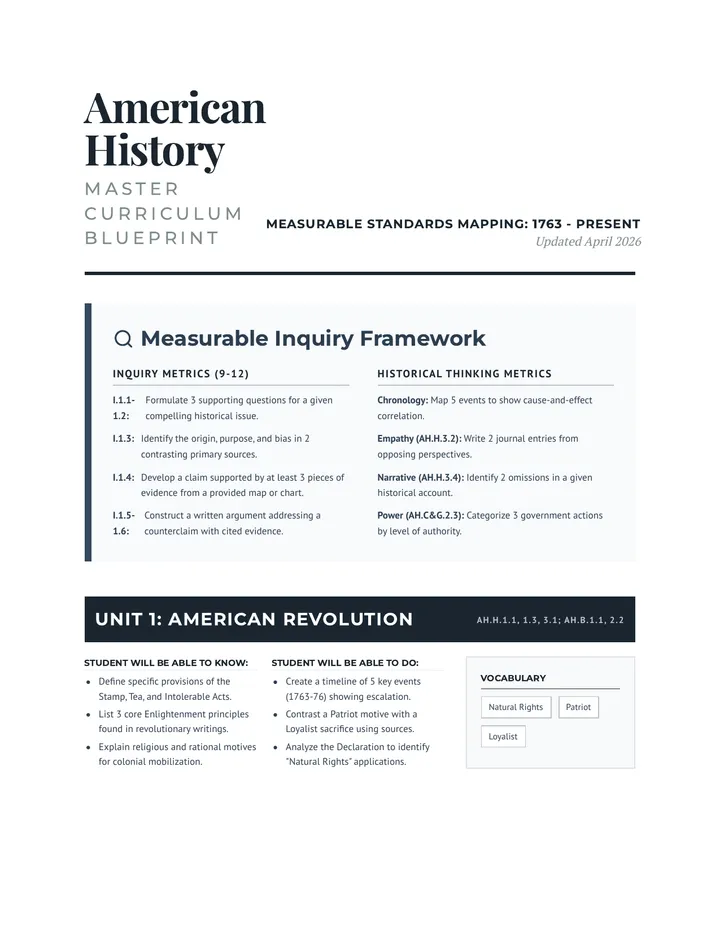
Curriculum Blueprint Document v2

History Horizon Sequence

A comprehensive high school curriculum plan for American History, covering 13 units from the American Revolution to the modern era, aligned with North Carolina Social Studies standards.

AK

Amity Kea

21
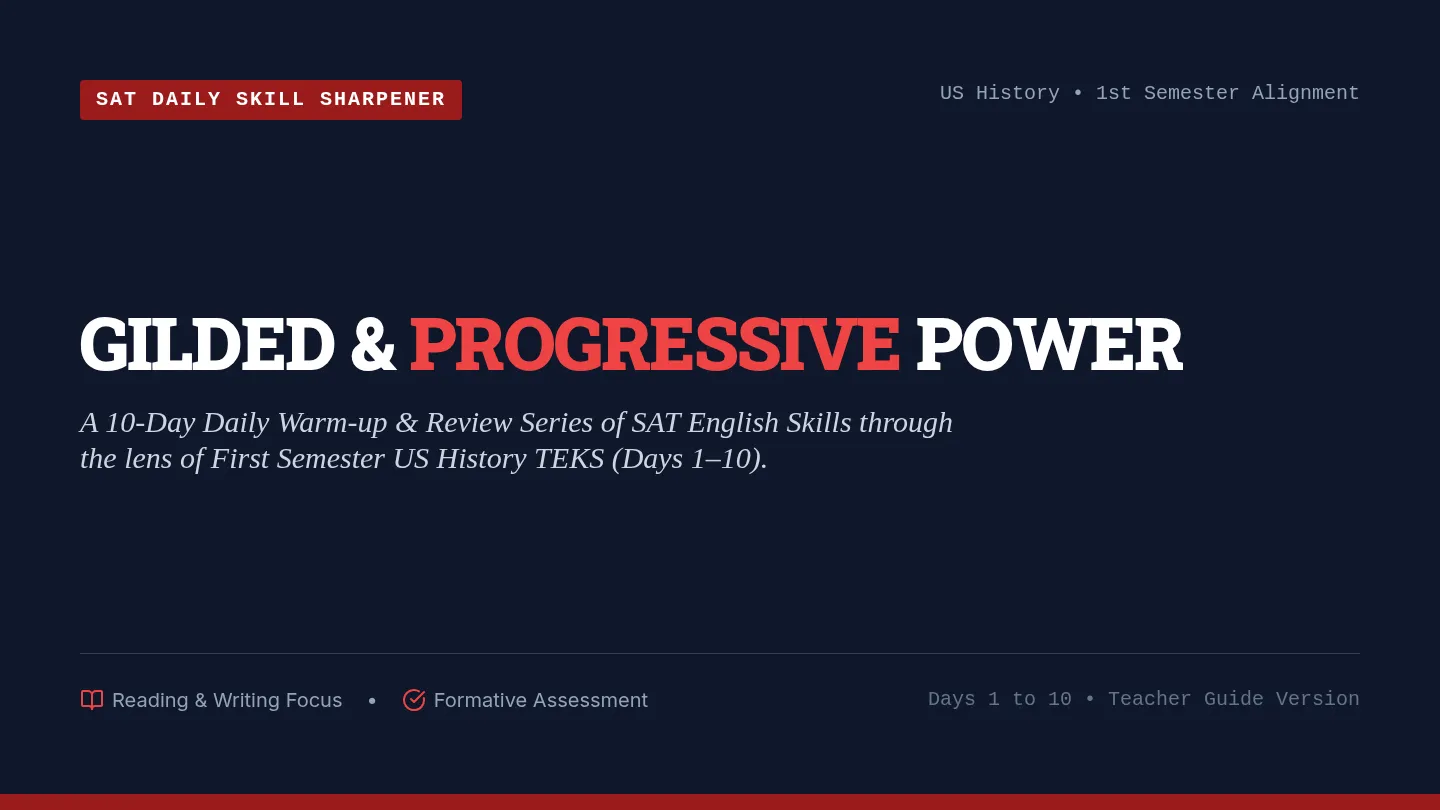
Gilded Progressive Power Presentation

USH SAT Skill Sharpener

A 20-day dual-purpose review program aligning SAT English Reading and Writing skills with US History first-semester TEKS content. This curriculum covers key historic eras from the Gilded Age through the Great Depression with daily warmups, answers, and strategies.

PR

Penne Reed

3

Lessons

History Sprint Pacing Guide

STAAR History Sprint

A comprehensive pacing guide and activity resource designed to cover the remaining 11th Grade US History TEKS before the STAAR test on April 16th. This lesson provides a day-by-day calendar for A/B block schedules and high-engagement activities for each remaining historical era.

BB

Bridgette Burdick

51
Imperial Shift Briefing Handout

Splendid Little War

This lesson explores the Spanish-American War, focusing on Theodore Roosevelt's rise, the Treaty of Paris, and the United States' transition from isolationism to an imperial power. Students will analyze the motives and arguments surrounding the annexation of the Philippines and other territories.

GE

Genevieve Eubanks

12
Headline Hype Slides

Headline Hype

A deep dive into the sensational world of yellow journalism and its pivotal role in propelling the United States into the Spanish-American War. Students analyze historical headlines and the impact of the USS Maine's sinking on public opinion.

GE

Genevieve Eubanks

8
Empire Dilemma Cornell Notes

Empire Crossroads

A 42-minute lesson exploring the annexation of the Philippines, the arguments for and against American imperialism, and the resulting Philippine-American War.

GE

Genevieve Eubanks

9
Era Review Challenge Practice Sheet

Era Review Challenge

A quick review lesson designed to prepare students for US History STAAR assessments, focusing on four key eras: Imperialism, the Roaring 20s, the Great Depression, and WWII.

BB

Bridgette Burdick

14
Path Through Panama Teacher Guide

Path Through Panama

A 40-minute introductory lesson exploring the geopolitical, military, and economic motivations behind the US involvement in the Panama Canal's construction and Panamanian independence.

GE

Genevieve Eubanks

12